Choosing mathematical methods for a real problem

What this lesson covers
- A real problem has to be turned into mathematical questions before any method can be chosen.
- Methods from different strands of mathematics can work on the same problem.
What this standard asks for
- A real problem from Aotearoa or the Pacific.
- At least four processes, from two or more strands.
- Accurate answers, with units.
| Rule | Means |
|---|---|
| Four processes | at least four |
| Two strands | from number, algebra, measurement, geometry |
| Accurate | correct answers with units |
| Not counted | statistics and probability |
The problem: māra kai beds
- A school is building three raised garden beds.
- They need soil, timber, and a brace for each.
- What should they order, and what will it cost?
| Details | |
|---|---|
| Beds | 3, each 2.4 m × 1.2 m |
| Depth | 0.4 m of soil |
| Planks | 0.2 m high, 4.8 m long |
| Also | a diagonal brace across the top |
Break it into maths questions
- One big problem becomes four smaller questions.
- Each question points to a method.
- Four methods, four different strands.
| Question | Method | Strand |
|---|---|---|
| How much soil? | volume | measurement |
| What will it cost? | rounding, money | number |
| How long is the brace? | Pythagoras | geometry |
| How much timber? | a formula | algebra |
Process 1: volume of soil
- Each bed is a rectangular prism.
- Length × width × depth: 1.152 m³.
- Three beds: 3.456 m³.
| Working | Volume | |
|---|---|---|
| One bed | 2.4 × 1.2 × 0.4 | 1.152 m³ |
| Three beds | 3 × 1.152 | 3.456 m³ |
Try it: volume of the bed
Process 2: rounding and cost
- Soil is sold by the whole cubic metre.
- 3.456 m³ must round UP, to 4 m³.
- 4 × $95 = $380.
| Step | Working | |
|---|---|---|
| Needed | 3.456 m³ | |
| Sold by | the whole cubic metre | round up |
| Order | 4 m³ | |
| Cost | 4 × $95 | $380 |
Round the way the context needs
- Rounding down to 3 m³ leaves beds unfilled.
- You cannot buy 0.456 of a delivery.
- Say why you rounded the way you did.
Process 3: Pythagoras for the brace
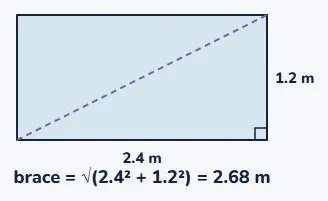
- The brace is the hypotenuse of a right-angled triangle.
- 2.4² + 1.2² = 7.2.
- √7.2 = 2.68 m, to 2 decimal places.
| Step | Working | |
|---|---|---|
| Diagonal² | 2.4² + 1.2² | 5.76 + 1.44 |
| Diagonal² | 7.2 | |
| Diagonal | √7.2 | 2.68 m |
Try it: the brace
The top of one bed
- Sides 2.4 m and 1.2 m, meeting at a right angle.
- The brace joins opposite corners.
- It must be at least 2.68 m long.
Process 4: a formula for the timber
- One row of planks goes round the perimeter: 7.2 m.
- Two rows reach 0.4 m: 14.4 m a bed, so L = 14.4n.
- Three beds: 43.2 m, exactly nine 4.8 m planks.
| Step | Working | Result |
|---|---|---|
| One row | perimeter 2(2.4 + 1.2) | 7.2 m |
| Two rows | 0.4 m ÷ 0.2 m | 14.4 m a bed |
| n beds | L = 14.4n | |
| 3 beds | 14.4 × 3 = 43.2 m | 9 planks |
Every answer is a sentence
- A number alone does not answer the problem.
- Say what it means for the school.
- Units every time.
| The answer, communicated | |
|---|---|
| Soil | Order 4 m³ of soil, costing $380. |
| Brace | Each brace must be at least 2.68 m. |
| Timber | Buy nine 4.8 m planks for three beds. |
Check it is sensible
- Is the brace longer than the long side? 2.68 > 2.4. Yes.
- Is 4 m³ just more than 3.456 m³? Yes.
- A quick estimate catches a slipped decimal.
Try it: plan the beds
Where this sits in the grades
- Achieved: four accurate processes, two strands.
- Merit: the processes linked, one feeding the next.
- Excellence: extended, with assumptions or a rule.
What to take away
- A real problem, broken into questions, answered with units.
| Break it down | into mathematical questions |
| Four processes | from at least two strands |
| Units | on every single answer |
| Round in context | soil and planks round up |
| A formula | turns one bed into n beds |
| Communicate | each answer as a sentence |
Common mistakes
- 3.456 m³ rounds to 3 m³ of soil, costing $285.Soil comes in whole cubic metres and 3 m³ leaves beds unfilled, so round up to 4 m³, costing $380.
- Brace: 2.4² + 1.2² = 7.2 m7.2 is the diagonal squared; take the square root: √7.2 ≈ 2.68 m, which is longer than 2.4 m as it must be.
- Question 1 answer: 1.944Give units and a sentence about the problem: the four beds need 1.944 m³ of soil, so order 2 m³.
- My four processes include a mean and a probability.Statistics and probability are not counted; use at least two strands from number, algebra, measurement and geometry.
Your turn: eight questions
- A smaller bed this time.
- Answer each with units.
- Think carefully about rounding in question 2.
| Question | |
|---|---|
| Bed | 4 beds, each 1.8 m long, 0.9 m wide, 0.3 m of soil |
| 1 | How much soil is needed for all four beds? |
| 2 | Soil is $95 per whole cubic metre. What is the cost? |
| 3 | How long is a diagonal brace across the top of one bed? |
| 4 | Which strands did questions 1 to 3 use? |
| 5 | A student says the diagonal brace across one bed is 1.35 m. Which quick check shows this must be wrong? |
| 6 | Soil also comes in 0.25 m³ bags at $30 a bag. What would bags for all four beds cost? |
| 7 | The sides are 0.15 m high planks, stacked to the 0.3 m soil depth. Write a formula for L, the metres of timber needed for n beds. |
| 8 | Soil is $95 per whole cubic metre and the school has $500. How many beds of this size can it fill? |
Show answer
1. 1.8 × 0.9 × 0.3 = 0.486 m³ a bed, so 4 × 0.486 = 1.944 m³. 2. Round up to 2 m³: 2 × $95 = $190. 3. √(1.8² + 0.9²) = √4.05 = 2.01 m (2 dp). 4. Measurement (volume), number (rounding and cost), geometry (Pythagoras): three strands. 5. A diagonal must be longer than the 1.8 m long side, and 1.35 m is shorter. The true brace is √4.05 = 2.01 m. 6. 1.944 ÷ 0.25 = 7.776, which rounds UP to 8 bags, since 7 bags leave beds unfilled. 8 × $30 = $240. 7. One row is the perimeter 2(1.8 + 0.9) = 5.4 m, and 0.3 ÷ 0.15 = 2 rows, so 10.8 m a bed: L = 10.8n. 8. $500 buys 5 whole m³ (500 ÷ 95 = 5.26). Each bed needs 0.486 m³ and 5 ÷ 0.486 = 10.29, so 10 beds (10 × 0.486 = 4.86 m³, $475).
The answers
- 0.486 m³ a bed, 1.944 m³ in total.
- Round up to 2 m³: $190.
- √4.05 = 2.01 m.
- Measurement, number and geometry.
Sample question: Achieved
A rectangular deck is 3.6 m by 2.5 m. One litre of stain covers 4 m², and stain is sold only in whole litres at $28 a litre. How much stain should be bought for one coat, and what will it cost?
Hint
Find the area first, then divide by the area one litre covers, and think about which way to round.
Answer
Buy 3 litres, costing $84.
Step by step
- Two processes are needed: an area (measurement), then a rounding and cost (number).
- Area of a rectangle = length × width = 3.6 × 2.5 = 9 m².
- Each litre covers 4 m², so the stain needed is 9 ÷ 4 = 2.25 litres.
- Stain is sold only in whole litres. 2 litres would leave part of the deck bare, so round up to 3 litres.
- Cost: 3 × $28 = $84.
- Classic mistake: rounding 2.25 to the nearest whole number, 2. In context you must round up.
- Check: 3 litres covers 3 × 4 = 12 m², which is more than 9 m². Enough.
Full working
- 3.6 × 2.5 = 9 m²area of the deck
- 9 ÷ 4 = 2.25 L1 L covers 4 m²
- round up to 3 Lsold in whole litres
- 3 × $28 = $84
- 3 litres, $84
Sample questions: Merit
A school builds a garden bed in a corner shaped like a right-angled triangle, with the two shorter sides 3 m and 4 m. Edging goes around all three sides and is sold in 1.8 m lengths at $14.50 each. The bed is filled with soil 0.25 m deep; soil costs $95 a cubic metre and is sold in half cubic metres. Find the total cost of edging and soil, showing each process.
Hint
Use Pythagoras for the third side, the perimeter for the edging, and the triangle's area times depth for the soil.
Answer
Edging: perimeter 12 m, so 7 lengths, $101.50. Soil: 1.5 m³, $142.50. Total $244.00.
Step by step
- Plan the processes first: Pythagoras (geometry) for the missing side, perimeter and rounding (measurement and number) for the edging, area and volume (measurement) for the soil.
- The missing side is the hypotenuse. Pythagoras: c² = 3² + 4² = 9 + 16 = 25, so c = 5 m.
- Perimeter = 3 + 4 + 5 = 12 m of edging.
- Lengths needed: 12 ÷ 1.8 = 6.67. You cannot buy part of a length and 6 would be too short, so buy 7.
- Edging cost: 7 × $14.50 = $101.50.
- Soil: area of a triangle = 12 × base × height. The two shorter sides are at right angles, so area = 12 × 3 × 4 = 6 m².
- Volume = area × depth = 6 × 0.25 = 1.5 m³. It is sold in half cubic metres, and 1.5 is exactly three halves, so no rounding is needed.
- Soil cost: 1.5 × $95 = $142.50.
- Total: $101.50 + $142.50 = $244.00.
- Check: 7 lengths give 7 × 1.8 = 12.6 m, just over 12 m. And 5 m is longer than both other sides, as a hypotenuse must be.
Full working
- c² = 3² + 4² = 25, c = 5 mPythagoras
- perimeter = 3 + 4 + 5 = 12 m
- 12 ÷ 1.8 = 6.67 → 7 lengths, 7 × $14.50 = $101.50round up
- area = 12 × 3 × 4 = 6 m²triangle
- volume = 6 × 0.25 = 1.5 m³, 1.5 × $95 = $142.50
- Total $244.00
A kapa haka group hires a bus to a festival in Rotorua, 228 km away, and back. The bus costs $350 plus $2.40 per kilometre. The cost is shared equally by the n students who go. Write a formula for the cost per student, c, in terms of n. How many students must go for each to pay no more than $40?
Hint
Find the total cost for the return trip first, then divide by n and solve c ≤ 40.
Answer
c = 1444.40n. At least 37 students must go (each then pays $39.04).
Step by step
- Plan: a rate (number) for the total cost, then a formula and an inequality (algebra), then rounding in context.
- The trip is there and back: 2 × 228 = 456 km.
- Distance cost: 456 × $2.40 = $1094.40. Total: $350 + $1094.40 = $1444.40.
- Shared by n students: c = 1444.40n dollars each.
- Each should pay no more than $40: 1444.40n ≤ 40.
- Multiply both sides by n (n is positive): 1444.40 ≤ 40n. Divide by 40: n ≥ 36.11.
- n must be a whole number of students and at least 36.11, so round up: n = 37.
- Classic mistake: rounding 36.11 down to 36. Check it: 1444.40 ÷ 36 = $40.12, which is more than $40.
- Check 37: 1444.40 ÷ 37 = $39.04, which is under $40.
Full working
- 2 × 228 = 456 kmthere and back
- 350 + 2.40 × 456 = 1444.40total cost
- c = 1444.40n
- 1444.40n ≤ 40, so n ≥ 1444.40 ÷ 40 = 36.11
- n = 37round up: 36 gives $40.12
- c = 1444.40n; at least 37 students
Sample questions: Excellence
Raised garden beds are 1.2 m wide, L metres long and filled with soil 0.4 m deep. (a) Write a formula for the volume of soil V for n beds. (b) The school can order at most 6 m³ of soil. If each bed is 2.4 m long, what is the largest number of beds it can fill? (c) The school wants exactly 5 beds that use exactly 6 m³. How long must each bed be? (d) Hence find the length of a diagonal brace across the top of one of these beds.
Hint
Each bed is a rectangular prism, so V = n × L × 1.2 × 0.4. Then use the formula backwards for (b) and (c).
Answer
(a) V = 0.48Ln. (b) 1.152n ≤ 6 gives n ≤ 5.2, so 5 beds. (c) L = 2.5 m. (d) √(2.5² + 1.2²) = √7.69 ≈ 2.77 m.
Step by step
- (a) One bed is a rectangular prism: volume = length × width × depth = L × 1.2 × 0.4 = 0.48L.
- n beds: V = 0.48Ln cubic metres. This general rule works for any bed length and any number of beds.
- (b) Put L = 2.4 into the rule: V = 0.48 × 2.4 × n = 1.152n.
- At most 6 m³: 1.152n ≤ 6, so n ≤ 6 ÷ 1.152 = 5.21.
- n must be a whole number, and 6 beds would need 6.912 m³, too much. So round down: 5 beds. Here rounding down is right, because the soil is the limit.
- (c) Now n = 5 and V = 6, and L is unknown: 0.48 × L × 5 = 6.
- 2.4L = 6, so L = 6 ÷ 2.4 = 2.5 m.
- (d) "Hence" means use the length you just found. The top of the bed is a rectangle 2.5 m by 1.2 m, and the brace is its diagonal.
- Pythagoras: d² = 2.5² + 1.2² = 6.25 + 1.44 = 7.69, so d = √7.69 ≈ 2.77 m.
- Check (c): 0.48 × 2.5 × 5 = 6. Check (d): 2.77 is longer than 2.5, as a diagonal must be.
Full working
- V = L × 1.2 × 0.4 × n = 0.48Lnvolume of n prisms
- 1.152n ≤ 6, n ≤ 5.21 → 5 bedsL = 2.4; soil is the limit, round down
- 0.48 × L × 5 = 6, so L = 6 ÷ 2.4 = 2.5 m
- d² = 2.5² + 1.2² = 7.69Pythagoras
- d = √7.69 ≈ 2.77 m
- V = 0.48Ln; 5 beds; L = 2.5 m; brace 2.77 m
A school builds a concrete wheelchair ramp to a door 0.45 m above the ground. The ramp may rise no more than 1 m for every 12 m across. It is a solid triangular prism 1.2 m wide. (a) Find the shortest horizontal length and the sloping length of the ramp. (b) Concrete costs $310 a cubic metre and is ordered in steps of 0.2 m³. Find the cost. (c) If the rule is instead 1 m of rise for every k m across, write a formula for the volume of concrete in terms of k, and use it to find how the order and cost change for k = 14.
Hint
The horizontal length is 12 times the rise. The ramp's side is a right-angled triangle, so its area is 12 × base × height.
Answer
(a) 5.4 m across; sloping length √(5.4² + 0.45²) ≈ 5.42 m. (b) Volume 1.458 m³, order 1.6 m³, cost $496. (c) V = 0.1215k; for k = 14, V = 1.701 m³, order 1.8 m³, cost $558, which is $62 more.
Step by step
- (a) The ramp rises 1 m for every 12 m across, so for a rise of 0.45 m it must go 12 × 0.45 = 5.4 m across.
- The sloping surface is the hypotenuse: √(5.4² + 0.45²) = √(29.16 + 0.2025) = √29.3625 ≈ 5.42 m.
- (b) The side of the ramp is a right-angled triangle: area = 12 × 5.4 × 0.45 = 1.215 m².
- The ramp is a prism 1.2 m wide: volume = 1.215 × 1.2 = 1.458 m³.
- Concrete comes in steps of 0.2 m³: 1.4 is too little, so order 1.6 m³. Cost: 1.6 × $310 = $496.
- (c) Generalise: replace 12 with k. The length across is 0.45k.
- Volume = 12 × 0.45k × 0.45 × 1.2 = 0.1215k cubic metres. Check with k = 12: 0.1215 × 12 = 1.458. It matches (b).
- For k = 14: V = 0.1215 × 14 = 1.701 m³. 1.6 is too little, so order 1.8 m³, costing 1.8 × $310 = $558.
- So the gentler ramp costs $558 − $496 = $62 more, and is 0.45 × 14 = 6.3 m long across.
- The rule shows the volume grows in direct proportion to k: a ramp twice as gentle needs twice as much concrete.
- Classic mistake: forgetting the 12 for a triangle and getting double the concrete.
Full working
- across = 12 × 0.45 = 5.4 m
- sloping = √(5.4² + 0.45²) ≈ 5.42 mPythagoras
- V = 12 × 5.4 × 0.45 × 1.2 = 1.458 m³triangular prism
- order 1.6 m³, 1.6 × $310 = $496round up to a 0.2 step
- V = 12 × 0.45k × 0.45 × 1.2 = 0.1215k
- k = 14: V = 1.701, order 1.8 m³, $558
- 5.4 m and 5.42 m; $496; V = 0.1215k; k = 14 costs $558, $62 more
Challenge
A school makes a round raised garden bed from a sheet of corrugated iron 3.6 m long and 0.6 m high, bent into a circle with the ends overlapping by 0.2 m. It is filled with soil 0.5 m deep. Soil comes in 40 litre bags at $11.50 a bag. (a) Find the radius of the bed. (b) How many bags are needed, and what do they cost? (c) A teacher suggests bending the same sheet into a square bed instead (same overlap). How many bags would that need? (d) Show that, for any length of sheet, the circle holds 4 ÷ π times as much soil as the square.
Hint
The circumference is the length of sheet left after the overlap. Rearrange C = 2πr to find r. For (d), write both areas in terms of C.
Answer
(a) C = 3.4 m, so r = 3.4 ÷ 2π ≈ 0.541 m. (b) Volume ≈ 0.460 m³ = 460 litres, which is 11.5 bags, so 12 bags costing $138. (c) Side 0.85 m, volume 0.361 m³ = 361 litres, 9.03 bags, so 10 bags. (d) Circle area = C² ÷ 4π and square area = C² ÷ 16; dividing gives 16 ÷ 4π = 4 ÷ π ≈ 1.27.
Step by step
- The overlap is used up in the join, so the circumference is 3.6 − 0.2 = 3.4 m.
- Rearrange C = 2πr: r = C ÷ 2π = 3.4 ÷ 2π ≈ 0.5411 m. Keep the full value on the calculator.
- Volume = πr²h = π × 0.5411² × 0.5 ≈ 0.4600 m³, which is 460 litres. 460 ÷ 40 = 11.5, and you cannot buy half a bag, so 12 bags: 12 × $11.50 = $138.
- As a square, each side is 3.4 ÷ 4 = 0.85 m, so volume = 0.85² × 0.5 = 0.36125 m³ = 361 litres. 361.25 ÷ 40 = 9.03, so 10 bags.
- In general r = C ÷ 2π, so the circle's area is π × (C ÷ 2π)² = C² ÷ 4π. The square's side is C ÷ 4, so its area is C² ÷ 16.
- Circle ÷ square = (C² ÷ 4π) ÷ (C² ÷ 16) = 16 ÷ 4π = 4 ÷ π ≈ 1.27. The C² cancels, so it is true for any sheet.
Full working
- C = 3.6 − 0.2 = 3.4 moverlap
- r = 3.4 ÷ 2π = 0.5411 mrearranged C = 2πr
- V = π × 0.5411² × 0.5 = 0.4600 m³ = 460 L1 m³ = 1000 L
- 460 ÷ 40 = 11.5, so 12 bags; 12 × 11.50 = $138round up
- square: 0.85² × 0.5 = 0.36125 m³ = 361.25 L; ÷ 40 = 9.03, so 10 bags
- (C² ÷ 4π) ÷ (C² ÷ 16) = 4 ÷ π ≈ 1.27
- r ≈ 0.541 m; 12 bags, $138; square needs 10 bags; the circle always holds 4 ÷ π times as much
A school wants rectangular raised beds whose length is twice their width, with a diagonal brace across the top exactly 3 m long. The beds are filled with soil 0.35 m deep. Soil costs $95 per cubic metre and is sold only in whole cubic metres. (a) Without finding the width first, show that the top of each bed has an area of exactly 3.6 m². (b) Find the width and length to the nearest centimetre. (c) The school has $380 for soil. How many whole beds can it fill, and how much soil is left over? (d) Name the strands each part used.
Hint
Call the width w, so the length is 2w. Pythagoras gives an equation in w². The area is length × width = 2w², so you only need w².
Answer
(a) w² + (2w)² = 3², so 5w² = 9 and w² = 1.8. Area = 2w × w = 2w² = 3.6 m². (b) w = √1.8 ≈ 1.34 m, length ≈ 2.68 m. (c) $380 buys 4 m³. Each bed needs 3.6 × 0.35 = 1.26 m³, so 3 beds (3.78 m³), with 0.22 m³ left over. (d) (a) geometry (Pythagoras) and algebra (the equation in w); (b) number (square root and rounding); (c) measurement (volume) and number (cost, and rounding down to whole beds).
Step by step
- Let the width be w metres. The length is 2w, and the brace is the hypotenuse: w² + (2w)² = 3².
- (2w)² = 4w², so 5w² = 9 and w² = 1.8.
- The area is length × width = 2w × w = 2w², and 2 × 1.8 = 3.6 m², exactly. No square root was needed.
- For the sizes: w = √1.8 = 1.3416, about 1.34 m, and the length is 2.6833, about 2.68 m. Check: √(1.3416² + 2.6833²) = 3.
- Each bed holds 3.6 × 0.35 = 1.26 m³ of soil. $380 ÷ $95 = 4 m³. 4 ÷ 1.26 = 3.17, so 3 whole beds, using 3.78 m³ and leaving 0.22 m³.
- That is four processes from four strands, each feeding the next.
Full working
- w² + (2w)² = 3²Pythagoras on the top of the bed
- 5w² = 9, w² = 1.8
- area = 2w × w = 2w² = 3.6 m²
- w = √1.8 = 1.34 m; length = 2.68 m
- volume per bed = 3.6 × 0.35 = 1.26 m³; 380 ÷ 95 = 4 m³
- 4 ÷ 1.26 = 3.17, so 3 beds; 4 − 3.78 = 0.22 m³ left
- Area exactly 3.6 m²; 1.34 m by 2.68 m; 3 beds with 0.22 m³ of soil left over
Three raised beds are each 2.0 m long and 1.2 m wide, with sides two planks high. Planks are 4.8 m long and pieces cannot be joined end to end, so each side of each row is one cut piece. (a) Use the lesson's method (total length ÷ 4.8) to estimate the number of planks. (b) Explain why that many planks cannot be enough, and find the smallest number that is, with a cutting plan. (c) Keeping the width 1.2 m, find every bed length between 2 m and 4 m for which the planks can be cut with no waste at all.
Hint
List what can be cut from one 4.8 m plank. Total length is exactly a whole number of planks, so that count would need zero waste on every plank. Can a plank holding a 2.0 m piece have zero waste?
Answer
(a) 3 beds × 2 rows × 2(2.0 + 1.2) = 38.4 m, which is 8 planks. (b) 38.4 m is exactly 8 × 4.8, so 8 planks would leave no waste at all. But any plank with a 2.0 m piece in it wastes some: 2.0 + 2.0 leaves 0.8 m, and 2.0 + 1.2 + 1.2 leaves 0.4 m. So 8 is impossible, and 9 is the least: cut 6 planks into 2.0 + 2.0 (twelve long pieces) and 3 planks into 1.2 + 1.2 + 1.2 + 1.2 (twelve short pieces). (c) 2.4 m and 3.6 m.
Step by step
- Each row goes round the perimeter: 2(2.0 + 1.2) = 6.4 m. There are 2 rows on each of 3 beds, so 6 × 6.4 = 38.4 m, and 38.4 ÷ 4.8 = 8.
- The pieces needed are twelve 2.0 m and twelve 1.2 m pieces, because each row has two long and two short sides.
- Since 38.4 is exactly 8 planks, 8 planks would only work if no plank had any offcut. Check every way to cut a plank that includes a 2.0 m piece: 2.0 + 2.0 wastes 0.8 m; 2.0 + 1.2 + 1.2 wastes 0.4 m. There is always waste.
- So at least 9 planks. Nine works: six planks give two 2.0 m pieces each, and three planks give four 1.2 m pieces each. Waste is 6 × 0.8 = 4.8 m, and 9 × 4.8 − 38.4 = 4.8 m checks.
- For no waste, every plank must be filled exactly. A plank with 1.2 m pieces only is fine. A plank with one length L must have L + 1.2b = 4.8, giving L = 3.6 or 2.4 in range; with two lengths, 2L + 1.2b = 4.8 gives L = 2.4.
- Both work in full: L = 3.6 cuts as 3.6 + 1.2 from each plank, matching twelve of each; L = 2.4 is the lesson's 9 plank plan.
Full working
- 6 rows × 2(2.0 + 1.2) = 38.4 m; 38.4 ÷ 4.8 = 8lesson method
- pieces: twelve 2.0 m, twelve 1.2 m2 long and 2 short sides per row
- 2.0 + 2.0 = 4.0, waste 0.8; 2.0 + 1.2 + 1.2 = 4.4, waste 0.4no zero-waste plank has a 2.0 m piece
- 8 planks = 38.4 m needs zero waste, impossibleat least 9
- 6 × (2.0 + 2.0) + 3 × (4 × 1.2) = 9 planks9 × 4.8 − 38.4 = 4.8 m waste
- L + 1.2b = 4.8 gives L = 3.6 or 2.4; 2L + 1.2b = 4.8 gives L = 2.4lengths from 2 m to 4 m
- 8 by length, but 9 planks are needed; no waste only for lengths 2.4 m and 3.6 m
Practise this
Report a mistake
More in AS 91945


Is your child on track?
Take the free placement test