Units, prefixes, and how precise an answer can be

What this lesson covers
- A solution to a calculation cannot be more precise than the least precise number used in that calculation.
- Conversions between different-sized metric units may be needed to give the appropriate units for a measurement or calculation.
- The metric prefixes kilo–, mega–, giga–, and tera– signify a unit that is one thousand, one million, one billion, and one trillion times larger than the base unit.
- The metric prefixes centi–, milli–, micro–, and nano– signify a unit one hundredth, one thousandth, one millionth, and one billionth the size of the base unit.
- Derived units (e.g. cm², km/h) reflect a relationship (a product or quotient) between two different measurements.
A measurement is a number and a unit
- Neither half means anything without the other.
- Say 4.5 and nobody knows what you measured.
- Most measurement mistakes are unit mistakes, not arithmetic.
The prefixes that scale up
- Kilo is a thousand. Mega is a million.
- Giga is a billion, tera is a trillion.
- You already use three of those for file sizes.
| Prefix | Means | Power | Seen in |
|---|---|---|---|
| kilo | × 1000 | 10³ | kilometre, kilogram |
| mega | × 1 million | 10⁶ | megabyte, megawatt |
| giga | × 1 billion | 10⁹ | gigabyte |
| tera | × 1 trillion | 10¹² | terabyte |
And the prefixes that scale down
- Centi is a hundredth. Milli is a thousandth.
- Micro is a millionth. Nano is a billionth.
- Each one is the mirror of a prefix on the other list.
| Prefix | Means | Power | Seen in |
|---|---|---|---|
| centi | a hundredth | 10⁻² | centimetre |
| milli | a thousandth | 10⁻³ | millimetre, millisecond |
| micro | a millionth | 10⁻⁶ | microgram |
| nano | a billionth | 10⁻⁹ | nanometre |
Look at the third column of both tables
- Every prefix is a power of ten. Every single one.
- That is the ladder you built in Year 8, with names on the rungs.
- So this is not a new topic. It is place value with labels.
Converting is one multiplication
- 2.5 km into metres. Kilo means a thousand, so times 1000.
- 2500 metres.
- 1500 grams into kilograms goes the other way: divide by 1000.
| Convert | Reasoning | Answer |
|---|---|---|
| 2.5 km to m | kilo means × 1000 | 2500 m |
| 1500 g to kg | going up, so ÷ 1000 | 1.5 kg |
| 45 mm to cm | 10 mm in a cm | 4.5 cm |
| 250 mg to g | milli means ÷ 1000 | 0.25 g |
Which way round, without memorising it
- Going to a smaller unit means you need more of them.
- So the number gets bigger. Going the other way, smaller.
- Then look at your answer and ask if it is sensible.
| Direction | Think | So |
|---|---|---|
| Smaller unit to bigger | fewer of them | the number goes down |
| Bigger unit to smaller | more of them | the number goes up |
| Check | does your answer look sensible? |
Now the one everybody gets wrong
- One metre is a hundred centimetres. Everyone agrees.
- So how many square centimetres are in a square metre?
- Not a hundred. Ten thousand. Look at the square.
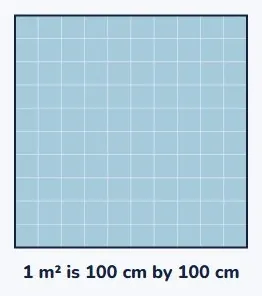
Try it: why area units square
Because both sides got converted
- A square metre is 100 cm along one side and 100 cm along the other.
- A hundred times a hundred is ten thousand.
- For volume it happens three times. A cubic metre is a million cm³.
| Line | Working | Note |
|---|---|---|
| 1 m | 100 cm | the length conversion |
| 1 m² | 100 cm × 100 cm | |
| So 1 m² | 10 000 cm² | not 100 |
| Why | both sides were converted |
Units made out of other units
- Cm² is not a name. It is centimetres times centimetres.
- Km/h is kilometres divided by hours.
- The unit is telling you what calculation produced it.
| Unit | Built from | Kind |
|---|---|---|
| cm² | cm × cm | a product |
| m³ | m × m × m | a product |
| km/h | km ÷ h | a quotient |
| g/cm³ | g ÷ cm³ | a quotient |
Which means a unit can rebuild a formula
- Forgotten how speed works? The unit is kilometres per hour.
- Per means divided by. So speed is distance over time.
- The formula was written on the unit the whole time.
Picking a unit that reads well
- A height in kilometres is technically correct and useless.
- Choose the unit that gives a number a person can hold.
- Roughly: between one and a thousand.
| Measuring | Sensible unit | Not |
|---|---|---|
| A person’s height | metres or centimetres | not kilometres |
| Distance between cities | kilometres | not millimetres |
| Mass of a vitamin tablet | milligrams | not kilograms |
| Width of a virus | nanometres |
Last idea, and it will feel wrong at first
- Sometimes you have to write down fewer digits than you calculated.
- That feels like throwing away accuracy. It is the opposite.
- The extra digits were never real.
A rectangle measured to one decimal place
- 12.4 cm by 5.2 cm. The calculator says 64.48 square centimetres.
- But 12.4 means somewhere near 12.4. It is not exact.
- So the answer cannot be either. Report 64.5.
| Step | Value | Note |
|---|---|---|
| Measured | 12.4 cm by 5.2 cm | both to 1 decimal place |
| Calculator says | 64.48 cm² | |
| But | the inputs were not that precise | |
| Report | 64.5 cm² | one decimal place |
Try it: how precise can it be?
The same rule, on an addition
- 2.5 plus 1.25. One is to one decimal place, the other to two.
- The roughest measurement sets the limit. That is the 2.5.
- So 3.75 gets reported as 3.8.
| Step | Detail | |
|---|---|---|
| 2.5 + 1.25 | one is to 1 dp, one to 2 | |
| Calculator says | 3.75 | |
| Least precise | 2.5, to 1 dp | |
| Report | 3.8 |
What to take away
- Six things, and the fourth one is the classic lost mark.
| Every prefix | is a power of ten |
| kilo, mega, giga, tera | thousand, million, billion, trillion |
| centi, milli, micro, nano | hundredth, thousandth, millionth, billionth |
| 1 m² | is 10 000 cm², because both sides convert |
| A derived unit | tells you which operation made it |
| An answer | cannot be more precise than the roughest measurement in it |
Common mistakes
- 1 m² = 100 cm²Both sides of the square convert: 1 m² = 100 cm × 100 cm = 10 000 cm².
- 1500 g = 1 500 000 kgA bigger unit means fewer of them, so divide by 1000: 1500 g = 1.5 kg.
- 45 mm = 450 cmThere are 10 mm in a centimetre, so divide by 10: 45 mm = 4.5 cm.
- 12.3 cm ÷ 7 = 1.757142857 cmAn answer cannot be more precise than the measurement it came from, so round it, to about 1.8 cm.
Your turn
- Try all eight.
Convert 3.6 km to metres.
Convert 250 mg to grams.
A rectangle is 12.4 cm by 5.2 cm. Give the area sensibly.
What does the prefix micro mean?
A phone stores 128 GB. How many megabytes is that?
A density is given in g/cm³. Which calculation produced it?
Convert 3.5 m² to cm².
Hana walks 3.2 km in 0.7 h. Give her speed sensibly.
Show answer
1. 3600 m. Kilo means a thousand, and you are going to a smaller unit, so the number gets bigger. 2. 0.25 g. Milli means a thousandth, and you are going to a bigger unit. 3. 64.5 cm². The calculator says 64.48, but both measurements were only given to one decimal place, so the answer cannot be better than that. 4. One millionth, or 10 to the minus six. 5. 128 000 MB. Giga is 10⁹ and mega is 10⁶, so each gigabyte is 1000 megabytes: 128 × 1000. 6. Mass divided by volume. g/cm³ reads grams per cubic centimetre, and per means divided by. 7. 35 000 cm². Both sides convert, so 1 m² is 100 × 100 = 10 000 cm², and 3.5 × 10 000 = 35 000. 8. 4.6 km/h. Per means divide: 3.2 ÷ 0.7 = 4.571..., and both measurements are to 1 decimal place, so report 4.6 km/h.
The answers
- Smaller unit, so the number gets bigger.
- The calculator says 64.48, but the inputs were 1 dp.
- Micro is ten to the minus six.
| Answer | |
|---|---|
| 1 | 3600 m |
| 2 | 0.25 g |
| 3 | 64.5 cm² |
| 4 | One millionth |
Challenge
A phone screen is 14.4 cm tall and 6.4 cm wide. It is covered by 921 600 identical square pixels in rows and columns, with no gaps. (a) How wide is one pixel, in micrometres? (b) How many pixels fit in 1 mm² of the screen?
Hint
Find the area of one pixel first. To get it into square micrometres, remember that a square unit is converted along both sides: work out how many µm are in 1 cm, then square it.
Answer
(a) 100 µm. (b) 100 pixels.
Step by step
- The screen's area is 14.4 × 6.4 = 92.16 cm².
- 1 cm is 10 mm and 1 mm is 1000 µm, so 1 cm is 10 000 µm and 1 cm² is 10 000 × 10 000 = 100 000 000 µm².
- So the screen is 9 216 000 000 µm², and each pixel gets 9 216 000 000 ÷ 921 600 = 10 000 µm².
- A square of area 10 000 µm² has sides of 100 µm.
- 100 µm is 0.1 mm, so 10 pixels fit along 1 mm and 10 × 10 = 100 fit in 1 mm².
Full working
- Screen area = 14.4 × 6.4 = 92.16 cm²length times width
- 1 cm = 10 000 µm, so 1 cm² = 100 000 000 µm²convert both sides of the square
- 92.16 cm² = 9 216 000 000 µm²multiply by 10⁸
- One pixel = 9 216 000 000 ÷ 921 600 = 10 000 µm²share the area equally
- Side = 100 µm, since 100 × 100 = 10 000a square pixel
- 100 µm = 0.1 mm, so 10 × 10 = 100 pixels per mm²10 along each side of the 1 mm square
- Pixel width 100 µm, and 100 pixels in 1 mm²
Your fingernails grow about 3 mm in 30 days. (a) Find this growth rate in nanometres per second. (b) How long does a fingernail take to grow 1 micrometre? Give your answer in minutes and seconds. (c) Hemi writes the answer to (a) as 1.157407 nm per second. Why is that a poor answer, and what should he write?
Hint
Change the distance into nanometres and the time into seconds before you divide. A day has 24 × 60 × 60 seconds. For (c), look at how precise the measurement "about 3 mm" is.
Answer
(a) About 1.16 nm per second (exactly 3 000 000 ÷ 2 592 000). (b) 864 s, which is 14 min 24 s. (c) The data, about 3 mm, has only 1 significant figure, so the answer cannot be that precise: write about 1 nm per second.
Step by step
- 3 mm is 3 × 1 000 000 = 3 000 000 nm, because a millimetre is a million nanometres.
- 30 days is 30 × 86 400 = 2 592 000 seconds.
- Divide to get the rate: about 1.157 nm every second.
- 1 µm is 1000 nm, so the time is 1000 ÷ 1.157..., which is 864 s exactly (2 592 000 ÷ 3000).
- 864 s is 14 minutes and 24 seconds.
- An answer cannot be more precise than the least precise number used. "About 3 mm" is 1 significant figure, so give about 1 nm per second.
Full working
- 3 mm = 3 × 10⁶ nm = 3 000 000 nm1 mm = 1 000 000 nm
- 30 days = 30 × 24 × 60 × 60 = 2 592 000 s86 400 s in a day
- Rate = 3 000 000 ÷ 2 592 000 ≈ 1.157 nm per seconddistance ÷ time
- 1 µm = 1000 nmmicro is a thousand times nano
- Time = 2 592 000 ÷ 3000 = 864 s1000 nm is 13000 of 3 000 000 nm
- 864 s = 14 × 60 + 24 = 14 min 24 s60 seconds in a minute
- Data has 1 significant figure, so rate ≈ 1 nm per secondprecision rule
- About 1 nm per second; 1 µm takes 14 min 24 s
A car uses 6 litres of petrol per 100 km. Litres per kilometre is a volume divided by a length, so it is really an area. (a) Write 6 L per 100 km as an area in mm². (b) Imagine the petrol laid along the road as a thin thread, using it up as the car drives over it. Explain what your area from (a) means for that thread. (c) Another car's petrol thread would be a square 0.3 mm by 0.3 mm. How many litres does it use per 100 km?
Hint
1 L is 1000 cm³, which is 1 000 000 mm³. Write the volume in mm³ and the distance in mm, then divide.
Answer
(a) 0.06 mm². (b) It is the cross-section area of the thread: the car would use up a thread of petrol whose end has an area of 0.06 mm². (c) 9 L per 100 km.
Step by step
- 6 L is 6 000 000 mm³, and 100 km is 100 000 000 mm.
- Volume ÷ length = 6 000 000 ÷ 100 000 000 = 0.06 mm².
- A thread with a cross-section of 0.06 mm² that is 100 km long holds exactly 6 L, so this area is the size of the end of the thread.
- The second thread has a cross-section of 0.3 × 0.3 = 0.09 mm².
- 100 km of it is 0.09 × 100 000 000 = 9 000 000 mm³, which is 9 L.
Full working
- 6 L = 6 × 1 000 000 = 6 000 000 mm³1 L = 1000 cm³ and 1 cm³ = 1000 mm³
- 100 km = 100 × 1 000 000 = 100 000 000 mm1 km = 1000 m = 1 000 000 mm
- 6 000 000 ÷ 100 000 000 = 0.06 mm²mm³ ÷ mm gives mm²
- Thread volume = cross-section × lengthso the area is the thread's cross-section
- 0.3 × 0.3 = 0.09 mm²the second car's cross-section
- 0.09 × 100 000 000 = 9 000 000 mm³ = 9 Lvolume of 100 km of thread
- (a) 0.06 mm² (c) 9 L per 100 km
Where science uses this
Report a mistake
More in Measurement
Is your child on track?
Take the free placement test