Multi-step equations, and word problems in four moves
What this lesson covers
- The properties of operations (commutative, distributive, associative, inverse, and identity) and the order of operations apply to numbers and variables.
One rule makes all of it work
- Linear equations that take more than one step, then word problems.
- Whatever you do to one side, you do to the other.
- Have some paper ready for the pause moments.
Keep it level: a two-step equation
- 3x + 5 = 17 is a balance: three x tiles and five ones on the left, seventeen ones on the right.
- Take five off the left only and the scale tips. Take five from both sides and it stays level.
- Undo the adding first, then the multiplying: the order of operations, run backwards.
| Step | Working | Why |
|---|---|---|
| Start | 3x + 5 = 17 | |
| Subtract 5 | 3x = 12 | − 5 both sides |
| Divide by 3 | x = 4 | ÷ 3 both sides |
| Check | 3 × 4 + 5 = 17 | it balances |
x on both sides
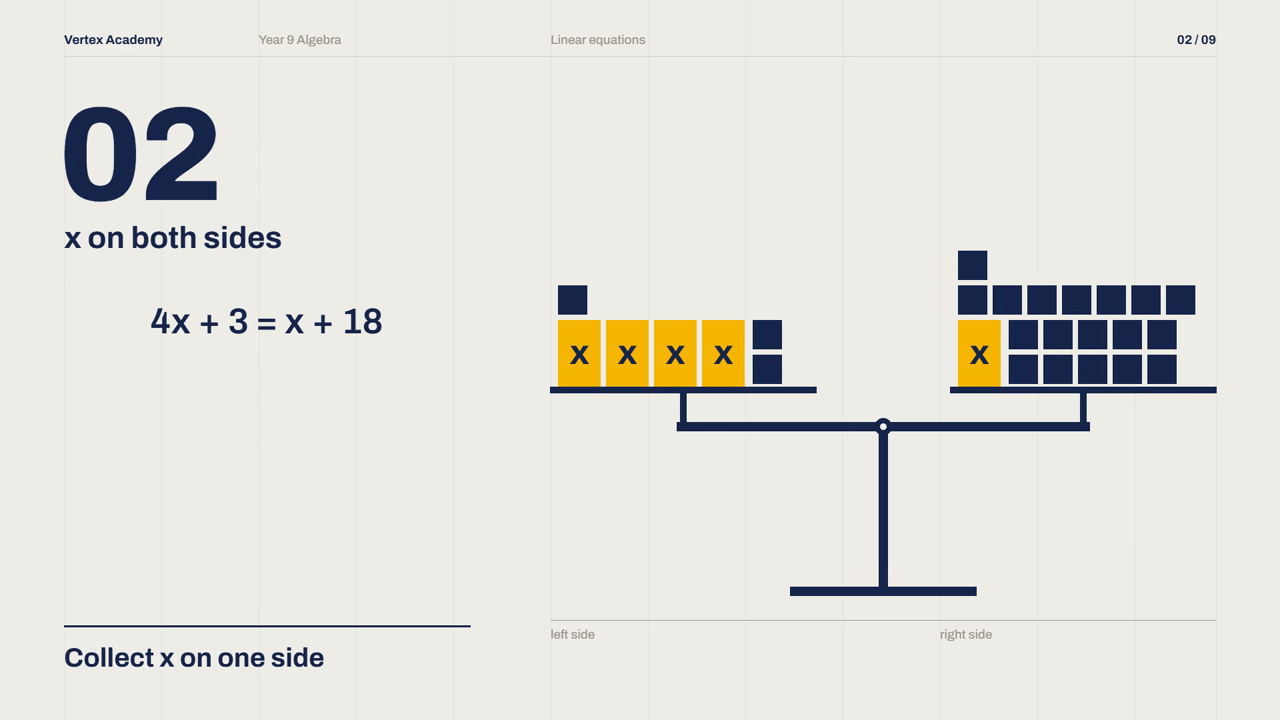
- 4x + 3 = x + 18. First collect the x terms on one side.
- Take away the smaller x term, so the x terms you keep are positive.
- Check: 4 × 5 + 3 and 5 + 18 are both 23.
| Step | Working | Why |
|---|---|---|
| Start | 4x + 3 = x + 18 | |
| Collect x | 3x + 3 = 18 | − x both sides |
| Subtract 3 | 3x = 15 | − 3 both sides |
| Divide by 3 | x = 5 | ÷ 3 both sides |
Try it: keep it level
Try it: 7x − 4 = 3x + 20
- Take 3x from both sides: 4x − 4 = 20.
- Add 4: 4x = 24, so x = 6.
- Check: both sides come to 38.
| Step | Working | Why |
|---|---|---|
| Start | 7x − 4 = 3x + 20 | |
| Collect x | 4x − 4 = 20 | − 3x both sides |
| Add 4 | 4x = 24 | + 4 both sides |
| Divide by 4 | x = 6 | ÷ 4 both sides |
| Check | 7 × 6 − 4 = 3 × 6 + 20 | 38 = 38 |
Negatives, and the sign slip
- 15 − 3x = 2x − 10. The sign belongs to the term after it: this term is −3x.
- Add 3x to both sides to get rid of the negative x term.
- The slip: moving the 10 across but keeping it as −10 gives 5 = 5x. Add 10 to both sides instead.
| Step | Working | Why |
|---|---|---|
| Start | 15 − 3x = 2x − 10 | |
| Add 3x | 15 = 5x − 10 | + 3x both sides |
| Add 10 | 25 = 5x | + 10 both sides |
| Divide by 5 | x = 5 | ÷ 5 both sides |
| Check | 15 − 3 × 5 = 2 × 5 − 10 | 0 = 0 |
Brackets: expand first
- 3(2x − 5) = 4(x + 1) + 3. Multiply everything inside a bracket by the number outside.
- The slip: multiplying only the first term and writing 6x − 5.
- Check: 3 × 17 = 51 and 4 × 12 + 3 = 51.
| Step | Working | Why |
|---|---|---|
| Start | 3(2x − 5) = 4(x + 1) + 3 | |
| Expand | 6x − 15 = 4x + 4 + 3 | every term inside |
| Simplify | 6x − 15 = 4x + 7 | 4 + 3 = 7 |
| Collect x | 2x − 15 = 7 | − 4x both sides |
| Add 15 | 2x = 22 | + 15 both sides |
| Divide by 2 | x = 11 | ÷ 2 both sides |
Try it: 2(x + 7) = 5(x − 2)
- Expand both brackets: 2x + 14 = 5x − 10.
- Take 2x from both sides and add 10: 24 = 3x, so x = 8.
- Check: 2 × 15 and 5 × 6 are both 30.
| Step | Working | Why |
|---|---|---|
| Start | 2(x + 7) = 5(x − 2) | |
| Expand | 2x + 14 = 5x − 10 | |
| Collect x | 14 = 3x − 10 | − 2x both sides |
| Add 10 | 24 = 3x | + 10 both sides |
| Divide by 3 | x = 8 | ÷ 3 both sides |
Fractions: multiply every term
- x/3 + 2 = x/2 − 1. Multiply every term by 6, because 3 and 2 both go into 6.
- The slip: multiplying only the fractions gives 2x + 2 = 3x − 1.
- Check: 18/3 + 2 = 8 and 18/2 − 1 = 8.
| Step | Working | Why |
|---|---|---|
| Start | x/3 + 2 = x/2 − 1 | |
| Clear fractions | 2x + 12 = 3x − 6 | × 6 every term |
| Collect x | 12 = x − 6 | − 2x both sides |
| Add 6 | 18 = x | + 6 both sides |
Try it: keep it balanced
Word problems in four moves
- The same algebra, in four moves.
- Find the unknown, write the equation, solve it, then check it in the story.
| Move | What you do |
|---|---|
| 1. Unknown | say what the letter stands for, with units |
| 2. Equation | turn the sentence into an equation |
| 3. Solve | same to both sides |
| 4. Check in context | put the answer back into the story |
A taxi fare
- A taxi charges $3.50 to start, plus $2.80 per kilometre. Mere's ride cost $31.50. How far did she travel?
- Let d be the distance in kilometres: 3.50 + 2.80d = 31.50.
- Check: 10 km at $2.80 is $28.00, plus $3.50 is $31.50. The ride was 10 km.
| Move | Working | Note |
|---|---|---|
| Unknown | d = distance in km | |
| Equation | 3.50 + 2.80d = 31.50 | |
| Solve | 2.80d = 28.00 | − 3.50 |
| d = 10 | ÷ 2.80 | |
| Check | 3.50 + 2.80 × 10 = 31.50 | 10 km |
Phone plans
- Plan A costs $20 a month plus $4 per GB. Plan B costs $35 a month plus $1 per GB. For how many GB do they cost the same?
- The same cost means the two expressions are equal: 20 + 4g = 35 + g.
- At 5 GB both cost $40. Use more than 5 GB and Plan B is cheaper.
| Move | Working | Note |
|---|---|---|
| Unknown | g = number of GB | |
| Equation | 20 + 4g = 35 + g | |
| Solve | 20 + 3g = 35 | − g |
| 3g = 15 | − 20 | |
| g = 5 | ÷ 3 | |
| Check | 20 + 4 × 5 = 35 + 5 | $40 each |
Try it: where the plans cross
Try it: ages
- Aroha is three times as old as her brother Tama. In five years, she will be twice as old as him. How old is Tama now?
- Let t be Tama's age now, so Aroha is 3t. In five years: 3t + 5 = 2(t + 5).
- Tama is 5 and Aroha is 15. In five years they are 10 and 20, and 20 is twice 10.
| Move | Working | Note |
|---|---|---|
| Unknown | t = Tama's age now | Aroha is 3t |
| Equation | 3t + 5 = 2(t + 5) | in five years |
| Solve | 3t + 5 = 2t + 10 | expand |
| t = 5 | − 2t, − 5 | |
| Check | Tama 5, Aroha 15 | 10 and 20 in five years |
Garden fencing
- A rectangular vege garden is 3 m longer than it is wide. It takes 26 m of fencing to go right around it.
- Let w be the width, so the length is w + 3. Two widths plus two lengths make 26.
- Width 5 m, length 8 m. Check: 5 + 8 + 5 + 8 = 26.
| Move | Working | Note |
|---|---|---|
| Unknown | w = width in m | length is w + 3 |
| Equation | 2w + 2(w + 3) = 26 | all four sides |
| Solve | 4w + 6 = 26 | expand and collect |
| 4w = 20 | − 6 | |
| w = 5 | ÷ 4 | |
| Check | 2 × 5 + 2 × 8 = 26 | 5 m by 8 m |
Solving linear equations
- The whole method on one card.
| Brackets | expand first, every term inside |
| Fractions | multiply every term to clear them |
| x on both sides | collect x on one side |
| Order | undo + and − first, then × and ÷ |
| Always | do the same to both sides |
| Finally | check in the original equation |
| Word problems | unknown, equation, solve, check in context |
Common mistakes
- 15 = 5x − 10, so 5 = 5x (the 10 moved across but stayed −10).Add 10 to both sides: 25 = 5x, so x = 5.
- 3(2x − 5) = 6x − 5.Multiply every term inside the bracket: 3(2x − 5) = 6x − 15.
- x/3 + 2 = x/2 − 1, times 6, gives 2x + 2 = 3x − 1.Multiply every term, not only the fractions: 2x + 12 = 3x − 6, so x = 18.
Your turn
- Try all eight.
Solve 5x + 9 = x + 17.
Solve 4(3x + 2) = 2(x − 1).
Solve x/4 + 3 = x/2 − 1.
A taxi charges $4.00 to start plus $3.00 per km. A ride costs $25.00. How far was it?
Ben adds 2x to both sides of 9 − 2x = 3x − 6 and writes 9 = x − 6. What is the correct solution?
Solve 4(x + 3) − 2(x − 5) = 30.
Three consecutive whole numbers add to 87. What is the largest of them?
A class trip to Te Papa costs $180 for the bus plus $12 per student. The budget is $500. What is the most students who can go?
Show answer
1. x = 2. Take x from both sides: 4x + 9 = 17, then 4x = 8. 2. x = −1. Expand: 12x + 8 = 2x − 2, then 10x = −10. 3. x = 16. Multiply every term by 4: x + 12 = 2x − 4, so x = 16. Check: 4 + 3 = 7 and 8 − 1 = 7. 4. 7 km. 4.00 + 3.00d = 25.00, so 3.00d = 21.00 and d = 7. 5. x = 3. Adding 2x gives 9 = 5x − 6, not x − 6. Then 15 = 5x. Check: 9 − 2 × 3 = 3 and 3 × 3 − 6 = 3. 6. x = 4. Expand: 4x + 12 − 2x + 10 = 30, since −2 × −5 = +10. So 2x + 22 = 30 and 2x = 8. 7. 30. Let the smallest be n: n + (n + 1) + (n + 2) = 87, so 3n + 3 = 87 and n = 28. The numbers are 28, 29, 30. 8. 26 students. 180 + 12s ≤ 500 gives 12s ≤ 320, so s ≤ 26.67, and 27 students would go over budget.
The answers
- Collect x first, then undo the adding, then the multiplying.
- Expand every term inside both brackets before collecting.
- Multiply every term by 4, not only the fractions.
| Answer | |
|---|---|
| 1 | x = 2 |
| 2 | x = −1 |
| 3 | x = 16 |
| 4 | 7 km |
Equality Explorer
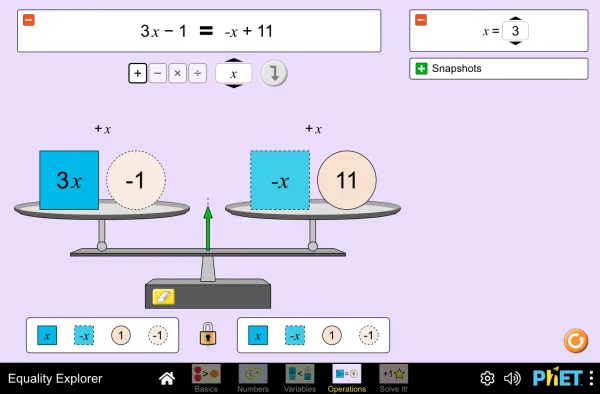
Full screen · PhET Interactive Simulations, University of Colorado Boulder, CC BY 4.0
Challenge
The equations 2(x + 3) = 5x − 9 and kx − 4 = x + 11 have the same solution for x. Find the value of k.
Hint
Only one of the two equations can be solved straight away. Solve it, then put that value of x into the other one.
Answer
k = 4
Step by step
- The first equation has only one unknown, x, so solve it first.
- Expand: 2x + 6 = 5x − 9. Take 2x from both sides and add 9: 15 = 3x, so x = 5.
- The second equation has the same solution, so x = 5 must make it balance.
- Substitute: 5k − 4 = 5 + 11 = 16, so 5k = 20 and k = 4.
- Check: 4 × 5 − 4 = 16 and 5 + 11 = 16.
Full working
- 2x + 6 = 5x − 9expand every term inside the bracket
- 15 = 3xtake 2x from both sides, add 9 to both sides
- x = 5divide both sides by 3
- 5k − 4 = 5 + 11put x = 5 into the second equation
- 5k = 20add 4 to both sides
- k = 4
Hemi cycles from home to Lake Rotoiti at 18 km per hour. On the way back his chain breaks, so he walks the same road home pushing the bike at 6 km per hour. The whole trip takes 2 hours 40 minutes. How far is the lake from his home?
Hint
Time = distance ÷ speed. Write each part of the trip as a time in hours, and write 2 hours 40 minutes as a fraction of an hour.
Answer
12 km
Step by step
- Let d be the distance to the lake in km.
- Cycling there takes d18 hours and walking back takes d6 hours.
- 40 minutes is 23 of an hour, so the whole trip is 83 hours: d18 + d6 = 83.
- Multiply every term by 18: d + 3d = 48, so 4d = 48 and d = 12.
- Check: cycling 12 km takes 40 minutes, walking 12 km takes 2 hours, total 2 hours 40 minutes.
Full working
- d = distance to the lake in kmthe unknown
- d18 + d6 = 83time there plus time back, 2 h 40 min = 83 h
- d + 3d = 48multiply every term by 18
- 4d = 48collect
- d = 12divide both sides by 4
- Check: 40 min + 2 h = 2 h 40 minit fits the story
- The lake is 12 km away
Look at the equation 2(3x − 4) − (x − a) = 5x + 6, where a is a number. (a) Tama says he can choose a so that the solution is x = 3. Show that he is wrong: whatever a is, x = 3 is never the only solution. (b) Find the one value of a that makes the equation true for every value of x.
Hint
Expand carefully. The minus sign in front of (x − a) changes the sign of both terms inside. Then see what happens to the x terms.
Answer
(a) It simplifies to 5x + a − 8 = 5x + 6, so the x terms cancel: if a is not 14 there is no solution at all, and if a = 14 every x works. (b) a = 14.
Step by step
- Expand: 2(3x − 4) is 6x − 8, and −(x − a) is −x + a.
- The left side becomes 6x − 8 − x + a = 5x + a − 8.
- So the equation is 5x + a − 8 = 5x + 6. Take 5x from both sides and the x disappears: a − 8 = 6.
- If a is not 14, this says two different numbers are equal, which is never true, so no x works, not even x = 3.
- If a = 14, both sides are 5x + 6, so every x works. No value of a gives exactly one solution, so Tama cannot make x = 3 the solution.
Full working
- 2(3x − 4) − (x − a) = 6x − 8 − x + athe minus changes both signs in the second bracket
- = 5x + a − 8collect like terms
- 5x + a − 8 = 5x + 6the equation now
- a − 8 = 6take 5x from both sides: x is gone
- a ≠ 14: a false statement, so no solution(a) Tama is wrong
- a = 14: 5x + 6 = 5x + 6, true for every x(b)
- a = 14
Report a mistake
More in Algebra

Is your child on track?
Take the free placement test