Patterns, rules and the four quadrants
What this lesson covers
- A coordinate plane extends to 4 quadrants that meet at the origin (0, 0).
- Linear patterns have a constant increase or decrease, can be described by the rule t = a × n + d, and can be graphed as a straight line on a coordinate plane.
The grid goes all four ways
- You have used the top right corner for years.
- The axes carry on the other way as well, into negatives.
- That makes four regions, meeting at the origin, (0, 0).
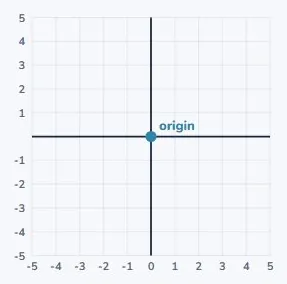
Four quadrants, numbered anticlockwise
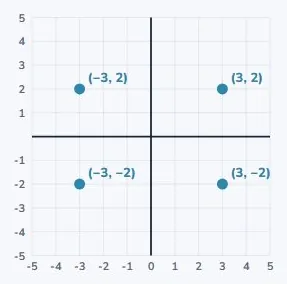
- The first is the top right, where both are positive.
- Then you go anticlockwise: second, third, fourth.
- The signs tell you which one a point lands in.
And the order never changes
- x first, then y. Along the corridor, then up the stairs.
- (−3, 2) means 3 to the left and 2 up.
- (2, −3) is a completely different point.
| Quadrant | Signs | Example |
|---|---|---|
| First | x positive, y positive | (3, 2) |
| Second | x negative, y positive | (−3, 2) |
| Third | x negative, y negative | (−3, −2) |
| Fourth | x positive, y negative | (3, −2) |
Now a pattern: 5, 8, 11, 14
- Number the positions: 1st, 2nd, 3rd, 4th. Call that n.
- The value at each position is the term. Call that t.
- We want a rule that turns any n into its t.
| Position n | Term t |
|---|---|
| 1 | 5 |
| 2 | 8 |
| 3 | 11 |
| 4 | 14 |
Find the step between terms
- 5 to 8 is +3. 8 to 11 is +3. 11 to 14 is +3.
- The same every time, which is what makes it linear.
- That constant step is the a in t = a × n + d.
| From | Step | |
|---|---|---|
| 5 to 8 | +3 | |
| 8 to 11 | +3 | |
| 11 to 14 | +3 | |
| Constant | so the pattern is linear | a = 3 |
Try it: find the step
So is the rule just t = 3n?
- It is the obvious guess, and it is worth testing.
- At n = 1 it gives 3.
- But the first term is 5. The rule is wrong.
| Try | Working | Gives |
|---|---|---|
| Try t = 3n | at n = 1 that gives | 3 |
| But the first term is | 5 |
Wrong by the same amount every time
- It is 2 short at n = 1. And at n = 2. And at n = 3.
- So add 2 to it. t = 3n + 2.
- That 2 is the d, and this is how you find it.
| Try | Working | Gives |
|---|---|---|
| Try t = 3n | at n = 1 that gives | 3 |
| But the first term is | 5 | |
| Short by | 2 | |
| So | t = 3n + 2 |
What d actually is
- Run the table backwards one step, to n = 0.
- 3 times 0 plus 2 is 2.
- So d is what the term before the first one would have been.
| Position | Working | Term |
|---|---|---|
| n = 1 | 3 + 2 | 5 |
| n = 0 | 0 + 2 | 2 |
| So d is | the term before the first one | 2 |
Always test against the first term
- Finding a is easy. Everyone gets that bit.
- Forgetting to check is why t = 3n gets handed in.
- One substitution, five seconds, catches it every time.
| Rule | At n = 1 | Verdict |
|---|---|---|
| t = 3n | 3 | wrong, first term is 5 |
| t = 3n + 2 | 5 | right |
Now the rule earns its keep
- The 10th term: 3 times 10 plus 2, which is 32.
- The 50th: 152. The 100th: 302.
- You never had to write the pattern out to get there.
| Position | Working | Term |
|---|---|---|
| n = 10 | 3(10) + 2 | 32 |
| n = 50 | 3(50) + 2 | 152 |
| n = 100 | 3(100) + 2 | 302 |
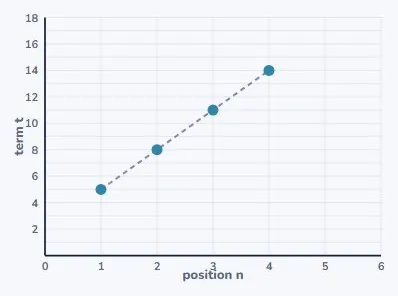
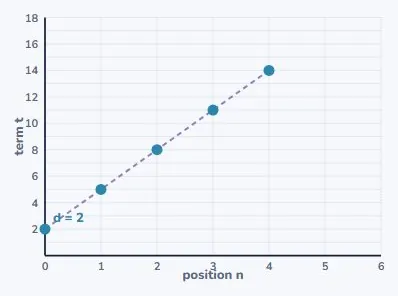
Plotted, it is a straight line
- Position along the bottom, term up the side.
- (1, 5), (2, 8), (3, 11), (4, 14).
- Perfectly straight, because the step never changes.
And d is where the line starts
- Follow the line back to position zero.
- It crosses at 2, which is the d we found.
- The step a is how steeply it climbs.
Try it: steepness and starting point
When the pattern goes down
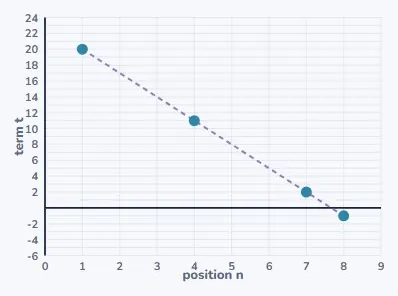
- 20, 17, 14, 11. The step is −3, so a is negative.
- At n = 1, −3 plus d must be 20, so d is 23.
- t = −3n + 23.
| Step | Working | Gives |
|---|---|---|
| 20, 17, 14, 11 | goes down by 3 | a = −3 |
| At n = 1 | −3 + d = 20 | d = 23 |
| So | t = −3n + 23 |
Which eventually goes below zero
- At n = 8: −24 plus 23 is −1.
- The pattern has run past zero into negative terms.
- And the graph drops into the fourth quadrant.
Three patterns worth knowing
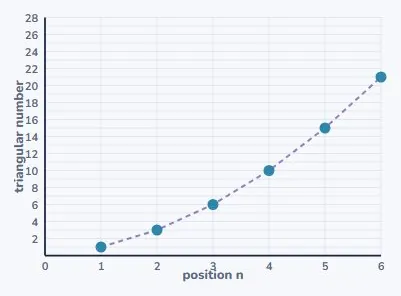
- Triangular: 1, 3, 6, 10, 15. Dots stacked in a triangle.
- Square: 1, 4, 9, 16, 25. And cube: 1, 8, 27, 64, 125.
- All three turn up constantly. Now look at their steps.
| Family | Starts | Steps |
|---|---|---|
| Triangular | 1, 3, 6, 10, 15 | differences 2, 3, 4, 5 |
| Square | 1, 4, 9, 16, 25 | differences 3, 5, 7, 9 |
| Cube | 1, 8, 27, 64, 125 | differences grow fast |
None of them is linear
- Triangular goes up by 2, then 3, then 4, then 5.
- That is not constant, so t = an + d cannot describe it.
- Plotted, they curve. The rules for those come later.
So check the differences first
- Before reaching for t = an + d, take the differences.
- Constant? Then it is linear and the rule applies.
- Not constant? Then it does not, and forcing it gives nonsense.
| Test | Meaning | |
|---|---|---|
| Linear needs | the same difference every time | |
| Triangular gives | 2, then 3, then 4 | not constant |
| So t = an + d | does not apply |
Try it: hunt the rule
Common mistakes
- 5, 8, 11, 14 goes up by 3, so the rule is t = 3n.Test it at n = 1: 3 × 1 = 3, not 5, so add the missing 2 to get t = 3n + 2.
- (2, −3) and (−3, 2) are the same point.x always comes first: (2, −3) is 2 right and 3 down, while (−3, 2) is 3 left and 2 up.
- 20, 17, 14, 11 has rule t = 3n + 17.The terms go down, so a = −3; at n = 1, −3 + d = 20 gives d = 23, so t = −3n + 23.
- Triangular numbers 1, 3, 6, 10 fit t = 2n − 1.The steps are 2, 3, 4, not constant, so the pattern is not linear and t = an + d cannot describe it.
Your turn: eight questions
- Try all eight.
- For question 1, test your rule at n = 1 before you write it down.
- Question 4 wants a reason, not just yes or no.
Find the rule for 7, 10, 13, 16.
Which quadrant holds the point (−5, 3)?
For t = 4n − 1, what is the 10th term?
Is 1, 3, 6, 10 a linear pattern? How do you know?
Start at the origin, move 4 left and then 3 down. Which point are you at?
Aroha says the rule for 6, 10, 14, 18 is t = 4n. Which is true?
A 50 L tank drains 4 L a minute, leaving 46, 42, 38 litres after n = 1, 2, 3 minutes. Which rule gives t?
A pattern has the rule t = 5n + 5. At which position n is the term 65?
Show answer
1. t = 3n + 4. The difference is 3, and 3n would give 3 at n = 1 when the first term is 7, so it is 4 short. 2. The second. x is negative and y is positive. 3. 39. Substitute n = 10 to get 40 − 1. 4. No. The differences are 2, 3 and 4, which are not constant. These are the triangular numbers, and their rule is not of the form an + d. 5. (−4, −3). x comes first and left is negative; y comes second and down is negative. 6. Wrong: at n = 1 it gives 4, not 6. The step of 4 is right, but the rule is 2 short, so it should be t = 4n + 2. 7. t = −4n + 50. The step is −4, and at n = 1, −4 + d = 46, so d = 50. 8. n = 12. Solve 5n + 5 = 65: subtract 5 to get 5n = 60, then divide by 5.
The answers
- t = 3n + 4. The step is 3, and 3n is 4 short at n = 1.
- (−5, 3) is in the second quadrant. And 4(10) − 1 is 39.
- 1, 3, 6, 10 is not linear. Its steps are 2, 3, 4.
| Answer | |
|---|---|
| 1 | t = 3n + 4 |
| 2 | second |
| 3 | 39 |
| 4 | no, steps are 2, 3, 4 |
Graphing Lines
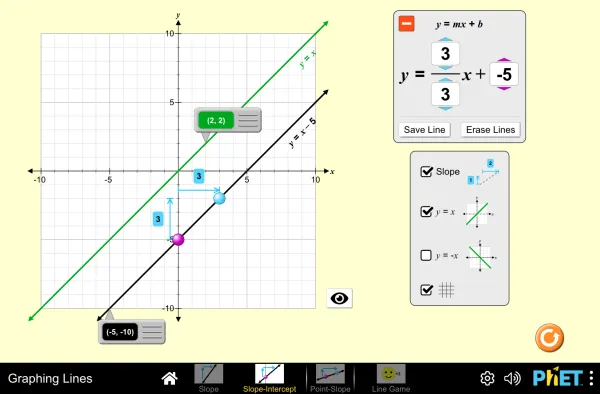
Full screen · PhET Interactive Simulations, University of Colorado Boulder, CC BY 4.0
What to take away
- A is the constant step. d is the term before the first one.
- Test every rule at n = 1. That is where t = 3n dies.
- And if the differences are not constant, it is not linear.
| Remember | |
|---|---|
| Four quadrants | numbered anticlockwise from the top right |
| a | is the constant difference |
| d | is what the term before the first one would be |
| Always test | your rule against n = 1 |
| No constant difference | means it is not linear at all |
Challenge
The rule y = 2x − 7 is used to make points (x, y) for every integer x from −5 to 5. (a) How many of the 11 points land in each quadrant, and which point lands on an axis? (b) Explain why no point made with this rule, for any value of x at all, can ever land in the second quadrant.
Hint
Work out y for each x and look at the signs of x and y. For part (b), the second quadrant needs x negative and y positive. What happens to 2x − 7 when x is negative?
Answer
(a) Third quadrant: 5 points (x = −5 to −1). On the y-axis: (0, −7). Fourth quadrant: 3 points, (1, −5), (2, −3), (3, −1). First quadrant: 2 points, (4, 1) and (5, 3). Second quadrant: none. (b) If x is negative, 2x is negative, and taking 7 away makes it more negative, so y is negative. A point in the second quadrant needs y positive.
Step by step
- For x from −5 to −1, y runs −17, −15, −13, −11, −9: both negative, so the third quadrant.
- At x = 0, y = −7, which is on the y-axis, not in any quadrant.
- For x = 1, 2, 3, y is −5, −3, −1: x positive, y negative, so the fourth quadrant.
- For x = 4 and 5, y is 1 and 3: both positive, so the first quadrant.
- A negative x makes 2x negative, and subtracting 7 can only make it lower, so y is always negative there.
Full working
- x = −5, −4, −3, −2, −1 gives y = −17, −15, −13, −11, −9third quadrant, 5 points
- x = 0 gives y = −7on the y-axis
- x = 1, 2, 3 gives y = −5, −3, −1fourth quadrant, 3 points
- x = 4, 5 gives y = 1, 3first quadrant, 2 points
- Second quadrant needs x < 0 and y > 0the signs it needs
- x < 0 means 2x < 0, so 2x − 7 < −7 < 0y is always negative
- Third 5, fourth 3, first 2, second 0; (0, −7) is on an axis
A linear pattern t = a × n + d has 41 as its 10th term, and its 3rd and 7th terms add up to 52. (a) Explain why the 5th term must be 26. (b) Find the rule. (c) Is 2026 a term of the pattern? Which term is the first one bigger than 2026, and what is it?
Hint
The 3rd term is 2 steps below the 5th term and the 7th term is 2 steps above it. What happens to the steps when you add them?
Answer
(a) The 3rd term is the 5th minus 2 steps and the 7th is the 5th plus 2 steps, so they add to twice the 5th term: 52 ÷ 2 = 26. (b) t = 3n + 11. (c) No, 2026 is not a term. The first term bigger than 2026 is the 672nd, which is 2027.
Step by step
- The 3rd term is 2 steps before the 5th and the 7th is 2 steps after it.
- Adding them, the steps cancel, leaving 2 × the 5th term = 52, so the 5th term is 26.
- From the 5th term to the 10th is 5 steps, and 41 − 26 = 15, so each step is 3 and a = 3.
- At n = 5: 3 × 5 + d = 26, so d = 11.
- 3n + 11 = 2026 gives 3n = 2015, and 2015 ÷ 3 is not a whole number, so 2026 is not a term.
- The 671st term is 2024 and the 672nd is 2027.
Full working
- 3rd + 7th = (5th − 2 steps) + (5th + 2 steps) = 2 × 5ththe steps cancel
- 5th term = 52 ÷ 2 = 26(a)
- a = (41 − 26) ÷ 5 = 35 steps from the 5th to the 10th term
- 3 × 5 + d = 26, so d = 11use the 5th term
- Check: 3rd 20, 7th 32, 20 + 32 = 52; 10th 3 × 10 + 11 = 41both facts work
- 3n + 11 = 2026 gives 3n = 2015, n = 671.67...not a whole number, so not a term
- n = 671 gives 2024, n = 672 gives 2027first term above 2026
- t = 3n + 11; 2026 is not a term; the 672nd term, 2027, is the first above it
Pattern A is linear: 8, 13, 18, 23, 28, ... Pattern B is the square numbers: 1, 4, 9, 16, 25, ... (a) Find the rule for pattern A. (b) Compare the nth term of each pattern. For which n is pattern B's term bigger than pattern A's term for the first time? (c) Hemi says that if you keep going, one of the terms of pattern A will turn out to be a square number. Show that he is wrong.
Hint
For part (c), look only at the last digit. What can the last digit of a term in pattern A be? What last digits can square numbers have? Try squaring 0 to 9.
Answer
(a) t = 5n + 3. (b) n = 6 (36 is bigger than 33; at n = 5, 25 is less than 28). (c) Every term of A ends in 3 or 8, but square numbers only end in 0, 1, 4, 5, 6 or 9, so no term of A is a square.
Step by step
- Pattern A goes up by 5 each time, so a = 5. At n = 1, 5 + d = 8, so d = 3.
- Compare n² with 5n + 3: at n = 5 it is 25 against 28, at n = 6 it is 36 against 33.
- Pattern B's differences keep growing (3, 5, 7, 9, ...) while A's stay at 5, so once B is ahead it stays ahead.
- 5n always ends in 0 or 5, so 5n + 3 always ends in 3 or 8.
- The last digit of a square depends only on the last digit of the number squared: 0, 1, 4, 9, 6, 5, 6, 9, 4, 1. Never 3 or 8.
Full working
- a = 13 − 8 = 5, and 5 × 1 + d = 8 gives d = 3rule for A
- t = 5n + 3pattern A
- n = 5: 5² = 25 and 5 × 5 + 3 = 28B is still behind
- n = 6: 6² = 36 and 5 × 6 + 3 = 33B is ahead for the first time
- 5n ends in 0 or 5, so 5n + 3 ends in 3 or 8last digits of A
- 0², 1², ..., 9² end in 0, 1, 4, 9, 6, 5, 6, 9, 4, 1last digits of squares
- No square ends in 3 or 8so no term of A is a square
- t = 5n + 3; B first wins at n = 6; Hemi is wrong
Practise this
Report a mistake
More in Algebra


Is your child on track?
Take the free placement test