Expanding, factorising and the laws behind them
What this lesson covers
- The distributive, commutative, and associative laws are true for all real numbers.
- Algebraic expressions can be presented in many different ways including fully factorised, partially factorised, and fully expanded forms.
Three laws, and each one is a permission
- Commutative: you may swap the order.
- Associative: you may regroup which pair goes first.
- Distributive: you may multiply across a bracket.
| Law | Lets you | Example |
|---|---|---|
| Commutative | you may swap the order | 3 + 5 = 5 + 3 |
| Associative | you may regroup them | (2 + 3) + 4 = 2 + (3 + 4) |
| Distributive | you may multiply across | 3(4 + 5) = 3 × 4 + 3 × 5 |
Why bother with the names
- Every move in algebra is allowed by one of these.
- Knowing which one tells you when a move is not allowed.
- That second half is where the marks are.
| Law | Lets you | Example |
|---|---|---|
| Commutative | you may swap the order | 3 + 5 = 5 + 3 |
| Associative | you may regroup them | (2 + 3) + 4 = 2 + (3 + 4) |
| Distributive | you may multiply across | 3(4 + 5) = 3 × 4 + 3 × 5 |
Two operations that do not swap
- 5 − 3 is 2. But 3 − 5 is −2. Not the same.
- 6 ÷ 2 is 3. But 2 ÷ 6 is a third.
- Adding and multiplying swap freely. These two never do.
| Expression | Value | |
|---|---|---|
| 5 − 3 | is 2 | |
| 3 − 5 | is −2 | not the same |
| 6 ÷ 2 | is 3 | |
| 2 ÷ 6 | is a third | not the same |
The distributive law, as a rectangle
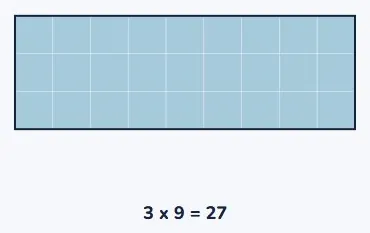
- 3 rows of 9 is 27.
- Split the 9 into 4 and 5, and you have 3 fours and 3 fives.
- 12 and 15, which is 27. The same rectangle, cut in two.
So both routes are legal
- Add inside the bracket first, then multiply. 3 × 9 = 27.
- Or multiply across first. 12 + 15 = 27.
- Which means you may do the same with letters inside.
| Route | Order | Answer |
|---|---|---|
| 3(4 + 5) | add first | 3 × 9 = 27 |
| 3 × 4 + 3 × 5 | multiply first | 12 + 15 = 27 |
| Same answer | so both routes are legal |
First, collecting like terms
- 3x and 5x are the same kind of thing. They combine to 8x.
- 3x and 2y are not. Leave them alone.
- Nor are 4a and 4a². Same letter, different power.
| Terms | Why | Do |
|---|---|---|
| 3x and 5x | same letter | collect: 8x |
| 2y and 7y | same letter | collect: 9y |
| 3x and 2y | different letters | leave them |
| 4a and 4a² | different powers | leave them |
Gathering them up
- 3x + 2y + 5x. The commutative law lets you reorder.
- So put the x terms together: 3x + 5x is 8x.
- The 2y has no partner. Answer: 8x + 2y.
| Expression | Step | Gives |
|---|---|---|
| 3x + 2y + 5x | gather the x terms | 3x + 5x = 8x |
| the y term is alone | 2y | |
| So | 8x + 2y |
And the sign belongs to the term after it
- In 4a + 7b − a, the minus belongs to that a.
- So the a terms are 4a and −a, leaving 3a.
- Because subtraction does not swap, the sign cannot wander.
| Expression | The a terms | Leaves |
|---|---|---|
| 4a + 7b − a + 2b | 4a and −a | 3a |
| 7b and 2b | 9b | |
| So | 3a + 9b |
Expanding a bracket
- 2(x + 3) + 1. The 2 multiplies everything inside.
- Both terms: 2x and 6. So 2x + 6 + 1.
- Then collect the numbers. 2x + 7.
| Expression | Step | Gives |
|---|---|---|
| 2(x + 3) + 1 | multiply across | 2x + 6 + 1 |
| 2x + 6 + 1 | collect the numbers | 2x + 7 |
| Note | the 2 hits both terms |
Try it: a bracket as an area
Everything inside, not just the first
- The commonest slip is 2(x + 3) becoming 2x + 3.
- The 3 was inside the bracket. It gets multiplied too.
- Draw an arrow to each term if it helps. 4(2x + 3) is 8x + 12.
| Written | Verdict | Why |
|---|---|---|
| 2(x + 3) = 2x + 3 | wrong | the 3 was missed |
| 2(x + 3) = 2x + 6 | right | both terms doubled |
With a subtraction inside
- 3(x − 2) + 2x. The 3 multiplies the x and the 2.
- And the minus stays with the 2. So 3x − 6 + 2x.
- Collect the x terms: 5x − 6.
| Expression | Step | Gives |
|---|---|---|
| 3(x − 2) + 2x | multiply across | 3x − 6 + 2x |
| 3x − 6 + 2x | collect the x terms | 5x − 6 |
| The sign | travels with the 2 |
Now run the arrow backwards
- 5x − 35. What number divides both terms? 5.
- Take it outside: 5(x − 7).
- Note the order: x minus 7, not 7 minus x. The sign stayed.
| Expression | Step | Gives |
|---|---|---|
| 5x − 35 | what divides both? | 5 |
| Take it out | 5(? − ?) | 5(x − 7) |
And check it by expanding again
- Expand 5(x − 7) and you should get back to 5x − 35.
- 5 times x is 5x. 5 times −7 is −35. It works.
- Factorising is expanding read backwards. Always check.
| Expression | Step | Gives |
|---|---|---|
| 5x − 35 | what divides both? | 5 |
| Take it out | 5(? − ?) | 5(x − 7) |
| Check | expand it again | 5x − 35 |
The word "fully" costs marks
- 12x − 18 = 2(6x − 9) is a correct factorisation.
- But 6x − 9 still divides by 3, so it is only partial.
- 6(2x − 3) is fully factorised. Nothing left inside.
| Written | Test | Verdict |
|---|---|---|
| 12x − 18 = 2(6x − 9) | 6x − 9 still divides by 3 | partial |
| 12x − 18 = 6(2x − 3) | 2x − 3 shares nothing | fully |
| The test | can the inside be factorised again? |
Rearranging is not a new skill
- A = bh, and you want b on its own.
- The b is multiplied by h, so divide both sides by h.
- b = A ÷ h. That is last lesson, with letters on the other side.
| Formula | Move | Gives |
|---|---|---|
| A = bh | divide both sides by h | b = A ÷ h |
Two steps, same idea
- P = 2(l + w), and you want l.
- Divide both sides by 2 first: P ÷ 2 = l + w.
- Then subtract w. l = P ÷ 2 − w.
| Formula | Move | Gives |
|---|---|---|
| A = bh | divide both sides by h | b = A ÷ h |
| P = 2(l + w) | divide both sides by 2 | P ÷ 2 = l + w |
| subtract w from both | l = P ÷ 2 − w |
Common mistakes
- 2(x + 3) + 1 = 2x + 3 + 1 = 2x + 4.The 2 multiplies every term inside the bracket: 2x + 6 + 1 = 2x + 7.
- 3(x − 2) + 2x = 3x + 6 + 2x = 5x + 6.The minus stays with the 2, so 3 × −2 = −6, giving 5x − 6.
- 12x − 18 = 2(6x − 9), fully factorised.6x − 9 still divides by 3; take out the HCF, 6, to get 6(2x − 3).
- 4a + 7b − a = 5a + 7b.The minus belongs to the a after it, so 4a − a = 3a, giving 3a + 7b.
Your turn: eight questions
- Try all eight.
- Question 3 says fully. Check the inside when you think you are done.
- Check question 1 and 3 by expanding them back out.
Expand and simplify 3(x + 4) + 2.
Simplify 4a + 7b − a + 2b.
Factorise 8x + 12 fully.
Rearrange A = lw to make w the subject.
Simplify 4a + 3a² + 2a.
Which of these is NOT always true, whatever numbers a, b and c stand for?
Tama expands 4(2x − 5) and writes 8x − 5. What did he do wrong?
A taxi fare in Wellington is C = 4 + 3k dollars for k km. Make k the subject.
Show answer
1. 3x + 14. Expanding gives 3x + 12 + 2, then collect the numbers. 2. 3a + 9b. The a terms are 4a and −a, which leave 3a. 3. 4(2x + 3). Taking out 2 gives 2(4x + 6), which is only partial, because 4x + 6 still divides by 2. 4. w = A ÷ l. Divide both sides by l, exactly as with an equation. 5. 6a + 3a². Only 4a and 2a are like terms; 3a² has a different power, so it is left alone. 6. a − b = b − a. Subtraction is not commutative: 5 − 3 is 2 but 3 − 5 is −2. 7. He forgot to multiply the 5 by 4. The 4 hits every term inside, so the answer is 8x − 20. 8. k = (C − 4) ÷ 3. Subtract 4 from both sides first, then divide both sides by 3.
The answers
- 3(x + 4) + 2 expands to 3x + 12 + 2, which is 3x + 14.
- 4a + 7b − a + 2b collects to 3a + 9b.
- 8x + 12 is 4(2x + 3). And w = A ÷ l.
| Answer | |
|---|---|
| 1 | 3x + 14 |
| 2 | 3a + 9b |
| 3 | 4(2x + 3) |
| 4 | w = A ÷ l |
Area Model Algebra
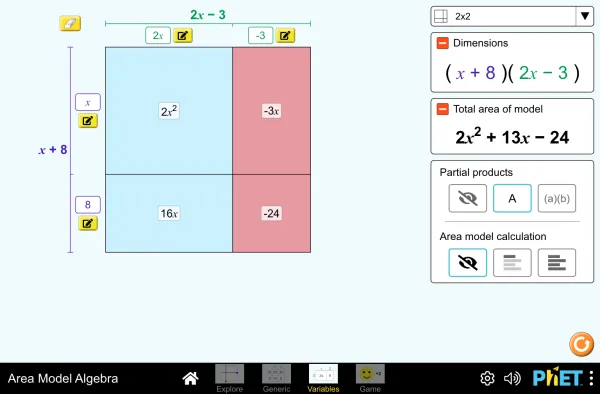
Full screen · PhET Interactive Simulations, University of Colorado Boulder, CC BY 4.0
What to take away
- The three laws are permissions, and two operations lack them.
- Expanding hits every term inside the bracket, signs included.
- Factorising is the same arrow backwards, so check by expanding.
| Remember | |
|---|---|
| The three laws | each one is a permission |
| Subtraction | is not commutative, so signs stay put |
| Expanding | the outside term hits every term inside |
| Factorising | is expanding read backwards; check by expanding |
| Fully factorised | means the inside shares nothing left |
Challenge
(a) Write 12x + 20 in the form p(qx + r), where p, q and r are whole numbers and p is bigger than 1. Find every way, and say which one is fully factorised. (b) A rectangle is 4 cm tall and its area is 12x + 20 square cm. Its perimeter is 60 cm. Find x, then check the area two ways: height × width, and 12x + 20.
Hint
p must divide both 12 and 20 exactly. For (b), the fully factorised form tells you the width. The perimeter is 2 × (height + width).
Answer
(a) 2(6x + 10) and 4(3x + 5); 4(3x + 5) is fully factorised. (b) x = 7: the rectangle is 4 cm by 26 cm, area 104 square cm.
Step by step
- p has to be a common factor of 12 and 20 that is bigger than 1, so p is 2 or 4.
- p = 2 gives 2(6x + 10) and p = 4 gives 4(3x + 5).
- In 2(6x + 10) the bracket still has a common factor of 2, so it is only partly factorised. 3 and 5 have no common factor, so 4(3x + 5) is fully factorised.
- Area = 4 × width, so the width is 3x + 5.
- Perimeter = 2(4 + 3x + 5) = 6x + 18 = 60, so 6x = 42 and x = 7.
- The width is 3 × 7 + 5 = 26, so 4 × 26 = 104, and 12 × 7 + 20 = 104 as well: the distributive law at work.
Full working
- Common factors of 12 and 20 bigger than 1: 2 and 4the choices for p
- 12x + 20 = 2(6x + 10) = 4(3x + 5)the two ways
- 6x + 10 still shares a 2; 3x + 5 shares nothing4(3x + 5) is fully factorised
- Width = 3x + 5area 4(3x + 5), height 4
- 2(4 + 3x + 5) = 6x + 18 = 60perimeter
- 6x = 42, so x = 7take 18 off, divide by 6
- 4 × 26 = 104 and 12 × 7 + 20 = 104both routes agree
- (a) 2(6x + 10) and 4(3x + 5), fully factorised 4(3x + 5); (b) x = 7, area 104 square cm
Hine adds four consecutive whole numbers, such as 7 + 8 + 9 + 10 = 34. (a) Using n for the smallest number, write the sum and simplify it. (b) Show that the sum is always 2 more than a multiple of 4, so it can never be a multiple of 4. (c) Four consecutive whole numbers add to 1 002. Find them.
Hint
The four numbers are n, n + 1, n + 2 and n + 3. After collecting like terms, try to write the answer as 4(something) + 2.
Answer
(a) 4n + 6. (b) 4n + 6 = 4(n + 1) + 2, which is 2 more than a multiple of 4. (c) 249, 250, 251 and 252.
Step by step
- Add the four numbers: n + (n + 1) + (n + 2) + (n + 3).
- Collect the n terms and the numbers: 4n + 6.
- Split the 6 into 4 + 2: 4n + 4 + 2 = 4(n + 1) + 2.
- 4(n + 1) is a multiple of 4, so the sum is always 2 more than one, never a multiple of 4 itself.
- For part (c), 4n + 6 = 1 002 gives 4n = 996 and n = 249.
Full working
- n + (n + 1) + (n + 2) + (n + 3)four consecutive numbers
- 4n + 6collect like terms
- 4n + 4 + 2 = 4(n + 1) + 2factorise the first two terms
- 4(n + 1) is a multiple of 4so the sum leaves 2 over
- 4n + 6 = 1 002, so 4n = 996subtract 6 from both sides
- n = 249divide both sides by 4
- Check: 249 + 250 + 251 + 252 = 1 002it works
- Sum 4n + 6 = 4(n + 1) + 2; the numbers are 249, 250, 251, 252
(a) Expand and simplify (a − b) − c and a − (b − c). Show that they always differ by 2c, so they are equal only when c = 0. (b) Brackets can be put into 20 − 8 − 5 − 2 in many ways, using one or more pairs, for example 20 − (8 − 5) − 2. List every different answer that can be made this way, and say which is the largest.
Hint
The minus in front of a bracket multiplies everything inside it by −1. In 20 − 8 − 5 − 2, the 20 is always added and the 8 is always taken away. Which signs can the 5 and the 2 end up with?
Answer
(a) (a − b) − c = a − b − c and a − (b − c) = a − b + c; the second is 2c bigger. (b) The answers are 5, 9, 15 and 19, and 19 is the largest.
Step by step
- (a − b) − c has no bracket to open after the first, so it is a − b − c.
- a − (b − c) = a − b + c, because the minus in front turns −c into +c.
- Their difference is 2c, which is 0 only when c = 0. So subtraction is not associative.
- In 20 − 8 − 5 − 2, the 20 is always + and the 8 is always −, but brackets can flip the 5 and the 2 to +.
- The four sign choices give 20 − 8 − 5 − 2 = 5, 20 − 8 − 5 + 2 = 9, 20 − 8 + 5 − 2 = 15, 20 − 8 + 5 + 2 = 19, and each can be made with brackets.
Full working
- (a − b) − c = a − b − cthe bracket is worked first, nothing to flip
- a − (b − c) = a − b + cthe minus multiplies −c to give +c
- (a − b + c) − (a − b − c) = 2cthey differ by 2c
- 20 − 8 − 5 − 2 = 5no brackets
- 20 − 8 − (5 − 2) = 9flips the 2
- 20 − (8 − 5) − 2 = 15flips the 5
- 20 − (8 − 5 − 2) = 19flips both the 5 and the 2
- The 20 cannot be negative and the 8 cannot be positiveno other answers
- Possible answers 5, 9, 15, 19; the largest is 19
Practise this
Report a mistake
More in Algebra
Is your child on track?
Take the free placement test