Listing outcomes, probability and complements
What this lesson covers
- Lists, tables, and tree diagrams are useful systematic methods for generating all possible outcomes.
- If all possible outcomes are assumed to be equally likely, the probability of an event is number of ways the event can happen / total number of possible outcomes.
- Probabilities can be expressed as a fraction or decimal between 0 and 1, or as a percentage between 0% and 100%.
- An event is a subset of the sample space and thus can be a single outcome or a combination of outcomes.
- The probability of an event and its complement add to 1.
Flip two coins. How many outcomes?
- Most people say three.
- Two heads, two tails, or one of each.
- There are four.
| First coin | Second coin | Outcome |
|---|---|---|
| Heads | Heads | HH |
| Heads | Tails | HT |
| Tails | Heads | TH |
| Tails | Tails | TT |
The problem with thinking of them
- Thinking of outcomes is how you miss one.
- You need a method that cannot skip anything.
- The curriculum calls that being systematic.
| First coin | Second coin | Outcome |
|---|---|---|
| Heads | Heads | HH |
| Heads | Tails | HT |
| Tails | Heads | TH |
| Tails | Tails | TT |
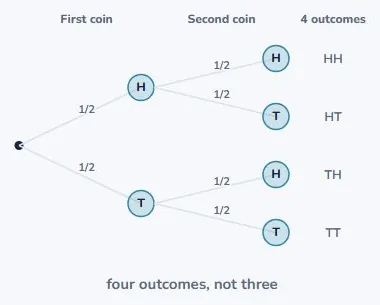
A tree diagram cannot miss one
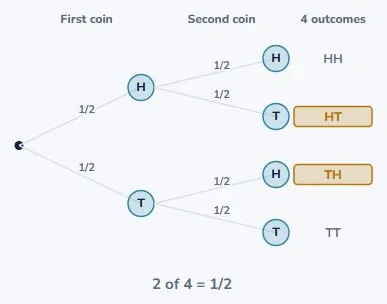
- Every branch of the second coin, from every branch of the first.
- Follow each path from left to right.
- Four paths. Four outcomes.
Try it: run an experiment
Try it: two coins in a tree
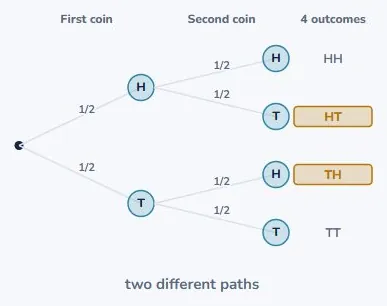
Why "one of each" is two outcomes
- Head then tail is a different result from tail then head.
- They are separate paths through the tree.
- Which is why one of each is twice as likely as two heads.
Turning a list into a probability
- Count the outcomes you want.
- Divide by the total number of outcomes.
- That works when every outcome is equally likely.
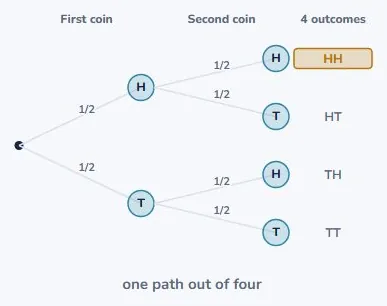
P(two heads)
- Only HH gives two heads. That is one outcome.
- There are four altogether.
- So the probability is one quarter.
| Event | Outcomes | Chance |
|---|---|---|
| Two heads | HH | 1 of 4 |
| One of each | HT, TH | 2 of 4 |
| At least one head | HH, HT, TH | 3 of 4 |
| No heads | TT | 1 of 4 |
An event can be more than one outcome
- "Two heads" is a single outcome.
- "One of each" is two of them, HT and TH.
- Count all the ones that qualify.
| Event | Outcomes | Chance |
|---|---|---|
| Two heads | HH | 1 of 4 |
| One of each | HT, TH | 2 of 4 |
| At least one head | HH, HT, TH | 3 of 4 |
| No heads | TT | 1 of 4 |
P(one of each)
- Two outcomes qualify: HT and TH.
- Two out of four.
- Which simplifies to one half.
Three ways to write the same chance
- A quarter. Or 0.25. Or 25 percent.
- All the same number, exactly as in fractions.
- Use whichever the question uses.
| Fraction | Decimal | Percentage |
|---|---|---|
| 1/4 | 0.25 | 25% |
| 1/2 | 0.5 | 50% |
| 3/4 | 0.75 | 75% |
| 1/8 | 0.125 | 12.5% |
| 7/8 | 0.875 | 87.5% |
Always between 0 and 1
- 0 means it cannot happen. 1 means it must.
- Everything else sits between them.
- A probability above 1 is a mistake, every time.
Three coins
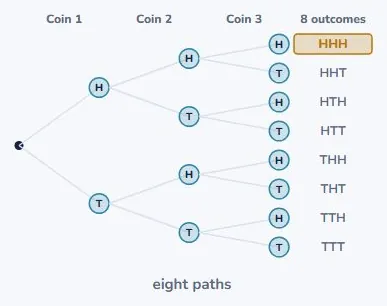
- Add a third stage to the tree.
- Every path from before splits in two again.
- Eight outcomes.
Counting without drawing
- Two choices, then two, then two: 2 × 2 × 2 = 8.
- A coin and a three-colour spinner: 2 × 3 = 6.
- Two dice: 6 × 6 = 36.
| Experiment | Working | Outcomes |
|---|---|---|
| 2 coins | 2 × 2 | 4 outcomes |
| 3 coins | 2 × 2 × 2 | 8 outcomes |
| Coin and 3-spinner | 2 × 3 | 6 outcomes |
| 2 dice | 6 × 6 | 36 outcomes |
The opposite of an event
- Every event has an opposite: it does not happen.
- That opposite is called its complement.
- Together they cover every outcome, so they total 1.
| Event | P | Complement | P |
|---|---|---|---|
| Two heads | 1/4 | not two heads | 3/4 |
| At least one head | 7/8 | no heads | 1/8 |
| Rolling a six | 1/6 | not a six | 5/6 |
Why they have to add to 1
- Something has to happen.
- Either the event does, or it does not.
- So between them they account for everything.
| Event | P | Complement | P |
|---|---|---|---|
| Two heads | 1/4 | not two heads | 3/4 |
| At least one head | 7/8 | no heads | 1/8 |
| Rolling a six | 1/6 | not a six | 5/6 |
Where that saves you work
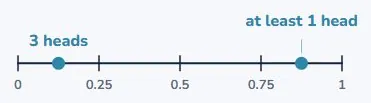
- Three coins. What is P(at least one head)?
- The long way is counting seven outcomes.
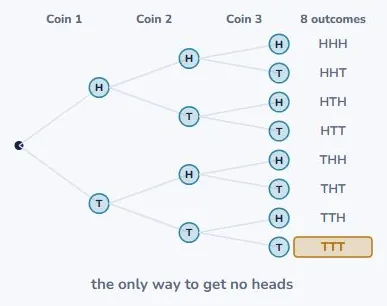
- The short way: the only failure is TTT.
| Method | What you do | Working |
|---|---|---|
| The long way | count 7 outcomes | HHH HHT HTH HTT THH THT TTH |
| The short way | the only failure is TTT | 1 − 1/8 |
| Both give | 7/8 |
1 minus one eighth
- P(no heads) is TTT, which is one out of eight.
- So P(at least one head) is 1 − 1/8.
- Seven eighths, or 0.875, or 87.5 percent.
Comparing two events
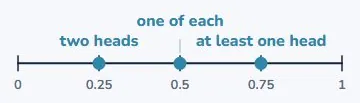
- Put both on the 0-to-1 scale.
- Whichever is further right is more likely.
- Convert to the same form first if you need to.
Common mistakes
- Two coins give three outcomes, two heads, two tails or one of each, so P(two heads) = 1/3.HT and TH are separate paths on the tree, so there are four outcomes and P(two heads) = 1/4.
- Three coins have 2 + 2 + 2 = 6 outcomes.Each stage multiplies the paths, so there are 2 × 2 × 2 = 8 outcomes.
- P(at least one head) with three coins is 1/8.1/8 is P(no heads), the complement; P(at least one head) = 1 − 1/8 = 7/8.
- The probability came out as 4/3.A probability is always between 0 and 1, so a value over 1 means the count is wrong; recheck the outcomes.
Your turn: eight questions
- Try all eight.
- Do question 1 as a tree, not from memory.
- Then use it for the rest.
Two coins are flipped. List every possible outcome.
What is the probability of at least one head?
Write that answer as a decimal and a percentage.
What is the probability of no heads? Check it against question 2.
A coin is flipped and a spinner with red, blue, green and yellow sections is spun. How many possible outcomes are there?
A fair die is rolled. What is the probability of a number greater than 4?
The chance of rain in Taupō tomorrow is 35%. What is the chance that it does not rain?
Bag A has 3 red balls out of 5. Bag B has 5 red balls out of 8. Which bag gives the better chance of red?
Show answer
1. HH, HT, TH, TT: four of them. 2. 3/4. Three of the four outcomes contain at least one head. 3. 0.75 and 75%. 4. 1/4, only TT. And 3/4 + 1/4 = 1, which is the complement check. 5. 8. Two outcomes for the coin, then four for the spinner from each: 2 × 4 = 8. 6. 1/3. Only 5 and 6 are greater than 4, so it is 2 out of 6, which simplifies to 1/3. 7. 65%. Rain and no rain are complements, so they total 100%: 100% − 35% = 65%. 8. Bag B. As decimals, 5/8 = 0.625 and 3/5 = 0.6, and 0.625 is further right on the scale.
The answers
- HH, HT, TH and TT: four outcomes.
- Three contain a head, so 3/4, which is 0.75 or 75%.
- No heads is 1/4, and 3/4 + 1/4 = 1.
| Answer | |
|---|---|
| 1 | HH, HT, TH, TT |
| 2 | 3/4 |
| 3 | 0.75 and 75% |
| 4 | 1/4, and the pair totals 1 |
What to take away
- List outcomes with a tree, not from memory.
- Probability is ways it happens over total outcomes.
- And P(not A) is 1 − P(A), which is often far quicker.
| Remember | |
|---|---|
| List systematically | a tree cannot miss an outcome |
| Probability | ways it happens ÷ total outcomes |
| An event | can be one outcome or several |
| Fraction, decimal, percentage | the same number three ways |
| P(not A) | is 1 − P(A), often much quicker |
Challenge
A bike lock has three dials, and each dial shows one of the digits 1, 2, 3 or 4. Kiri spins all three dials at random, so every combination is equally likely. How many different combinations are there? What is the probability that at least two of the dials show the same digit?
Hint
Counting every combination with a repeat is messy. Count the opposite event instead: all three digits different. How many choices does the first dial have, then the second, then the third?
Answer
64 combinations; P(at least two the same) = 58 (0.625 or 62.5%)
Step by step
- Each dial has 4 choices, so there are 4 × 4 × 4 = 64 equally likely combinations.
- The complement of 'at least two the same' is 'all three different'.
- For all different: 4 choices for the first dial, then 3 left for the second, then 2 left for the third, so 4 × 3 × 2 = 24 combinations.
- P(all different) = 2464 = 38.
- P(at least two the same) = 1 − 38 = 58.
Full working
- 4 × 4 × 4 = 64every dial has 4 choices
- 4 × 3 × 2 = 24all three digits different
- P(all different) = 2464 = 38ways over total, simplified
- Check: 36 with exactly two the same + 4 with all the same = 4064 − 24 = 40
- P(at least two the same) = 1 − 38 = 58complement
Sione has not studied for a quiz of four true or false questions, so he guesses every answer. Each guess is equally likely to be right or wrong. What is the probability that he never gets two questions in a row right? Then use your answer to find the probability that somewhere in the quiz he gets at least two in a row right.
Hint
Write each result as R (right) or W (wrong), like RWWR. How many patterns are there altogether? Now list the patterns with no RR in them, sorted by how many R's they have.
Answer
P(never two in a row right) = 816 = 12; P(at least two in a row right) = 12
Step by step
- Each question is R or W, so there are 2 × 2 × 2 × 2 = 16 equally likely patterns.
- Sort the patterns with no RR by the number of R's. No R's: WWWW, 1 pattern.
- One R: it can go in any of the 4 places, 4 patterns.
- Two R's that are not next to each other: RWRW, RWWR, WRWR, 3 patterns. Three or four R's must put two side by side, so 0 patterns.
- That is 1 + 4 + 3 = 8 patterns, so the probability is 816 = 12.
- 'At least two in a row right' is the complement, so it is 1 − 12 = 12.
Full working
- 2 × 2 × 2 × 2 = 16four questions, two results each
- 0 right: WWWW = 1no R at all
- 1 right: RWWW, WRWW, WWRW, WWWR = 4one R anywhere
- 2 right, not together: RWRW, RWWR, WRWR = 3no RR
- 3 or 4 right: 0two R's would have to touch
- 1 + 4 + 3 = 8patterns with no RR
- P(never two in a row) = 816 = 12ways over total
- P(at least two in a row right) = 1 − 12 = 12complement
Hemi rolls a normal six-sided die and spins a spinner with n equal sections, numbered 1, 2, 3, and so on up to n. The probability that the die shows a bigger number than the spinner is exactly 14. Find n.
Hint
Picture a table with the die down the side and the spinner across the top: it has 6 × n cells. Count the cells where the die wins for spinner numbers 1, 2, 3, ... in turn. What happens once the spinner number reaches 6 or more?
Answer
n = 10
Step by step
- The table of outcomes has 6 × n equally likely cells.
- If the spinner shows 1 the die wins with 2, 3, 4, 5 or 6 (5 ways). If it shows 2, 4 ways; 3, 3 ways; 4, 2 ways; 5, 1 way; 6 or more, 0 ways.
- So once n is 5 or more, the die wins in exactly 5 + 4 + 3 + 2 + 1 = 15 cells, however big n is.
- If n is 6 or less the probability is at least 1536 = 512, which is bigger than 14, so n must be more than 6.
- Then 15 out of 6 × n must equal 14, so 6 × n = 15 × 4 = 60, giving n = 10.
Full working
- Total outcomes = 6 × ndie times spinner
- Spinner 1, 2, 3, 4, 5: die wins 5, 4, 3, 2, 1 wayscount down each column
- Spinner 6 or more: die wins 0 waysa die cannot beat 6
- Die wins in 5 + 4 + 3 + 2 + 1 = 15 ways when n ≥ 5the count stops growing
- n = 6 gives 1536 = 512, and smaller n give moretoo big, so n > 6
- 15 out of 6 × n = 14, so 6 × n = 6015 × 4 = 60
- Check: 1560 = 14correct
- n = 10
Practise this
Report a mistake
More in Probability
Is your child on track?
Take the free placement test