Chance experiments and the Law of Large Numbers
What this lesson covers
- Some chance-based situations, such as rolling a weighted die, can only be explored through probability experiments.
- Results from sets of repeated trials for the same experiment may vary.
- The Law of Large Numbers states that as the number of trials in a chance experiment increases, the experimental probability will approach the theoretical probability.
- The estimated probability of an event from an experiment is the number of times the event happens divided by the total number of trials.
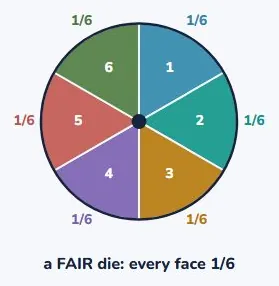
What is the chance of a six on this die?
- It has six faces, so you would say one sixth.
- But this one has a weight hidden inside it.
- Now no amount of looking will tell you.
Some probabilities cannot be worked out
- Counting faces only works if they are equally likely.
- A weighted die breaks that assumption.
- So there is nothing to count.
| Situation | Can you calculate it? |
|---|---|
| A fair coin | yes, two equal outcomes |
| A fair die | yes, six equal outcomes |
| A weighted die | no |
| A drawing pin landing point up | no |
So you roll it. A lot.
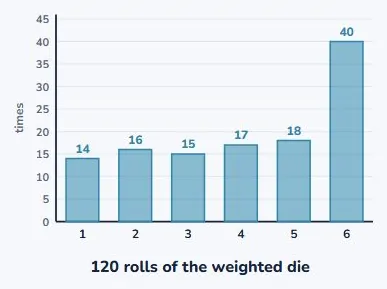
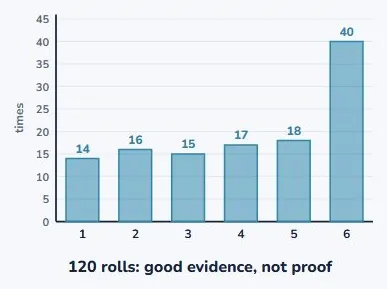
- 120 rolls, and count how often each face came up.
- Five faces landed between 14 and 18 times.
- The six landed 40 times.
Try it: roll it a lot
Experimental probability
- How many times it happened, divided by how many trials.
- 40 sixes out of 120 rolls.
- 40 ÷ 120 = one third.
| Face | Working | Probability |
|---|---|---|
| 1 | 14 / 120 | 0.12 |
| 2 | 16 / 120 | 0.13 |
| 3 | 15 / 120 | 0.13 |
| 4 | 17 / 120 | 0.14 |
| 5 | 18 / 120 | 0.15 |
| 6 | 40 / 120 | 0.33 |
Against a fair die
- A fair die gives one sixth, about 0.17.
- This one gives 0.33 for a six.
- Twice as often. It is definitely weighted.
| Die | Working | P(six) |
|---|---|---|
| Fair die, any face | 1 / 6 | 0.17 |
| This die, a six | 40 / 120 | 0.33 |
| So a six comes up | about twice as often |
They still add to 1
- Every roll produced exactly one face.
- So the counts total 120, and the probabilities total 1.
- That is true whether the die is fair or not.
| Face | Working | Probability |
|---|---|---|
| 1 | 14 / 120 | 0.12 |
| 2 | 16 / 120 | 0.13 |
| 3 | 15 / 120 | 0.13 |
| 4 | 17 / 120 | 0.14 |
| 5 | 18 / 120 | 0.15 |
| 6 | 40 / 120 | 0.33 |
What a fair die would have looked like
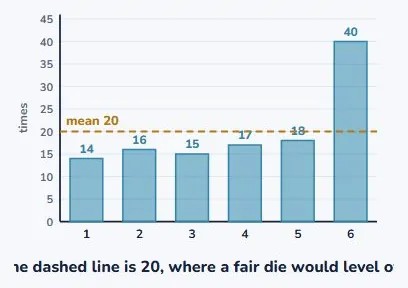
- Twenty of each, all six bars the same height.
- The dashed line is where they would all sit.
- One bar is a long way above it.
Probability simulator
Now something about fair coins
- Flip a fair coin 30 times and count the heads.
- Then do it again. And again.
- You will get three different answers.
| Run | Result | P(heads) |
|---|---|---|
| First 30 flips | 18 heads | 0.60 |
| Second 30 flips | 13 heads | 0.43 |
| Third 30 flips | 16 heads | 0.53 |
And that is completely normal
- 0.60, then 0.43, then 0.53: all from a fair coin.
- None of those runs was wrong.
- Repeated sets of trials just do vary.
| Run | Result | P(heads) |
|---|---|---|
| First 30 flips | 18 heads | 0.60 |
| Second 30 flips | 13 heads | 0.43 |
| Third 30 flips | 16 heads | 0.53 |
So 18 heads out of 30 proves nothing
- It is not evidence the coin is rigged.
- 30 trials is simply not many.
- To find out, you need more of them.
| Run | Result | P(heads) |
|---|---|---|
| First 30 flips | 18 heads | 0.60 |
| Second 30 flips | 13 heads | 0.43 |
| Third 30 flips | 16 heads | 0.53 |
Watch what more trials do
- 10 flips gave 0.70. 30 gave 0.60.
- 100 gave 0.54. 500 gave 0.506.
- Closing in on a half, and not by accident.
| Trials | Heads | P(heads) |
|---|---|---|
| 10 flips | 7 heads | 0.70 |
| 30 flips | 18 heads | 0.60 |
| 100 flips | 54 heads | 0.54 |
| 500 flips | 253 heads | 0.506 |
The Law of Large Numbers
- As the number of trials goes up...
- ...the experimental probability gets closer to the true one.
- Which is why 100 trials beats 30, and 1000 beats 100.
| Trials | Heads | P(heads) |
|---|---|---|
| 10 flips | 7 heads | 0.70 |
| 30 flips | 18 heads | 0.60 |
| 100 flips | 54 heads | 0.54 |
| 500 flips | 253 heads | 0.506 |
What it does not promise
- You will not land exactly on 0.5. Almost never.
- And a run of heads does not have to be paid back.
- The coin has no memory of what it just did.
| The Law | Says | |
|---|---|---|
| It does say | more trials get you closer | |
| It does not say | you will land exactly on it | |
| It does not say | a run of heads must be balanced out |
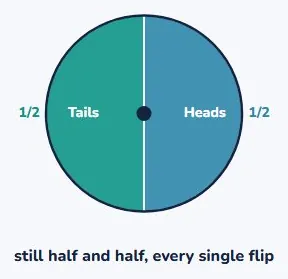
Five heads in a row. What next?
- People say tails is "due". It is not.
- The next flip is still exactly 0.5.
- The coin does not know about the last five.
Back to the weighted die
- The same warning applies there.
- 120 rolls is decent, but not proof.
- 600 rolls would make the case much stronger.
How many is enough?
- At least 30 for a rough answer.
- At least 100 before you compare each outcome.
- More whenever you can be bothered.
| Trials | Good enough for |
|---|---|
| under 10 | nothing much |
| 30 | a rough estimate |
| 100 | comparing each outcome |
| 500+ | being fairly confident |
Common mistakes
- 18 heads out of 30 flips, so the coin must be rigged.Sets of 30 trials vary a lot even with a fair coin (0.43 to 0.60 earlier), so you need many more trials before judging.
- Five heads in a row, so tails is due next.The coin has no memory, so the next flip is still exactly 0.5 for tails.
- The die has six faces, so P(six) is 1/6 even though it is weighted.1/6 assumes equally likely faces; for a weighted die use the experiment: 40 ÷ 120 = 1/3.
- With 5000 flips I will get exactly 2500 heads.More trials bring the result closer to 0.5, but the Law of Large Numbers never promises an exact match.
Your turn: eight questions
- Try all eight.
- Question 3 wants a judgement and a reason.
- Think about how much 30 flips varied earlier.
In 40 spins, red comes up 14 times. Experimental probability of red?
A coin is flipped 50 times and lands heads 31 times. Give P(heads).
Is that strong evidence the coin is unfair? Say why.
Flipped 5000 times, what should the experimental probability be near?
Which of these probabilities can only be found by doing an experiment?
A fair coin lands heads 5 times in a row. What is P(heads) on the next flip?
A bottle flip is tried 80 times. The experimental P(lands upright) is 0.35. How many flips landed upright?
In 200 spins of a weighted spinner, P(red) = 0.42 and P(blue) = 0.31. Green is the only other colour. Find P(green).
Show answer
1. 14 ÷ 40 = 0.35, or 7/20. 2. 31 ÷ 50 = 0.62. 3. Not strong evidence. Fifty trials is a small number and this much variation is ordinary: the sets of thirty in this lesson ranged from 0.43 to 0.60 on a fair coin. 4. Near 0.5. With that many trials the experimental probability should be very close to the theoretical one, though almost certainly not exactly 0.5. 5. A drawing pin landing point up. Its outcomes are not equally likely, so there is nothing to count; the others all have equal outcomes. 6. 0.5. The coin has no memory of the last five flips, so tails is not due and the next flip is still 0.5. 7. 28. Times it happened = probability × trials, so 0.35 × 80 = 28. 8. 0.27. The probabilities of all the outcomes total 1, so P(green) = 1 − 0.42 − 0.31 = 0.27.
The answers
- 14 ÷ 40 = 0.35. And 31 ÷ 50 = 0.62.
- No, 50 flips is not strong evidence; 30 gave 0.43 to 0.60.
- At 5000 flips, expect very close to 0.5.
| Answer | |
|---|---|
| 1 | 0.35 |
| 2 | 0.62 |
| 3 | no, 50 trials is too few |
| 4 | near 0.5 |
Plinko Probability
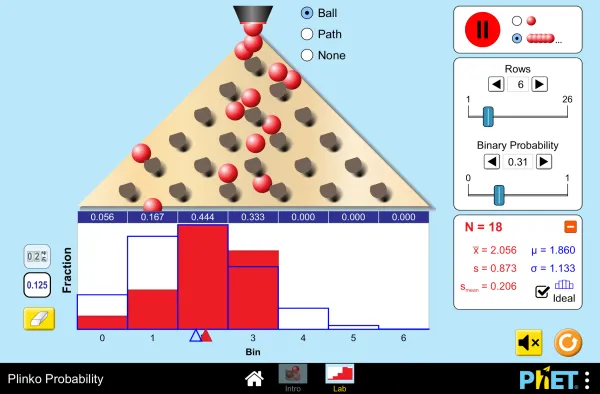
Full screen · PhET Interactive Simulations, University of Colorado Boulder, CC BY 4.0
What to take away
- Experimental probability: how often ÷ how many trials.
- Some situations can only be measured, never calculated.
- More trials get closer, but never promise exactness.
| Remember | |
|---|---|
| Experimental probability | times it happened ÷ total trials |
| Some situations | can only be measured, not calculated |
| Repeated sets | give different answers; that is normal |
| More trials | get you closer to the truth |
| All the outcomes | still total 1 |
Challenge
A weighted die is rolled 200 times. A 1 came up 28 times, a 2 came up 34 times and a 4 came up 26 times. The experimental probability of a six was 0.2. A 3 came up 6 fewer times than a 5. How many times did each of 3, 5 and 6 come up? What is the experimental probability of rolling less than 3? If the die is rolled 600 times, about how many 5s would you expect?
Hint
Turn the probability of a six back into a count out of 200. Every roll gave exactly one face, so all six counts add to 200.
Answer
Six 40 times, 3 came up 33 times, 5 came up 39 times. P(less than 3) = 0.31. About 117 fives in 600 rolls.
Step by step
- P(six) = 0.2 out of 200 rolls means 0.2 × 200 = 40 sixes.
- The counts add to 200, so the 3s and 5s together are 200 − 28 − 34 − 26 − 40 = 72.
- The 5s are 6 more than the 3s: take away the extra 6 and share 66 equally, so 33 threes and 39 fives.
- Less than 3 means a 1 or a 2: 28 + 34 = 62 rolls, and 62 ÷ 200 = 0.31.
- P(five) = 39200, so in 600 rolls (three times as many) expect about 39 × 3 = 117.
Full working
- 0.2 × 200 = 40sixes
- 200 − 28 − 34 − 26 − 40 = 72threes and fives together
- (72 − 6) ÷ 2 = 33, 33 + 6 = 39threes 33, fives 39
- (28 + 34) ÷ 200 = 62 ÷ 200 = 0.31a 1 or a 2
- 39 × 3 = 117600 is three lots of 200
- 3: 33, 5: 39, 6: 40; P(less than 3) = 0.31; about 117 fives
Tia spins a spinner 40 times and gets red 14 times. She then gets red on every spin until the experimental probability of red is exactly 0.5. How many reds in a row did that take? She keeps spinning until she has done 200 spins altogether, and her overall experimental probability of red is 0.4. How many reds did she get after the run of reds ended, and what was the experimental probability of red for just those later spins (to 2 decimal places)? What does this suggest about the run of reds?
Hint
Each red spin adds 1 to the reds and 1 to the total. Keep adding until the reds are exactly half. For the second part, turn 0.4 of 200 back into a count.
Answer
12 reds in a row (26 out of 52). Then 54 reds in the last 148 spins, about 0.36, close to the first 0.35, so the run of reds was most likely just chance.
Step by step
- At the start there are 14 reds and 26 non-reds.
- Red spins only add reds, so you need the reds to catch up to the 26 non-reds: 26 − 14 = 12 more reds.
- That makes 26 reds out of 52 spins, which is 0.5.
- After 200 spins, 0.4 × 200 = 80 reds. The later spins are 200 − 52 = 148, with 80 − 26 = 54 reds.
- 54 ÷ 148 ≈ 0.36, which is very close to the 0.35 from the first 40 spins.
- So the run did not change the spinner. Over many spins, red settles near 0.35 to 0.4.
Full working
- 40 − 14 = 26 non-redsthese never change during the run
- 26 − 14 = 12reds needed to catch up
- 26 ÷ 52 = 0.5after the run
- 0.4 × 200 = 80; 80 − 26 = 54 reds in 200 − 52 = 148 spinsthe later spins
- 54 ÷ 148 ≈ 0.36close to 14 ÷ 40 = 0.35
- 12 in a row; 54 reds in the last 148, about 0.36
Rua rolls a weighted die and after every 10 rolls writes down the experimental probability of a six so far. After 10, 20, 30, 40 and 50 rolls her results are 0.4, 0.35, 0.3, 0.35 and 0.32. How many sixes came up in each block of ten rolls? In which block were there the most sixes? Rua says that after 60 rolls her result could be 0.25. Is that possible? What are the smallest and largest results she could have after 60 rolls?
Hint
Turn each probability back into the total number of sixes so far, then subtract to find each block. A block of ten can hold anywhere from 0 to 10 sixes.
Answer
Blocks: 4, 3, 2, 5, 2 sixes; most in rolls 31 to 40. 0.25 is not possible. After 60 rolls the result is between 1660 ≈ 0.27 and 2660 ≈ 0.43.
Step by step
- The totals so far are 0.4 × 10 = 4, 0.35 × 20 = 7, 0.3 × 30 = 9, 0.35 × 40 = 14 and 0.32 × 50 = 16.
- Subtracting each total from the next gives the blocks: 4, 3, 2, 5 and 2.
- The biggest block is the fourth one, rolls 31 to 40, with 5 sixes.
- After 60 rolls there are at least 16 sixes (none in the last block) and at most 26 (all ten).
- 0.25 of 60 is 15, which is fewer than the 16 she already has, so 0.25 is impossible.
- The results lie between 16 ÷ 60 ≈ 0.27 and 26 ÷ 60 ≈ 0.43.
Full working
- 4, 7, 9, 14, 160.4 × 10, 0.35 × 20, 0.3 × 30, 0.35 × 40, 0.32 × 50
- 4, 7 − 4 = 3, 9 − 7 = 2, 14 − 9 = 5, 16 − 14 = 2sixes in each block
- 0.25 × 60 = 15 < 16she already has 16 sixes
- 16 ÷ 60 ≈ 0.27no sixes in rolls 51 to 60
- 26 ÷ 60 ≈ 0.43ten sixes in rolls 51 to 60
- blocks 4, 3, 2, 5, 2 (most in rolls 31 to 40); 0.25 impossible; range 0.27 to 0.43
Practise this
Report a mistake
More in Probability
Is your child on track?
Take the free placement test