Working out probabilities, and the 0 to 1 line
What this lesson covers
- Likelihood can be visualised using a number line from 0 to 1.
- The sample space is the set of all possible outcomes of an experiment.
- The probability of an event, if events are believed to be equally likely, is the number of ways the event can happen divided by the total number of possible outcomes.
- The sum of the probabilities of all outcomes is equal to 1.
What is the chance of NOT landing on 6?
- You could count the other five numbers and divide.
- Or you could take one sixth away from one.
- By the end of this you will see why the second one works.
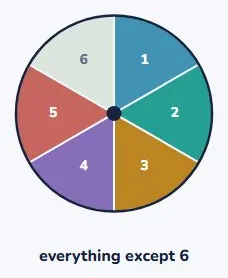
First, list everything that can happen
- The set of all possible outcomes is the sample space.
- For this spinner: 1, 2, 3, 4, 5, 6. Six things, nothing missing.
- Get this list wrong and every answer after it is wrong.
| the sample space | how many |
|---|---|
| 1, 2, 3, 4, 5, 6 | 6 outcomes |
| heads, tails | 2 outcomes |
| the days of the week | 7 outcomes |
Then count, and divide
- Count the ways your event can happen. That is the top.
- Count every outcome in the sample space. That is the bottom.
- The probability is the first divided by the second.
| part of the fraction | what it counts |
|---|---|
| the top | outcomes in your event |
| the bottom | outcomes altogether |
Try it: run an experiment
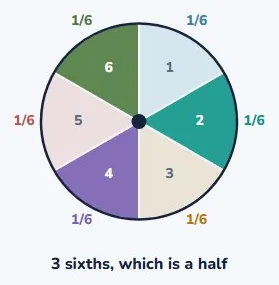
An even number
- Ways it can happen: 2, 4, 6. That is 3.
- Outcomes altogether: 6.
- So the probability is 3 over 6, which is a half.
Four more, all by counting
- Landing on 4 is 1 way out of 6.
- More than 4 is 2 ways, so 2 sixths, a third.
- And a 7 is 0 ways, so the probability is 0.
| event | ways | probability |
|---|---|---|
| landing on 4 | 1 | 1/6 |
| an even number | 3 | 3/6 = 1/2 |
| more than 4 | 2 | 2/6 = 1/3 |
| landing on 7 | 0 | 0 |
| a number under 10 | 6 | 6/6 = 1 |
The two ends fall out of the rule
- An impossible event has 0 ways, so 0 over 6 is 0.
- A certain event has all 6, so 6 over 6 is 1.
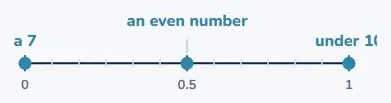
- That is where the 0 and the 1 on the scale come from.
| event | fraction | value |
|---|---|---|
| a 7 | 0/6 | 0 |
| an even number | 3/6 | 0.5 |
| a number under 10 | 6/6 | 1 |
All of them together make 1
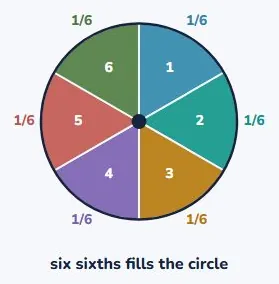
- Six outcomes, each one sixth. Add them: six sixths.
- Which is 1. Something has to happen, so it must be.
- That is not just tidy. It is a shortcut.
Back to the opening question
- Landing on 6 has probability one sixth.
- Everything that is not a 6 must make up the rest.
- So it is 1 take away one sixth, which is five sixths.
| event | probability |
|---|---|
| landing on 6 | 1/6 |
| NOT landing on 6 | 1 − 1/6 = 5/6 |
The rule has a condition
- Counting outcomes only works if they are equally likely.
- The curriculum says so, and it is not decoration.
- Equal parts on the spinner is what made the counting fair.
| spinner | can you just count? |
|---|---|
| six equal parts | yes |
| one big part, three small | no |
Where counting breaks
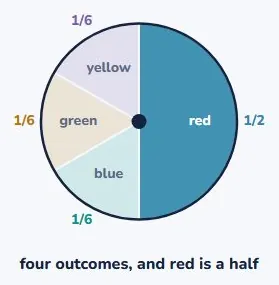
- Four colours, so four outcomes. But red is half the circle.
- Counting would say red is 1 out of 4. It is actually a half.
- When the parts differ, use the sizes, not the count.
Try it: an unfair spinner
Every probability has a place on the line
- Draw a line from 0 to 1 and you can put any event on it.
- Impossible at the left end, certain at the right.
- A half sits exactly in the middle.
Placing everyday events
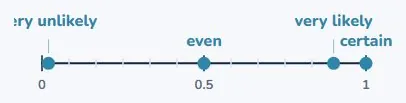
- Eating something later today: likely, so past the half way point.
- Snow in Auckland tomorrow: very unlikely, so near 0.
- You do not need a number. You need the right region.
Common mistakes
- The spinner has four colours, so red has a probability of 1/4.Red covers half the circle, so its probability is 1/2. Counting only works when the parts are the same size.
- The chance of not landing on 6 is 1/5.All the probabilities add up to 1, so take it away from 1: 1 − 1/6 = 5/6.
- More than 4 is 4, 5 and 6, so the probability is 3/6.More than 4 does not include 4. It is only 5 and 6, so 2/6, which is 1/3.
Your turn
Write the sample space for one roll of an ordinary die.
On this spinner, the probability of an odd number?
If the chance of rain is 1/4, what is the chance of no rain?
Place "you will sleep tonight" on the 0 to 1 line.
A bag holds 3 red, 2 blue and 5 green counters. You pick one without looking. What is the probability it is blue?
Which of these can NOT be a probability?
A spinner lands on red, blue or yellow. The chance of red is 1/2 and the chance of blue is 1/4. What is the chance of yellow?
A spinner has 4 colours and red covers half the circle. Mere says the chance of red is 1/4. What is it, and why?
Show answer
1. 1, 2, 3, 4, 5, 6: six outcomes. 2. 3 ways out of 6, so a half. 3. 1 − 1/4 = 3/4. 4. Very close to 1, but not quite certain. 5. 1/5. There are 2 blue ways out of 10 counters altogether, and 2/10 is 1/5. 6. 5/4. It is bigger than 1, and no probability can sit outside 0 and 1; 0, 1 and 3/5 all fit on the line. 7. 1/4. All the chances add to 1, and 1 − 1/2 − 1/4 = 1/4. 8. 1/2, because the parts are not equally likely, so use the sizes: red is half the circle. Counting 4 colours only works for equal parts.
What to take away
- List the sample space first. Everything, once each.
- Probability is ways it happens over outcomes altogether.
- And they all add to 1, so "not" is a subtraction.
| job | the move |
|---|---|
| starting out | list every possible outcome |
| a probability | ways it happens ÷ outcomes altogether |
| "not" something | take its probability away from 1 |
| unequal parts | use the sizes, not the count |
Challenge
Tama flips a coin and spins a fair spinner with 3 equal parts numbered 1, 2 and 3. His score is the number on the spinner, but if the coin shows heads the number is doubled. List the sample space. What is the probability that his score is 2? What is the probability that his score is NOT an even number?
Hint
Each outcome is a pair, like (heads, 3). How many pairs are there? Then work out the score for each one. Two different pairs might give the same score.
Answer
6 outcomes. P(score is 2) = 26 = 13. P(score is not even) = 26 = 13.
Step by step
- Each coin result can go with each spinner number, so there are 2 × 3 = 6 equally likely outcomes.
- Heads gives scores 2, 4 and 6. Tails gives scores 1, 2 and 3.
- A score of 2 happens two ways: heads with 1, and tails with 2. So it is 2 out of 6.
- Even scores happen 4 ways, so there are 6 − 4 = 2 ways that are not even.
- Or use the shortcut: 1 − 46 = 26, which is 13.
Full working
- sample space: H1, H2, H3, T1, T2, T32 × 3 = 6 outcomes
- scores: 2, 4, 6, 1, 2, 3heads doubles the number
- score 2 from H1 and T22 ways
- P(score 2) = 26 = 13ways over outcomes
- even scores: 2, 4, 6, 24 ways, so P(even) = 46
- P(not even) = 1 − 46 = 26they add to 1
- P(score 2) = 13, P(not even) = 13
Aroha makes a spinner. She colours half of the circle red. She splits the other half into two equal parts and colours one of them blue. She splits the last part into two equal parts again, one green and one yellow. What is the probability that the spinner does NOT land on blue or yellow?
Hint
Counting the four colours will not work: the parts are different sizes. Imagine cutting the whole circle into eighths. How many eighths is each colour?
Answer
58
Step by step
- The parts are not the same size, so use the sizes, not the count of colours.
- Red is half the circle, which is 4 eighths.
- Blue is half of a half, a quarter, which is 2 eighths.
- Green and yellow share the last quarter, so each is 1 eighth.
- Not blue or yellow means red or green: 4 eighths + 1 eighth = 58. Check: blue and yellow make 38, and 1 − 38 = 58.
Full working
- red = 12 = 48half the circle
- blue = 14 = 28half of the other half
- green = 18, yellow = 18the last quarter split in two
- 48 + 28 + 18 + 18 = 88 = 1check: all add to 1
- P(blue or yellow) = 28 + 18 = 38the colours we do not want
- P(not blue or yellow) = 1 − 38 = 58the shortcut
- 58
Ana and Ben toss three coins at the same time. Ana wins if all three coins land the same way up (all heads or all tails). Ben wins if they do not. Ben says: "The results can be 3 heads, 2 heads, 1 head or 0 heads. Ana wins with 2 of those 4, so the game is fair." (a) List the full sample space. (b) Find the probability that Ana wins and the probability that Ben wins. (c) Explain Ben's mistake.
Hint
Think of the coins as a 10c, a 20c and a 50c coin, so you can tell them apart. Each coin can land H or T.
Answer
(a) HHH, HHT, HTH, THH, HTT, THT, TTH, TTT. (b) Ana 28 = 14, Ben 68 = 34. (c) His four results are not equally likely: 3 heads can happen only 1 way, but 2 heads can happen 3 ways, so the game is not fair.
Step by step
- Each coin has 2 outcomes, so three coins have 2 × 2 × 2 = 8 outcomes, each equally likely.
- Ana wins with HHH or TTT: 2 of the 8.
- Ben wins with the other 6, so his chance is 68 = 34.
- Ben counted results that are not equally likely. '2 heads' covers HHT, HTH and THH, so it is three times as likely as '3 heads'.
Full working
- 2 × 2 × 2 = 8 outcomeseach coin H or T
- HHH, HHT, HTH, THH, HTT, THT, TTH, TTTsample space
- Ana: HHH, TTT, so P(Ana) = 28 = 14all the same
- P(Ben) = 1 − 14 = 34the other 6 outcomes
- 2 heads: HHT, HTH, THH, 3 ways; 3 heads: 1 waynot equally likely
- P(Ana) = 14, P(Ben) = 34; not fair
Practise this
Report a mistake
More in Probability
Is your child on track?
Take the free placement test