Chance, trials, outcomes and how likely things are
What this lesson covers
- Situations that involve chance, uncertainty, and randomness are called chance-based situations. Probability can be used to describe such situations.
- A trial is a single run of a chance-based situation that results in one of a set of possible outcomes.
- The possible outcomes for a chance-based situation can be arranged into events.
- The probability of an outcome is the chance of it occurring.
- Probabilities are associated with values between 0 and 1, where: 0 is impossible between 0 and 0.5 or 1/2 ranges from very unlikely to unlikely 0.5 or 1/2 is equally likely between 0.5 or 1/2 and 1 range from likely to very likely 1 is certain.
Two questions that are not alike
- Will it land on 4? Will it land on an even number?
- Those are different kinds of question, not just different ones.
- The whole of probability depends on knowing which is which.
Chance-based means not settled yet
- Some questions have an answer waiting to be worked out.
- Others genuinely are not decided until they happen.
- Those are chance-based, and probability is how we talk about them.
| question | chance-based? |
|---|---|
| what is 7 × 8 | no, the answer already exists |
| where will it land | yes, nothing decides it until it stops |
| will it rain tomorrow | yes |
One spin is one trial
- A trial is a single run of a chance-based situation.
- Spin it once: that is one trial, and it gives one result.
- Spin it thirty times and you have done thirty trials.
| trial | result |
|---|---|
| 1st spin | 3 |
| 2nd spin | 6 |
| 3rd spin | 3 |
Probability simulator
An outcome is one thing that can happen
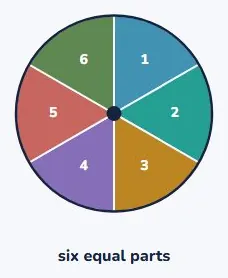
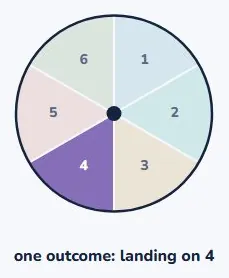
- This spinner has six possible outcomes: 1, 2, 3, 4, 5, 6.
- Landing on 4 is one outcome. Just the one.
- Every trial produces exactly one of them.
An event is a set of outcomes
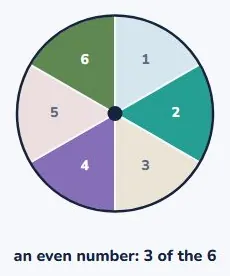
- "An even number" is not one outcome. It is three.
- 2, 4 and 6: any of them makes it happen.
- A set of outcomes you have decided to care about is an event.
Outcome or event?
- An outcome is a single result. An event is a collection.
- So every outcome is also an event, containing just itself.
- And an event can hold two, three, or all six.
| description | which is it | how many outcomes |
|---|---|---|
| landing on 4 | outcome | 1 of the 6 |
| landing on an even number | event | 3 of the 6 |
| landing on more than 4 | event | 2 of the 6 |
| landing on 7 | event with nothing in it | 0 of the 6 |
Try it: outcome or event?
An event can hold nothing at all
- "Landing on 7" is a perfectly good description.
- It just contains none of the six outcomes.
- An event with no outcomes in it cannot happen. It is impossible.
| event | outcomes in it | so |
|---|---|---|
| a number bigger than 0 | 6 | certain |
| an even number | 3 | a fair chance |
| a 7 | 0 | impossible |
Probability is how likely it is
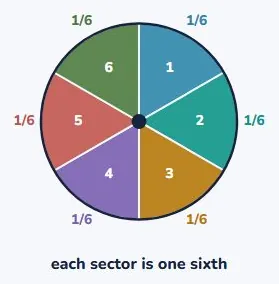
- The six parts are the same size, so none is favoured.
- So each outcome has a one in six chance.
- That number is the probability of the outcome.
Probability runs from 0 to 1
- Nothing is less likely than impossible, which is 0.
- Nothing is more likely than certain, which is 1.
- Everything real sits somewhere in between those two.

The five words for where you are
- Exactly half way along is equally likely: a 50-50 chance.
- Below half is unlikely. Above half is likely.
- But it is a sliding scale, not five separate boxes.
| probability | what you call it |
|---|---|
| 0 | impossible |
| between 0 and 1/2 | unlikely |
| 1/2 | equally likely |
| between 1/2 and 1 | likely |
| 1 | certain |
Using the words on real events
- The sun rising tomorrow is certain. A coin landing heads is even.
- This spinner landing on 7 is impossible.
- And rain in Auckland tomorrow is genuinely arguable.
| event | how likely |
|---|---|
| the sun will rise tomorrow | certain |
| this spinner lands on 7 | impossible |
| a coin lands heads | equally likely |
| it rains in Auckland tomorrow | arguable, and that is fine |
What actually happens when you spin it
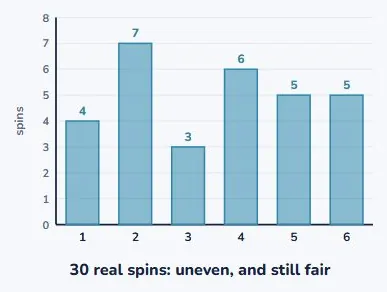
- Thirty trials on a fair spinner. Expect about 5 of each.
- You will not get exactly 5 of each. Nobody ever does.
- The spinner is still fair. Real trials wobble around the expected.
Try it: spin it many times
Common mistakes
- Landing on an even number is one outcome.It is an event. It holds three outcomes: 2, 4 and 6.
- I spun the fair spinner 30 times and got 9 threes, so the spinner is not fair.Real trials wobble. You expect about 5 of each, but you almost never get exactly 5, so this does not prove it is unfair.
- A coin landing on heads is likely.Heads is one of two equal outcomes, so it is equally likely: a chance of exactly 1/2.
Your turn
Is "landing on 3 or 5" an outcome or an event?
How many outcomes are in "a number less than 3"?
Name the likelihood of "you will breathe in the next minute".
Give an event on this spinner that is impossible.
You spin the 1 to 6 spinner 30 times. How many trials is that?
Which question is not chance-based?
On the 1 to 6 spinner, which event is equally likely, a 50-50 chance?
A 1 to 6 spinner lands on 4 eight times in 30 spins. Ana says it must be unfair. Is she right?
Show answer
1. An event: it holds two outcomes. 2. Two: 1 and 2. 3. Certain. 4. Anything with no outcomes in it: landing on 0, on 9, on a letter. 5. 30 trials. Each spin is one trial, giving one result. 6. What is 9 × 6? Its answer already exists; the others are not decided until they happen. 7. Landing on an odd number. It holds 3 of the 6 outcomes (1, 3, 5), which is half. 8. No. In 30 trials you expect about 5 of each, but real trials wobble around about 5 each, so 8 fours does not prove it is unfair.
Plinko Probability
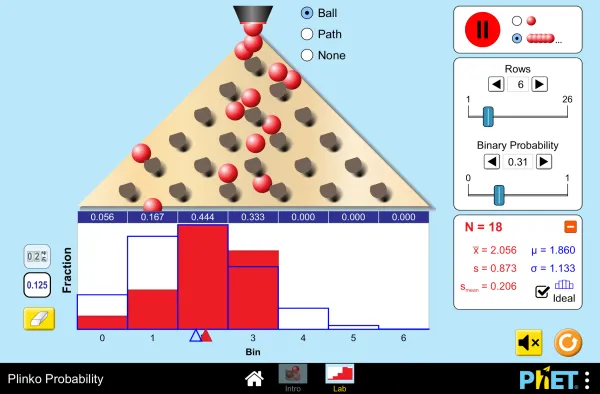
Full screen · PhET Interactive Simulations, University of Colorado Boulder, CC BY 4.0
What to take away
- A trial is one run. An outcome is one possible result.
- An event is a set of outcomes, and it can hold none or all.
- Probability runs from 0, impossible, to 1, certain.
| word | means | on this spinner |
|---|---|---|
| chance-based | the result is not settled in advance | spinning it |
| trial | one single run of it | one spin |
| outcome | one thing that could result | landing on 4 |
| event | a set of outcomes you chose | landing on an even number |
| probability | how likely that is | one sixth for each number |
Challenge
A fair spinner has 10 equal parts, numbered 1 to 10. Here are four events: A is "a number in the 3 times table", B is "a number with two digits", C is "a number less than 4 or more than 7", D is "an odd number". Put the four events in order from least likely to most likely, and give each one a word: unlikely, equally likely or likely.
Hint
Turn each event into a list of outcomes, then count. Be careful with C: it joins two groups together.
Answer
B (1 outcome, unlikely), A (3 outcomes, unlikely), D (5 outcomes, equally likely), C (6 outcomes, likely).
Step by step
- Write out the outcomes that are in each event.
- A holds 3, 6 and 9. B holds only 10. D holds 1, 3, 5, 7 and 9.
- C holds 1, 2, 3 and also 8, 9, 10, so it has 6 outcomes, more than half of the 10.
- Fewer than 5 out of 10 is unlikely, exactly 5 out of 10 is equally likely, more than 5 is likely.
- So the order is B, A, D, C.
Full working
- A = {3, 6, 9}3 outcomes out of 10
- B = {10}only one number has two digits
- C = {1, 2, 3, 8, 9, 10}less than 4, or more than 7
- D = {1, 3, 5, 7, 9}5 out of 10 is exactly half
- 1 < 3 < 5 < 6compare the counts
- B unlikely, A unlikely, D equally likely, C likely
Mere has a blank spinner with 6 equal parts. She writes a whole number from 1 to 9 in each part, and she may use a number more than once. She wants all of these to be true: landing on an odd number is certain; landing on a 9 is impossible; landing on a number more than 5 is equally likely; landing on a 3 is unlikely, but not impossible. What is the largest possible total of the six numbers she writes?
Hint
Certain means every part must be odd. Which odd numbers can she use, and which of them are more than 5?
Answer
34 (for example 7, 7, 7, 5, 5, 3).
Step by step
- Odd is certain, so all six numbers are odd: 1, 3, 5, 7 or 9.
- 9 is impossible, so she can only use 1, 3, 5 and 7.
- More than 5 is equally likely, so exactly 3 of the 6 parts are more than 5. The only choice is 7, so three parts say 7.
- The other three parts are 1, 3 or 5. At least one must be 3, and fewer than half the parts can be 3.
- To make the total big, use just one 3 and make the other two 5.
Full working
- all six numbers odd, no 9certain odd, impossible 9
- allowed: 1, 3, 5, 7the odd numbers left
- three parts are 73 out of 6 must be more than 5
- one part is 33 must be possible, use as few as we can
- two parts are 5the biggest number left that is not more than 5
- 7 + 7 + 7 + 3 + 5 + 5 = 34add them up
- Largest total = 34
Sam's spinner has 6 equal parts with a number in each, but he keeps it hidden. He spins it 60 times and writes down the results: a 2 came up 31 times and a 5 came up 29 times. Nothing else came up. Rua says: "So it has four 2s and two 5s." Lena says: "It has three 2s and three 5s, for sure." Who is closer to the truth? Explain, and say whether we can be certain.
Hint
For each guess, work out about how many 2s and 5s you would expect in 60 spins. Then think about the lesson: do real trials ever give exactly what you expect?
Answer
Lena's spinner fits the results much better (about 30 of each expected, and 31 and 29 came up). Rua's would give about 40 twos and 20 fives. But Lena cannot say "for sure": trials wobble, so it is very likely, not certain.
Step by step
- With three 2s and three 5s, each number is 3 out of 6, which is a half, so in 60 spins you expect about 30 of each.
- With four 2s and two 5s, a 2 is 4 out of 6, so you expect about 40 twos and only about 20 fives.
- The real results, 31 and 29, are very close to 30 and 30 and far from 40 and 20, so Lena's guess fits best.
- Real trials wobble around what you expect, so a spinner with a different mix could still, by chance, give these results. That makes Lena's guess very likely, not certain.
- Even a third number written in one part is very unlikely to stay hidden for 60 spins, but it is not impossible either.
Full working
- three 2s, three 5s: 3 out of 6 = 12 eachLena's spinner
- 12 of 60 = 30expect about 30 twos and 30 fives
- four 2s, two 5s: 46 of 60 = 40 and 26 of 60 = 20Rua's spinner
- results 31 and 29close to 30 and 30, far from 40 and 20
- results wobble, so nothing is provedlikely is not the same as certain
- Lena is closer, but it is only very likely, not certain
Practise this
Report a mistake
More in Probability
Is your child on track?
Take the free placement test