Angles, and telling the time
What this lesson covers
- Angle classification can aid the estimation of angle size.
- Angles are classified with reference to the benchmark angles of 90°, 180°, and 360°. Acute angles are less than 90°. Right angles are exactly 90°. Obtuse angles are more than 90° and less than 180°. Reflex angles are more than 180° and less than 360°.
- A point in time is typically measured in hours and minutes past midnight.
- Clocks relate seconds to minutes and minutes to hours according to a system based on 60.
Five words for every angle
- An angle measures turn, from barely open to all the way round.
- There are five words that say roughly where you are.
- They are not labels for a test. They are how you check an answer.
Acute and right
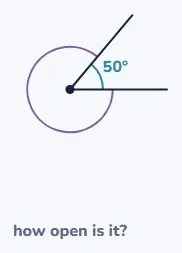
- An acute angle is less than 90°. Sharp, like a pizza slice.
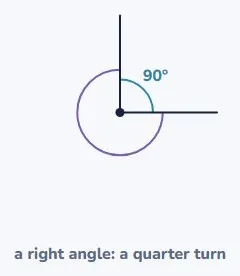
- A right angle is exactly 90°, like the corner of this page.
- 90° is the first benchmark, and it is a quarter of a full turn.
Obtuse and straight
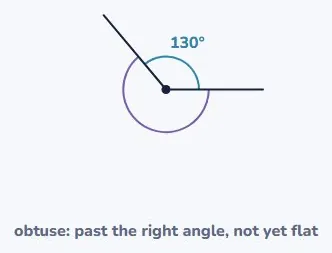
- Obtuse is more than 90° but less than 180°.
- At exactly 180° the two arms make a straight line.
- So 180° is a half turn, and the second benchmark.
Reflex is the long way round
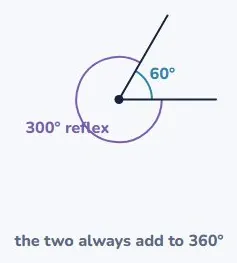
- Two arms make two angles: the small one and the rest.
- Here the small one is 60°, so the other is 300°.
- More than 180° and less than 360° is reflex.
All five, with their bounds
- Three of them are exact sizes: 90°, 180°, 360°.
- The other two are ranges between those benchmarks.
- Learn the ranges, not just the names.
| name | size | looks like |
|---|---|---|
| acute | less than 90° | a slice of pizza |
| right | exactly 90° | the corner of a page |
| obtuse | between 90° and 180° | a reclined chair |
| straight | exactly 180° | a flat line |
| reflex | between 180° and 360° | the long way round |
Try it: name the angle
Why the words are useful
- Naming an angle gives you a bound before you measure.
- Obtuse means the answer must be between 90 and 180.
- So if your protractor says 35°, you know you misread it.
| it looks | so it must be | a reading of 35° is |
|---|---|---|
| acute | under 90° | believable |
| obtuse | 90° to 180° | wrong |
Using a protractor
- Vertex on the cross, one arm along the zero line.
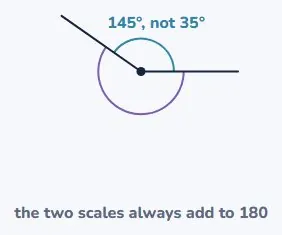
- A protractor has two scales, and one of them is wrong for you.
- This is obtuse, so it reads 145°, not 35°.
You already own an angle measurer
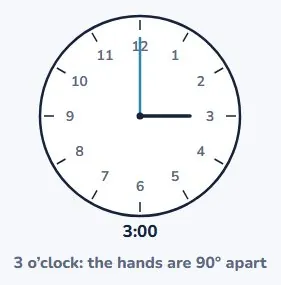
- A clock face is a full turn cut into twelve.
- So one hour of the hour hand is 30°.
- At 3 o’clock the hands are exactly a right angle apart.
A clock runs on 60s
- 60 seconds make a minute, 60 minutes make an hour.
- That is why quarter of an hour is 15 minutes, not 25.
- Nothing about a clock is base 10. Do not treat it as if it were.
| this much | makes |
|---|---|
| 60 seconds | 1 minute |
| 60 minutes | 1 hour |
| 15 minutes | a quarter of an hour |
| 30 minutes | half an hour |
Analogue and digital
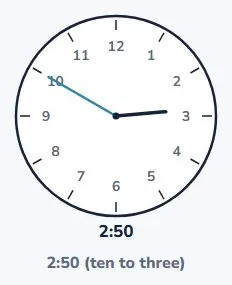
- The short hand is between 2 and 3, so the hour is 2.
- The long hand is at 50 minutes past.
- So 2:50, which most people say as "ten to three".
24-hour time, and its two exceptions
- A point in time is counted in hours and minutes past midnight.
- Afternoon times add 12: 3 p.m. is 15:00. Mornings do not.
- But noon is 12:00 and midnight is 00:00. Never 24:00.
| said as | written as | why |
|---|---|---|
| 3 a.m. | 03:00 | morning: no change |
| 3 p.m. | 15:00 | afternoon: add 12 |
| 12 noon | 12:00 | not 24:00 |
| 12 midnight | 00:00 | the start of the day |
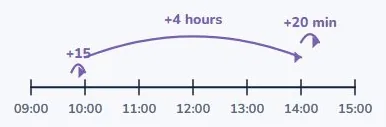
How long from 09:45 to 14:20?
- Do not subtract in columns. Minutes go up in 60s, not 10s.
- Count on instead: 15 minutes gets you to 10:00.
- Then 4 whole hours to 14:00, then 20 minutes.
Try it: how long is it?
Add up what you counted
- 15 minutes, then 4 hours, then 20 minutes.
- The minutes come to 35, and there are 4 hours.
- So 4 hours 35 minutes. No borrowing anywhere.
| jump | lands on |
|---|---|
| 15 minutes | 10:00 |
| 4 hours | 14:00 |
| 20 minutes | 14:20 |
| total | 4 hours 35 minutes |
Common mistakes
- This obtuse angle measures 35° on my protractor.An obtuse angle is between 90° and 180°, so you read the wrong scale: it is 180° − 35° = 145°.
- 14:20 − 09:45 = 4:75, so it is 4 hours 75 minutes.Minutes go up in 60s, so count on: 15 minutes to 10:00, 4 hours to 14:00, then 20 minutes, making 4 hours 35 minutes.
- 12 midnight is 24:00, and 3 a.m. is 15:00.Midnight is 00:00, and only afternoon times add 12: 3 a.m. is 03:00 and 3 p.m. is 15:00.
- The short hand is between 2 and 3, so the time is 3:50.The hour is the number the short hand has just passed, so it is 2:50, or ten to three.
Your turn
Classify 45°, 90°, 120°, 200° and 180°.
An angle looks obtuse. Your protractor says 60°. What now?
Write 7 p.m., 7 a.m. and midnight in 24-hour time.
How long from 08:50 to 13:15?
Two arms make a 70° angle. How big is the angle the long way round, and what is it called?
How many degrees does the hour hand turn as it moves from 12 to 4?
A netball game starts at 16:45. What is that in a.m. or p.m. time?
A bus leaves Auckland at 10:40 a.m. and reaches Rotorua at 2:05 p.m. How long is the trip?
Show answer
1. acute, right, obtuse, reflex, straight. 2. You read the wrong scale; it is 120°. 3. 19:00, 07:00, 00:00. 4. 10 min to 09:00, 4 hours to 13:00, 15 min more: 4 hours 25 minutes. 5. 290°, reflex. A full turn is 360°, so the long way round is 360° − 70° = 290°, which is between 180° and 360°. 6. 120°. A full turn of 360° is cut into twelve, so each hour is 30°, and 4 × 30° = 120°. 7. 4:45 p.m. It is an afternoon time, so take away 12: 16 − 12 = 4, giving 4:45 p.m. 8. 3 hours 25 minutes. Count on: 20 minutes to 11:00, 3 hours to 2:00 p.m., then 5 minutes. 20 + 5 = 25 minutes.
What to take away
- The benchmarks are 90°, 180° and 360°. Everything else sits between.
- Classify before you measure, and the name checks the reading.
- For a duration, count on. Never subtract clock times in columns.
| job | the move |
|---|---|
| name an angle | compare it to 90° and 180° |
| read a protractor | pick the scale your arm starts on |
| p.m. to 24-hour | add 12, except noon and midnight |
| find a duration | count on to the next hour first |
Challenge
Look only at the o'clock times from 1 o'clock to 12 o'clock. At which of them is the smaller angle between the hour hand and the minute hand obtuse? At which of them is the reflex angle between the hands exactly 240°?
Hint
At an o'clock time the minute hand is on the 12. How many degrees is one hour gap on the clock face?
Answer
Obtuse at 4, 5, 7 and 8 o'clock. The reflex angle is 240° at 4 o'clock and 8 o'clock.
Step by step
- A full turn of 360° is cut into 12 hour gaps, so each gap is 30°.
- At an o'clock time the minute hand is on 12, so the hands are 30° times the number of gaps apart.
- Obtuse means more than 90° and less than 180°, so 4 or 5 gaps (120° or 150°).
- Going the short way, 4 and 5 o'clock are 4 and 5 gaps from 12, and so are 8 and 7 o'clock.
- A reflex angle of 240° leaves 360° − 240° = 120° for the smaller angle, which is 4 gaps: 4 and 8 o'clock.
Full working
- 360° ÷ 12 = 30°one hour gap
- 3 gaps = 90°, 6 gaps = 180°the benchmarks
- 4 gaps = 120°, 5 gaps = 150°the only obtuse ones
- 4 and 8 o'clock: 120°; 5 and 7 o'clock: 150°4 or 5 gaps the short way
- 360° − 240° = 120° = 4 gapsthe smaller angle for a 240° reflex angle
- Obtuse at 4, 5, 7 and 8 o'clock; reflex 240° at 4 and 8 o'clock
Mele's flight lands at 01:15. The flight took 3 hours 50 minutes. She got to the airport 1 hour 45 minutes before take-off, and the drive to the airport took 55 minutes. At what time did she leave home? Give it in 24-hour time and as a.m. or p.m.
Hint
Work backwards from 01:15, one step at a time. The first step goes back past midnight, so count back to 00:00 first.
Answer
She left home at 18:45, which is 6:45 p.m. the day before she landed.
Step by step
- Take-off was 3 hours 50 minutes before 01:15. Back 1 hour 15 minutes reaches midnight, 00:00.
- That leaves 2 hours 35 minutes still to go back, and 2 hours 35 minutes before midnight is 21:25 on the day before.
- She reached the airport 1 hour 45 minutes before 21:25: back 1 hour is 20:25, back 45 more minutes is 19:40.
- She left home 55 minutes before 19:40: back 40 minutes is 19:00, back 15 more is 18:45.
- 18:45 is an afternoon time, so take away 12: 6:45 p.m.
Full working
- 01:15 back 1 h 15 min = 00:00reach midnight first
- 3 h 50 min − 1 h 15 min = 2 h 35 minstill to go back
- 00:00 back 2 h 35 min = 21:25take-off, the day before
- 21:25 back 1 h 45 min = 19:40arrived at the airport
- 19:40 back 55 min = 18:45left home
- 18 − 12 = 6afternoon time to a.m. and p.m.
- 18:45, which is 6:45 p.m.
At 9:00 the hands of a clock make a right angle. As the minutes pass, the minute hand sweeps round and the hour hand creeps slowly towards the 10. At what time between 9:00 and 10:00, on an exact minute (no seconds), is the smaller angle between the hands exactly 160°?
Hint
In 60 minutes the hour hand moves one hour gap, 30°. So how far does it move in 2 minutes? The minute hand moves 360° in 60 minutes.
Answer
At 9:20 (the minute hand is at 120°, the hour hand at 280°, and they are 160° apart).
Step by step
- Measure every position clockwise from the 12.
- The minute hand turns 360° in 60 minutes, so 6° each minute.
- The hour hand turns 30° in 60 minutes, so 1° every 2 minutes. At 9:00 it is at 270°.
- Try 9:20: the minute hand is at 20 × 6 = 120° and the hour hand at 270 + 10 = 280°.
- 280 − 120 = 160°, and that is less than 180°, so it is the smaller angle.
- After 9:00 the smaller angle grows to 180° (just after 9:16) and then shrinks. On the way up it passes 160° between 9:12 and 9:13, not on a whole minute, so 9:20 is the only answer.
Full working
- 360 ÷ 60 = 6°minute hand each minute
- 30 ÷ 60 = 12°hour hand each minute
- 9 × 30 = 270°hour hand at 9:00
- 20 × 6 = 120°minute hand at 9:20
- 270 + 20 ÷ 2 = 280°hour hand at 9:20
- 280 − 120 = 160°less than 180°, so the smaller angle
- 9:20
Where science uses this
Practise this
Report a mistake
More in Measurement
Is your child on track?
Take the free placement test