Earth's tilt, the seasons, Matariki and Puanga
What this lesson covers
- Earth's axis and its tilt of about 23.5 degrees
- How the tilt points our half of Earth towards or away from the Sun during the year
- Why a high sun and long days make summer, and a low sun and short days make winter
- Reading real day-length data for New Zealand
- Matariki and Puanga, the stars that many iwi use to mark the new year
Earth leans over
- Earth spins around an imaginary line that goes through the North Pole and the South Pole. This line is called the axis.
- One full spin takes a day. The side facing the Sun has daytime, and the side facing away has night.
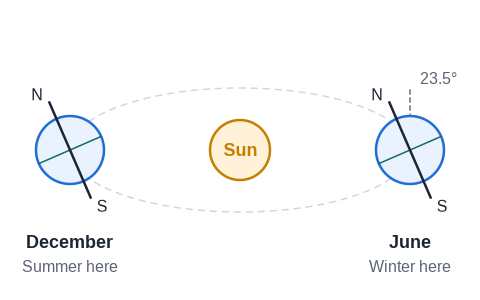
- Earth's axis is not straight up and down. It is tilted, or leaning, by about 23.5 degrees.
- Earth is divided into two halves by the equator. New Zealand is in the southern half, called the Southern Hemisphere.
The tilt as Earth goes round the Sun
- Earth travels around the Sun once a year. Its path is called its orbit.
- As Earth moves, its axis keeps leaning the same way in space. It does not swing round to face the Sun.
- So in December the Southern Hemisphere leans towards the Sun, and it is summer in New Zealand.
- In June the Southern Hemisphere leans away from the Sun, and it is winter here.
- At the same time the Northern Hemisphere has the opposite season, so December is winter in Japan and Canada.
Try it: the tilt and the seasons
High sun, low sun
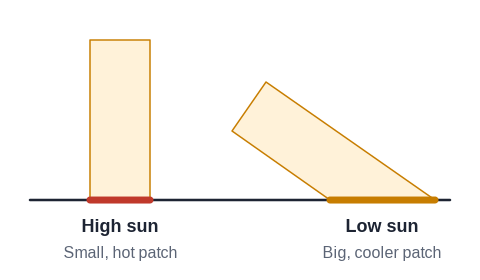
- When our half of Earth leans towards the Sun, the Sun climbs high in the sky at midday.
- Sunlight from a high sun hits the ground almost straight on, so its energy is packed into a small area. The ground warms up a lot.
- In winter the midday sun stays low. The same sunlight comes in at a slant and spreads over a bigger area, so each part of the ground gets less energy.
- You can check this with your shadow: at midday in summer it is short, and at midday in winter it is long.
Long days and short days
- The tilt also changes how many hours of daylight we get.
- When the Southern Hemisphere leans towards the Sun, New Zealand spends more of each spin in sunlight. Days are long and nights are short.
- When it leans away, New Zealand spends more of each spin in darkness. Days are short and nights are long.
- Summer is warm for two reasons that add together: the sun is higher, and it shines for more hours.
| Season in New Zealand | Months | Midday sun | Daylight |
|---|---|---|---|
| Summer | December to February | High | Long |
| Autumn | March to May | Getting lower | Getting shorter |
| Winter | June to August | Low | Short |
| Spring | September to November | Getting higher | Getting longer |
Example: reading Auckland's day lengths
- The table shows how long the sun was up in Auckland on the 21st of each month in 2026.
- Which month had the longest day and which had the shortest? How big is the difference?
| Month | Daylight |
|---|---|
| January | 14 h 16 min |
| February | 13 h 13 min |
| March | 12 h 8 min |
| April | 10 h 57 min |
| May | 10 h 1 min |
| June | 9 h 38 min |
| July | 9 h 59 min |
| August | 10 h 55 min |
| September | 12 h 3 min |
| October | 13 h 14 min |
| November | 14 h 15 min |
| December | 14 h 42 min |
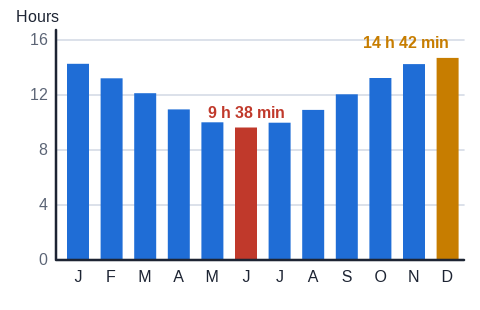
- Longest: December, 14 h 42 minread the biggest value
- Shortest: June, 9 h 38 minread the smallest value
- 14 h 42 min − 9 h 38 min = 5 h 4 minsubtract hours, then minutes
- December's day was 5 h 4 min longer than June's
Further south, bigger change
- The further a place is from the equator, the bigger the difference between summer days and winter days.
- Invercargill is much further south than Auckland. Its summer days are longer and its winter days are shorter.
| City | 21 June | 22 December | Difference |
|---|---|---|---|
| Auckland | 9 h 38 min | 14 h 42 min | 5 h 4 min |
| Invercargill | 8 h 35 min | 15 h 49 min | 7 h 14 min |
Try it: tilt detective
Different stars at different times of year
- At night our part of Earth has turned away from the Sun, so we look out into space.
- As Earth travels round its orbit, the night side faces a different part of space, so different stars are in the sky at different times of year.
- A constellation is a group of stars that people see as a pattern, such as Orion.
- Because the pattern repeats every year, people have long used the stars as a calendar.
Matariki and Puanga
- Matariki is a cluster of stars, also known as the Pleiades. A star cluster is a group of stars close together in the sky.
- In midwinter Matariki appears in the eastern sky just before dawn. For many Māori its rising marks the start of a new year, and iwi celebrate it in different ways and at different times.
- Since 2022 New Zealand has had a public holiday for Matariki in June or July.
- Puanga is the Māori name for Rigel, a bright star in the constellation Orion. It shows in the early morning sky before Matariki does.
- Some iwi on the west coast of the North Island, including Taranaki, Whanganui and Rangitīkei, use Puanga to mark the new year.
| Name | Also called | What it is |
|---|---|---|
| Matariki | The Pleiades | A cluster of stars |
| Puanga | Rigel | One bright star in Orion |
Try it: find Matariki
Common mistakes
- It is summer because Earth is closer to the Sun.Seasons come from the tilt; when it is summer in New Zealand it is winter in the Northern Hemisphere, at the same distance from the Sun.
- Earth's axis swings round so it always leans towards the Sun.The axis keeps leaning the same way in space, so each hemisphere leans towards the Sun for part of the year and away for the rest.
- Summer is warm only because the days are longer.Long days help, but the high midday sun matters too, because straight-on sunlight packs more energy into each patch of ground.
- Matariki is a single star.Matariki is a cluster of many stars; Puanga is the single star Rigel.
Model the seasons with a torch and a ball
You need: a ball, such as a tennis ball or an orange, a marker pen, a small sticker, a torch, a table in a dark room
- Draw a line round the middle of the ball for the equator, and put the sticker below it for New Zealand.
- Stand the torch on the table pointing sideways, and switch it on in the dark room.
- Hold the ball a short way from the torch with the bottom of the ball leaning towards the torch. Turn the ball slowly and count how long the sticker stays in the light.
- Now walk to the other side of the torch, keeping the ball leaning towards the same wall, and turn it again.
- Look for this: when the bottom leans towards the torch, the sticker spends longer in the light (summer); when it leans away, the sticker spends longer in the dark (winter).
Safety: Have an adult with you in the dark room, clear the floor so nobody trips, and never shine the torch into anyone's eyes.
Your turn
About how many degrees is Earth's axis tilted?
In December, does the Southern Hemisphere lean towards the Sun or away from it?
Use the Auckland table. Which month had the shortest day, and how long was it?
A torch beam shines straight down on the floor, then at a slant. Why does the slanted beam warm each part of the floor less?
In which season does Matariki appear in the dawn sky in New Zealand?
Show answer
1. About 23.5 degrees. 2. Towards the Sun, which is why December is summer in New Zealand. 3. June, with 9 h 38 min of daylight. 4. The same light is spread over a bigger area, so each part gets less energy. 5. Midwinter, around June or July.
Recap
- Earth spins on an axis tilted by about 23.5 degrees, and the tilt keeps pointing the same way.
- In December the Southern Hemisphere leans towards the Sun (summer); in June it leans away (winter).
- A high sun packs its energy into a small area; a low sun spreads it out.
- Summer days are long and winter days are short, and the change is bigger further from the equator.
- Different stars are seen at different times of year.
- Matariki is a star cluster and Puanga is the star Rigel; both mark the new year for different iwi.
Challenge
Use the lesson's Auckland table of daylight on the 21st of each month in 2026. Find how much the day length changed from each month to the next. Between which months did it change the most, and between which months did it change the least? What does this tell you about when in the year the days are changing fastest?
Hint
Change every time into minutes first (14 h 16 min = 856 min). Then subtract each month from the next. Look where the big changes and the small changes sit on the calendar.
Answer
Most: March to April (71 min shorter) and September to October (71 min longer). Least: June to July (21 min longer), then May to June (23 min). Days change fastest around March and September, halfway between the shortest and longest days, and hardly change around midwinter (June) and midsummer (December).
Step by step
- Change each day length into minutes so the subtractions are easy.
- Subtract each month from the next one and ignore whether the days got longer or shorter, just the size of the change.
- The two biggest changes are 71 minutes, from March to April and from September to October.
- The smallest are 21 minutes from June to July and 23 minutes from May to June; around December the changes are also small (27 and 26 minutes).
- So day length changes fastest around March and September, and slowest near the shortest day in June and the longest day in December.
Full working
- Mar 12 h 8 min = 728 min, Apr 10 h 57 min = 657 minhours × 60 + minutes
- 728 − 657 = 71March to April, days shorter
- Sep 723 min, Oct 794 min: 794 − 723 = 71September to October, days longer
- Jun 578 min, Jul 599 min: 599 − 578 = 21June to July, smallest change
- May 601 − Jun 578 = 23, Nov 855 → Dec 882 = 27, Dec 882 − Jan 856 = 26the other small changes
- Fastest change: March to April and September to October (71 min); slowest: June to July (21 min)
On 21 June 2026, Auckland had 9 h 38 min from sunrise to sunset. Tokyo in Japan is about as far north of the equator as Auckland is south of it. Without looking it up, estimate, to the nearest half hour, how long Tokyo's daylight was on the same day, and explain your thinking. Also say whether the midday sun was high or low in Tokyo that day.
Hint
On that day the two hemispheres lean in opposite ways. What is Auckland's NIGHT that day? A whole spin of Earth takes 24 hours.
Answer
About 14 and a half hours (Auckland's night was 14 h 22 min; real tables for Tokyo give about 14 h 35 min). In June the Northern Hemisphere leans towards the Sun, so Tokyo has summer: long days and a high midday sun.
Step by step
- In June the Southern Hemisphere leans away from the Sun and the Northern Hemisphere leans towards it.
- So Tokyo, at about the same distance from the equator, gets the opposite: its day is about as long as Auckland's night.
- One spin takes 24 hours, so Auckland's night was 24 h − 9 h 38 min = 14 h 22 min.
- To the nearest half hour that is 14 and a half hours. Real tables give about 14 h 35 min, a little more, because sunrise and sunset are counted at the Sun's top edge and the air bends sunlight, which adds some minutes to every day.
- Leaning towards the Sun also means the midday sun is high in Tokyo, because it is summer there.
Full working
- June: Southern Hemisphere leans away, Northern leans towardsthe tilt keeps pointing the same way
- Tokyo day ≈ Auckland nightsame distance from the equator, opposite hemispheres
- 24 h − 9 h 38 min = 14 h 22 minAuckland's night on 21 June
- 14 h 22 min ≈ 14 h 30 minto the nearest half hour
- Tokyo: summer, so high midday sunleaning towards the Sun
- About 14 and a half hours of daylight, with a high midday sun
In April, Matariki can be seen low in the western sky just after sunset. In late May and early June it cannot be seen at all, even on clear nights. Then in late June it appears low in the eastern sky just before dawn. Use Earth's journey around the Sun to explain why Matariki disappears for a few weeks and then comes back in the morning sky.
Hint
From Earth, the Sun seems to sit in front of different stars as Earth moves round its orbit. What would happen to a star that is in the same direction as the Sun?
Answer
As Earth moves round its orbit, the direction of the Sun from Earth changes, so the Sun seems to move in front of different stars. In late May and early June the Sun is in almost the same direction as Matariki, so Matariki is up in the daytime sky, hidden by sunlight. As Earth keeps moving, the Sun passes Matariki, so Matariki rises a little before the Sun, and it can be seen in the east just before dawn.
Step by step
- We only see stars at night, on the side of Earth turned away from the Sun.
- As Earth travels round the Sun, the Sun seems to sit in front of different groups of stars through the year.
- In April, Matariki is a little way from the Sun's direction, so it is still above the western horizon just after the Sun sets.
- In late May and early June the Sun is in nearly the same direction as Matariki. Matariki is in the sky only during the day, and sunlight hides it.
- By late June Earth has moved on, so Matariki rises just before the Sun and can be seen in the east before dawn, which marks the new year for many Māori.
Full working
- stars are seen only on Earth's night sidethe day side is lit by the Sun
- Earth moves round its orbit, so the Sun's direction changesthe Sun seems to move against the stars
- April: Matariki just behind the setting Sunseen in the west after sunset
- late May to early June: Sun and Matariki in nearly the same directionMatariki is hidden in daylight
- late June: Sun has moved past MatarikiMatariki rises just before dawn in the east
- Matariki vanishes while it is in the Sun's direction, then reappears in the dawn sky once Earth has moved on
The maths behind it
Report a mistake
How is Year 5 maths going?
See the Year 5 maths guide