Reading a dot plot properly
What this lesson covers
- Interpreting a data visualisation includes describing its variables and their units, the context for the data, and the visualisation’s key features: its shape (e.g. the number of peaks) its middle group(s) (where the middle of the data lies) its spread (how spread the data is from the minimum (lowest) value to the maximum (highest) value).
Every dot is a person
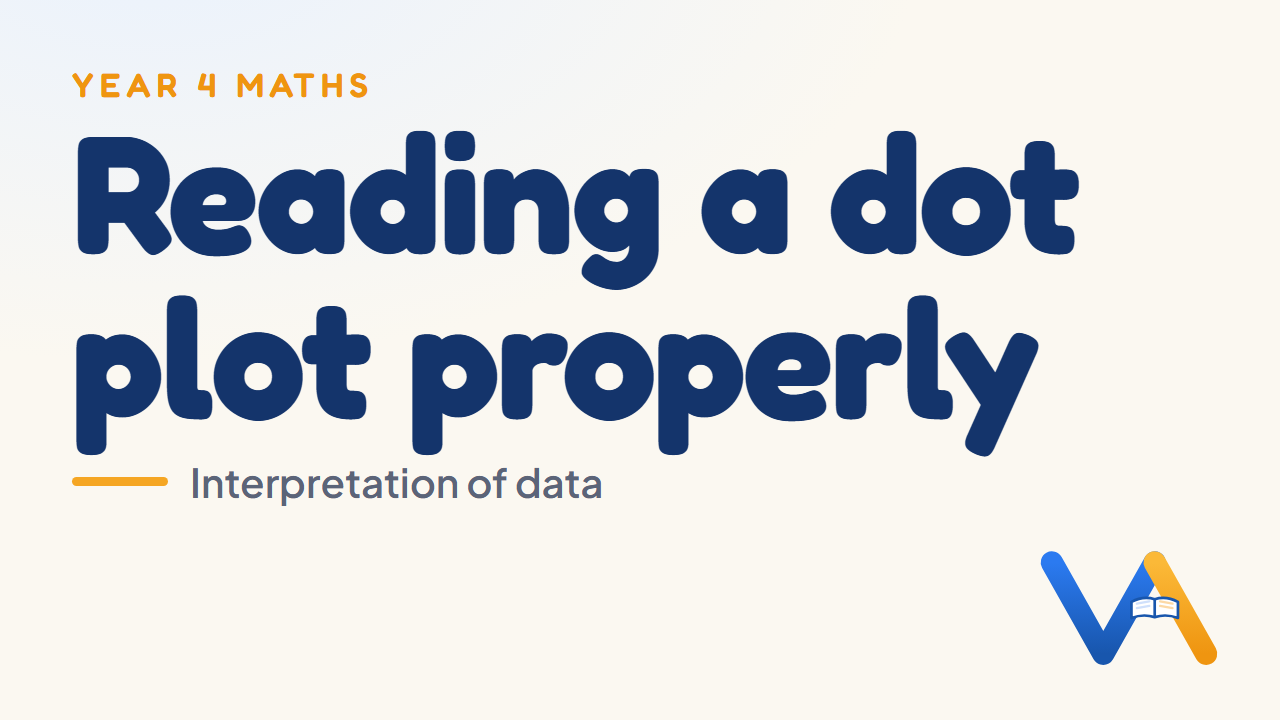
- Eleven children were asked how many pets they have.
- Each dot is one child.
- Remember that and the rest gets much easier.
Two things are being counted
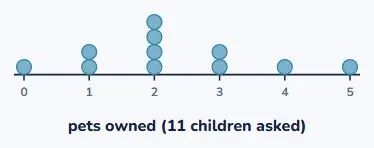
- How tall a stack is counts PEOPLE.
- Where a stack sits counts PETS.
- Two different things, in one picture.
| this bit of the picture | counts |
|---|---|
| one dot | one person |
| how tall a stack is | how many people |
| where a stack sits | how many pets |
Question one: how many pets?
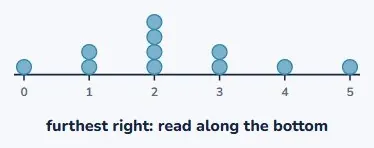
- "How many pets does the person with the most pets have?"
- Find the dot furthest to the right.
- It sits above 5. So the answer is 5 pets.
Question two: which is commonest?
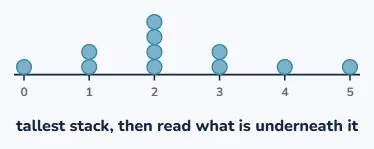
- "What is the commonest number of pets?"
- Find the TALLEST stack. That is the one at 2.
- The answer is 2 pets. Not 4.
Try it: read the dot plot
Why the answer is not 4
- The tallest stack has 4 dots in it.
- But 4 is how many PEOPLE, not how many pets.
- The question asked about pets. So read underneath.
| if you answer | you have said | but the question asked about |
|---|---|---|
| 4 | 4 people | pets |
| 2 | 2 pets | pets (correct) |
So ask yourself first
- Before you answer: is this about pets, or about people?
- Pets: read along the bottom.
- People: count the dots.
| question | about | so |
|---|---|---|
| how many pets does the person with the most have? | pets | read along the bottom |
| what is the commonest number of pets? | pets | find the tallest stack, read below it |
| how many people have 2 pets? | people | count the dots in that stack |
Describing the shape
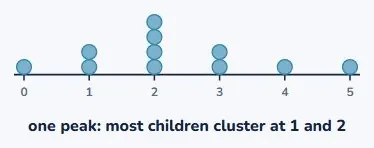
- Step back and look at the outline.
- Is there one lump, or two, or none?
- This one has a single peak, at 2 pets.
Try it: change the shape
Where it starts and where it stops
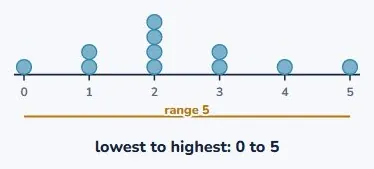
- The lowest answer was 0 pets. The highest was 5.
- So the answers spread from 0 to 5.
- That is 5 apart, end to end.
Say what it is actually about
- Never just say "the answer is 2".
- Say "2 pets, that is the commonest in this class".
- A number with no context has not told anyone anything.
| not this | this |
|---|---|
| "5" | "the most any child had was 5 pets" |
| "4" | "4 children have 2 pets each" |
| "0 to 5" | "answers ranged from 0 to 5 pets" |
Common mistakes
- The commonest number of pets is 4, because the tallest stack has 4 dots.4 is how many children; read underneath the tallest stack instead: the commonest number of pets is 2.
- The person with the most pets has 1 pet, because there is only 1 dot at the end.Find the dot furthest to the right and read along the bottom: it sits above 5, so the most is 5 pets.
- The answer is 2.Say what the number means: 2 pets is the commonest number of pets in this class.
- The answers spread from 0 to 5, so they are 6 apart.From 0 pets to 5 pets is 5 − 0 = 5 apart, end to end.
Your turn
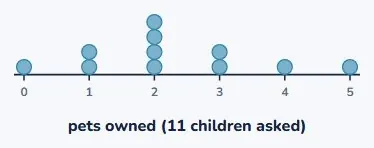
Pets owned by 11 children: 0, 1, 1, 2, 2, 2, 2, 3, 3, 4, 5. How many children have exactly 3 pets?
Pets owned by 11 children: 0, 1, 1, 2, 2, 2, 2, 3, 3, 4, 5. What is the fewest pets anybody has?
Some children said how many pets they have: 0, 1, 1, 2, 2, 2, 2, 3, 3, 4, 5. How many children were asked altogether?
Goals scored by 9 players: 0, 1, 1, 1, 2, 2, 3, 4, 4. What is the commonest number of goals?
Brothers and sisters of 10 children: 0, 0, 1, 1, 1, 2, 2, 3, 3, 6. The answers spread from what to what?
Show answer
1. 2 children: count the dots in the stack above 3. This one is about people. 2. 0 pets: the leftmost dot. This one is about pets. 3. 11 children: one answer, or one dot, for each child, so count them all. 4. 1 goal: the tallest stack has 3 dots, and it sits above 1. 5. 0 to 6 brothers and sisters: the lowest answer was 0 and the highest was 6.
Reading the picture
- Every dot is one person.
- Ask whether the question is about people or about the thing.
- Then answer with the units, not just a number.
| idea | what to remember |
|---|---|
| one dot | one person |
| stack height | how many people |
| stack position | how many pets |
| "commonest" | tallest stack, read underneath it |
| shape | how many lumps, and where |
| spread | lowest to highest |
| every answer | say the units and who was asked |
Challenge
A dot plot shows how many brothers and sisters some children have. The stacks are: 0: 3 dots. 1: 5 dots. 2: 4 dots. 3: 1 dot. 4: no dots. 5: 1 dot. Hemi says, "The answers spread from 1 to 5, and the commonest is 5." What did he do wrong? Give the right spread and commonest, with units. How many children were asked?
Hint
Is Hemi reading along the bottom, or counting dots? Spread and commonest are about brothers and sisters, not about people.
Answer
Hemi read the stack heights (people) instead of the numbers along the bottom. The answers spread from 0 to 5 brothers and sisters, which is 5 apart. The commonest is 1 brother or sister. 14 children were asked.
Step by step
- Hemi's 1 and 5 are stack heights, so they count children, not brothers and sisters.
- The lowest stack sits at 0 and the highest dot sits above 5, so the spread is 0 to 5.
- 5 − 0 = 5 apart, end to end.
- The tallest stack has 5 dots and sits above 1, so the commonest answer is 1 brother or sister.
- Count every dot: 3 + 5 + 4 + 1 + 0 + 1 = 14 children.
Full working
- Hemi used 1 dot and 5 dotsthose count children
- lowest dot at 0, highest at 5read along the bottom
- 5 − 0 = 5spread, end to end
- tallest stack (5 dots) sits at 1commonest answer
- 3 + 5 + 4 + 1 + 0 + 1 = 14every dot is a child
- Spread 0 to 5 brothers and sisters; commonest 1; 14 children
At a sports day, the new entrants class and a Year 4 class do a standing long jump, measured to the nearest 10 cm. The dot plot stacks are: 50 cm: 2. 60 cm: 4. 70 cm: 3. 80 cm: 1. 90 cm: 0. 100 cm: 0. 110 cm: 2. 120 cm: 4. 130 cm: 3. Describe the shape, the spread, and give a likely reason for the shape. How many children jumped?
Hint
Look at the outline. How many lumps are there? Who is likely to be in each lump?
Answer
Two peaks: one at 60 cm and one at 120 cm, with an empty gap at 90 cm and 100 cm. The jumps spread from 50 cm to 130 cm, which is 80 cm apart. Likely reason: two groups of different ages, so the younger new entrants make the lower lump and the older Year 4s make the higher lump. 19 children jumped.
Step by step
- The outline rises to 60 cm, falls to nothing at 90 cm and 100 cm, then rises again to 120 cm.
- So the shape has two lumps, with peaks at 60 cm and 120 cm.
- Shortest jump 50 cm, longest 130 cm: 130 − 50 = 80 cm apart.
- Two lumps often mean two different groups were mixed together.
- Older children can usually jump further, so the Year 4s are most likely the lump on the right.
- Count every dot: 2 + 4 + 3 + 1 + 2 + 4 + 3 = 19 children.
Full working
- stacks 2, 4, 3, 1, 0, 0, 2, 4, 3read across the plot
- peaks at 60 cm and 120 cm, gap at 90 to 100 cmtwo lumps
- 130 − 50 = 80 cmspread, end to end
- two lumpstwo groups mixed together
- 2 + 4 + 3 + 1 + 2 + 4 + 3 = 19every dot is a child
- Two peaks (60 cm and 120 cm); spread 50 to 130 cm; 19 children
A dot plot shows how many books 15 children read this week. Stacks: 0 books: 2. 1 book: 5. 2 books: 3. 3 books: 4. 4 books: 1. Two more children come back from being away and add their dots. Now the plot has two separate peaks of the same height, and the answers spread from 0 to 6 books. Where did the two new dots go? What is the commonest number of books now?
Hint
To make the spread reach 6 books, where must one dot go? Then, which stack can the other dot make as tall as the 1 book stack?
Answer
One dot goes at 6 books and the other at 3 books. Now 1 book and 3 books both have 5 dots, so there are two commonest answers: 1 book and 3 books.
Step by step
- The highest answer was 4 books. For the spread to reach 6 books, one new dot must sit at 6.
- That leaves one more dot. The tallest stack is 5 dots, at 1 book.
- Adding it at 1 book would make 6 dots there: still only one peak.
- Adding it at 3 books makes 4 + 1 = 5 dots, the same as at 1 book, with the shorter 2 books stack between them.
- So the plot now has two separate peaks, at 1 book and at 3 books.
Full working
- highest was 4 books, must reach 6one dot at 6 books
- tallest stack: 5 dots at 1 bookthe height to match
- 3 books: 4 + 1 = 5 dotsmatches the 1 book stack
- 2 books stack has 3 dots, lower than 5so the two peaks are separate
- 15 + 2 = 17 children nowcheck the total
- New dots at 3 books and 6 books; commonest is 1 book and 3 books
Where science uses this
Practise this
Report a mistake
More in Statistics
Is your child on track?
Take the free placement test