Heat: where thermal energy comes from and where it goes
What this lesson covers
- What thermal energy and temperature are
- Where thermal energy comes from: the Sun, fire, friction and electricity
- Why thermal energy always moves from warmer things to cooler things
- Why the flow stops once both things are at the same temperature
- How light warms the things it shines on
- Asking testable questions and running a fair test with temperature or melting
Thermal energy and temperature
- Energy is what makes things happen: things move, light up, or warm up.
- Thermal energy is the energy something has because it is hot. The hotter something is, the more thermal energy it has. Heat is thermal energy on the move.
- Temperature tells you how hot or cold something is. It is measured in degrees Celsius (°C) with a thermometer.
- Water freezes at 0 °C and boils at 100 °C. A healthy person's body is about 37 °C.
Where thermal energy comes from
- A source of thermal energy is anything that makes things warmer.
- Friction is the rubbing force between two surfaces. Rub your hands together fast and they warm up.
| Source | Example |
|---|---|
| The Sun | A deck warming up on a summer afternoon |
| Fire | A campfire or a gas barbecue |
| Friction | Rubbing your hands on a frosty morning; bike brakes after a long hill |
| Electricity | A toaster, a heater or an electric blanket |
Try it: where does the heat come from?
Warm to cool, never the other way
- Thermal energy always moves from a warmer thing to a cooler thing. It never moves from cool to warm on its own.
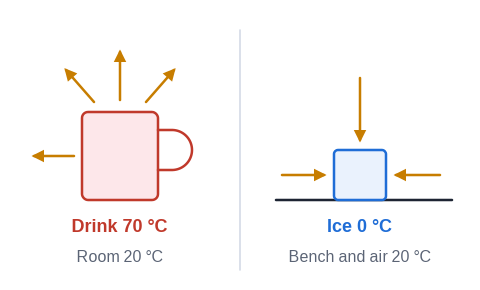
- A hot drink cools down because thermal energy moves out of it into the cooler cup and air.
- An ice block melts because thermal energy moves into it from the warmer air and bench.
- When you hold an ice cube, your hand feels cold. That is not cold going into your hand. It is thermal energy leaving your hand and going into the ice.
The flow stops when temperatures match
- Thermal energy keeps moving between two things for as long as one is warmer than the other.
- The warm thing cools down and the cool thing warms up.
- Once both are at the same temperature, there is no warmer side, so the overall flow stops.
- That is why a cup of tea left on the table ends up at room temperature, and a cold drink left out does too.
Try it: in or out?
Example: a cold jar in warm water
- Room 9 stood a small jar of cold water in a big bowl of warm tap water. They read a thermometer in each every 2 minutes.
- What happened, and why did the readings stop changing?
| Time (min) | 0 | 2 | 4 | 6 | 8 | 10 |
|---|---|---|---|---|---|---|
| Bowl (°C) | 40 | 38 | 37 | 36 | 35 | 35 |
| Jar (°C) | 8 | 20 | 28 | 32 | 35 | 35 |
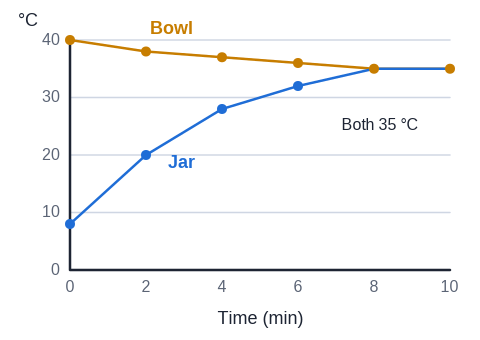
- Bowl went down from 40 °C to 35 °Cit lost thermal energy
- Jar went up from 8 °C to 35 °Cit gained thermal energy
- At 8 minutes both read 35 °Csame temperature, so no more overall flow
- Thermal energy moved from the warm bowl into the cold jar until both were 35 °C
Light can warm things
- When light shines on an object, some of the light is soaked up. Soaking up light is called absorbing it.
- The absorbed light turns into thermal energy, so the object gets warmer.
- Dark colours absorb more light than pale colours. A black car seat in the sun gets much hotter than a white one.
- Shade blocks the light, so the ground under a tree or a sail stays cooler. That is why playgrounds in New Zealand often have shade sails.
Asking a question you can test
- A testable question is one you can answer by changing one thing and measuring what happens.
- "Is summer the best season?" is not testable, because "best" is an opinion.
- "Does ice melt faster on a metal tray or a plastic tray?" is testable. You change the tray and time the melting.
- Some testable questions are still not right for a classroom, for example if they need a fire, boiling water or weeks of waiting. Choose ones that are safe and quick.
Keeping the test fair
- A variable is anything that can change in an experiment.
- In a fair test you change only one variable, measure one variable, and keep every other variable the same.
- If you change two things at once, you cannot tell which one caused the result.
| Kind of variable | In this test |
|---|---|
| Change (one thing) | The material of the tray |
| Measure | Time until the ice cube has fully melted |
| Keep the same | Size of the ice cube, the room, the start time, the tray thickness |
Example: which tray melts ice fastest?
- Room 9 put same-sized ice cubes on a metal tray, a plastic board and a wooden board, all in the same room. They timed each one until it had melted, and did it three times.
- Which material melted the ice fastest, and why?
| Material | Try 1 (min) | Try 2 (min) | Try 3 (min) |
|---|---|---|---|
| Metal tray | 6 | 7 | 6 |
| Plastic board | 15 | 14 | 16 |
| Wooden board | 19 | 18 | 20 |
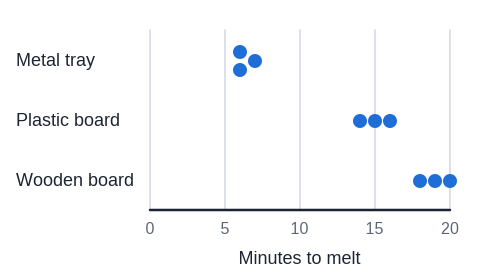
- Metal took 6 to 7 minutes, plastic 14 to 16, wood 18 to 20read the table
- The three tries for each material are close togetherthe test was well controlled
- Metal lets thermal energy from the warm room flow into the ice fastestthe explanation
- The metal tray melted the ice fastest
Explaining everyday heat
- Ice in a drink: thermal energy moves from the drink into the ice, so the ice melts and the drink gets colder.
- A chilly bin: its thick plastic and foam walls slow the flow of thermal energy from the warm air outside into the cold food.
- A woolly hat: it does not make heat. It slows the thermal energy leaving your warm head into the cold air.
- A car parked in the sun: sunlight is absorbed by the seats and dashboard and turns into thermal energy, so the inside gets very hot.
Common mistakes
- When I hold ice, the cold moves into my hand.Thermal energy moves out of your warmer hand into the ice; your hand feels cold because it is losing energy.
- A jumper makes heat, so it warms you up.A jumper makes no thermal energy; it slows the energy leaving your body, so you stay warm.
- A hot drink keeps cooling until it is colder than the room.It stops cooling once it reaches room temperature, because then nothing around it is cooler.
- Using a big ice cube on one tray and a small one on another is still a fair test.The ice cube size is a variable too, so it must be the same on every tray or you cannot compare the trays.
Race ice cubes on different materials
You need: 4 ice cubes from the same tray, a metal baking tray, a plastic chopping board, a wooden chopping board, a folded tea towel, a clock or timer, paper and a pencil
- Put the four surfaces side by side on a bench in the same room, away from sunny windows.
- Write down a prediction: which surface will melt the ice fastest?
- Place one ice cube on each surface at the same moment and start the timer.
- Check every minute and write down the time when each ice cube has fully melted.
- Look at your results: the ice on the metal tray usually melts first, because metal lets thermal energy from the room reach the ice fastest, and the tea towel usually comes last.
Safety: Ask an adult before taking things from the kitchen and the freezer, and wipe up the melt water afterwards so nobody slips.
Your turn
You rub your hands together quickly and they get warm. What is the source of the thermal energy?
A cold can of drink sits on a table in a room at 22 °C. Which way does thermal energy move?
A bowl of soup at 60 °C is left on the bench in a room at 20 °C. What temperature will it end up at?
Which of these is a testable question: "Is summer the best season?" or "Does a lid change how fast hot water cools?"
Mia tests ice melting on two trays. She uses a big ice cube on the metal tray and a small one on the plastic tray. What is wrong with her test?
Show answer
1. Friction, from rubbing the two surfaces together. 2. From the warmer air and table into the cold can, so the can warms up. 3. It cools to 20 °C, room temperature, then stops cooling. 4. "Does a lid change how fast hot water cools?", because you can change one thing (lid or no lid) and measure the temperature. 5. It is not a fair test: the ice cube size should be the same, so only the tray material changes.
Energy Forms and Changes
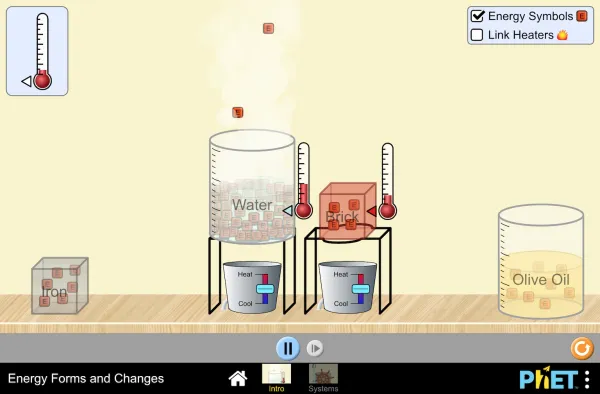
Full screen · PhET Interactive Simulations, University of Colorado Boulder, CC BY 4.0
Recap
- Thermal energy is the energy of hot things. Temperature, in °C, says how hot something is.
- Thermal energy comes from the Sun, fire, friction and electricity.
- It always moves from warmer to cooler, never the other way on its own.
- It keeps moving until both things are at the same temperature.
- Absorbed light turns into thermal energy, so things in sunlight warm up; dark colours absorb more.
- A fair test changes one variable, measures one, and keeps the rest the same.
Challenge
Two ice blocks of the same size come out of the freezer into a room at 20 °C. One is wrapped in a thick woolly jumper and the other is left bare on a plate. Mia says, "The wrapped one will melt first, because jumpers keep things warm." Which block will melt first? Explain, saying which way the thermal energy moves.
Hint
Does a jumper make any thermal energy of its own? Then think about where the thermal energy that melts ice has to come from.
Answer
The bare block melts first. Thermal energy moves from the warm room into the ice. The jumper makes no heat; it only slows that flow, so the wrapped block gets thermal energy more slowly and melts later.
Step by step
- The room (20 °C) is warmer than the ice, so thermal energy moves from the room into the ice.
- That incoming thermal energy is what melts the ice.
- A jumper makes no thermal energy. It only slows the flow of thermal energy through it.
- On a person, the jumper slows energy leaving the warm body. On ice, it slows energy getting in.
- So the wrapped block melts more slowly, and the bare block melts first.
Full working
- room 20 °C, ice below 0 °Croom is warmer
- thermal energy moves room → icewarm to cool
- jumper makes no thermal energyit only slows the flow
- wrapped ice gains energy more slowlymelts later
- The bare block melts first; the jumper slows thermal energy getting into the ice
Kahu asks, "Does a black cover make ice melt faster in the sun than a white cover?" He puts one ice cube under a black cloth on a metal tray in full sun. He puts another the same size under a white cloth on a wooden board near a tree; after 10 minutes the tree's shade covers it. The black one melts in 12 minutes, the white one in 31 minutes. Name two things he forgot to keep the same, explain how each one alone could make the white cube melt more slowly, and describe a fair test.
Hint
List everything that is different between the two set-ups, not just the colour. For each difference, ask: does it change how much thermal energy reaches the ice?
Answer
1) The surface: metal lets thermal energy flow into ice much faster than wood, so the wooden board alone could slow the white cube. 2) The light: shade blocks sunlight, so less light is absorbed and turned into thermal energy. Fair test: same-size cubes, both on the same kind of tray, side by side in full sun, only the cloth colour different, repeated three times.
Step by step
- Three things differ: the cloth colour, the tray material and the amount of sunlight. Only the colour should change.
- Metal lets thermal energy from the warm surroundings flow into ice faster than wood does, so ice on wood melts more slowly anyway.
- Shade blocks light. Less light absorbed means less thermal energy, so the shaded cube melts more slowly anyway.
- Because three things changed, Kahu cannot tell which one caused the difference.
- A fair test keeps the tray and the sunlight the same, changes only the colour, and repeats each try three times.
Full working
- change: cloth colourthe only thing meant to change
- also changed: metal tray vs wooden boardmetal lets thermal energy into ice faster
- also changed: full sun vs shadeshade means less light absorbed
- three variables changedcannot say colour caused it
- fair test: same trays, side by side in full sun, same-size cubes, repeat 3 timeschange only the colour
- He forgot the tray material and the sunlight; keep both the same and change only the cloth colour
In a room at 20 °C, Room 9 stands a small jar of hot water in a big bowl of cold water. Readings: at 0 min the jar is 70 °C and the bowl is 10 °C. At 4 min, jar 24 °C, bowl 17 °C. At 8 min, both 18 °C. At 10 min, both still 18 °C. Three hours later, both read 20 °C. Explain why the readings stopped changing at 8 minutes, and how a jar that started hot can end up gaining thermal energy.
Hint
Deal with it in two stages. In each stage, ask which thing is the warmest and which way thermal energy moves. Notice that 18 °C is not the room temperature.
Answer
First, thermal energy moved from the hot jar into the cold bowl until both were 18 °C, so the flow between them stopped. But the room is 20 °C, warmer than 18 °C, so thermal energy then moved slowly from the room into both the bowl and the jar until all three were at 20 °C. In that second stage the jar gains thermal energy.
Step by step
- At the start the jar (70 °C) is warmer than the bowl (10 °C), so thermal energy moves jar → bowl. The jar cools and the bowl warms.
- At 8 minutes both are 18 °C, so there is no warmer side between them and the overall flow between them stops.
- But 18 °C is colder than the room at 20 °C, so now the room is the warmer thing.
- Thermal energy moves slowly from the room air into the bowl and the jar, so both warm from 18 °C to 20 °C.
- Once everything is at 20 °C, there is no warmer side anywhere, so the temperatures stay at 20 °C.
Full working
- jar 70 °C, bowl 10 °Cjar warmer, energy jar → bowl
- jar 70 → 24 → 18 °C, bowl 10 → 17 → 18 °Cjar loses, bowl gains
- 8 min: both 18 °Csame temperature, flow between them stops
- room 20 °C, jar and bowl 18 °Croom is now warmer
- energy room → bowl and jarboth rise 18 → 20 °C
- Stage 1: jar → bowl until both 18 °C; stage 2: room → jar and bowl until all 20 °C, so the jar gains energy
The maths behind it
Report a mistake
How is Year 5 maths going?
See the Year 5 maths guide