Independent or mutually exclusive? The two tests
What this lesson covers
- Mutually exclusive events cannot happen together; independent events do not affect each other.
- Each has its own test, and each test must be written as a probability statement.
Two ideas, two tests
- Mixing up the tests: a named 2025 error.
- Each idea has its own test.
- Write each test as a probability.
What the words mean
- Mutually exclusive: cannot happen together.
- Independent: one does not change the other.
- Overlap versus influence.
| Word | Means |
|---|---|
| Mutually exclusive | cannot happen together |
| Independent | no effect on each other |
The two tests side by side
- Mutually exclusive: P(A and B) = 0.
- Independent: P(A and B) = P(A) × P(B).
- Or: P(A | B) = P(A).
| Claim | Test |
|---|---|
| Mutually exclusive | P(A and B) = 0 |
| Independent | P(A and B) = P(A) × P(B) |
| or | P(A | B) = P(A) |
Try it: the two tests
Mutually exclusive: no overlap
- Main way to school, 250 students.
- P(walk) = 0.32, P(driven) = 0.4.
- Nobody has two main ways: overlap 0.
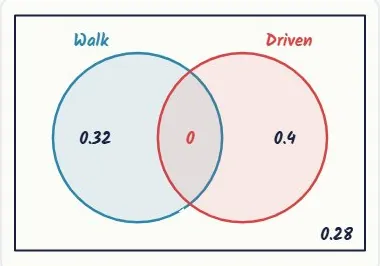
A probability, not a count
- State it as a probability.
- Write P(W and D) = 0.
- P(neither) = 1 − (0.32 + 0.4)
- = 1 − 0.72 = 0.28
- no student did botha count, not the test
- P(W and D) = 0 ÷ 250 = 0a probability
- W and D are mutually exclusive
Independence: 400 café customers
- 160 have a loyalty card.
- 100 order oat milk; 40 do both.
- Does a card make a difference?
| Oat milk | Other | Total | |
|---|---|---|---|
| Loyalty card | 40 | 120 | 160 |
| No card | 60 | 180 | 240 |
| Total | 100 | 300 | 400 |
The rest of the table
- Each gap: total − known.
- Check one cell twice.
- card, other: 160 − 40 = 120
- no card: 400 − 160 = 240
- no card, oat: 100 − 40 = 60
- other: 400 − 100 = 300
- no card, other: 240 − 60 = 180
- check: 300 − 120 = 180
The product test
- Find P(L and O).
- Multiply P(L) × P(O).
- Equal: independent.
- P(L and O) = 40 ÷ 400 = 0.1
- P(L) = 160 ÷ 400 = 0.4
- P(O) = 100 ÷ 400 = 0.25
- P(L) × P(O) = 0.4 × 0.25 = 0.1
- P(L and O) = P(L) × P(O)
- L and O are independent
Try it: the product test
The conditional test
- Given a card: 0.25.
- Overall: also 0.25.
- No difference.
- P(O | L) = 40 ÷ 160 = 0.25card holders only
- P(O) = 100 ÷ 400 = 0.25everyone
- P(O | L) = P(O)
- P(O | no card) = 60 ÷ 240 = 0.25
- a card makes no difference
A pair that fails the test
- P(S) = 0.5, P(C) = 0.3.
- P(S and C) = 0.2.
- Middle first, then the rest.
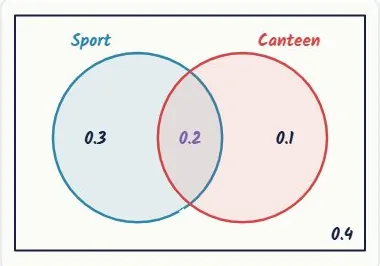
The product test fails
- Regions first.
- Then the product test.
- only S = 0.5 − 0.2 = 0.3
- only C = 0.3 − 0.2 = 0.1
- neither = 1 − 0.6 = 0.41 − (0.3 + 0.2 + 0.1)
- P(S) × P(C) = 0.5 × 0.3
- = 0.15
- P(S and C) = 0.2the overlap
- 0.15 ≠ 0.2product test fails
- S and C are not independent
Explaining it in context
- Compare with P(C).
- Then say it in context.
- P(C | S) = P(S and C) ÷ P(S)
- = 0.2 ÷ 0.5 = 0.4
- P(C) = 0.3overall
- P(C | S) > P(C)sport: canteen more often
Exclusive, so not independent
- Exclusive: P(W and D) = 0.
- Product: 0.128, not 0.
- P(W and D) = 0mutually exclusive
- P(W) × P(D) = 0.32 × 0.4
- = 0.128
- 0.128 ≠ 0product test fails
- W and D are not independent
- P(D | W) = 0, but P(D) = 0.4
Try it: tap the tests
Why they are never the same
- Both probabilities above zero.
- Mutually exclusive means not independent.
- Never use one word for the other.
Where the marks are
- Achieved: the probabilities each test needs.
- Merit: both tests, as probability statements.
- Excellence: the relationship, in context.
What to take away
- Two ideas, two tests, each written as a probability statement.
| Exclusive | P(A and B) = 0 |
| Independent | P(A and B) = P(A)P(B) |
| or | P(A | B) = P(A) |
| Write | as a probability |
| Explain | compare P(A | B), P(A) |
| Not the same | exclusive is dependent |
Common mistakes
- Walking and being driven are mutually exclusive, so they are independent.P(W) × P(D) = 0.32 × 0.4 = 0.128, but P(W and D) = 0, so they are not independent; exclusive events never are.
- No student did both, so W and D are mutually exclusive.Write the test as a probability: P(W and D) = 0 ÷ 250 = 0, so they are mutually exclusive.
- P(S and C) = 0.2 is not 0, so S and C are independent.Not 0 only shows they are not exclusive; independence needs P(S) × P(C) = 0.15 to equal 0.2, and it does not.
Your turn: eight questions
- Classify: independent, exclusive, both, neither.
- Question 3: explain in context.
- Question 4 is out of 200.
| Given | Find | |
|---|---|---|
| 1 | A 0.4, B 0.5, both 0.2 | classify |
| 2 | A 0.2, B 0.45, both 0 | classify |
| 3 | P(L | R) 0.4, P(L) 0.2 | independent? |
| 4 | A 50, B 80, both 20 | classify |
| 5 | events A and B | test for mutually exclusive |
| 6 | A, B independent; P(A) = 0.3, P(A and B) = 0.12 | P(B) |
| 7 | 500 commuters: 200 drive, 300 podcasts, 150 both | independent? |
| 8 | P(A) = 0.5, P(B) = 0.4, P(neither) = 0.25 | classify |
Show answer
1. P(A) × P(B) = 0.2 = P(A and B): independent; P(A and B) ≠ 0, so not mutually exclusive. 2. P(A and B) = 0: mutually exclusive; P(A) × P(B) = 0.09 ≠ 0, so not independent. 3. P(L | R) = 0.4 ≠ P(L) = 0.2: not independent; a student is twice as likely to be late on a rainy day. 4. P(A) = 0.25, P(B) = 0.4, P(A) × P(B) = 0.1 = 20 ÷ 200: independent; not mutually exclusive. 5. P(A and B) = 0: mutually exclusive events cannot happen together, so the overlap has probability 0. 6. 0.4: independent means P(A and B) = P(A) × P(B), so P(B) = 0.12 ÷ 0.3 = 0.4. 7. Not independent: P(P | D) = 150 ÷ 200 = 0.75, but P(P) = 300 ÷ 500 = 0.6, so drivers are more likely to listen. 8. Neither: P(A or B) = 1 − 0.25 = 0.75, so P(A and B) = 0.5 + 0.4 − 0.75 = 0.15. That is not 0, and not P(A) × P(B) = 0.2.
The answers: questions 1 and 2
- 1. P(A) × P(B) = 0.4 × 0.5 = 0.2
- = P(A and B): independent
- P(A and B) = 0.2 ≠ 0not mutually exclusive
- 2. P(A and B) = 0mutually exclusive
- P(A) × P(B) = 0.2 × 0.45 = 0.09
- 0.09 ≠ 0not independent
The answers: questions 3 and 4
- 3. P(L | R) = 0.4, P(L) = 0.2
- 0.4 ≠ 0.2: not independent
- 0.4 ÷ 0.2 = 2twice the overall chance
- 4. P(A) = 50 ÷ 200 = 0.25
- P(B) = 80 ÷ 200 = 0.4
- P(A) × P(B) = 0.25 × 0.4 = 0.1
- P(A and B) = 20 ÷ 200 = 0.1
- equal: independent
- P(A and B) ≠ 0: not exclusive
Sample question: Achieved
For a randomly chosen Year 13 student, A is the event they own a bike, with P(A) = 0.3, and B is the event they have a brother or sister at the same school, with P(B) = 0.6. P(A and B) = 0.18. Are A and B independent? Are they mutually exclusive? Write each test as a probability statement.
Hint
Independent: check P(A and B) = P(A) × P(B). Mutually exclusive: check P(A and B) = 0.
Answer
Independent, because P(A) × P(B) = 0.3 × 0.6 = 0.18 = P(A and B). Not mutually exclusive, because P(A and B) = 0.18 ≠ 0.
Step by step
- There are two different tests, one for each idea.
- Independence test: is P(A and B) equal to P(A) × P(B)?
- P(A) × P(B) = 0.3 × 0.6 = 0.18. That equals P(A and B) = 0.18, so A and B are independent.
- Mutually exclusive test: is P(A and B) = 0?
- P(A and B) = 0.18, not 0. Some students do both, so A and B are not mutually exclusive.
- Classic mistake: thinking independent means they cannot happen together. That is mutually exclusive, a different idea.
- In context: owning a bike does not change the chance of having a sibling at the school.
Full working
- P(A) × P(B) = 0.3 × 0.6 = 0.18
- P(A and B) = 0.18 = P(A) × P(B)independent
- P(A and B) = 0.18 ≠ 0not mutually exclusive
- independent, not mutually exclusive
Sample questions: Merit
In a survey of 500 Napier residents, 200 own a dog, 150 walk for at least 30 minutes every day, and 80 do both. Test whether owning a dog and walking daily are independent, using both the product test and the conditional test, and explain the result in context.
Hint
Turn the counts into probabilities first; for the conditional test compare P(W | D) with P(W).
Answer
P(D) = 0.4, P(W) = 0.3, P(D and W) = 0.16. P(D) × P(W) = 0.12 ≠ 0.16, so not independent. P(W | D) = 80 ÷ 200 = 0.4, which is more than P(W) = 0.3: dog owners are more likely than residents overall to walk daily.
Step by step
- Let D be owns a dog and W be walks daily. Write each as a probability out of 500.
- P(D) = 200 ÷ 500 = 0.4. P(W) = 150 ÷ 500 = 0.3. P(D and W) = 80 ÷ 500 = 0.16.
- Product test: P(D) × P(W) = 0.4 × 0.3 = 0.12.
- 0.12 ≠ 0.16, so D and W are not independent.
- Conditional test: P(W | D) = 80 ÷ 200 = 0.4, using only the dog owners.
- Compare with P(W) = 0.3. 0.4 ≠ 0.3, which confirms they are not independent.
- In context: 40% of dog owners walk daily, against 30% of all residents. Owning a dog goes with a higher chance of daily walking.
- Going further: of the 300 without a dog, 150 − 80 = 70 walk daily, which is 70 ÷ 300 = 0.2333.
- Classic mistake: writing the test with counts, like 80 ≠ 60. Write it as a probability statement.
- Not independent does not mean the dog causes the walking. It is a survey, so it shows an association only.
Full working
- P(D) = 0.4, P(W) = 0.3, P(D and W) = 0.16
- P(D) × P(W) = 0.12 ≠ 0.16product test fails
- P(W|D) = 80 ÷ 200 = 0.4
- P(W|D) = 0.4 > P(W) = 0.3conditional test
- not independent; dog owners more likely to walk daily
Each Hutt Valley student names one main way of getting to school. Let A be "main way is the bus", with P(A) = 0.35, and B be "main way is cycling", with P(B) = 0.15. Show that A and B are mutually exclusive but not independent, and find the probability that a student's main way is neither the bus nor cycling.
Hint
Each student names only one main way, so P(A and B) = 0; then compare with P(A) × P(B).
Answer
P(A and B) = 0, so A and B are mutually exclusive. P(A) × P(B) = 0.0525 ≠ 0, so they are not independent. P(neither) = 1 − (0.35 + 0.15) = 0.5.
Step by step
- Each student names only one main way, so no student can have both the bus and cycling as their main way.
- Write that as a probability: P(A and B) = 0. So A and B are mutually exclusive.
- Independence test: P(A) × P(B) = 0.35 × 0.15 = 0.0525.
- 0.0525 ≠ 0 = P(A and B), so A and B are not independent.
- Why does this make sense? If you know a student's main way is the bus, the chance it is cycling drops from 0.15 to 0. Knowing one changes the other.
- So two mutually exclusive events with probabilities above zero are never independent.
- Neither: there is no overlap, so P(A or B) = 0.35 + 0.15 = 0.5.
- P(neither) = 1 − 0.5 = 0.5.
- Classic mistake: saying they are independent because they have nothing to do with each other. Exclusive events affect each other completely.
Full working
- P(A and B) = 0one main way each, mutually exclusive
- P(A) × P(B) = 0.35 × 0.15 = 0.0525
- 0.0525 ≠ 0not independent
- P(A or B) = 0.35 + 0.15 = 0.5no overlap
- mutually exclusive, not independent; P(neither) = 0.5
Sample questions: Excellence
P(A) = 0.4 and P(A or B) = 0.7. Find P(B) if (a) A and B are mutually exclusive, (b) A and B are independent. (c) Explain why A and B cannot be both mutually exclusive and independent here.
Hint
Use P(A or B) = P(A) + P(B) − P(A and B), with P(A and B) = 0 in (a) and P(A) × P(B) in (b).
Answer
(a) P(B) = 0.3 (b) P(B) = 0.5 (c) Both would need P(A and B) = 0 and P(A and B) = 0.4 × P(B), so P(B) = 0; but then P(A or B) = 0.4, not 0.7.
Step by step
- Start from the addition rule: P(A or B) = P(A) + P(B) − P(A and B). Let P(B) = x.
- (a) Mutually exclusive means P(A and B) = 0.
- So 0.7 = 0.4 + x − 0, which gives x = 0.3.
- (b) Independent means P(A and B) = P(A) × P(B) = 0.4x.
- So 0.7 = 0.4 + x − 0.4x = 0.4 + 0.6x.
- 0.6x = 0.3, so x = 0.5.
- Check (b): P(A and B) = 0.4 × 0.5 = 0.2, and 0.4 + 0.5 − 0.2 = 0.7.
- (c) For both at once we would need P(A and B) = 0 and also P(A and B) = 0.4x.
- That forces 0.4x = 0, so x = 0.
- But if P(B) = 0, then P(A or B) = 0.4, not 0.7. That is a contradiction.
- So here A and B cannot be both. In general, two events with non-zero probabilities are never both independent and mutually exclusive.
Full working
- P(A or B) = P(A) + P(B) − P(A and B)addition rule
- (a) 0.7 = 0.4 + x, x = 0.3P(A and B) = 0
- (b) 0.7 = 0.4 + x − 0.4xP(A and B) = 0.4x
- 0.6x = 0.3, x = 0.5
- (c) 0.4x = 0 gives x = 0, then P(A or B) = 0.4 ≠ 0.7
- (a) 0.3 (b) 0.5 (c) both would force P(B) = 0
On a Wellington morning the probability of rain is 0.4, and the probability that the Cook Strait ferry is delayed is 0.25. Given that it rains, the probability of a delay is 0.4. (a) Are rain and a delay independent? (b) Find the probability of a delay on a morning with no rain, and compare the two in context. (c) Evaluate the claim "most delays happen on rainy mornings".
Hint
Find P(rain and delay) from P(delay | rain) × P(rain); the delays without rain are the rest of P(delay).
Answer
(a) No: P(delay | rain) = 0.4 ≠ P(delay) = 0.25. (b) P(rain and delay) = 0.16, so P(no rain and delay) = 0.09 and P(delay | no rain) = 0.09 ÷ 0.6 = 0.15. A delay is about 2.67 times as likely on a rainy morning. (c) P(rain | delay) = 0.16 ÷ 0.25 = 0.64 > 0.5, so the claim is supported.
Step by step
- Let R be rain and D be a delay. P(R) = 0.4, P(D) = 0.25, P(D | R) = 0.4.
- (a) Conditional test: P(D | R) = 0.4 but P(D) = 0.25. They are not equal, so R and D are not independent.
- (b) Rainy and delayed: P(R and D) = P(D | R) × P(R) = 0.4 × 0.4 = 0.16.
- Delays happen on rainy or dry mornings, so delayed and dry: 0.25 − 0.16 = 0.09.
- Dry mornings: P(not R) = 1 − 0.4 = 0.6. So P(D | not R) = 0.09 ÷ 0.6 = 0.15.
- Compare: 0.4 on rainy mornings against 0.15 on dry ones. 0.4 ÷ 0.15 = 2.67, so a delay is about 2.67 times as likely when it rains.
- (c) The claim is about delays, so the group is delayed mornings. We need P(R | D).
- P(R | D) = P(R and D) ÷ P(D) = 0.16 ÷ 0.25 = 0.64.
- Most means more than 0.5, and 0.64 > 0.5, so the claim is supported: about 64% of delays are on rainy mornings.
- Classic mistake: using P(D | R) = 0.4 for (c). That is the chance of a delay given rain, the wrong way round.
- Check: the product test agrees with (a). P(R) × P(D) = 0.1, which is not 0.16.
Full working
- (a) P(D|R) = 0.4 ≠ P(D) = 0.25not independent
- P(R and D) = 0.4 × 0.4 = 0.16
- P(not R and D) = 0.25 − 0.16 = 0.09
- (b) P(D|not R) = 0.09 ÷ 0.6 = 0.150.4 ÷ 0.15 ≈ 2.67
- (c) P(R|D) = 0.16 ÷ 0.25 = 0.64 > 0.5
- not independent; 0.15 on dry mornings; claim supported (0.64)
Challenge
Two invented schools each have 40% of their students in kapa haka (K). At both schools, 30% of the kapa haka students play rugby (R). At School 1, 40% of the rugby players are in kapa haka; at School 2, 50% are. (a) For each school, find P(R) and test whether K and R are independent. (b) For each school, find P(R | not K). (c) A report says: "At both schools 30% of kapa haka students play rugby, so the link between the two activities is the same." Evaluate this.
Hint
P(K and R) is the same at both schools. Use P(K | R) to work back to P(R), then compare P(R | K) with P(R).
Answer
(a) P(K and R) = 0.12 at both. School 1: P(R) = 0.3, and P(R | K) = 0.3 = P(R), so K and R are independent. School 2: P(R) = 0.24, and P(R | K) = 0.3 ≠ 0.24 (also 0.4 × 0.24 = 0.096 ≠ 0.12), so they are not independent. (b) School 1: 0.3. School 2: 0.2. (c) The claim is wrong. One conditional probability cannot show a link; it must be compared. At School 1 kapa haka makes no difference (30% either way); at School 2 kapa haka students are more likely to play rugby (30% against 20%).
Step by step
- Both schools: P(K and R) = 0.4 × 0.3 = 0.12.
- School 1: P(K | R) = 0.4, so P(R) = 0.12 ÷ 0.4 = 0.3. School 2: P(R) = 0.12 ÷ 0.5 = 0.24.
- School 1: P(R | K) = 0.3 = P(R), independent. School 2: 0.3 ≠ 0.24, not independent.
- Rugby players not in kapa haka: School 1 0.3 − 0.12 = 0.18, School 2 0.24 − 0.12 = 0.12. Divide each by P(not K) = 0.6.
- School 1: 0.3, the same as for K. School 2: 0.2, lower than for K.
- Same 30%, different links: the comparison group is what decides it.
Full working
- P(K and R) = 0.4 × 0.3 = 0.12both schools
- School 1: P(R) = 0.12 ÷ 0.4 = 0.3P(R given K) = P(R), independent
- School 2: P(R) = 0.12 ÷ 0.5 = 0.240.3 ≠ 0.24, not independent
- School 2 check: 0.4 × 0.24 = 0.096 ≠ 0.12product test fails
- P(R given not K): 0.18 ÷ 0.6 = 0.3 and 0.12 ÷ 0.6 = 0.2
- same 30%, different comparisonsclaim not supported
- School 1 independent; School 2 not; the report's claim is wrong
Mere and Hemi sit their restricted driving licence tests on different days, and their results are independent. The probability that exactly one of them passes is 0.5, and the probability that neither passes is 0.2. Mere is more likely to pass than Hemi. (a) Find the probability that each of them passes. (b) Given that exactly one of them passed, find the probability that it was Mere. (c) Explain why "Mere passes" and "Hemi passes" cannot be mutually exclusive.
Hint
Let m and h be their pass probabilities. Find P(both pass) first. Then the product rule gives m × h, and the addition rule gives m + h.
Answer
(a) Mere 0.6, Hemi 0.5. (b) 0.3 ÷ 0.5 = 0.6. (c) Mutually exclusive would need P(both pass) = 0, but P(both pass) = 0.3.
Step by step
- P(both) = 1 − 0.5 − 0.2 = 0.3.
- Independent, so m × h = 0.3. P(at least one) = 0.8 = m + h − mh, so m + h = 1.1.
- m and h solve t² − 1.1t + 0.3 = 0, giving t = 0.6 or 0.5. Mere is more likely, so m = 0.6, h = 0.5.
- Only Mere: 0.6 × 0.5 = 0.3. Only Hemi: 0.4 × 0.5 = 0.2. Check: 0.3 + 0.2 = 0.5.
- Given exactly one: 0.3 ÷ 0.5 = 0.6.
Full working
- P(both) = 1 − 0.5 − 0.2 = 0.3the rest of the outcomes
- mh = 0.3independent
- m + h − mh = 0.8, so m + h = 1.1addition rule
- t² − 1.1t + 0.3 = 0, t = (1.1 ± 0.1) ÷ 2t = 0.6 or 0.5
- only Mere = 0.6 × 0.5 = 0.3, only Hemi = 0.4 × 0.5 = 0.2check 0.5
- P(Mere given exactly one) = 0.3 ÷ 0.5 = 0.6
- (a) Mere 0.6, Hemi 0.5; (b) 0.6; (c) P(both) = 0.3 ≠ 0
An invented conservation group puts sound recorders in a forest to detect kiwi calls. Each recorder detects a given call with probability 0.3. (a) Assuming recorders detect calls independently, find the smallest number of recorders needed so that the probability that at least one detects a call is at least 0.95. (b) Field data for pairs of recorders show that both detect a call with probability 0.15. Test whether the two recorders' detections are independent, and find P(second detects | first detects). (c) Find the probability that at least one of a pair detects a call, compare it with the independent model, and explain in context why the answer to (a) is probably too small.
Hint
At least one detects = 1 − P(none detect). For (a), try values of n. For (b), use the product test, then divide P(both) by P(first).
Answer
(a) 9 recorders: 1 − 0.7⁸ ≈ 0.9424 is too small, 1 − 0.7⁹ ≈ 0.9596 is enough. (b) 0.3 × 0.3 = 0.09 ≠ 0.15, so not independent; P(second | first) = 0.5, more than 0.3. (c) 0.3 + 0.3 − 0.15 = 0.45, against 0.51 if independent. A loud or nearby call tends to be picked up by both recorders and a faint or distant call by neither, so extra recorders often repeat each other. Coverage grows more slowly than the independent model says, so more than 9 recorders are likely to be needed.
Step by step
- If independent, P(none of n detect) = 0.7ⁿ, so P(at least one) = 1 − 0.7ⁿ.
- 0.7⁸ ≈ 0.0576 is above 0.05, but 0.7⁹ ≈ 0.0404 is below. So n = 9.
- Product test: 0.3 × 0.3 = 0.09, but P(both) = 0.15. Not independent.
- P(second | first) = 0.15 ÷ 0.3 = 0.5. Detections go together.
- A pair detects with probability 0.45, not 0.51. The same calls keep being missed.
- So the 9 from (a) assumes more independence than the forest gives.
Full working
- P(at least one of n) = 1 − 0.7ⁿindependent model
- n = 8: 1 − 0.0576 = 0.9424too small
- n = 9: 1 − 0.0404 = 0.9596(a)
- 0.3 × 0.3 = 0.09 ≠ 0.15not independent
- P(second given first) = 0.15 ÷ 0.3 = 0.5(b)
- pair: 0.3 + 0.3 − 0.15 = 0.45model: 1 − 0.7² = 0.51
- (a) 9; (b) not independent, 0.5; (c) 0.45 < 0.51, so more than 9 needed
Practise this
Report a mistake
More in AS 91585
 Tables, trees and Venn diagrams from written information10 min
 Conditional probability from tables, trees and Venn diagrams9 minIndependent or mutually exclusive? The two tests10 min
 Relative risk: times as likely, and when you need a ratio9 min
 True probability, model estimates and experimental estimates8 min
 Organising information: 7 exam questions solved step by step11 min
 Conditional probability: 7 exam questions solved step by step10 min
 Independent or exclusive: 7 exam questions solved step by step10 min
 Relative risk: 7 exam questions solved step by step10 min
 Probability estimates: 7 exam questions solved step by step9 min
Is your child on track?
Take the free placement test