Organising information: 7 exam questions solved step by step
What this lesson covers
- Most probability questions become easy once the information is in a table, a tree or a Venn diagram.
- Choose the structure that matches how the information is given.
Organise the words first
- Two variables: draw a two-way table.
- Overlapping groups: a Venn diagram, middle first.
- "Of those": draw a tree.
- Probabilities in a full set total 1 (counts total n).
Question 1 · Achieved, in context
- 300 campground guests: 180 from overseas,
- 210 booked online (the rest by phone),
- 140 were overseas and booked online.
- Find P(a guest is from NZ, by phone).
Q1: words into a table
- Two variables: where from, how booked.
- Place the givens, mark the gaps.
| Online | Phone | Total | |
|---|---|---|---|
| Overseas | 140 | ? | 180 |
| NZ | ? | ? | ? |
| Total | 210 | ? | 300 |
Q1: fill the gaps
- Each gap: total − known.
- Check one cell twice.
- NZ: 300 − 180 = 120row totals
- phone: 300 − 210 = 90column totals
- overseas, phone: 180 − 140 = 40
- NZ, online: 210 − 140 = 70
- NZ, phone: 120 − 70 = 50
- check: 90 − 40 = 50
- P(NZ and phone) = 50 ÷ 300
- = 0.16674 d.p.
Try it: fill the gaps
Question 2 · Achieved
- X: the number of phones in a household.
- Find p, then P(X ≥ 3).
- Careful: "at least 3" includes 3.
| x | P(X = x) |
|---|---|
| 1 | 0.1 |
| 2 | 0.3 |
| 3 | p |
| 4 | 0.2 |
| 5 | 0.05 |
Q2: the table sums to 1
- Missing: 1 minus the rest.
- ≥ 3 means 3, 4 or 5.
- 0.1 + 0.3 + p + 0.2 + 0.05 = 1
- 0.65 + p = 1
- p = 1 − 0.65 = 0.35
- every value from 0 to 1
- P(X ≥ 3) = 0.35 + 0.2 + 0.05
- = 0.6
- P(X > 3) = 0.25leaves out X = 3
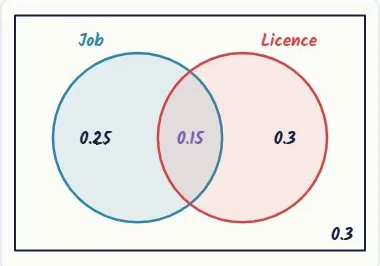
Question 3 · Merit
- Year 13 students at a Whangārei school:
- 40% have a part-time job, 45% have
- A driver licence, 15% have both.
- Find P(exactly one of the two).
Q3: each region
- Both goes in the middle.
- Circle minus the middle.
- both = 0.15the middle
- only job = 0.4 − 0.15 = 0.25
- only licence = 0.45 − 0.15 = 0.3
- neither = 1 − (0.25 + 0.15 + 0.3)
- = 1 − 0.7 = 0.3
- exactly one = 0.25 + 0.3only job or only licence
- = 0.55
- 0.4 + 0.45 = 0.85counts both twice
Try it: each region
Q3: the finished Venn
- Middle first, then each circle.
- Four regions, total 1.
Question 4 · Merit
- Visitors to a Rotorua park: 60% see
- The geysers, 45% the mud pools, and
- 80% see at least one of them.
- Complete the Venn diagram and table.
- Careful: 80% is "or", not "both".
Q4: both from "or"
- Addition rule first.
- Then the regions.
- P(G or M) = P(G) + P(M)addition rule
- − P(G and M)
- 0.8 = 0.6 + 0.45 − P(G and M)
- P(G and M) = 1.05 − 0.8 = 0.25
- only G = 0.6 − 0.25 = 0.35
- only M = 0.45 − 0.25 = 0.2
- neither = 1 − 0.8 = 0.2outside both
- 0.35 + 0.25 + 0.2 + 0.2 = 1
Q4: the same regions as a table
- Four regions, four cells.
- Totals match P(G) and P(M).
| Mud pools | No mud pools | Total | |
|---|---|---|---|
| Geysers | 0.25 | 0.35 | 0.6 |
| No geysers | 0.2 | 0.2 | 0.4 |
| Total | 0.45 | 0.55 | 1 |
Question 5 · Merit, in context
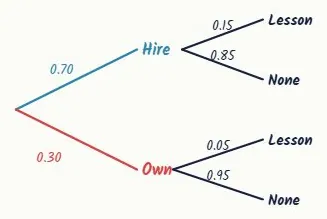
- At a ski field, 70% of visitors hire gear.
- Of those who hire, 15% book a lesson.
- Of the rest, 5% book a lesson.
- Expected lessons from 2000 visitors?
Q5: words into a tree
- First: hire 0.7, own gear 0.3.
- "Of those who hire": after hire.
- "Of the rest": after own.
Q5: multiply along, add across
- Two lesson paths.
- Then times 2000.
- hire, lesson: 0.7 × 0.15 = 0.105
- own, lesson: 0.3 × 0.05 = 0.015
- P(lesson) = 0.105 + 0.015both lesson paths
- = 0.12
- (0.15 + 0.05) ÷ 2 = 0.1ignores 70 : 30
- expected = 2000 × 0.12
- = 240
- about 240 lessons that day
Try it: words into a structure
Question 6 · Excellence
- 50 Year 13s: 22 take Chemistry and
- 18 take Physics. Three times as many
- Take neither as take both.
- Find P(a student takes exactly one).
Q6: an unknown in the middle
- Let both = x.
- Four regions total 50.
- let x = number taking both
- only C = 22 − x, only P = 18 − x
- neither = 3x
- (22 − x) + x + (18 − x) + 3x = 50
- 40 + 2x = 50
- x = 52x = 10
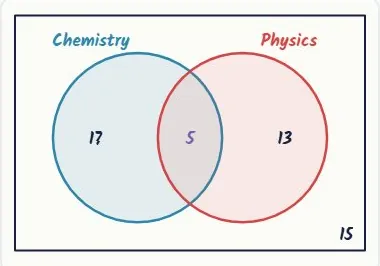
- only C 17, only P 13, neither 15
- P(exactly one) = (17 + 13) ÷ 50
- = 30 ÷ 50 = 0.6
Q6: check with the Venn
- Circles: 17 + 5 = 22, 5 + 13 = 18.
- Regions total 50.
Question 7 · Excellence
- X: the number of days a student's bus
- Is late in a school week.
- Find k, then P(X ≥ 2).
| x | 0 | 1 | 2 | 3 |
|---|---|---|---|---|
| P(X = x) | 0.3 | k | k² | 0.14 |
Q7: a quadratic in k
- Sums to 1: an equation.
- A probability is never < 0.
- 0.3 + k + k² + 0.14 = 1the table sums to 1
- k² + k − 0.56 = 0collect, then − 1
- (k − 0.4)(k + 1.4) = 0−0.4 × 1.4 = −0.56
- k = 0.4 or k = −1.4
- k = −1.4a probability is ≥ 0
- 0.3, 0.4, 0.16, 0.14total 1
- P(X ≥ 2) = 0.16 + 0.14
- = 0.3
Common mistakes
- 60% see the geysers, so 60% goes in the only-geysers region.Put the overlap in first, then subtract it to find the 'only' regions.
- 'At least 3' means X > 3.At least 3 includes 3: X ≥ 3.
- Keeping a negative k.A probability cannot be negative, so reject that solution and say why.
The structures that solved all seven
- Organise the words first, then check every set totals 1.
| Step | How |
|---|---|
| Two-way | gaps: total − known |
| Venn | middle first, then the rest |
| Tree | "of those" is a 2nd branch |
| P table | sums to 1, each from 0 to 1 |
| Unknown | form an equation, then check |
| Check | every set totals 1 or n |
Challenge
80 households in an invented Napier street were asked about pets. 20 have neither a cat nor a dog. The number with only a cat is twice the number with only a dog, and 60% of all households have a cat. Find P(a household has a dog | it has at least one of the two pets).
Hint
Let only dog = d and both = b, so only cat = 2d. Write one equation for the cat households and one for the total of all four regions.
Answer
Only dog 12, both 24, only cat 24, neither 20. P(dog | at least one) = 36 ÷ 60 = 0.6.
Step by step
- Let d be the number with only a dog and b the number with both, so only cat is 2d.
- 60% of 80 is 48 households with a cat: 2d + b = 48.
- The four regions total 80: 2d + b + d + 20 = 80, so 3d + b = 60.
- Subtracting the equations gives d = 12, then b = 24 and only cat = 24.
- Given at least one pet means 80 − 20 = 60 households, and 12 + 24 = 36 of them have a dog.
Full working
- only dog = d, both = b, only cat = 2dunknowns
- 2d + b = 0.6 × 80 = 48cat circle
- 2d + b + d + 20 = 80, so 3d + b = 60all four regions
- (3d + b) − (2d + b) = 60 − 48, d = 12subtract
- b = 48 − 24 = 24, only cat = 24back-substitute
- check: 24 + 24 + 12 + 20 = 80total
- dog = 12 + 24 = 36; at least one = 60the given group
- P(dog given at least one) = 36 ÷ 60 = 0.6
At an invented outdoor education camp, each of 60 students could try kayaking (K), climbing (C) and archery (A). 28 tried kayaking, 26 climbing and 24 archery. 10 tried both kayaking and climbing, 9 kayaking and archery, and 8 climbing and archery (these counts include anyone who tried all three). 5 students tried none. Draw a three-circle Venn diagram and find P(a student tried exactly one activity) and P(tried all three | tried at least two).
Hint
Let x be the number who tried all three and put it in the centre first. Each "both" count includes x, so each two-only region is that count minus x. All eight regions must total 60.
Answer
All three: 4. Exactly one: 13 + 12 + 11 = 36, so P = 0.6. At least two: 15 + 4 = 19, so P(all three | at least two) = 4 ÷ 19 = 0.2105.
Step by step
- Let x be all three. The two-only regions are 10 − x, 9 − x and 8 − x.
- Only K = 28 − (10 − x) − (9 − x) − x = 9 + x; only C = 8 + x; only A = 7 + x.
- Adding all eight regions: 51 + x + 5 = 60, so x = 4.
- Exactly one: 13 + 12 + 11 = 36 out of 60, which is 0.6.
- At least two: the two-only regions 6 + 5 + 4 = 15, plus 4 in the centre, makes 19. Of these, 4 tried all three.
Full working
- centre = x; K and C only = 10 − x, K and A only = 9 − x, C and A only = 8 − xmiddle first
- 28 + 26 + 24 − 10 − 9 − 8 + x = 51 + xin at least one circle
- 51 + x + 5 = 60, x = 4regions total 60
- only K = 28 − 6 − 5 − 4 = 13, only C = 26 − 6 − 4 − 4 = 12, only A = 24 − 5 − 4 − 4 = 11circle minus the rest
- check: 13 + 12 + 11 + 6 + 5 + 4 + 4 + 5 = 60total
- P(exactly one) = 36 ÷ 60 = 0.6one circle only
- at least two = 6 + 5 + 4 + 4 = 19given group
- P(exactly one) = 0.6; P(all three given at least two) = 4 ÷ 19 = 0.2105
A bag holds n counters, and 4 of them are red. Two counters are taken out at random, one after the other, without replacement. The probability that both are red is 215. Find n, then find the probability that exactly one of the two counters is red.
Hint
Draw the tree. On the second draw there is one fewer counter in the bag, and one fewer red if the first was red. Multiply along the red, red path and set it equal to 215.
Answer
n = 10 (n = −9 rejected). P(exactly one red) = 815 ≈ 0.5333.
Step by step
- P(red, then red) = (4n) × (3n − 1) = 12 ÷ (n(n − 1)).
- Set this equal to 215: 2n(n − 1) = 180, so n² − n − 90 = 0.
- Factorise: (n − 10)(n + 9) = 0, so n = 10 or n = −9. A number of counters cannot be negative, so n = 10.
- Exactly one red can happen two ways: red then not red, or not red then red.
- Each way is (410)(69) = 2490, so together 4890 = 815.
Full working
- P(R, R) = (4n) × (3n − 1)without replacement
- 12 ÷ (n(n − 1)) = 215given
- 2n(n − 1) = 180, n² − n − 90 = 0rearrange
- (n − 10)(n + 9) = 0factorise
- n = 10 (n = −9 rejected)counters cannot be negative
- check: (410)(39) = 1290 = 215matches
- P(R, not R) + P(not R, R) = (410)(69) + (610)(49)two paths
- = 2490 + 2490 = 4890 = 815 ≈ 0.5333
Practise this
Report a mistake
More in AS 91585
 Tables, trees and Venn diagrams from written information10 min
 Conditional probability from tables, trees and Venn diagrams9 min
 Independent or mutually exclusive? The two tests10 min
 Relative risk: times as likely, and when you need a ratio9 min
 True probability, model estimates and experimental estimates8 minOrganising information: 7 exam questions solved step by step11 min
 Conditional probability: 7 exam questions solved step by step10 min
 Independent or exclusive: 7 exam questions solved step by step10 min
 Relative risk: 7 exam questions solved step by step10 min
 Probability estimates: 7 exam questions solved step by step9 min
Is your child on track?
Take the free placement test