Finding the equation from a graph
What this lesson covers
- Roots suggest y = k(x − a)(x − b).
- A vertex suggests y = k(x − h)² + c.
- One extra point finds k.
Choose the form that fits
- If you can see the roots, use the factorised form.
- If you can see the turning point, use the vertex form.
- Either way, substitute one more point to find k.
Roots 1 and 5, through (0, 10)
- The roots go in the brackets.
- y = k(x − 1)(x − 5)
- 10 = k(−1)(−5) = 5kuse (0, 10)
- k = 2
- y = 2(x − 1)(x − 5)
Try it: roots 1 and 5
Vertex (2, 3), through (0, 11)
- The vertex goes in the bracket and on the end.
- y = k(x − 2)² + 3
- 11 = 4k + 3
- k = 2
- y = 2(x − 2)² + 3
Cubic with roots −1, 2 and 3, through (0, 12)
- The same idea with a third bracket.
- y = k(x + 1)(x − 2)(x − 3)
- 12 = k(1)(−2)(−3) = 6k
- k = 2
- y = 2(x + 1)(x − 2)(x − 3)
Use what you can see
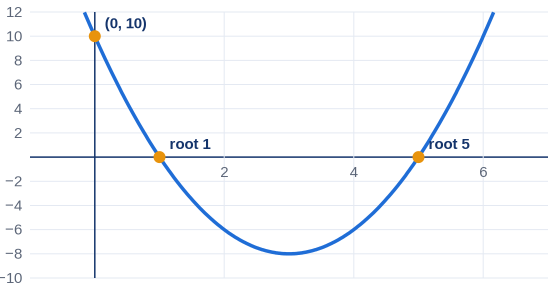
- This graph shows two roots and a y-intercept, so the factorised form suits it.
Try it: match the graph
A hyperbola
- Asymptotes x = 1 and y = 2, through (2, 5).
- y = k/(x − 1) + 2
- 5 = k + 2
- k = 3
- y = 3/(x − 1) + 2
An exponential
- Asymptote y = 3, through (0, 5), doubling.
- y = a × 2ˣ + 3
- 5 = a + 3
- y = 2 × 2ˣ + 3
Graphing calculator
Common mistakes
- Leaving k out and assuming it is 1.Always test with another point on the graph.
- Writing (x − 2) for a root at −2.A root at −2 gives the bracket (x + 2).
Try it: pin down the equation
Your turn
Roots 2 and 3, through (0, 12). Find the equation.
Vertex (0, 4), through (1, 6). Find the equation.
Asymptote y = 1, through (0, 4), base 2. Find the equation.
Touches the x-axis at 2, through (0, 8). Find the equation.
A parabola has roots 1 and 5 and its vertex is (3, −8). Find the equation.
Asymptotes x = 2 and y = −1, through (3, 4). Find the equation.
Vertex (3, 8), through (1, 0). Find the equation.
A cubic touches the x-axis at 1, crosses it at −3 and passes through (0, 6). Find the equation.
Show answer
1. y = 2(x − 2)(x − 3) 2. y = 2x² + 4 3. y = 3 × 2ˣ + 1 4. y = 2(x − 2)² 5. y = 2(x − 1)(x − 5). The roots give y = k(x − 1)(x − 5), and the vertex (3, −8) gives −8 = k(2)(−2) = −4k, so k = 2. 6. y = 5/(x − 2) − 1. Start from y = k/(x − 2) − 1, then (3, 4) gives 4 = k − 1, so k = 5. 7. y = −2(x − 3)² + 8. Start from y = k(x − 3)² + 8, then (1, 0) gives 0 = 4k + 8, so k = −2. 8. y = 2(x − 1)²(x + 3). Touching at 1 means a squared bracket, so y = k(x − 1)²(x + 3), and (0, 6) gives 6 = 3k, so k = 2.
Sample question: Achieved
A parabola has roots x = −1 and x = 4 and passes through (2, −12). Find its equation.
Hint
Put the roots in the brackets of y = k(x − a)(x − b), then substitute the point to find k.
Answer
y = 2(x + 1)(x − 4)
Step by step
- The roots are visible, so use the factorised form y = k(x − a)(x − b).
- A root of −1 gives the bracket (x + 1). A root of 4 gives (x − 4). So y = k(x + 1)(x − 4).
- Substitute (2, −12): −12 = k(3)(−2) = −6k.
- So k = 2.
- The equation is y = 2(x + 1)(x − 4).
- Classic mistake: writing (x − 1) for the root −1. The bracket is zero at the root, so −1 needs (x + 1).
- Check: x = 2 gives 2 × 3 × (−2) = −12. Correct.
Full working
- y = k(x + 1)(x − 4)factorised form
- −12 = k(3)(−2)substitute (2, −12)
- k = 2
- y = 2(x + 1)(x − 4)
Sample questions: Merit
A parabola has vertex (3, −2) and crosses the y-axis at 16. Find its equation, and then find its roots.
Hint
Use y = k(x − h)² + c with the vertex, and the point (0, 16) to find k.
Answer
y = 2(x − 3)² − 2; roots x = 2 and x = 4
Step by step
- A known vertex means the vertex form y = k(x − h)² + c, with (h, c) = (3, −2).
- So y = k(x − 3)² − 2.
- Crossing the y-axis at 16 means the point (0, 16) is on it: 16 = k(0 − 3)² − 2 = 9k − 2.
- 9k = 18, so k = 2. The equation is y = 2(x − 3)² − 2.
- Roots: set y = 0. 2(x − 3)² = 2, so (x − 3)² = 1.
- x − 3 = 1 or x − 3 = −1, so x = 4 or x = 2.
- Classic mistake: forgetting the negative square root and finding only x = 4.
- Check: the vertex x = 3 should sit halfway between the roots. (2 + 4) ÷ 2 = 3. Correct.
Full working
- y = k(x − 3)² − 2vertex form
- 16 = 9k − 2, so k = 2substitute (0, 16)
- 2(x − 3)² − 2 = 0roots
- (x − 3)² = 1, so x = 2 or x = 4
- y = 2(x − 3)² − 2; roots x = 2 and x = 4
The graph of y = a × bˣ + c has horizontal asymptote y = 2 and passes through (0, 7) and (2, 47), with b > 0. Find a, b and c.
Hint
The asymptote gives c straight away. Then x = 0 makes bˣ = 1, which gives a.
Answer
a = 5, b = 3 and c = 2, so y = 5 × 3ˣ + 2
Step by step
- For y = a × bˣ + c, the term a × bˣ never reaches 0, so the asymptote is y = c. Here c = 2.
- Use (0, 7): b⁰ = 1, so 7 = a × 1 + 2 and a = 5.
- Use (2, 47): 47 = 5b² + 2.
- 5b² = 45, so b² = 9 and b = 3. We reject b = −3, because an exponential base must be positive.
- The equation is y = 5 × 3ˣ + 2.
- Classic mistake: substituting (0, 7) as 7 = a × 0 + 2. Any positive number to the power 0 is 1, not 0.
- Check: x = 2 gives 5 × 9 + 2 = 47. Correct.
Full working
- c = 2asymptote y = c
- 7 = a × b⁰ + 2 = a + 2, so a = 5substitute (0, 7)
- 47 = 5b² + 2, so b² = 9substitute (2, 47)
- b = 3b > 0
- y = 5 × 3ˣ + 2
Sample questions: Excellence
A cubic touches the x-axis at x = 2, crosses it at x = −1, and passes through (1, 4). Find its equation and y-intercept. Hence find where it meets the line y = 8, and explain what the repeated answer tells you about the line.
Hint
Touching the axis at x = 2 means a squared bracket (x − 2)². Use the point to find k, then solve the cubic equation by factorising.
Answer
y = 2(x − 2)²(x + 1), y-intercept 8; it meets y = 8 at x = 0 (a repeated root, so the line touches the curve there) and at x = 3
Step by step
- Touching the x-axis without crossing means a repeated root: the bracket is squared. So y = k(x − 2)²(x + 1).
- Use (1, 4): 4 = k(1 − 2)²(1 + 1) = k × 1 × 2 = 2k, so k = 2.
- The cubic is y = 2(x − 2)²(x + 1). Its y-intercept: x = 0 gives 2 × 4 × 1 = 8.
- Now meet y = 8: 2(x − 2)²(x + 1) = 8, so (x − 2)²(x + 1) = 4.
- Expand: (x² − 4x + 4)(x + 1) = x³ − 3x² + 0x + 4.
- So x³ − 3x² + 4 = 4, which gives x³ − 3x² = 0.
- Factorise: x²(x − 3) = 0, so x = 0 (twice) or x = 3.
- At x = 3: y = 2 × 1 × 4 = 8. So the points are (0, 8) and (3, 8).
- A repeated root means the line does not cross the curve at x = 0; it just touches it. So y = 8 is a tangent at the y-intercept, which is a turning point of the cubic.
- Classic mistake: dividing x³ − 3x² = 0 by x². That loses x = 0, the most interesting answer.
- Check: the roots −1 and 2 still give y = 0, and (1, 4) gives 2 × 1 × 2 = 4.
Full working
- y = k(x − 2)²(x + 1)touch at 2, cross at −1
- 4 = k(1)(2), so k = 2substitute (1, 4)
- x = 0: y = 2(4)(1) = 8y-intercept
- (x − 2)²(x + 1) = 4, so x³ − 3x² = 0meet y = 8
- x²(x − 3) = 0, so x = 0 (repeated) or x = 3
- y = 2(x − 2)²(x + 1), y-intercept 8; meets y = 8 at (0, 8), where it touches, and (3, 8)
A parabola y = ax² + bx + c passes through (−1, 8), (1, 2) and (3, 4). Find a, b and c, find the vertex, and prove that the parabola never meets the x-axis.
Hint
Substitute each point to get three equations. Subtracting the first two removes a and c at once.
Answer
y = x² − 3x + 4; vertex (1.5, 1.75); the discriminant is 9 − 16 = −7 < 0, so there are no roots
Step by step
- Each point gives one equation. (−1, 8): a − b + c = 8. (1, 2): a + b + c = 2. (3, 4): 9a + 3b + c = 4.
- Take the first from the second: 2b = −6, so b = −3.
- Put b = −3 in the second: a + c = 5.
- Put b = −3 in the third: 9a + c = 13.
- Take a + c = 5 from 9a + c = 13: 8a = 8, so a = 1 and then c = 4.
- The parabola is y = x² − 3x + 4.
- Vertex: complete the square. x² − 3x + 4 = (x − 1.5)² − 2.25 + 4 = (x − 1.5)² + 1.75. The vertex is (1.5, 1.75).
- Never meets the x-axis: the discriminant is b² − 4ac = 9 − 16 = −7. It is negative, so x² − 3x + 4 = 0 has no real solutions.
- Another way to see it: a = 1 is positive, so the vertex is the lowest point, and it is 1.75 above the axis.
- Check all three points: (−1): 1 + 3 + 4 = 8. (1): 1 − 3 + 4 = 2. (3): 9 − 9 + 4 = 4. All correct.
Full working
- a − b + c = 8, a + b + c = 2, 9a + 3b + c = 4substitute the points
- 2b = −6, so b = −3second minus first
- a + c = 5 and 9a + c = 13, so a = 1, c = 4
- y = (x − 1.5)² + 1.75complete the square
- b² − 4ac = 9 − 16 = −7 < 0no real roots
- y = x² − 3x + 4, vertex (1.5, 1.75), never meets the x-axis
What to take away
- Pick the form that matches what you can see.
- One extra point always gives k.
Challenge
The graph of y = a × bˣ + c passes through (1, 11), (2, 29) and (3, 83). Its asymptote is not given. Find a, b and c, and state the asymptote.
Hint
Take each y value from the next one. The c cancels in every difference, and the differences grow by a constant ratio.
Answer
a = 3, b = 3, c = 2, so y = 3 × 3ˣ + 2, with asymptote y = 2
Step by step
- Subtracting neighbouring points removes c: 29 − 11 = ab² − ab and 83 − 29 = ab³ − ab².
- So ab(b − 1) = 18 and ab²(b − 1) = 54.
- Divide the second by the first: b = 54 ÷ 18 = 3.
- Then a × 3 × 2 = 18, so a = 3.
- Use (1, 11): 11 = 3 × 3 + c, so c = 2. The asymptote is y = c, so y = 2.
- Check (3, 83): 3 × 27 + 2 = 83. Correct.
Full working
- 29 − 11 = ab(b − 1) = 18c cancels
- 83 − 29 = ab²(b − 1) = 54c cancels
- b = 54 ÷ 18 = 3divide
- 3a × 2 = 18, so a = 3substitute b
- 11 = 9 + c, so c = 2use (1, 11)
- y = 3 × 3ˣ + 2, asymptote y = 2
A hyperbola of the form y = kx − a + b passes through (2, 5), (3, 3) and (5, 2). Find k, a and b. Then explain why the fact that both (2, 5) and (5, 2) lie on the curve fits the answer.
Hint
Rewrite the equation as (x − a)(y − b) = k and multiply out. Subtracting the equations for two points removes both k and ab.
Answer
k = 4, a = 1, b = 1, so y = 4x − 1 + 1; the asymptotes cross at (1, 1) on the line y = x, and the curve is symmetric in y = x, so swapping x and y in any point gives another point on it
Step by step
- Multiply out (x − a)(y − b) = k: xy − bx − ay + ab = k. Each point gives one equation.
- (2, 5): 10 − 2b − 5a + ab = k. (3, 3): 9 − 3b − 3a + ab = k. (5, 2): 10 − 5b − 2a + ab = k.
- First minus second: 1 + b − 2a = 0. Third minus second: 1 − 2b + a = 0.
- From the first, b = 2a − 1. Substitute: 1 − 4a + 2 + a = 0, so a = 1 and b = 1. Then k = 9 − 3 − 3 + 1 = 4.
- The equation (x − 1)(y − 1) = 4 stays the same if x and y swap, so the graph is its own mirror image in y = x.
- That is why (2, 5) and its swap (5, 2) are both on it. Check (3, 3): 4 ÷ 2 + 1 = 3. Correct.
Full working
- xy − bx − ay + ab = kfrom (x − a)(y − b) = k
- 1 + b − 2a = 0(2, 5) minus (3, 3)
- 1 − 2b + a = 0(5, 2) minus (3, 3)
- a = 1, b = 1solve together
- k = (3 − 1)(3 − 1) = 4use (3, 3)
- y = 4x − 1 + 1, symmetric in the line y = x
A parabola passes through (0, 7) and (4, 7), and the line y = 2x − 2 touches it at exactly one point. Find every parabola that fits, and the touching point for each.
Hint
The two points at the same height give the axis of symmetry, so start from y = a(x − 2)² + q. Use (0, 7) to link a and q, then make the meeting equation with the line have a repeated root.
Answer
Two parabolas: y = (x − 2)² + 3, touching at (3, 4), and y = (14)(x − 2)² + 6, touching at (6, 10)
Step by step
- (0, 7) and (4, 7) are at the same height, so the axis is halfway between: x = 2. Write y = a(x − 2)² + q.
- (0, 7) gives 4a + q = 7.
- Meet the line: a(x − 2)² + q = 2x − 2. Expand and use q = 7 − 4a: ax² − (4a + 2)x + 9 = 0.
- Touching means a repeated root: (4a + 2)² − 36a = 0, which simplifies to 16a² − 20a + 4 = 0, or 4(4a − 1)(a − 1) = 0.
- a = 1 gives q = 3 and x² − 6x + 9 = 0, so it touches at x = 3, y = 4. a = 14 gives q = 6 and (14)x² − 3x + 9 = 0, so x² − 12x + 36 = 0 and it touches at x = 6, y = 10.
- Classic mistake: stopping at one answer. The discriminant condition is a quadratic in a, so there are two parabolas.
Full working
- y = a(x − 2)² + qaxis x = 2
- 4a + q = 7use (0, 7)
- ax² − (4a + 2)x + 9 = 0meet y = 2x − 2
- (4a + 2)² − 36a = 4(4a − 1)(a − 1) = 0repeated root
- a = 1, q = 3: (x − 3)² = 0, point (3, 4)first parabola
- a = 14, q = 6: (x − 6)² = 0, point (6, 10)second parabola
- y = (x − 2)² + 3 touching at (3, 4); y = (14)(x − 2)² + 6 touching at (6, 10)
Report a mistake
More in AS 91257
Is your child on track?
Take the free placement test