Families of graphs
What this lesson covers
- Parabolas have roots and a vertex.
- Exponential graphs have a horizontal asymptote.
- Hyperbolas have one vertical and one horizontal asymptote.
Four shapes to recognise
- Each family has its own outline.
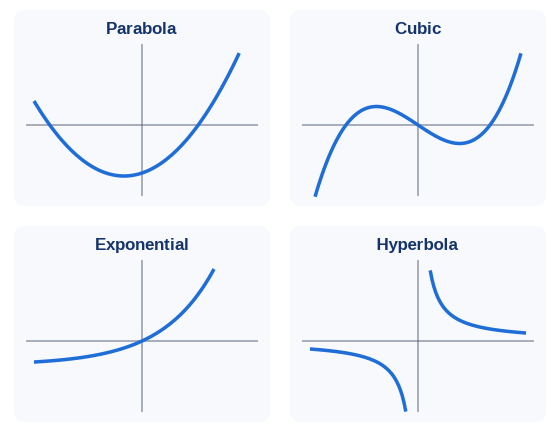
Try it: five families
The families
- Name the family, then find its features.
| Equation | Shape | Look for |
|---|---|---|
| y = (x − a)(x − b) | Parabola | Roots a and b, vertex halfway |
| y = (x − a)(x − b)(x − c) | Cubic | Three roots |
| y = 2ˣ + c | Exponential | Asymptote y = c |
| y = k/(x − a) + b | Hyperbola | Asymptotes x = a and y = b |
A parabola: y = x² − 4x + 3
- Factorise for the roots, and use symmetry for the vertex.
- y = (x − 1)(x − 3)
- roots at x = 1 and x = 3
- y-intercept = 3put x = 0
- vertex at x = 2, y = −1halfway between the roots
Try it: a parabola from its roots
A hyperbola: y = 1/(x − 2) + 3
- The bottom cannot be zero, and the fraction never reaches zero.
- vertical asymptote x = 2
- horizontal asymptote y = 3
- y-intercept: 1/(−2) + 3 = 2.5
A cubic
- y = (x + 1)(x − 1)(x − 3).
- roots at −1, 1 and 3
- y-intercept: (1)(−1)(−3) = 3
Graphing calculator
Try it: graph detective
Common mistakes
- Drawing a curve that crosses an asymptote of y = 2ˣ + 1.The curve gets close to y = 1 and never reaches it.
- Reading x − 2 as an asymptote at x = −2.Set x − 2 = 0, which gives x = 2.
Your turn
Find the roots of y = (x − 2)(x + 4).
State the asymptote of y = 3ˣ − 2.
State the vertex of y = (x − 3)² + 1.
State the vertical asymptote of y = 1/(x + 1).
Find the y-intercept of y = (x − 2)(x + 1)(x + 3).
Find the vertex of y = (x + 1)(x − 5).
A hyperbola has asymptotes x = 3 and y = −1. Which equation could it be?
A graph crosses the y-axis at 5 and, as x becomes very negative, gets ever closer to y = 4 without reaching it. Which equation fits?
Show answer
1. 2 and −4 2. y = −2 3. (3, 1) 4. x = −1 5. −6. Put x = 0: (−2)(1)(3) = −6. 6. (2, −9). The roots are −1 and 5, so the vertex is halfway at x = 2, and y = (3)(−3) = −9. 7. y = 2/(x − 3) − 1. In y = k/(x − a) + b the asymptotes are x = a and y = b, so a = 3 and b = −1. 8. y = 2ˣ + 4. It is exponential with asymptote y = 4, and at x = 0 it gives 1 + 4 = 5.
Sample question: Achieved
For y = x² − 6x + 5, find the roots, the y-intercept and the vertex.
Hint
Factorise for the roots. The vertex is halfway between the roots.
Answer
Roots x = 1 and x = 5; y-intercept 5; vertex (3, −4)
Step by step
- This is a parabola, so its features are roots, a y-intercept and a vertex.
- Factorise: find two numbers that multiply to 5 and add to −6. They are −1 and −5, so y = (x − 1)(x − 5).
- Roots: y = 0 when x = 1 or x = 5.
- y-intercept: put x = 0, giving y = 5.
- A parabola is symmetric, so the vertex is halfway between the roots: x = (1 + 5) ÷ 2 = 3.
- y = 9 − 18 + 5 = −4, so the vertex is (3, −4).
- Check: completing the square gives (x − 3)² − 4, which has vertex (3, −4) as well.
Full working
- y = (x − 1)(x − 5)factorise
- roots x = 1, x = 5
- x = 0: y = 5y-intercept
- x = 3: y = 9 − 18 + 5 = −4vertex halfway between the roots
- roots 1 and 5, y-intercept 5, vertex (3, −4)
Sample questions: Merit
For y = x + 2x − 1, write it in the form y = ax − 1 + c. Hence state the asymptotes and find both intercepts.
Hint
Write the top as (x − 1) + 3 and split the fraction into two parts.
Answer
y = 3x − 1 + 1; asymptotes x = 1 and y = 1; intercepts (0, −2) and (−2, 0)
Step by step
- The asymptotes are easy to read once the graph is in the form ax − 1 + c, so rearrange first.
- Make the top match the bottom: x + 2 = (x − 1) + 3.
- Split: x + 2x − 1 = x − 1x − 1 + 3x − 1 = 1 + 3x − 1.
- Vertical asymptote: the bottom cannot be zero, so x ≠ 1. The asymptote is x = 1.
- Horizontal asymptote: 3x − 1 gets close to 0 but never reaches it, so y gets close to 1. The asymptote is y = 1.
- y-intercept: x = 0 gives y = 2 ÷ (−1) = −2.
- x-intercept: y = 0 means the top is zero, x + 2 = 0, so x = −2.
- Classic mistake: reading the horizontal asymptote as y = 0. Here the + 1 shifts it up to y = 1.
- Check the rearranged form: x = 0 gives 3−1 + 1 = −2. It matches.
Full working
- x + 2 = (x − 1) + 3match the bottom
- y = 3x − 1 + 1split the fraction
- asymptotes x = 1 and y = 1
- x = 0: y = 2−1 = −2
- y = 0: x + 2 = 0, so x = −2
- asymptotes x = 1, y = 1; intercepts (0, −2) and (−2, 0)
For the cubic y = −(x − 1)(x + 2)(x − 4), find the roots and the y-intercept, and find the values of x for which y > 0.
Hint
Read the roots from the brackets. The minus sign out the front means the graph starts high on the left and ends low on the right.
Answer
Roots −2, 1 and 4; y-intercept −8; y > 0 when x < −2 or 1 < x < 4
Step by step
- A cubic in factorised form shows its roots directly: each bracket is zero at one value.
- Roots: x = 1, x = −2 and x = 4.
- y-intercept: x = 0 gives −(−1)(2)(−4) = −8.
- Now the shape. Multiplying out would start with −x³. A negative x³ cubic comes down from the top left and goes off to the bottom right.
- So, reading left to right, the graph is above the axis before x = −2, below between −2 and 1, above between 1 and 4, and below after 4.
- That gives y > 0 for x < −2 or 1 < x < 4.
- Check one point in each part: x = −3 gives −(−4)(−1)(−7) = 28 > 0. x = 2 gives −(1)(4)(−2) = 8 > 0. x = 0 gave −8 < 0. All fit.
- Classic mistake: ignoring the minus sign at the front. Without it, every sign above would flip.
Full working
- roots x = −2, 1, 4each bracket zero
- x = 0: y = −(−1)(2)(−4) = −8
- leading term −x³starts high, ends low
- x = −3: y = 28 > 0; x = 2: y = 8 > 0test each part
- y > 0 for x < −2 or 1 < x < 4
Sample questions: Excellence
The parabola y = x² − kx + 9 depends on k. Find the values of k for which it has two roots. Find the values of k for which its vertex lies on the x-axis, and give the vertex in each case.
Hint
The number of roots depends on the discriminant b² − 4ac. The vertex is on the x-axis when there is exactly one root.
Answer
Two roots when k < −6 or k > 6; the vertex is on the x-axis when k = 6, vertex (3, 0), or k = −6, vertex (−3, 0)
Step by step
- The roots come from solving x² − kx + 9 = 0. The discriminant b² − 4ac decides how many there are.
- Here a = 1, b = −k and c = 9, so the discriminant is k² − 36.
- Two roots: k² − 36 > 0, so k² > 36.
- Careful: k² > 36 does not just mean k > 6. It also holds for k < −6, for example k = −7 gives 49.
- So there are two roots when k < −6 or k > 6.
- The vertex sits on the x-axis when the parabola just touches it: one repeated root, discriminant 0. So k² = 36 and k = ±6.
- k = 6: y = x² − 6x + 9 = (x − 3)², vertex (3, 0).
- k = −6: y = x² + 6x + 9 = (x + 3)², vertex (−3, 0).
- In general the vertex is at x = k2. Between k = −6 and k = 6 the vertex is above the axis and there are no roots.
- Check k = 7: x² − 7x + 9 has discriminant 49 − 36 = 13 > 0, so two roots, as expected.
Full working
- discriminant = (−k)² − 4(1)(9) = k² − 36
- two roots: k² − 36 > 0discriminant positive
- k < −6 or k > 6
- vertex on the axis: k² − 36 = 0, so k = ±6one repeated root
- k = 6: (x − 3)², vertex (3, 0); k = −6: (x + 3)², vertex (−3, 0)
- two roots for k < −6 or k > 6; k = ±6 gives vertex (±3, 0)
Find the exact points where y = 6x − 1 + 3 meets the line y = x + 2. Show that the midpoint of these two points is where the asymptotes of the hyperbola cross, and explain why.
Hint
Set the two expressions equal and take 3 from both sides first. Then multiply by (x − 1).
Answer
The points are (1 + √6, 3 + √6) and (1 − √6, 3 − √6); their midpoint is (1, 3), the asymptote crossing, because the hyperbola has half-turn symmetry about (1, 3) and the line passes through (1, 3)
Step by step
- Where graphs meet, their y values are equal: 6x − 1 + 3 = x + 2.
- Take 3 from both sides: 6x − 1 = x − 1.
- Multiply both sides by (x − 1): 6 = (x − 1)².
- So x − 1 = ±√6, giving x = 1 + √6 or x = 1 − √6. Both values are allowed, because neither is x = 1.
- y = x + 2 gives y = 3 + √6 and y = 3 − √6.
- Midpoint: x is (1 + √6 + 1 − √6) ÷ 2 = 1, and y is (3 + √6 + 3 − √6) ÷ 2 = 3. So the midpoint is (1, 3).
- The asymptotes are x = 1 (the bottom is zero there) and y = 3 (the fraction never reaches 0). They cross at (1, 3).
- Why: a hyperbola like this looks the same after a half turn about the point where its asymptotes cross.
- The line passes through (1, 3) too, since 1 + 2 = 3. So the half turn swaps the two meeting points, and (1, 3) is exactly halfway between them.
- Classic mistake: forgetting the negative square root and finding only one point.
Full working
- 6x − 1 + 3 = x + 2equal y values
- 6 = (x − 1)²take 3, multiply by (x − 1)
- x = 1 ± √6, y = 3 ± √6
- midpoint = ((1 + √6 + 1 − √6) ÷ 2, (3 + √6 + 3 − √6) ÷ 2) = (1, 3)
- asymptotes x = 1 and y = 3 cross at (1, 3); the line passes through ithalf-turn symmetry
- (1 + √6, 3 + √6) and (1 − √6, 3 − √6), midpoint (1, 3)
What to take away
- Name the family before you draw.
- Every family has its own features to find.
Challenge
A cubic of the form y = (x − a)(x − b)(x − c) has three roots equally spaced along the x-axis. The middle root is x = 2 and the y-intercept is 10. Find the three roots and the values of x for which y < 0. Then show that the points on the curve at x = 2 + t and x = 2 − t always have heights that are opposites, and say what this tells you about the shape.
Hint
Call the roots 2 − d, 2 and 2 + d. Put x = 0 into y = (x − 2 + d)(x − 2)(x − 2 − d) and solve for d. For the last part, write the cubic in terms of x − 2.
Answer
Roots −1, 2 and 5; y < 0 when x < −1 or 2 < x < 5; heights t³ − 9t and −(t³ − 9t), so the cubic has half-turn symmetry about (2, 0)
Step by step
- Equally spaced roots with the middle one at 2 can be written 2 − d, 2 and 2 + d, with d > 0.
- Pair the outer brackets: (x − 2 + d)(x − 2 − d) = (x − 2)² − d², so y = (x − 2)((x − 2)² − d²).
- x = 0 gives y = (−2)(4 − d²) = 10, so 4 − d² = −5 and d² = 9. With d > 0, d = 3, so the roots are −1, 2 and 5.
- The cubic starts with +x³, so it comes up from the bottom left. It is below the axis before −1, above between −1 and 2, below between 2 and 5, and above after 5.
- Put x = 2 + t: y = t(t² − 9) = t³ − 9t. Put x = 2 − t: y = (−t)(t² − 9) = −(t³ − 9t). The heights are always opposites.
- So a half turn about (2, 0) maps the curve onto itself: the middle root is the centre of the cubic.
Full working
- y = (x − 2)((x − 2)² − d²)roots 2 − d, 2, 2 + d
- (−2)(4 − d²) = 10, so d² = 9, d = 3y-intercept 10
- roots −1, 2, 52 ∓ 3
- x = −2: y = −28; x = 3: y = −8test points below the axis
- y(2 + t) = t³ − 9t, y(2 − t) = −(t³ − 9t)substitute
- roots −1, 2, 5; y < 0 for x < −1 or 2 < x < 5; half-turn symmetry about (2, 0)
For each value of k, the graph y = x² − 2kx + k² + k − 2 is a parabola. Show that, whatever k is, its vertex lies on the line y = x − 2. Then find all values of k for which the parabola has one positive root and one negative root.
Hint
Group x² − 2kx + k² as a perfect square to read off the vertex. For the roots, think about where the y-intercept must be if an upward parabola crosses the x-axis on both sides of the y-axis.
Answer
y = (x − k)² + k − 2, so the vertex (k, k − 2) is always on y = x − 2; one positive and one negative root when −2 < k < 1
Step by step
- x² − 2kx + k² is (x − k)², so y = (x − k)² + k − 2. The vertex is (k, k − 2).
- Its y value is always 2 less than its x value, so every vertex lies on the line y = x − 2.
- The parabola opens upwards. If it crosses the x-axis once to the left of the y-axis and once to the right, then at x = 0 it must be below the axis. So the y-intercept must be negative.
- The reverse is also true: an upward parabola below the axis at x = 0 must rise above it on both sides, giving one negative and one positive root.
- y-intercept: k² + k − 2 = (k + 2)(k − 1) < 0. This is negative only between its roots, so −2 < k < 1.
- Check k = 0: y = x² − 2, roots ±√2, one each side. At k = 1 the y-intercept is 0, so one root is 0 itself, which is not allowed.
Full working
- y = (x − k)² + k − 2complete the square
- vertex (k, k − 2), and k − 2 = x − 2 at x = kon y = x − 2
- roots either side of 0, which means y-intercept < 0, and the reverse is true tooparabola opens upwards
- k² + k − 2 = (k + 2)(k − 1) < 0y-intercept
- −2 < k < 1between the roots of the quadratic in k
- vertex always on y = x − 2; one positive and one negative root for −2 < k < 1
The hyperbola y = 4x − 1 + 2 and the line y = k − x are drawn on the same axes. Find the values of k for which the line touches the hyperbola at exactly one point, and find each touching point. Then explain why no line of the form y = x + k can ever touch this hyperbola.
Hint
Let u = x − 1 so the fraction becomes 4u. Set the two y values equal, multiply by u and get a quadratic in u. Touching means exactly one solution.
Answer
k = 7, touching at (3, 4), and k = −1, touching at (−1, 0); for y = x + k the discriminant is (k − 1)² + 16, which is always positive, so such a line always cuts the hyperbola twice
Step by step
- With u = x − 1, the line is y = k − (u + 1). Setting the y values equal: 4u + 2 = k − u − 1.
- Multiply by u (u is never 0): 4 + 2u = (k − 1)u − u², so u² + (3 − k)u + 4 = 0.
- One touching point means one repeated solution: discriminant (3 − k)² − 16 = 0, so 3 − k = ±4 and k = −1 or k = 7.
- k = 7: u² − 4u + 4 = (u − 2)² = 0, so u = 2, x = 3, y = 7 − 3 = 4. k = −1: u² + 4u + 4 = (u + 2)² = 0, so u = −2, x = −1, y = 0.
- For y = x + k: 4u + 2 = u + 1 + k gives u² + (k − 1)u − 4 = 0. Its discriminant (k − 1)² + 16 is at least 16, never 0.
- So a line of gradient 1 always meets the hyperbola at two points, one on each branch, and never just touches it.
Full working
- 4u + 2 = k − u − 1u = x − 1
- u² + (3 − k)u + 4 = 0multiply by u
- (3 − k)² − 16 = 0, so k = 7 or k = −1one repeated root
- k = 7: (u − 2)² = 0, point (3, 4); k = −1: (u + 2)² = 0, point (−1, 0)touching points
- y = x + k: u² + (k − 1)u − 4 = 0, discriminant (k − 1)² + 16 > 0always two points
- k = 7 at (3, 4) and k = −1 at (−1, 0); lines y = x + k always cross twice
Practise this
Report a mistake
More in AS 91257
Is your child on track?
Take the free placement test