Joint events, and why you cannot just add probabilities
What this lesson covers
- In joint events, events can be dependent or independent.
- Probabilities for joint events cannot simply be added, because doing so would double-count outcomes that are common to both events.
- Mutually exclusive events cannot occur together.
- The estimated probability of an event from an experiment is the number of times the event happens divided by the total number of trials in the experiment (i.e. the relative frequency for that event).
A calculation that proves something impossible
- Correct arithmetic, reasonable method, absurd answer.
- Watching it fail is the fastest way to learn the rule.
- So here it is.
Roll a die. Even, or greater than three?
- Even is 2, 4, 6. That is three out of six, so a half.
- Greater than three is 4, 5, 6. Also a half.
- Add them and you get 1. So it is certain.
| Event | Outcomes | Probability |
|---|---|---|
| P(even) | 2, 4, 6 | 3/6 |
| P(greater than 3) | 4, 5, 6 | 3/6 |
| Add them | 3/6 + 3/6 | 1 |
| So it is certain? | roll a 1 and it is neither | so no |
Except it clearly is not certain
- Roll a 1. It is not even, and it is not greater than three.
- So the event failed, and we just calculated it could not.
- The arithmetic was right. The method was wrong.
Try it: run an experiment
Look at what got counted twice
- Even was 2, 4, 6. Greater than three was 4, 5, 6.
- The 4 and the 6 are in both lists.
- Adding counts each of them once, and then again.
| List | Outcomes | Note |
|---|---|---|
| In the even list | 2, 4, 6 | |
| In the over-3 list | 4, 5, 6 | |
| In both | 4 and 6 | counted twice |
| So subtract them once | 3/6 + 3/6 − 2/6 | 4/6 |
Try it: count the overlap once
So list them and count once
- Either event happens for 2, 4, 5 and 6.
- Four outcomes out of six. Two thirds.
- And the 1 is in neither, which is exactly why 1 was impossible.
| Step | Detail | Value |
|---|---|---|
| Either event happens for | 2, 4, 5, 6 | 4 outcomes |
| Out of | 6 | |
| So | 4/6 | 2/3 |
| And the 1 | is in neither | which is why 1 was wrong |
But sometimes adding is exactly right
- Roll a 2, or roll a 5. Can both happen on one roll? No.
- No shared outcomes, so nothing gets double-counted.
- A sixth plus a sixth is two sixths, and that is correct.
| Events | Overlap | Result |
|---|---|---|
| Roll a 2, or roll a 5 | no outcome is in both | mutually exclusive |
| So | 1/6 + 1/6 | 2/6 |
| Even, or odd | nothing is both | also exclusive |
| So | 1/2 + 1/2 = 1 | and that one is correct |
One question to ask before you add
- Can both of these happen at the same time?
- If no, they are mutually exclusive and you can add.
- If yes, there is an overlap and you must take it off once.
| Answer | What to do | |
|---|---|---|
| Ask | can both happen at once? | |
| No | mutually exclusive, add freely | |
| Yes | there is an overlap, so subtract it | |
| Not sure | list the outcomes |
Now a completely different question
- Does one event change the probability of the other?
- Two coin tosses: no. The second is a half regardless.
- Drawing counters and keeping them out: yes, it does.
| Kind | Meaning | Example |
|---|---|---|
| Independent | one does not affect the other | two coin tosses |
| Dependent | one changes the other | drawing without replacing |
| Bag of 5 red, 3 blue | first draw is 5/8 red | |
| Keep the red out | second draw is 4/7 | the odds moved |
Five red and three blue in a bag
- First draw: five reds out of eight, so five eighths.
- Take a red out and keep it. Now there are four reds of seven.
- The first draw changed the second. That is dependence.
Try it: keep the first one out
And these two words are not the same thing
- Mutually exclusive: can both happen at once?
- Independent: does one affect the other?
- Different questions. They get confused constantly.
| Term | The question it answers | Note |
|---|---|---|
| Mutually exclusive | about whether both can happen | |
| Independent | about whether one affects the other | |
| Even and odd | mutually exclusive | |
| Are they independent? | no. Even tells you it is not odd | the opposite |
In fact they are close to opposites
- Even and odd are mutually exclusive. Obviously.
- Are they independent? Knowing it is even tells you it is not odd.
- That is as dependent as two events can possibly be.
Back to experiments, with every outcome at once
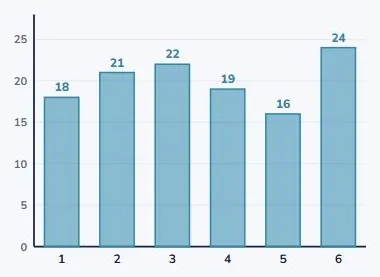
- Roll a die 120 times and count all six outcomes.
- Twenty-four sixes gives 24 over 120, which is 0.2.
- Eighteen ones gives 0.15. Theory says about 0.167 for each.
| Outcome | Working | Relative frequency |
|---|---|---|
| Roll a die 120 times | count each outcome | |
| 24 sixes | 24/120 | 0.2 |
| 18 ones | 18/120 | 0.15 |
| Theoretical for each | 1/6 | about 0.167 |
Chart it, and you can see the whole distribution
- Six bars. With 120 rolls you expect about 20 of each.
- The real ones came out between 18 and 24.
- Roughly level, with wobble. That is what fair looks like.
Knowing that shape is the useful part
- Perfectly level bars would actually be suspicious.
- Real randomness is lumpy. Some wobble is expected.
- One bar far above the rest is what deserves a second look.
| What you see | What it means | |
|---|---|---|
| Six bars, one per face | expected height about 20 | |
| Actual heights vary | 18 to 24 | that is normal |
| Roughly level | is what a fair die looks like | |
| One bar far above | would be worth investigating |
What to take away
- Six things, and the first one is where the marks are.
| Adding probabilities | double-counts anything in both events |
| Before adding | ask whether both can happen at once |
| Mutually exclusive | means they cannot, so adding is safe |
| Independent | is a different question: does one affect the other? |
| Exclusive events | are strongly dependent, not independent |
| Relative frequency | is the count divided by the number of trials |
Common mistakes
- P(even or greater than 3) = 3/6 + 3/6 = 14 and 6 are in both lists, so count them once: 2, 4, 5, 6 gives 4/6 = 2/3.
- Mutually exclusive events are independent.Mutually exclusive events cannot both happen, so if one happens the other's chance drops to 0; they are dependent.
- 100 rolls gave 21 fives instead of about 17, so the die is unfair.Results vary by chance; 21 in 100 is not strong evidence, so run many more trials before judging.
Your turn
- Try all eight.
One die. Find P(even or a 5).
One die. Find P(even or greater than 3).
Are two coin tosses independent? Why?
15 heads in 60 tosses. What is the relative frequency?
One die is rolled. Which pair of events is mutually exclusive?
Which pair of events is dependent?
In a class of 30, 12 play netball, 10 play rugby and 4 play both. Find P(a student plays netball or rugby).
A die is rolled 600 times. Six comes up 180 times, and each other face 84 times. What does this suggest?
Show answer
1. 2/3. Even is 2, 4, 6 and the 5 is not among them, so there is no overlap and you can add: 3/6 plus 1/6 is 4/6. 2. Also 2/3, but for a different reason. Here 4 and 6 are in both lists, so adding gives 1, which is wrong. List them instead: 2, 4, 5, 6 out of 6. 3. Yes. The coin has no memory, so the first toss changes nothing about the second. 4. 0.25, from 15 divided by 60. That is below the theoretical 0.5, and 60 tosses is few enough that this would be worth repeating. 5. Roll a 1, and roll an even number: no outcome is in both. The others share an outcome: 6, then 2, then 1. 6. Drawing two counters with the first kept out. Removing the first changes what is left in the bag, so it changes the second draw. 7. 18/30, which is 3/5. The 4 who play both were counted twice, so take them off once: 12 + 10 − 4 = 18 students. 8. The die is probably biased towards six. A fair die gives about 100 of each; 180 is one bar far above the rest, which is more than normal wobble.
The answers
- Question 1 has no overlap, so you can add.
- Question 2 does, so list them instead.
- Two coin tosses do not affect each other.
| Answer | |
|---|---|
| 1 | 2/3 |
| 2 | 2/3 |
| 3 | Yes |
| 4 | 0.25 |
Challenge
Two fair dice are rolled. Event A is 'at least one die shows a 6'. Event B is 'the total is 9 or more'. Rangi says P(A or B) = 1136 + 1036 = 2136. (a) Explain what Rangi has done wrong. (b) Find the correct probability of A or B. (c) What is the probability that exactly one of A and B happens?
Hint
Draw the 6 by 6 grid and mark the cells for A and the cells for B. How many cells are marked twice?
Answer
(a) A and B can happen together, so the 7 outcomes in both were counted twice. (b) 1436 = 718. (c) 736.
Step by step
- A: there are 11 cells with at least one 6 (the 6 row and the 6 column share the cell 6 and 6).
- B: totals of 9, 10, 11 and 12 come from 4 + 3 + 2 + 1 = 10 cells.
- Both: a 6 with a total of 9 or more means the other die is 3, 4, 5 or 6. That is (6,3), (6,4), (6,5), (6,6), (3,6), (4,6) and (5,6): 7 cells.
- A and B are not mutually exclusive, so Rangi counted those 7 cells twice. Take them off once: 11 + 10 − 7 = 14.
- Only (4,5), (5,4) and (5,5) are in B without a 6, so B is mostly inside A.
- Exactly one: A only is 11 − 7 = 4 cells and B only is 10 − 7 = 3 cells, so 7 cells, and 736.
Full working
- sample space: 6 × 6 = 36 cellsfirst die down, second across
- A: 6 + 6 − 1 = 11 cellsthe cell (6,6) is in the row and the column
- B: totals 9, 10, 11, 12 give 4 + 3 + 2 + 1 = 10 cellscount each total
- A and B: (6,3), (6,4), (6,5), (6,6), (3,6), (4,6), (5,6), 7 cellsin both lists
- A or B: 11 + 10 − 7 = 14subtract the overlap once
- P(A or B) = 1436 = 718not 2136
- exactly one: (11 − 7) + (10 − 7) = 4 + 3 = 7in one list but not both
- (a) the 7 shared outcomes were counted twice, (b) 718, (c) 736
One fair die is rolled. Event A is 'the number is even'. Event B is 'the number is 4 or less'. Event C is 'the number is 3 or less'. (a) Are A and B mutually exclusive? (b) Find P(A), and then find the probability of A if you are told that B happened. Are A and B independent? (c) Do the same for A and C. Explain how two events on the same roll can be independent.
Hint
If you are told B happened, the only possible rolls are 1, 2, 3 and 4. What fraction of those are even? Compare it with P(A).
Answer
(a) No: 2 and 4 are in both. (b) P(A) = 12, and given B it is still 24 = 12, so A and B are independent. (c) Given C it is 13, not 12, so A and C are dependent. Independent means knowing one event does not change the chance of the other, even on the same roll.
Step by step
- A is 2, 4, 6, so P(A) = 36 = 12.
- B is 1, 2, 3, 4. A and B share 2 and 4, so they can happen together: not mutually exclusive.
- If B happened, the roll is one of 1, 2, 3, 4, and 2 of those are even: still 12. Knowing B tells you nothing about A, so they are independent.
- If C happened, the roll is one of 1, 2, 3, and only 2 is even: 13. Knowing C lowers the chance of A, so A and C are dependent.
- Independence is not about being separate events. It is only about whether knowing one changes the probability of the other.
Full working
- A = {2, 4, 6}, P(A) = 36 = 12even numbers
- A and B share 2 and 4so not mutually exclusive
- given B: {1, 2, 3, 4}, even ones 2, 4, so 24 = 12same as P(A)
- A and B independentknowing B changes nothing
- given C: {1, 2, 3}, even one 2, so 13not 12
- A and C dependentknowing C lowers the chance
- (a) no, (b) 12 and 12, independent, (c) 13, dependent
Tama's drawer holds 4 black socks and 2 white socks, all loose. In the dark he takes socks out one at a time, without putting any back, and stops as soon as two of the socks he holds are the same colour. (a) Explain why he never needs more than 3 socks. (b) What is the probability he needs exactly 3? (c) What is the probability that his matching pair is white?
Hint
Use a tree. The second branch depends on the first sock, because that sock is no longer in the drawer. For (c), the pair can be white in two ways: on the second sock, or on the third.
Answer
(a) With only two colours, any 3 socks must include two of the same colour. (b) 815. (c) 15.
Step by step
- Three socks in only two colours must include a matching pair, so 3 is always enough.
- He stops at 2 if the first two match: both black is 46 × 35 = 1230, both white is 26 × 15 = 230. So 1430 = 715.
- Otherwise he needs exactly 3: 1 − 715 = 815.
- A white pair on 2 socks has probability 230 = 115.
- If the first two are one of each colour, 3 black and 1 white are left, so the third is white with probability 14. That gives 815 × 14 = 215.
- So the pair is white with probability 115 + 215 = 315 = 15.
Full working
- 3 socks, 2 colours: two must matchso never more than 3
- BB: 46 × 35 = 1230dependent: one black is gone
- WW: 26 × 15 = 230only one white left
- stop at 2: 1230 + 230 = 1430 = 715mutually exclusive, so add
- exactly 3: 1 − 715 = 815the first two differ
- third sock white: 3 black and 1 white left, so 14one of each colour is gone
- white pair: 230 + 815 × 14 = 115 + 215 = 315on sock 2 or sock 3
- (b) 815, (c) 15
Practise this
Report a mistake
More in Probability
Is your child on track?
Take the free placement test