Earth's layers, minerals and rocks
What this lesson covers
- The geosphere and how it differs from the other parts of the Earth system
- The four main layers inside the Earth
- Minerals: natural, solid and built from a repeating pattern
- Rocks as mixtures of minerals, and the properties that tell them apart
- Classifying rocks and soils by what you can observe
- What fossils in a rock say about the past
The geosphere
- Scientists divide the Earth system into four connected parts: the air (atmosphere), the water (hydrosphere), living things (biosphere) and the solid Earth (geosphere).
- The geosphere is all the solid, non-living ground of the planet: every rock, mineral, grain of soil and landform, from mountains to sea-floor trenches.
- It does not stop at the surface. It reaches right down through the Earth's interior to the very centre.
- Aoraki, the Canterbury Plains and the sand on Piha beach are all part of it.
Four layers inside the Earth
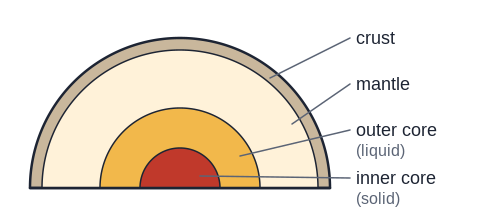
- The crust is the thin, rocky outer skin we live on. It is thinner under the oceans than under the continents.
- The mantle lies under the crust. It is very hot rock that is mostly solid but can flow extremely slowly, like very stiff toffee.
- The outer core is a layer of liquid metal, mostly iron and nickel.
- The inner core, at the centre, is also iron and nickel. It is the hottest part, but the huge pressure squeezes it into a solid ball.
- No one has drilled through the crust. We know about the deeper layers mainly from how earthquake waves travel through the Earth.
Try it: which layer?
What is a mineral?
- The crust is made of rocks, and rocks are made of minerals.
- A mineral is a solid that forms naturally, not made by people, and has its own fixed chemical make-up.
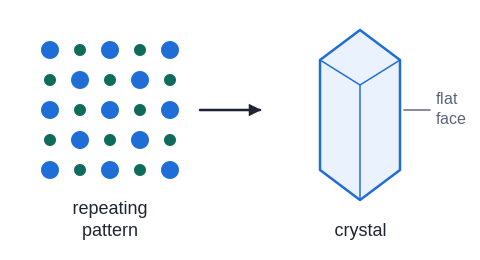
- Its particles are packed in a neat pattern that repeats over and over. That repeating pattern is why minerals grow as crystals with flat faces and straight edges.
- The pattern also gives each mineral its own properties: colour, shine (lustre), the way it breaks, and hardness.
- Quartz, feldspar, mica and calcite are common minerals. Ice is a mineral too; plastic and glass are not, because their particles have no repeating pattern.
Testing hardness
- Hardness means how well a mineral resists being scratched.
- A harder material scratches a softer one, never the other way round, so you can rank minerals by testing which scratches which.
- Geologists use the Mohs scale, which ranks ten minerals from talc, the softest, at 1 to diamond, the hardest, at 10.
- A quick field test uses everyday objects: a fingernail, a copper coin, a steel nail and a piece of glass, from softest to hardest.
- Talc can be scratched by a fingernail; quartz is hard enough to scratch glass.
Try it: scratch test
Rocks are mixtures of minerals
- A rock is a solid mixture of one or more minerals. Granite is mostly quartz, feldspar and mica, while limestone is mostly the single mineral calcite.
- Which minerals a rock contains, and how they are arranged, decide what it looks and feels like.
- Colour comes from the minerals. Texture describes the grains: coarse grains you can see easily, or fine grains too small to see.
- Structure describes how the grains sit: interlocking crystals, grains cemented together, or layers like the pages of a book.
- Hardness depends on how hard the minerals are and how strongly they are held together.
Classifying four rock samples
- A class examined four rock samples with a hand lens and a scratch test. Sort them using a key.
| Sample | Grains | Crystals? | Layers or fossils? | Scratches glass? |
|---|---|---|---|---|
| A | Coarse | Yes, interlocking | No | Yes |
| B | Fine | Yes, too small to see without a lens | No | Yes |
| C | Medium, rounded sand grains | No | Thin layers | No |
| D | Fine | No | Shell fossils | No |
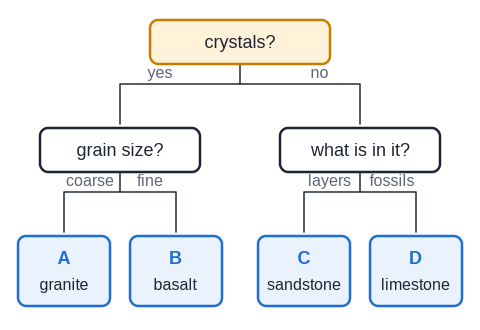
- Crystals? A and B yes; C and D nofirst question in the key
- A: coarse crystals; B: fine crystalssplit by grain size
- C: sand grains in layers; D: fossilssplit by what is in the rock
- A could be granite, B basalt, C sandstone, D limestone
Classifying soils
- Soils can be compared in the same way, by grain size and feel.
- Sandy soil has big grains you can see; it feels gritty and water drains through it fast.
- Clay soil has tiny grains; it feels sticky when wet, can be rolled into a thin sausage, and holds water.
- Silty soil sits in between and feels smooth, a little like flour.
- A loam is a mix of all three with plenty of rotting plant matter, which is why gardeners prize it.
Try it: sandy, clay or silty?
Fossils are clues to the past
- A fossil is the preserved remains or trace of a living thing from long ago, such as a shell, a bone, a leaf print or a footprint.
- Fossils tell you what lived at the time the rock formed, and so what the place was like then.
- Sea shells in a rock mean that rock formed under the sea, even if it is now high on a hill.
- Limestone in many parts of New Zealand, such as around Ōamaru and Waitomo, is packed with fossils of sea creatures, so that land was once under the sea.
Reading a cliff
- A road cutting on a hillside shows three rock layers. The bottom layer has fossil sea shells, the middle layer has fossil leaves and tree roots, and the top layer is soil. What happened here?
- Lower layers formed firstnew layers settle on top of older ones
- Bottom: sea shells, so this place was under the seathe oldest clue
- Middle: leaves and roots, so it later became land with plantsthe next clue
- The area was once sea floor, was later lifted up to become forested land, and soil formed on top
Common mistakes
- Rocks and minerals are the same thing.A mineral is one substance with a repeating pattern; a rock is a mixture of one or more minerals.
- The Earth's core is hot liquid all the way through.The outer core is liquid, but the inner core is solid because of the enormous pressure.
- A shiny or brightly coloured rock must be hard.Colour and shine do not tell you hardness; only a scratch test does.
- Fossils found on a mountain mean sea animals once lived on mountains.The rock formed under the sea and was later pushed up to become a mountain.
Scratch-test garden rocks
You need: 4 or 5 different small rocks or pebbles, a copper-coloured coin, a steel teaspoon, a magnifying glass if you have one, a notebook
- Rinse the rocks and let them dry, then number them 1 to 5 on a page of your notebook.
- Look at each with the magnifying glass and record its colour, whether you can see grains or crystals, and whether it has layers.
- Try to scratch each rock with your fingernail, then the coin, then the edge of the spoon, and record the first one that leaves a scratch.
- Rub away any powder to check it is a real scratch and not just a mark left by the coin.
- Look for the pattern: rank your rocks from softest to hardest, and see whether the crystal-filled ones tend to be harder.
Safety: Only collect loose rocks from your own garden or driveway, never from reserves or beaches where taking them is not allowed, and wash your hands after handling soil.
Your turn
Name the four layers of the Earth from the outside in.
Is glass a mineral? Explain.
Rock X scratches glass. Rock Y can be scratched by a copper coin. Which is harder?
A rock has thin layers of rounded sand grains and no crystals. Which rock from the example is it most like?
A rock near the top of a hill contains fossil fish. What does this tell you about the past?
Show answer
1. Crust, mantle, outer core, inner core. 2. No: its particles do not form a repeating pattern, so it has no crystals. 3. Rock X, because it scratches glass, which is harder than a coin. 4. Sandstone, like sample C. 5. That rock formed under water, so the area was once under the sea or a lake and has since been lifted up.
Recap
- The geosphere is the solid Earth, from the rocks, soil and landforms at the surface all the way to the centre.
- Inside the Earth are the crust, mantle, liquid outer core and solid inner core.
- Minerals form naturally and have a repeating pattern of particles, which gives them crystals and their own properties.
- Rocks are made of one or more minerals; colour, texture, structure and hardness depend on which minerals and how they are arranged.
- Fossils in a rock tell you what lived when it formed, and so what the place was like long ago.
Challenge
Tama has five unlabelled minerals, J, K, L, M and N. He knows they are talc (1 on the Mohs scale), calcite (3), fluorite (4), apatite (5) and quartz (7), but not which is which. He tests each with his fingernail (about 2.5), a copper coin (about 3.5), a steel nail (about 5.5) and glass (about 5.5). His results: L is scratched by his fingernail. N is not scratched by his fingernail but is scratched by the coin. J and K are not scratched by the coin but are both scratched by the steel nail. M is not scratched by any of the tools and it scratches the glass. J scratches K. (a) Name each mineral, and show how every result is needed. (b) Without the last test (J scratches K), what could Tama not decide? (c) His sister finds a sparkly golden mineral that is scratched by the coin and says it must be very hard because it is so shiny. What do you tell her?
Hint
Use the tools to sort the minerals into groups by hardness first, softest group to hardest. One group has two minerals in it: the tools cannot separate them, so you need a test between the minerals themselves.
Answer
(a) L is talc, N is calcite, J is apatite, K is fluorite and M is quartz. (b) Which of J and K is fluorite and which is apatite, because the tools put them in the same group. (c) It is soft: the coin scratches it, so it is softer than a copper coin. Shine and colour do not tell you hardness; only a scratch test does.
Step by step
- A fingernail scratches only the softest minerals, so L is talc.
- N needs the coin but not more, so it is the next softest: calcite.
- J and K need the steel nail, so they are the middle pair, fluorite and apatite.
- M resists every tool and scratches glass, so it is the hardest: quartz.
- The harder mineral scratches the softer one, so J (which scratches K) is apatite and K is fluorite.
- Hardness comes only from a scratch test, not from shine.
Full working
- Fingernail scratches Lsoftest: talc (1)
- Coin scratches N, fingernail does notnext: calcite (3)
- Steel nail scratches J and K, coin does notmiddle pair: fluorite (4) and apatite (5)
- Nothing scratches M; M scratches glasshardest: quartz (7)
- J scratches KJ harder: J apatite, K fluorite
- L talc, N calcite, K fluorite, J apatite, M quartz
Use these round figures: the Earth's radius is 6400 km. The crust is about 35 km thick under a continent and about 7 km under an ocean. The mantle goes down to 2900 km, the outer core from 2900 km to 5150 km, and the inner core from 5150 km to the centre. A class builds a scale model where 1 mm stands for 10 km. (a) Find the model's radius and how thick each layer is in the model (use continental crust for the mantle). (b) The deepest hole ever drilled went about 12 km down. How deep is it in the model, and what percentage of the way to the centre is that? (c) Earthquakes make two kinds of waves. One kind can travel through solids and liquids; the other can only travel through solids. When a big earthquake happens, the 'solids only' waves never reach the far side of the Earth by a straight path through the middle. Explain what this tells scientists, and why it is evidence they need.
Hint
Each layer's thickness is where it ends minus where it starts. Divide every distance in km by 10 to get mm. For (c), think about which layer a straight path through the middle has to cross.
Answer
(a) Radius 640 mm. Crust 3.5 mm under a continent (0.7 mm under an ocean), mantle 286.5 mm, outer core 225 mm, inner core 125 mm (a radius). (b) 1.2 mm deep in the model, about 0.19% of the way to the centre. (c) A straight path through the middle crosses the core, and the 'solids only' waves cannot get through, so part of the core must be liquid: the outer core. This is needed because no one has drilled more than a tiny fraction of the way down, so waves are the only way to 'see' inside.
Step by step
- Turn each layer's start and end depths into a thickness.
- Divide km by 10 to get mm in the model.
- The thin crust is only a few millimetres on a ball well over a metre across.
- Compare 12 km with 6400 km to see how little has been drilled.
- Waves that need a solid are stopped by the liquid outer core, which is how we know it is liquid.
Full working
- Radius: 6400 ÷ 10 = 640 mm1 mm per 10 km
- Crust: 35 ÷ 10 = 3.5 mm (ocean 7 ÷ 10 = 0.7 mm)thinnest layer
- Mantle: (2900 − 35) ÷ 10 = 286.5 mm; outer core: (5150 − 2900) ÷ 10 = 225 mmend minus start
- Inner core: (6400 − 5150) ÷ 10 = 125 mmdown to the centre
- Hole: 12 ÷ 10 = 1.2 mm; 12 ÷ 6400 × 100 ≈ 0.19%a tiny scratch on the model
- Radius 640 mm: crust 3.5 mm, mantle 286.5 mm, outer core 225 mm, inner core 125 mm; the hole is 1.2 mm, about 0.19%
A made-up road cutting in Hawke's Bay shows these layers, from the bottom up. Layer 1: grey mudstone with fossil shells of a kind that lives only in deep sea, about 400 m down. Layer 2: limestone packed with broken shells of shellfish that live in shallow, sunlit sea. Layer 3: sandstone with ripple marks and fossil cockle shells, like a beach or estuary today. Layer 4: dark mud with fossil leaves and roots. Layer 5: a thick layer of river sand and gravel. Soil is on top. A fossil tree trunk stands upright with its roots in layer 4, and its trunk reaches up through the whole of layer 5. The top of layer 1 is now 250 m above sea level. (a) Tell the story of this place from oldest to youngest. (b) By at least how many metres has the bottom layer been lifted? Why 'at least'? (c) What does the upright trunk tell you about how layer 5 was laid down?
Hint
Older layers are underneath. Each layer's fossils tell you how deep the water was, or whether it was land. For (c), think about how long a dead tree trunk can stand before it rots or falls over.
Answer
(a) Deep sea floor (1), then shallow sea (2), then a beach or estuary (3), then land with plants growing (4), then a river flooded the area and buried it in sand and gravel (5), and finally soil formed on top. The sea got shallower and the land rose. (b) At least 650 m: from 400 m below sea level up to 250 m above it. It is 'at least' because 650 m is only the change from where it started to where it is now. If the sea floor first sank further, for example under the weight of the later layers, before being pushed up, the total lift was bigger. (c) The tree was buried while still standing, so layer 5 was dumped quickly, probably by one or a few big floods, before the trunk could rot or fall.
Step by step
- Layers settle on top of older ones, so read from the bottom up.
- The fossils change from deep sea to shallow sea to beach to land, so the sea floor rose over time.
- Add the depth the mudstone formed at to the height it is at now.
- That is the smallest possible lift; if the land sank for a while before rising, the real lift was bigger.
- A standing dead tree would rot or fall in years, so the sand and gravel around it built up fast.
Full working
- Oldest at the bottomlayers settle on older ones
- Deep sea → shallow sea → beach → land → river flood → soilfossils show water depth
- Start: 400 m below sea level; now: 250 m aboveposition of layer 1
- Lift ≥ 400 + 250 = 650 mthe smallest possible uplift
- Upright trunk through layer 5buried before it could rot or fall, so laid down quickly
- Sea floor raised at least 650 m into land; layer 5 was dumped quickly by floods
Report a mistake
How is Year 8 maths going?
See the Year 8 maths guide