Mass, unbalanced forces and balancing a seesaw
What this lesson covers
- Why more mass needs a bigger unbalanced force for the same change
- Levers, pivots and the seesaw
- Turning effect: force multiplied by distance from the pivot
- When a seesaw balances and when it tips
- Unbalanced forces in everyday activities
- Designing a fair test with mass or distance
More mass, harder to change
- Mass measures how much matter an object contains, in kilograms (kg).
- Push an empty supermarket trolley and a full one with the same force: the empty one speeds up much more quickly.
- The more mass an object has, the bigger the unbalanced force needed to change its motion by the same amount.
- This works for slowing down too. A loaded truck needs a much bigger braking force than a car to stop in the same distance.
Room 9 tests mass
- Room 9 launched a toy cart along the floor with a rubber band stretched by the same 10 cm each time, adding 100 g weights to the cart. They measured how far it rolled.
| Mass added | Trial 1 | Trial 2 | Trial 3 | Mean distance |
|---|---|---|---|---|
| 0 g | 182 cm | 176 cm | 179 cm | 179 cm |
| 100 g | 121 cm | 125 cm | 123 cm | 123 cm |
| 200 g | 90 cm | 86 cm | 88 cm | 88 cm |
| 300 g | 70 cm | 66 cm | 68 cm | 68 cm |
- Same stretch each timeso the launching force was kept the same
- Mean distance falls from 179 cm to 68 cm as mass goes upread down the last column
- The same force gave the heavier cart less speed, so it rolled less farlink to the idea
- More mass: the same unbalanced force changes the motion less
A seesaw is a lever
- A lever is a rigid bar that can turn about a fixed point called the pivot (or fulcrum).
- A seesaw is a lever with the pivot in the middle and a person pushing down on each side.
- Each force tries to turn the seesaw: the force on the left tries to turn it one way, the force on the right the other way.
- Scissors, spanners, wheelbarrows and bottle openers are levers too.
Turning effect depends on force and distance
- How hard a force turns something depends on two things: the size of the force and how far from the pivot it acts.
- Turning effect = force × distance from the pivot. With force in newtons and distance in metres, the unit is newton metres (N m).
- A small force far from the pivot can turn things as much as a large force close to it. That is why a door handle sits far from the hinges.
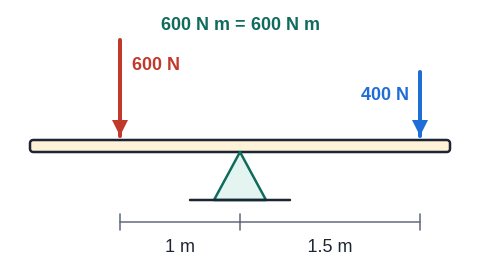
- A seesaw balances when the turning effect on the left equals the turning effect on the right.
Try it: balance the seesaw
Where should he sit?
- Aroha weighs 360 N and sits 2 m from the pivot of a seesaw. Her brother weighs 480 N. How far from the pivot must he sit, on the other side, to balance it?
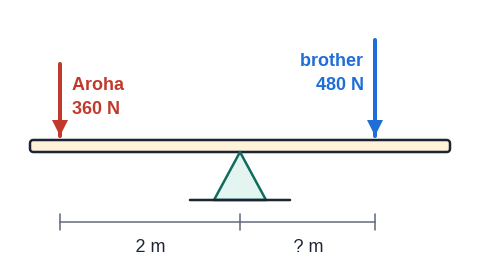
- Aroha's turning effect = 360 N × 2 m = 720 N mforce × distance
- To balance, his side must also be 720 N mturning effects equal
- 480 N × distance = 720 N mhis force times the unknown distance
- distance = 720 ÷ 480 = 1.5 mdivide to undo the multiply
- He sits 1.5 m from the pivot, closer than Aroha because he is heavier
When a seesaw tips
- If one side has a bigger turning effect, the seesaw is unbalanced and turns towards that side.
- This can happen because that person is heavier, sits further from the pivot, or both.
- In the example above, if Aroha's brother moved back to 2 m, his side would have 480 × 2 = 960 N m against her 720 N m, so his end would go down.
- A lighter child can tip a heavier adult by sitting right at the end while the adult sits near the middle.
Designing a fair test with a ruler seesaw
- Question: how does the distance from the pivot change how many coins it takes to balance a load?
- Balance a 30 cm ruler on a pencil at its 15 cm mark. Put a stack of 4 coins 5 cm left of the pivot and leave it there for every trial.
- Independent variable: the distance from the pivot on the right side. Dependent variable: the number of coins needed there to balance.
- Controlled variables: the same ruler, the same pivot point, the same type of coin, and the same load on the left.
| Distance right of pivot | Coins needed to balance |
|---|---|
| 5 cm | 4 |
| 10 cm | 2 |
| 20 cm | 1 |
- Left side: 4 coins × 5 cm = 20 coin cmturning effect, with coins as the force
- Right side: 4 × 5 = 20, 2 × 10 = 20, 1 × 20 = 20each balanced row
- Doubling the distance halves the coins needed
Unbalanced forces all around you
- Every time something speeds up, slows down or turns, an unbalanced force is at work.
| Activity | Unbalanced force | Change in motion |
|---|---|---|
| Kicking a rugby ball off a tee | Boot pushes the ball forward | Speeds up from rest |
| Braking on a bike | Friction from the brakes and road, backward | Slows down |
| Heading a football | Head pushes the ball at an angle | Changes direction and speed |
| Tacking a yacht on the Waitematā | Wind on the sail from a new side | Changes direction |
Try it: what does the force do?
Common mistakes
- A seesaw balances when the two people weigh the same.It balances when the turning effects are equal, so a heavier person can balance a lighter one by sitting closer to the pivot.
- Turning effect = force + distance.Turning effect is force multiplied by distance from the pivot, in N m.
- A heavy object needs a force to keep moving at a steady speed but a light one does not.Mass decides how big an unbalanced force is needed to change motion, not whether a steady speed needs a force.
- Measure the distance from the end of the seesaw.Always measure from the pivot, because that is the point everything turns around.
Balance a ruler seesaw
You need: a 30 cm ruler, a round pencil, 10 identical coins, sticky tape
- Tape the pencil to the table and balance the ruler across it at the 15 cm mark.
- Place 2 coins stacked at the 10 cm mark, which is 5 cm left of the pivot.
- Find where 1 coin on the right side balances them, and write down its distance from the pivot.
- Repeat with 3 coins, then 4 coins on the left, each time finding where 2 coins on the right balance them.
- Look for the pattern: coins × distance should come out the same on both sides whenever the ruler balances.
Safety: Coins are a choking hazard for babies and toddlers, so do this away from little children and count the coins back into a container afterwards.
Your turn
The same push is given to a 5 kg box and a 20 kg box on the same smooth floor. Which speeds up more?
A 300 N force acts 2 m from a pivot. What is its turning effect?
A 500 N person sits 1.2 m from a seesaw's pivot. How far from the pivot must a 400 N person sit to balance?
On a seesaw, the left side has 800 N m of turning effect and the right side 650 N m. Which way does it tip?
Why is it easier to open a door by pushing near the handle than near the hinges?
Show answer
1. The 5 kg box, because less mass needs less force for the same change. 2. 300 × 2 = 600 N m. 3. 500 × 1.2 = 600 N m, so 600 ÷ 400 = 1.5 m. 4. The left side goes down, because its turning effect is bigger. 5. The handle is further from the pivot (the hinges), so the same force gives a bigger turning effect.
Balancing Act
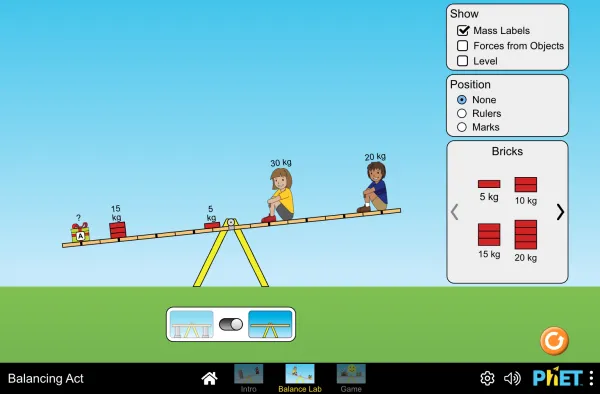
Full screen · PhET Interactive Simulations, University of Colorado Boulder, CC BY 4.0
Recap
- The more mass an object has, the bigger the unbalanced force needed for the same change in motion.
- A seesaw is a lever turning about a pivot, with forces on both sides.
- Turning effect = force × distance from the pivot, in newton metres.
- A seesaw balances when both turning effects are equal, and tips towards the side with the bigger one.
- In a fair test, change one variable, measure one, and keep the rest the same.
Challenge
A wheelbarrow is a lever with its pivot at the wheel's axle. Mere's wheelbarrow, full of soil, weighs 900 N in total, and that weight acts 0.4 m (measured along the ground) from the axle. Her hands lift the handles 1.5 m from the axle. (a) What upward force must she use to hold the handles up, keeping the wheelbarrow still? (b) She puts a 300 N bag of compost on top of the soil, 0.8 m from the axle. What force does she need now? (c) Mere can lift at most 300 N. How far from the axle can the bag sit, at most, for her to manage the load, and why is it better to load a wheelbarrow near the wheel?
Hint
Here the load and her hands are on the same side of the pivot, but they turn the wheelbarrow opposite ways: the load turns it down, her lift turns it up. It stays still when the two turning effects are equal. The ground's push on the wheel acts at the pivot, so it has no turning effect.
Answer
(a) 240 N. (b) 400 N. (c) No more than 0.3 m from the axle. A load near the wheel has a small turning effect, so the lift needed at the handles is small; most of the weight is carried by the wheel.
Step by step
- The weight of the barrow and soil tries to turn the wheelbarrow down about the axle; her lift at the handles tries to turn it up.
- Her hands are much further from the axle than the load, so a smaller force gives the same turning effect.
- The bag adds its own turning effect to the load side, so she needs a bigger lift.
- Work backwards from her biggest lift to the biggest turning effect she can balance, then find how much of that is left for the bag.
- The closer a load is to the pivot, the smaller its turning effect, so less lift is needed at the handles.
Full working
- Load: 900 N × 0.4 m = 360 N mturns it down
- Lift needed = 360 ÷ 1.5 = 240 Nturning effects equal
- (b) Bag: 300 N × 0.8 m = 240 N mextra turning down
- Total = 360 + 240 = 600 N m, so lift = 600 ÷ 1.5 = 400 Nmore than before
- (c) Most she can balance = 300 N × 1.5 m = 450 N mher biggest lift
- Left for the bag = 450 − 360 = 90 N msoil and barrow use 360 N m
- Bag distance = 90 ÷ 300 = 0.3 mdistance = turning effect ÷ force
- (a) 240 N (b) 400 N (c) at most 0.3 m from the axle; loads near the wheel need less lift
Tia wants to find the mass of her 30 cm ruler using only 20c coins, each with a mass of 4 g. The ruler is uniform, marked from 0 cm to 30 cm, and balances on its own on a pencil at the 15 cm mark. (a) She moves the pencil to the 10 cm mark. The ruler now tips towards the 30 cm end, but a stack of 5 coins placed at the 2 cm mark makes it balance exactly. What is the mass of the ruler? (b) She then tries to balance the ruler, with the pencil still at the 10 cm mark, using a stack of only 2 coins on the left side. Show that this is impossible. (c) Where should she put the pencil so that a stack of 2 coins at the 0 cm mark balances the ruler?
Hint
A uniform ruler acts as if all its weight is at its middle, the 15 cm mark. Measure every distance from the pencil, and treat each coin as one unit of force.
Answer
(a) 32 g (the weight of 8 coins). (b) 2 coins would need to sit 20 cm left of the pencil, but the ruler only reaches 10 cm to the left. (c) At the 12 cm mark.
Step by step
- When the pencil is at the 10 cm mark, the ruler's weight acts at the 15 cm mark, 5 cm right of the pivot, so it tips to the right.
- The coins on the left balance it, so their turning effect equals the ruler's turning effect. Work backwards to find the ruler's weight in coins.
- With only 2 coins, the distance needed comes out longer than the ruler's left side, so no position works.
- Moving the pencil changes both distances at once: the coins get further from the pivot and the ruler's middle gets closer.
- Try pencil positions until 2 × (distance to the coins) equals 8 × (distance to the middle).
Full working
- Coins: 5 coins × (10 − 2) cm = 5 × 8 = 40 coin cmleft turning effect
- Ruler's middle is 15 − 10 = 5 cm right of the penciluniform ruler
- Ruler's weight × 5 = 40, so ruler = 8 coinsturning effects equal
- Mass = 8 × 4 g = 32 geach coin is 4 g
- (b) 2 coins × distance = 40, so distance = 20 cmneeded to balance
- Left side of the ruler is only 10 cm long20 cm is off the end
- (c) Pencil at the 12 cm mark: coins 2 × 12 = 24 coin cm2 coins, 12 cm away
- Ruler: 8 × (15 − 12) = 8 × 3 = 24 coin cmthe two sides match
- (a) 32 g (b) 2 coins would need 20 cm, more than the 10 cm available (c) the 12 cm mark
Room 14 is making a hanging mobile from two light rods and some cardboard shapes. The bottom rod is 30 cm long, with a 0.6 N kiwi hanging from its left end and a 0.3 N fern from its right end. The whole bottom rod then hangs from the right end of a top rod 40 cm long, which has a 0.3 N star hanging from its left end. (a) How far from the kiwi must the string holding the bottom rod be tied so it hangs level? (b) How far from the star must the top string be tied so the top rod hangs level, and how big is the force in that top string? (c) The fern falls off. Explain what happens to each rod, using turning effects.
Hint
Turning effects can be in N cm, as long as both sides of a rod use the same units. Once the bottom rod is level, it pulls on the top rod like one single weight.
Answer
(a) 10 cm from the kiwi. (b) 30 cm from the star; 1.2 N. (c) The bottom rod tips kiwi end down (6 N cm against 0). The top rod tips star end down (9 N cm against 6 N cm).
Step by step
- On the bottom rod the kiwi is twice as heavy as the fern, so it must be half as far from the string: split 30 cm in the ratio 1 : 2.
- Everything on the bottom rod, 0.6 N + 0.3 N, hangs from the right end of the top rod.
- On the top rod 0.9 N is three times the star's 0.3 N, so the string must be three times closer to it: split 40 cm in the ratio 3 : 1.
- The top string holds up everything below it, so its force is the total weight.
- When the fern falls, the bottom rod has turning effect on one side only. The top rod loses 0.3 N on its right, so the star side now wins.
Full working
- Kiwi : fern = 0.6 : 0.3 = 2 : 1, so distances are 1 : 2heavier is closer
- 30 cm ÷ 3 = 10 cm from the kiwi, 20 cm from the fernsplit in 1 : 2
- Check: 0.6 × 10 = 6 N cm and 0.3 × 20 = 6 N cmbalanced
- (b) Bottom rod pulls 0.6 + 0.3 = 0.9 N on the top rodone single load
- 0.9 : 0.3 = 3 : 1, so 40 cm splits into 30 cm (star) and 10 cmheavier is closer
- Check: 0.3 × 30 = 9 N cm and 0.9 × 10 = 9 N cmbalanced
- Top string = 0.3 + 0.9 = 1.2 Nholds everything
- (c) Bottom rod: kiwi 0.6 × 10 = 6 N cm, fern side 0tips kiwi down
- Top rod: star 0.3 × 30 = 9 N cm, right side 0.6 × 10 = 6 N cmtips star down
- (a) 10 cm (b) 30 cm from the star, 1.2 N (c) bottom rod tips kiwi end down; top rod tips star end down
The maths behind it
Report a mistake
How is Year 8 maths going?
See the Year 8 maths guide