Sexual and asexual reproduction, and how a mammal develops
What this lesson covers
- Why every kind of living thing must reproduce
- Sexual reproduction: two parents and a mix of traits
- Asexual reproduction: one parent and identical offspring
- Sperm, eggs and fertilisation in animals
- Gametes, zygote, embryo and foetus in mammals
- Puberty as the start of being able to reproduce
Every living thing reproduces
- Reproduction is making new individuals of the same kind. It is one of the life processes shared by all living things.
- No individual lives forever, so a species survives only if its members reproduce.
- There are two main ways to do it: sexual reproduction, with two parents, and asexual reproduction, with one.
Sexual and asexual reproduction
- Sexual reproduction needs two parents. Each provides a special sex cell called a gamete, and the two gametes join.
- The offspring get a mix of features from both parents, so brothers and sisters differ from each other and from their parents.
- Asexual reproduction needs only one parent and no gametes. The offspring are genetically identical copies, or clones, of that parent.
- Strawberry plants send out runners that grow into new plants, potatoes sprout from tubers, and bacteria simply split in two. All of these are asexual.
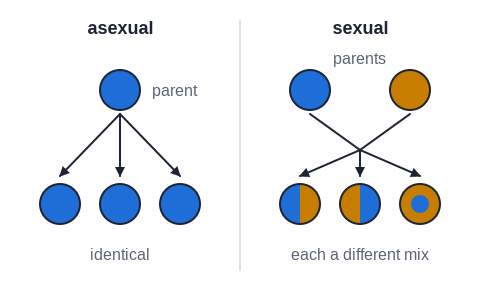
Try it: sexual or asexual?
Advantages of each
- Each way of reproducing suits different situations.
| Sexual | Asexual | |
|---|---|---|
| Parents | Two | One |
| Gametes | Yes, they join at fertilisation | None |
| Offspring | A mix of both parents; all different | Identical to the parent |
| Speed | Slower, needs a partner | Fast, no partner needed |
| Advantage | Variation, so some may survive a change such as a new disease | Can fill a good habitat quickly |
Animals: sperm, eggs and fertilisation
- Most animals reproduce sexually. Males make small gametes called sperm that can swim; females make larger gametes called eggs (ova).
- Fertilisation is when a sperm and an egg join, so their genetic information combines into one new cell.
- In many fish and frogs, fertilisation happens outside the body, in the water. Birds, reptiles and mammals use internal fertilisation, inside the female's body.
- A kiwi egg is fertilised inside the female, then laid; a mammal's young develop inside the mother.
From gametes to birth in a mammal
- Gametes form: sperm in the testes of the male, eggs in the ovaries of the female.
- Fertilisation: a sperm joins an egg in the oviduct (the tube leading to the uterus), making a single cell called a zygote.
- The zygote divides again and again into a ball of cells, the embryo, which settles into the soft lining of the uterus.
- Once the main body parts have formed, the developing young is called a foetus. In humans this is from about the ninth week.
- The foetus keeps growing in the uterus until birth, which in humans is about nine months after fertilisation.
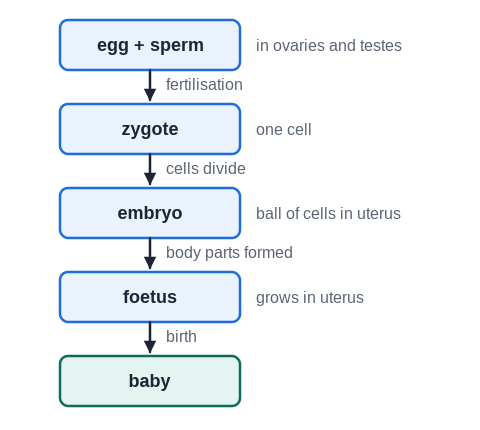
Putting the stages in order
- A student's cards say: foetus, egg and sperm, birth, embryo, zygote. Put them in order and say what happens at each change.
- Egg and spermgametes made in the ovaries and testes
- → zygotefertilisation joins them into one cell
- → embryothe cell divides many times and settles in the uterus
- → foetusbody parts have formed; it grows larger
- Egg and sperm, zygote, embryo, foetus, birth
Try it: zygote, embryo or foetus?
Puberty
- Animals are not able to reproduce from birth. They first have to grow and develop.
- In humans, puberty is the stage when the body develops the ability to reproduce.
- It is triggered by chemical messengers called hormones, and brings changes such as growth spurts, body hair, and the ovaries or testes starting to release eggs or make sperm.
- Puberty starts at different ages for different people, and the changes happen gradually. Your Health and PE lessons cover it in more detail.
Comparing plants, animals and fungi
- Organise what you know about reproduction in three kingdoms into a table, then pick out one similarity and one difference.
| Flowering plants | Animals | Fungi | |
|---|---|---|---|
| Sexual? | Yes: pollen and egg cells in flowers | Yes: sperm and eggs | Many can |
| Asexual? | Often: runners, bulbs, tubers, cuttings | Rarely: some, like sea anemones, split into copies | Yes: spores, and yeast buds |
| How offspring spread | Seeds carried by wind, water or animals | Young move or are carried | Tiny spores blown by the wind |
- Similarity: all three groups can reproduce sexuallyread the first row
- Difference: fungi spread by spores, plants by seedsread the last row
- One similarity and one difference, each backed by the table
Common mistakes
- Plants only reproduce asexually.Flowering plants reproduce sexually through their flowers, and many can also reproduce asexually.
- Offspring of sexual reproduction are half copies of each parent, so they look exactly like a blend.Each offspring gets a different mix of the parents' genes, which is why siblings differ.
- The zygote, embryo and foetus are three different babies.They are three stages of the same developing individual, named by how far it has developed.
- A zygote is a sperm.A zygote is the single new cell made when a sperm and an egg join at fertilisation.
Grow a clone from a cutting
You need: a stem of mint or basil about 10 cm long, scissors, a clear glass or jar, water
- Cut a healthy stem just below a leaf joint, where the leaves join the stem.
- Pull off the leaves from the bottom half of the stem.
- Stand the stem in the glass with water covering the bare part but not the top leaves, and put it on a bright windowsill out of strong sun.
- Change the water every two days and check the stem daily for a week or two.
- Look for white roots growing from the leaf joints: you have made a new plant from one parent, an asexual clone of it.
Safety: Only take cuttings from plants you know, such as mint or basil, because some garden plants have sap that irritates skin; use the scissors carefully and wash your hands afterwards.
Your turn
A flax bush (harakeke) is divided and replanted as five new plants. Is this sexual or asexual reproduction?
Why are siblings from the same two parents usually different from each other?
What is made at fertilisation?
Give the stage that follows the embryo in a mammal.
Give one advantage of asexual reproduction.
Show answer
1. Asexual: there is one parent and the new plants are identical to it. 2. Each gets a different mix of genes from the two parents. 3. A zygote, a single new cell from a sperm and an egg joining. 4. The foetus. 5. It is fast and needs no partner, so a good habitat can be filled quickly.
Recap
- All living things reproduce, or their species would die out.
- Sexual reproduction has two parents and gives offspring a mix of their traits; asexual reproduction has one parent and gives identical clones.
- Animals reproduce sexually: sperm and eggs join at fertilisation.
- In mammals the stages are gametes, zygote, embryo, foetus and birth.
- Puberty is when the body develops the ability to reproduce.
Challenge
A grower in Pukekohe buys one strawberry plant of a new, very sweet variety. Each season, every plant in the patch sends out runners that grow into exactly 4 new plants, and all the older plants stay alive. (a) How many plants will there be after 3 seasons? (b) Are any of them different from the first plant? Explain. (c) In the fourth season a fungus disease arrives that kills plants of this variety. Her neighbour grew his strawberries from seed. Explain why the disease is likely to wipe out her whole patch but leave some of his plants alive. (d) Give one reason growers still use runners anyway.
Hint
Each plant becomes itself plus 4 new ones, so the number of plants is multiplied by the same amount every season. Then ask: how many parents did her plants have, and how many did his?
Answer
(a) 125 plants (1, then 5, then 25, then 125). (b) No: runners are asexual reproduction from one parent, so all 125 are clones, genetically identical to the first plant. (c) If the disease can kill one of her plants it can kill them all, because they are identical. Seeds come from sexual reproduction, so each of his plants has a different mix of features; some may happen to resist the disease and survive. (d) Runners give many plants quickly and every one keeps the sweet fruit of the parent, while seedlings vary and may be less sweet.
Step by step
- Each season every plant becomes 5 plants: itself and 4 new ones.
- So the number is multiplied by 5 three times.
- Runners have one parent and no gametes, so all the plants are clones.
- Identical plants all share the same weakness to the disease.
- Seeds come from pollen and egg cells joining, so seedlings vary and some may survive.
- Clones are fast and keep the parent's good features, which is why growers use them.
Full working
- Start: 1 plantone parent
- Season 1: 1 × 5 = 5each plant plus 4 runners
- Season 2: 5 × 5 = 25same rule
- Season 3: 25 × 5 = 125same rule
- All clones, so all equally at risk; seedlings vary, so some may resistasexual versus sexual
- 125 identical plants; the disease can kill them all, while some varied seedlings may survive
Compare two animals, using these made-up round numbers. A female pond frog lays about 2000 eggs a year in water, where a male fertilises them; neither parent looks after the eggs or tadpoles. She breeds for 3 years. A female brown kiwi weighs about 2.8 kg. Her eggs are fertilised inside her body, each egg weighs about 450 g and is full of yolk, and the male sits on it for about 80 days. She lays about 2 eggs a year for 20 years. In both species the number of adults stays about the same year after year. (a) Over her life, how many eggs does each female lay? (b) If the numbers stay steady, about how many of each female's eggs must grow up into adults that breed? So what is the chance that one egg makes it? (c) About what percentage of her body mass is one kiwi egg? (d) Use your answers to explain why frogs lay so many eggs and kiwi so few.
Hint
If a population stays the same size, each pair of parents must, on average, be replaced by one new pair. Think about how many offspring that means, then compare it with the number of eggs laid.
Answer
(a) Frog: 6000 eggs; kiwi: 40 eggs. (b) About 2 from each, to replace the two parents, so about 1 frog egg in 3000 survives to breed, compared with about 1 kiwi egg in 20. (c) About 16%. (d) Frog eggs are fertilised outside the body and left unprotected, so almost all are eaten or die; only a huge number makes it likely that 2 survive. A kiwi puts a lot of food into each egg, which is fertilised inside her and then guarded, so each one has a far better chance; she can only make a few because each egg is so big.
Step by step
- Multiply eggs per year by the number of breeding years.
- For the number of adults to stay the same, the two parents must be replaced by about 2 offspring that grow up and breed.
- Divide the eggs laid by 2 to find the chance that one egg survives.
- Divide the egg mass by the mother's mass, in the same units, and multiply by 100.
- Many cheap, unprotected eggs, or a few costly, protected ones: both can keep a species going.
Full working
- Frog: 2000 × 3 = 6000 eggsper year × years
- Kiwi: 2 × 20 = 40 eggsper year × years
- Each pair must leave about 2 breeding adultsnumbers stay steady
- Frog: 2 out of 6000 = 1 in 3000; kiwi: 2 out of 40 = 1 in 20chance one egg survives
- Kiwi egg: 450 g ÷ 2800 g × 100 ≈ 16%change 2.8 kg to 2800 g
- 6000 versus 40 eggs; survival about 1 in 3000 versus 1 in 20; one kiwi egg is about 16% of her mass
The New Zealand mud snail lives in lakes and streams. In some lakes the snails reproduce sexually, with males and females in roughly equal numbers. In others, females reproduce asexually: they make young without a male, and every young snail is a female clone of its mother. Many lakes have both kinds mixed together. A tiny parasitic worm infects the snails and stops them reproducing. A team sampled three lakes. These are made-up results. Lake A: 2% of snails male, 5% infected. Lake B: 10% male, 20% infected. Lake C: 22% male, 45% infected. (a) Explain why the percentage of males tells you how much sexual reproduction is going on. (b) Estimate the percentage of snails in each lake that come from the sexual kind. (c) Describe the pattern, and use the idea of variation to suggest why sexual snails do better where the parasite is common. (d) Why do asexual snails take over in Lake A?
Hint
Only the sexual kind has any males, and about half of those snails are male. For (c), think about what happens when a parasite is good at infecting one clone and every snail in that clone is identical. For (d), compare how many young are produced when every snail in a group can have babies.
Answer
(a) Asexual snails are all females, so every male must belong to the sexual kind. (b) About half the sexual snails are male, so double the percentage of males: A about 4%, B about 20%, C about 44%. (c) The more parasites in a lake, the more sexual snails there are. Sexual reproduction gives young that are all different, so some are likely to resist the parasite; a clone is identical, so if the parasite can infect one snail it can infect them all. (d) With few parasites, being different matters little. Every asexual snail is a female that can have young, while half of the sexual snails are males that cannot lay eggs, so the asexual snails make more young and spread faster.
Step by step
- Asexual mud snails are all-female clones, so males come only from sexual reproduction.
- Sexual snails are about half male, so the sexual share is about twice the male percentage.
- As infection goes from 5% to 45%, the sexual share goes from about 4% to 44%.
- Variation means a parasite cannot attack every sexual snail equally well; clones share one weakness.
- When parasites are rare, the faster breeding of all-female clones wins.
Full working
- Males only in the sexual kind; about half of them maleso sexual share ≈ 2 × % males
- Lake A: 2 × 2% = 4% sexualinfected 5%
- Lake B: 2 × 10% = 20% sexualinfected 20%
- Lake C: 2 × 22% = 44% sexualinfected 45%
- More parasites, more sexual snailsvariation gives some resistance; clones share one weakness
- About 4%, 20% and 44% sexual; sexual reproduction wins where parasites are common, clones where they are rare
Report a mistake
How is Year 8 maths going?
See the Year 8 maths guide