Darwin, Wallace, new species and common ancestry
What this lesson covers
- How Darwin and Wallace presented natural selection together
- How helpful inherited traits spread through a population over generations
- Why populations evolve but individuals do not
- How new species form from a shared ancestor
- Extinction when a species cannot cope with change
- Common ancestry, and inferring how a fossil organism lived
Two naturalists, one idea
- Charles Darwin sailed round the world on HMS Beagle from 1831 to 1836, collecting animals, plants and fossils. He even stopped in the Bay of Islands in December 1835.
- Back in England he spent over twenty years gathering evidence for natural selection, but did not publish.
- Alfred Russel Wallace, collecting animals in the islands of South-East Asia, came to the same idea on his own and in 1858 sent Darwin an essay describing it.
- Their work was presented together at a scientific meeting in London in July 1858, and Darwin published his book On the Origin of Species the next year.
- Two people reaching the same explanation from different evidence made the idea much harder to dismiss.
Helpful traits spread over generations
- Natural selection works over many generations, not overnight.
- Individuals with a heritable trait that helps them survive or breed are a little more likely to leave offspring.
- Their offspring inherit the trait, so in the next generation a slightly bigger share of the population has it.
- Repeat that over many generations and a rare trait can become the common one.
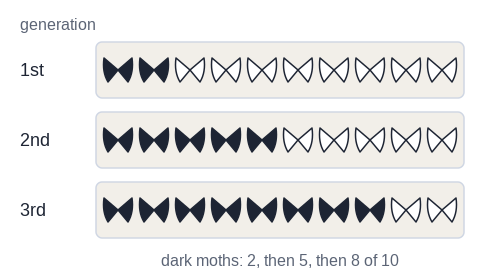
The peppered moth
- Peppered moths in England come in a pale speckled form and a dark form. Before the 1800s the pale form was common. As factories spread, soot blackened tree trunks, and by the late 1800s dark moths were common in industrial areas. Explain why.
- Variation: some moths are pale, some dark, and colour is inheritedthe raw material
- Selection pressure: birds hunt moths resting on tree trunkswhat decides survival
- On soot-blackened bark, dark moths are harder to seeso more dark moths survive and breed
- Over many generations, dark moths became the common form in sooty areas
- When clean-air laws reduced soot, pale moths became common againthe pressure reversed
Populations evolve, individuals do not
- A single moth cannot change its colour to survive. It is born pale or dark and stays that way.
- What changes is the population: the share of dark and pale moths shifts from one generation to the next.
- Evolution means a change in the inherited traits of a population over generations.
- So it is wrong to say an animal evolves during its life. It grows and learns, but it does not evolve.
From one ancestor to new species
- If groups of one species live in different places with different selection pressures, each group changes in its own way.
- Over very long periods the changes add up until the groups are so different that they can no longer breed together. They are now separate species.
- New Zealand's kea, kākā and kākāpō are all descended from one ancestral parrot.
- The kākāpō became a heavy, flightless parrot that feeds at night on the ground. The kea adapted to cold South Island mountains, and the kākā to life in native forest.
- Their shared ancestry shows in their features and their DNA.
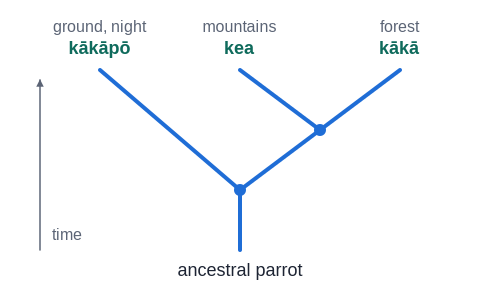
Try it: kea, kākā or kākāpō?
Some species cannot keep up
- Natural selection can only work on variation a population already has, and it needs many generations.
- If the environment changes faster than that, the species may die out.
- New Zealand had nine species of moa, huge flightless birds. After people arrived, moa were hunted and much of their habitat was burned, and within a few centuries every species was extinct.
- Haast's eagle, which hunted moa, then died out too, because it lost its main food.
Try it: why did it die out?
All life is related
- All vertebrates (animals with a backbone) share a body plan: a backbone, a skull, and limbs built from the same set of bones.
- The same upper-arm bone, two forearm bones, wrist bones and finger bones appear in your arm, a bat's wing, a whale's flipper and a bird's wing, shaped for different jobs.
- All living things use DNA in the same way to carry their genetic information.
- The evidence collected so far supports the idea that all living organisms are related, descended from shared ancestors over billions of years.
Reading a fossil
- A fossil skeleton has a long, streamlined body, paddle-shaped limbs, a long snout full of sharp cone-shaped teeth, and was found in rock that also holds fossil sea shells. What was the animal like and where did it live?
- Streamlined body and paddle limbsbuilt for swimming
- Sharp cone-shaped teethfor gripping slippery prey such as fish
- Rock with sea shellsthe rock formed on the sea floor
- A swimming predator that hunted fish in the sea
Common mistakes
- The moths turned dark so they could hide on sooty trees.No moth changed colour; dark moths already existed and survived better, so their share of the population grew.
- Humans evolved from chimpanzees.Humans and chimpanzees share a common ancestor; neither evolved from the other.
- Darwin came up with natural selection completely on his own.Wallace reached the same idea independently, and their work was presented together in 1858.
- Evolution happens to an animal during its lifetime.Evolution is a change in a population's inherited traits across generations.
A camouflage hunt
You need: a sheet of newspaper, a sheet of plain white paper, a hole punch or scissors, a timer, a helper
- Punch or cut 20 small circles from the newspaper and 20 from the white paper. These are your moths.
- Lay the full sheet of newspaper on the floor and have your helper scatter all 40 circles over it while you look away.
- Turn round and pick up as many circles as you can, one at a time, in 20 seconds. These have been eaten by a bird.
- Count how many of each kind are left: these survived and will breed.
- Look for the pattern: more newspaper circles survive because they blend in, so in the next generation the camouflaged form would be more common.
Safety: Small paper circles are a choking hazard for babies and toddlers, so play away from little children and pick up every circle afterwards.
Your turn
Why was it important that Wallace reached the same idea as Darwin?
A rabbit population lives where winter snow now lasts longer. Rabbits with whiter fur are seen less by hawks. What happens to the population over many generations?
Can a single rabbit evolve whiter fur? Explain.
Kea and kākā look alike but cannot interbreed. What does this tell you about where they came from?
A fossil has broad, flat, ridged teeth and was found among fossil leaves. What did it probably eat?
Show answer
1. Two people reaching it independently from different evidence made it far more convincing. 2. Whiter rabbits survive and breed more, so white fur becomes more common in the population. 3. No; an individual's inherited fur colour does not change, only the population's mix changes over generations. 4. They are separate species that evolved from a shared ancestor. 5. Plants, because flat ridged teeth grind tough leaves.
Natural Selection
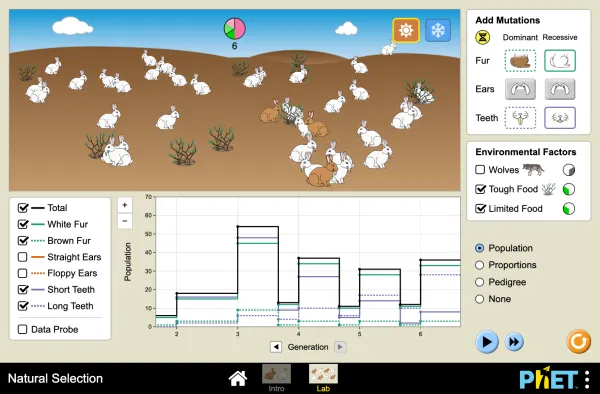
Full screen · PhET Interactive Simulations, University of Colorado Boulder, CC BY 4.0
Recap
- Darwin and Wallace reached natural selection independently and presented it together in 1858.
- Over many generations, inherited traits that help survival or breeding become more common, like dark peppered moths on sooty trees.
- Evolution is change in a population across generations, never in one individual.
- Changes that build up over long periods split one ancestor into new species, such as the kea, kākā and kākāpō.
- Species that cannot cope with fast change die out, like the moa, and shared features and DNA show all life is related.
Challenge
Ten seed-eating finches live on a small island (made-up data). Their beak depths in mm are 8.0, 8.5, 8.5, 9.0, 9.0, 9.5, 10.0, 10.0, 10.5 and 11.0. A long drought leaves only large, hard seeds, and only the birds with beaks at least 9.5 mm deep can crack them; the others starve. (a) Find the mean beak depth before the drought and the mean of the survivors. (b) The survivors breed. Beak depth is partly inherited and partly depends on how well a chick is fed, so suppose the chicks' mean beak depth moves only half of the way from the old mean towards the survivors' mean. Predict the chicks' mean beak depth. (c) A visitor says: 'The finches grew deeper beaks to crack the hard seeds.' Use your numbers to explain what really happened, and say why the change would be bigger if beak depth were completely inherited.
Hint
Selection acts on the parents, but only the inherited part of their difference reaches the chicks. Find the gap between the survivors' mean and the old mean first.
Answer
(a) 9.4 mm before; 10.2 mm for the survivors. (b) 9.8 mm. (c) No bird's beak grew: birds that already had deep beaks survived and bred, so the population's mean beak depth rose from 9.4 mm to about 9.8 mm in one generation. Only the inherited part of a difference is passed on; if all of it were inherited, the chicks' mean would be the full 10.2 mm.
Step by step
- Add the ten depths and divide by 10; then do the same for the five birds with beaks of 9.5 mm or more.
- The survivors' mean is 0.8 mm above the old mean. That is the difference selection made among the parents.
- Only half of that difference is inherited, so the chicks' mean moves up by half of 0.8 mm.
- Each bird kept the beak it hatched with. The drought only decided which birds lived to breed, so the population changed, not the individuals.
- The part of beak depth that comes from feeding is not passed on, so it does not carry into the next generation.
Full working
- Sum of all ten = 94.0 mm, so mean = 94.0 ÷ 10 = 9.4 mmbefore the drought
- Survivors: 9.5, 10.0, 10.0, 10.5, 11.0at least 9.5 mm
- Survivors' sum = 51.0 mm, so mean = 51.0 ÷ 5 = 10.2 mmfive birds
- (b) Gap = 10.2 − 9.4 = 0.8 mmselection among the parents
- Half inherited: 0.8 ÷ 2 = 0.4 mmthe part passed on
- Chicks' mean = 9.4 + 0.4 = 9.8 mmone generation later
- (a) 9.4 mm and 10.2 mm (b) 9.8 mm (c) deep-beaked birds survived; fully inherited would give 10.2 mm
Fossil bones of a giant extinct penguin have been found in Otago, in greensand rock that formed on the sea floor. The upper wing bone of a living yellow-eyed penguin (about 65 cm tall) is about 5 cm long; the same bone in the fossil is about 10 cm long (made-up measurements). The fossil wing bones are flat and stiff, and its bones are solid and heavy, while a flying bird's bones are light and partly hollow. (a) Estimate how tall the fossil penguin stood, and state the assumption you made. (b) Did it fly? How did it move and where did it feed? Use three clues. (c) Its flipper has the same upper-arm bone, forearm bones, wrist and finger bones as a seagull's wing. What does that tell you about where penguins came from?
Hint
Compare the two bones as a scale factor. Then think about what each feature would be good for: flat stiff wings, heavy bones, and rock formed under the sea.
Answer
(a) About 130 cm, assuming the giant penguin had the same body proportions as a yellow-eyed penguin. (b) No: it swam, using its flat stiff flippers to fly underwater, its heavy bones helped it dive, and the sea-floor rock shows it lived and fed in the sea, probably catching fish. (c) Penguins share a common ancestor with flying birds: they descend from birds that flew, and their wings were reshaped into flippers over many generations.
Step by step
- The fossil bone is twice as long, so if the body had the same shape, the whole penguin was about twice as tall.
- That assumption could be wrong: big animals often have different proportions from small ones, so this is only an estimate.
- Flat, stiff flippers push well against water but are no use for flying in air.
- Light, hollow bones help flying; solid, heavy bones make a body less floaty, which helps diving.
- The same set of bones arranged in the same order in a flipper and a gull's wing makes sense only if they were inherited from a shared ancestor and then shaped for different jobs.
Full working
- Scale factor = 10 ÷ 5 = 2fossil bone against living bone
- Height ≈ 65 cm × 2 = 130 cmsame proportions assumed
- Flat stiff flippersswimming, not flying
- Solid heavy boneshelps diving
- Sea-floor rocklived and fed in the sea
- Same bones as a gull's wingshared ancestor that flew
- (a) about 130 cm (b) a diving swimmer that fed in the sea (c) descended from flying birds
Four species of flightless beetle, W, X, Y and Z, live on four nearby islands (made-up data). X and Y live in dark caves and are both pale with tiny eyes. W and Z live on the forest floor and are both dark brown with large eyes. Scientists compare their DNA. Percentage difference: W and X 3%; Y and Z 5%; W and Y 9%; W and Z 9%; X and Y 9%; X and Z 9%. Assume two species' DNA drifts apart by about 1% every 400 000 years after they split. (a) Which two species are most closely related? (b) Put the splits in order and estimate when each happened. (c) Explain why X and Y look so alike even though they are not each other's closest relatives.
Hint
The smaller the DNA difference, the more recent the shared ancestor. Pairs that both show the same difference to everything else must have split from the others at the same time.
Answer
(a) W and X. (b) First the shared ancestor of all four split into the W and X line and the Y and Z line, about 3.6 million years ago; then Y and Z split about 2.0 million years ago; then W and X about 1.2 million years ago. (c) X and Y each adapted to caves separately: similar conditions in the dark favoured similar features in both lines, so they look alike without being closest relatives.
Step by step
- The smallest difference, 3%, is between W and X, so they share the most recent ancestor.
- Y and Z are next closest at 5%. Every pair that crosses between the two groups differs by 9%, so the two groups split once, longest ago.
- Turn each percentage into time with the drift rate: multiply by 400 000 years.
- Looks can mislead: X is closest to W, and Y is closest to Z, yet the cave beetles look alike.
- Each cave population faced the same selection pressures in the dark, so similar variations were favoured in both, on their own, after their lines had already split.
Full working
- Smallest difference: W and X, 3%most closely related
- W and X: 3 × 400 000 = 1 200 000 yearsmost recent split
- Y and Z: 5 × 400 000 = 2 000 000 yearsnext split
- Between groups: 9 × 400 000 = 3 600 000 yearsfirst split
- Tree: ancestor splits into (W, X) and (Y, Z)3.6 million years ago
- Cave look in X and Y: separate adaptation to the same conditionsnot shared ancestry
- (a) W and X (b) 3.6, then 2.0 (Y and Z), then 1.2 (W and X) million years ago (c) similar pressures in caves
Report a mistake
How is Year 8 maths going?
See the Year 8 maths guide