Probability as a fraction, a decimal and a percentage
What this lesson covers
- Lists, tables, and tree diagrams are useful systematic methods for generating all possible outcomes.
- If all possible outcomes are assumed to be equally likely, the probability of an event is number of ways the event can happen/total number of possible outcomes.
- Probabilities can be expressed as a fraction or decimal between 0 and 1, or as a percentage between 0% and 100%.
- An event is a subset of the sample space and thus can be a single outcome or a combination of outcomes.
- The probability of an event and its complement add to 1.
Which is more likely: 3/8 or 40%?
- You cannot tell while they are written differently.
- 3/8 is 0.375. And 40% is 0.4. So the 40% is bigger.
- That was a conversion problem, not a probability one.
| Written | As a decimal | |
|---|---|---|
| 3/8 | 0.375 | |
| 40% | 0.4 | larger |
Where a probability comes from
- Count the ways the thing you want can happen.
- Divide by how many outcomes there are altogether.
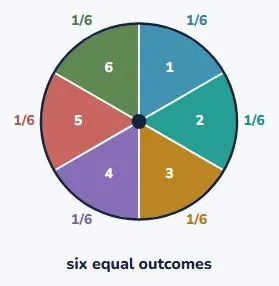
- One face is a 6, out of six faces. So P(6) is 1/6.
| Step | Working | Gives |
|---|---|---|
| Ways it can happen | one face is a 6 | 1 |
| Total outcomes | six faces | 6 |
| Probability | 1 ÷ 6 | 1/6 |
But only if the outcomes are equally likely
- That formula assumes no face is favoured over another.
- For the weighted die from last lesson, it is simply wrong.
- Check the assumption before you use the formula.
Try it: run an experiment
Every probability sits between 0 and 1
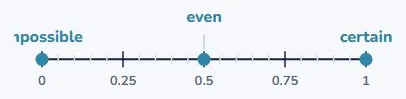
- 0 means impossible. 1 means certain.
- Everything real sits somewhere between them.
- As a percentage that is 0% to 100%. Never more.
And can be written three ways
- P(6) is 1/6, which is 0.167, which is 16.7%.
- One probability. Three notations. Same number.
- Exactly as fractions, decimals and percentages always were.
| Event | Fraction | Decimal or percentage |
|---|---|---|
| P(6) | 1/6 | 0.167 or 16.7% |
| P(even) | 1/2 | 0.5 or 50% |
| P(more than 4) | 1/3 | 0.333 or 33.3% |
| P(not 6) | 5/6 | 0.833 or 83.3% |
Which is not a formality
- A fraction is exact. 1/3 beats 0.333 every time.
- A percentage is easiest to say out loud and to compare.
- Pick whichever the question needs, and convert freely.
| Notation | Best for | |
|---|---|---|
| Fraction | being exact | 1/3 |
| Decimal | comparing and calculating | 0.333 |
| Percentage | saying it to somebody | 33.3% |
An event can be more than one outcome
- Rolling a 6 is one outcome. That is an event.
- Rolling an even number is three outcomes. Also one event.
- An event is just the set of outcomes that count as a win.
| Event | Outcomes in it | Probability |
|---|---|---|
| Rolling a 6 | one outcome | 1/6 |
| Rolling an even number | 2, 4 or 6 | 3/6 |
| Rolling more than 4 | 5 or 6 | 2/6 |
| All of these | are single events |
So count the ways, not the questions
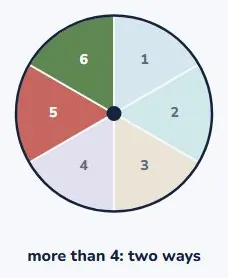
- "More than 4" on a die. Which faces count? 5 and 6.
- Two ways out of six. So 2/6, which is 1/3.
- Careful: more than 4 does not include the 4.
A bag of ten counters
- 5 red, 3 blue, 2 green. Ten altogether.
- P(red) is 5/10, which is a half, or 50%.
- P(blue) is 30%, P(green) 20%. They total 100%.
| Colour | Count | Probability |
|---|---|---|
| Red | 5 of 10 | 1/2 or 50% |
| Blue | 3 of 10 | 0.3 or 30% |
| Green | 2 of 10 | 1/5 or 20% |
| Together | 100% |
And they always total 1
- Every draw produces exactly one of the three colours.
- So the three probabilities have to account for everything.
- 50 plus 30 plus 20 is 100%. It is a useful check.
| Colour | Count | Probability |
|---|---|---|
| Red | 5 of 10 | 1/2 or 50% |
| Blue | 3 of 10 | 0.3 or 30% |
| Green | 2 of 10 | 1/5 or 20% |
| Together | 100% |
Comparing two events
- Is red more likely than blue? Put them in one notation.
- 1/2 is 0.5. 3/10 is 0.3.
- So red is more likely. That is why converting matters.
| Event | Converted | Value |
|---|---|---|
| P(red) = 1/2 | as a decimal | 0.5 |
| P(blue) = 3/10 | as a decimal | 0.3 |
| So red | is more likely |
Everything else is the complement
- P(6) is 1/6. So P(not 6) must be the other 5/6.
- Together they account for every outcome, so they total 1.
- P(not A) = 1 − P(A). Always.
| Event | Working | Probability |
|---|---|---|
| P(6) | 1/6 | |
| P(not 6) | 5/6 | |
| Together | 1/6 + 5/6 | 1 |
| So P(not A) | 1 − P(A) |
Try it: a bag of counters
Two coins, and all four outcomes
- A tree lists them without missing any.
- Two branches, then two more from each: four outcomes.
- HH, HT, TH, TT. Not three, which is the usual guess.
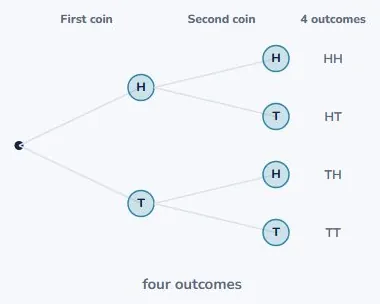
Try it: two coins in a tree
Now: at least one head
- Count them directly: HH, HT and TH. Three out of four.
- Or notice that the only failure is TT, which is 1/4.
- So it is 1 − 1/4, which is 3/4. One subtraction.
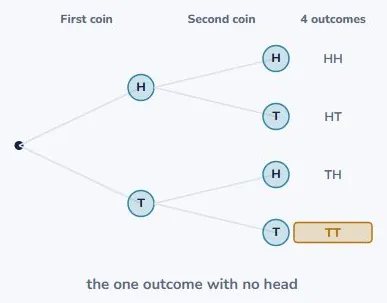
"At least" is the signal
- Whenever a question says at least, try the complement first.
- Counting the successes is usually the longer job.
- And the longer job is where the miscounts happen.
| Route | Work | Answer |
|---|---|---|
| P(at least one head) | count HH, HT, TH | 3/4 |
| Or: P(no heads) | only TT | 1/4 |
| So P(at least one) | 1 − 1/4 | 3/4 |
| "At least" | means try the complement |
Common mistakes
- P(more than 4) on a die is 3/6, counting 4, 5 and 6.More than 4 does not include 4, so only 5 and 6 count: 2/6 = 1/3.
- 3/8 is more likely than 40%.Convert to one form: 3/8 = 0.375 and 40% = 0.4, so 40% is more likely.
- 5 red, 3 blue, 2 green, so P(green) = 2/8.Divide by all ten counters, including the green ones: P(green) = 2/10 = 1/5.
- A weighted die still has P(6) = 1/6.Ways ÷ total only works when outcomes are equally likely; a weighted die needs an experiment.
Your turn: eight questions
- The bag holds 4 red and 6 blue.
- Question 1 wants all three notations.
- Question 4: read whether the 4 itself is included.
| Question | |
|---|---|
| A bag holds 4 red and 6 blue counters. | |
| 1 | Find P(red) as a fraction, a decimal and a percentage. |
| 2 | Find P(not red). |
| 3 | Flip two coins. Find P(two tails). |
| 4 | Roll a die. Find P(more than 4). |
| 5 | Which of these can never be a probability? |
| 6 | Which is more likely: an event with probability 3/8, or one with probability 35%? |
| 7 | A spinner lands on red with probability 0.25, on blue with 0.4, and otherwise on green. Find P(green). |
| 8 | Flip three coins. Find P(at least one head). |
Show answer
1. 4/10, which is 2/5, or 0.4, or 40%. 2. 0.6, or 60%, or 3/5. Either count the 6 blue out of 10, or take 1 − 0.4. 3. 1/4. The four outcomes are HH, HT, TH and TT, and only one is two tails. 4. 2/6, which is 1/3. More than 4 means 5 or 6, so two outcomes out of six. Note it does not include the 4 itself. 5. 7/5. It is more than 1, and every probability sits between 0 (impossible) and 1 (certain). 6. 3/8, because 3/8 is 0.375. 35% is 0.35, and 0.375 is larger. 7. 0.35. The three must total 1, and 1 − 0.25 − 0.4 = 0.35. 8. 7/8. There are 8 outcomes and only TTT has no heads, so 1 − 1/8 = 7/8.
The answers
- P(red) is 4/10, which is 2/5, or 0.4, or 40%.
- P(not red) is 0.6, either by counting or by 1 − 0.4.
- Two tails is 1/4. And more than 4 is 2/6, which is 1/3.
| Answer | |
|---|---|
| 1 | 2/5, 0.4, 40% |
| 2 | 0.6 |
| 3 | 1/4 |
| 4 | 1/3 |
What to take away
- Ways it can happen, over total outcomes, if they are equally likely.
- One probability, three notations. Convert before you compare.
- And when a question says at least, reach for the complement.
| Remember | |
|---|---|
| P(event) | ways it happens over total outcomes |
| Only when | the outcomes are equally likely |
| One probability | three notations; convert to compare |
| An event | can be several outcomes at once |
| "At least" | is the signal to use the complement |
Challenge
A bag holds only red, blue and green counters. A counter is taken at random. P(red) = 15 and P(blue) = 35%, and there are 18 green counters. How many counters of each colour are there? How many green counters must be taken out so that P(blue) becomes 12, and what is P(red) then?
Hint
The three probabilities must add to 1. Work out what fraction or percentage of the bag is green.
Answer
8 red, 14 blue, 18 green (40 in all). Take out 12 green; then P(red) = 828 = 27.
Step by step
- P(red) = 15 = 20%, so P(green) = 100% − 20% − 35% = 45%.
- 45% of the bag is 18 counters, so 1% is 0.4 and the bag holds 40.
- Red is 20% of 40 = 8 and blue is 35% of 40 = 14.
- For P(blue) = 12, the 14 blue must be half the bag, so the bag must hold 28. Take out 40 − 28 = 12 green.
- Then P(red) = 828 = 27.
Full working
- 100% − 20% − 35% = 45%P(green), since 15 = 20%
- 45% = 18, 1% = 0.4, 100% = 40counters in the bag
- 20% of 40 = 8, 35% of 40 = 14red and blue
- 14 × 2 = 28, 40 − 28 = 12green taken out
- 8 ÷ 28 = 27new P(red)
- 8 red, 14 blue, 18 green; take out 12 green; P(red) = 27
A whole number from 1 to 100 is chosen at random, each equally likely. What is the probability that it has at least one digit 7? Then answer the same question for a number chosen at random from 1 to 1000. Give both answers as a fraction, a decimal and a percentage.
Hint
At least is the signal: count the numbers with no 7 at all. For 1 to 1000, think of every number from 0 to 999 as three digits (like 007 or 042) and ask how many choices each digit has.
Answer
1 to 100: 19100 = 0.19 = 19%. 1 to 1000: 2711000 = 0.271 = 27.1%.
Step by step
- Write 1 to 99 as two digits, 01 to 99, plus 00 for zero. With no 7, each digit has 9 choices, so 9 × 9 = 81 of 00 to 99 have no 7.
- Take out 00 and put in 100 (no 7): still 81 numbers from 1 to 100 with no 7, so 19 have at least one 7.
- So P = 19100 = 0.19 = 19%. (Check: 7, 17, ..., 97 is ten numbers, 70 to 79 is ten more, and 77 was counted twice.)
- For 000 to 999, three digits each with 9 choices: 9 × 9 × 9 = 729 have no 7. Swap 000 for 1000 and it is still 729.
- So 1000 − 729 = 271 have at least one 7: P = 2711000 = 0.271 = 27.1%.
Full working
- 9 × 9 = 8100 to 99 with no 7
- 81 − 1 + 1 = 81remove 00, add 100
- P(at least one 7) = 1 − 81100 = 191001 to 100
- 9 × 9 × 9 = 729000 to 999 with no 7
- 729 − 1 + 1 = 729remove 000, add 1000
- 1 − 7291000 = 27110001 to 1000
- 19100 = 0.19 = 19%, and 2711000 = 0.271 = 27.1%
Four friends, Ana, Ben, Kai and Liu, leave their named drink bottles in a box after sport. Later each friend grabs one bottle at random, so every way of handing out the four bottles is equally likely. What is the probability that nobody gets their own bottle? What is the probability that at least one person gets their own bottle? Explain why the probability that exactly three people get their own bottle is 0.
Hint
List the ways systematically, like a tree: there are 4 choices for Ana's bottle, then 3 for Ben, then 2, then 1. To count the ways nobody gets their own, fix what Ana takes first.
Answer
P(nobody gets their own) = 924 = 38. P(at least one gets their own) = 1524 = 58. Exactly three is impossible: if three people have their own bottles, the only bottle left is the fourth person's own.
Step by step
- A tree gives 4 × 3 × 2 × 1 = 24 equally likely ways to hand out the bottles.
- Suppose Ana takes Ben's bottle. If Ben takes Ana's, then Kai and Liu must swap: 1 way. If Ben takes Kai's or Liu's, there is exactly 1 way to finish so nobody has their own each time. That is 3 ways.
- Ana could take Ben's, Kai's or Liu's bottle, and each gives 3 ways, so 3 × 3 = 9 ways with nobody getting their own.
- P(nobody) = 924 = 38, so P(at least one) = 1 − 38 = 58.
- If exactly three had their own, the last bottle in the box would belong to the fourth person, so that person would have their own too.
Full working
- 4 × 3 × 2 × 1 = 24all ways to hand out the bottles
- Ana takes Ben's: (Ben Ana, Kai Liu, Liu Kai), (Ben Kai, Kai Liu, Liu Ana), (Ben Liu, Kai Ana, Liu Kai)3 ways, nobody has their own
- 3 × 3 = 9Ana has 3 bottles she could take
- P(nobody) = 924 = 38ways over total
- P(at least one) = 1 − 38 = 58complement
- P(nobody) = 38, P(at least one) = 58, exactly three is impossible
Practise this
Report a mistake
More in Probability
Is your child on track?
Take the free placement test