Working out probabilities, and checking them
What this lesson covers
- Likelihood can be visualised using a number line from 0 to 1.
- The sample space is the set of all possible outcomes of an experiment.
- The probability of an event, if events are believed to be equally likely, is the number of ways the event can happen divided by the total number of possible outcomes.
- The sum of the probabilities of all outcomes is equal to 1.
They always add up to 1
- Last lesson every set of probabilities came to exactly 1.
- That is a rule, not a coincidence.
- And it is the most useful thing in this topic.
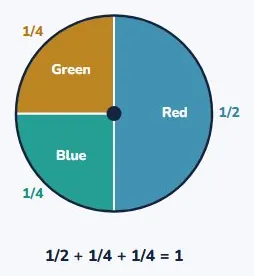
Why it has to be 1
- Spin it and something happens.
- One of the outcomes is certain to occur.
- And certain is 1. So the whole lot must come to 1.
| Question | Answer |
|---|---|
| Will you get a colour? | certainly |
| What is certain, as a number? | 1 |
| So all the colours together? | 1 |
Job one: it catches mistakes
- Work out every probability, then add them.
- If you do not get 1, something is wrong.
- Usually an outcome you forgot to list.
| Your answers add to | Verdict |
|---|---|
| 1 | consistent |
| 7/8 | an outcome is missing |
| 1.2 | something counted twice |
Try it: run an experiment
Job two: it gives you answers
- If you know all but one, you know that one.
- It is 1 take away the rest.
- No counting needed.
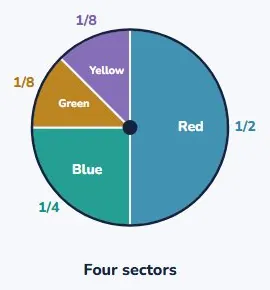
Finding the missing one
- Red 1/2, blue 1/4, green 1/8. Yellow unknown.
- 1/2 + 1/4 + 1/8 = 4/8 + 2/8 + 1/8 = 7/8.
- So yellow is 1 − 7/8 = 1/8.
- And the sector really is an eighth. It checks out.
| Colour | Probability | How |
|---|---|---|
| Red | 1/2 | given |
| Blue | 1/4 | given |
| Green | 1/8 | given |
| Yellow | 1/8 | 1 − 7/8 |
Which needs the whole sample space
- The sample space is every possible outcome of an experiment.
- All of them. That is what makes the total 1.
- Leave one out and the rule stops working.
| Experiment | Sample space |
|---|---|
| Rolling a die | 1, 2, 3, 4, 5, 6 |
| Spinning spinner A | red, blue, green |
| Flipping a coin | heads, tails |
The counting rule
- When the outcomes are equally likely:
- Ways the event can happen, over total outcomes.
- A fraction, top over bottom.
| Part | Where it goes | For "even" on a die |
|---|---|---|
| Number of ways the event can happen | the top | 3 even faces |
| Total number of possible outcomes | the bottom | 6 faces |
| Divide | the probability | 3/6 = 1/2 |
The rule on a die
- An even number: 2, 4, 6 (three ways out of six).
- 3/6, which simplifies to 1/2.
- More than 4: 5 and 6 (two ways). 2/6 = 1/3.
| Event | Ways | Probability |
|---|---|---|
| Rolling a 4 | 1 way | 1/6 |
| An even number | 3 ways | 3/6 = 1/2 |
| More than 4 | 2 ways | 2/6 = 1/3 |
| Less than 7 | 6 ways | 6/6 = 1 |
The rule has a condition
- "If the outcomes are equally likely."
- A fair die: yes. Six faces, same chance each.
- A spinner with different-sized sectors: no.
- Use the rule there and you will be wrong.
| Situation | Equally likely? | Count sectors? |
|---|---|---|
| Fair die | yes | yes |
| Coin | yes | yes |
| Spinner A | no | no, use the fractions |
A spinner in eighths
- Red takes three eighths of the turn.
- Blue takes two eighths, which is a quarter.
- Yellow takes three eighths.
- 3/8 + 1/4 + 3/8 = 1.
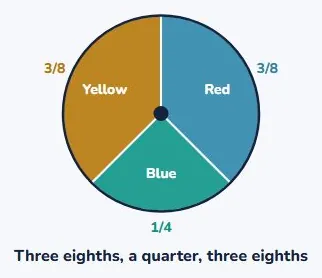
Read it off the sectors
- Not "one of three colours".
- How much of the whole turn each colour takes.
- That is the probability, and it is already a fraction.
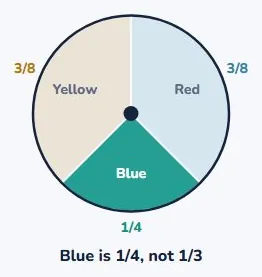
Try it: a spinner in eighths
Red or yellow
- Either one will do, so add the two probabilities.
- 3/8 + 3/8 = 6/8.
- Which simplifies to 3/4.
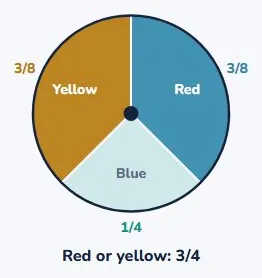
Or ask it the other way
- "Not blue" is the same event.
- Blue is 1/4, so not blue is 1 − 1/4.
- = 3/4. The same answer, one step.
- Two routes, and they agree.
| Event | Working | Answer |
|---|---|---|
| Red or yellow | 3/8 + 3/8 | 3/4 |
| Not blue | 1 − 1/4 | 3/4 |
| Red or blue | 3/8 + 1/4 | 5/8 |
| Any colour | 3/8 + 1/4 + 3/8 | 1 |
When to subtract instead
- If the event is "not something", subtract.
- If it lists a few things, add.
- On a die, "not a 6" is 1 − 1/6 = 5/6.
| Asked | Do this | Example |
|---|---|---|
| Not a 6 | 1 − 1/6 | 5/6 |
| A 2 or a 5 | 1/6 + 1/6 | 2/6 = 1/3 |
| Not an even number | 1 − 1/2 | 1/2 |
Adding unlike fractions
- Red or blue: 3/8 + 1/4.
- Different bottoms, so make them the same.
- 1/4 is 2/8, so 3/8 + 2/8 = 5/8.
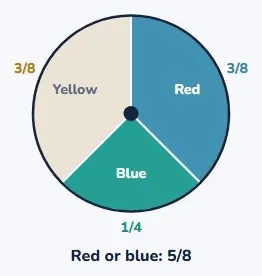
Try it: make it add to 1
All of them on the line
- Likelihood always fits on a line from 0 to 1.
- 1/8 is 0.125. 5/8 is 0.625.
- Which lets you compare two fractions at a glance.
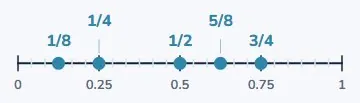
The check, in full
- A die: six outcomes, each 1/6.
- Add all six: 6/6.
- Which is 1. The sample space is complete.
- Do this and you will catch a missed outcome every time.
| Step | Working | Result |
|---|---|---|
| 1, 2, 3, 4, 5, 6 | six outcomes | each 1/6 |
| Add them | 6 lots of 1/6 | 6/6 |
| Which is | 1 |
Common mistakes
- P(red or blue) = 3/8 + 1/4 = 4/12Match the bottoms first: 1/4 = 2/8, so 3/8 + 2/8 = 5/8.
- Spinner B has three colours, so P(red or yellow) = 2/3.The sectors are different sizes, so read them off: 3/8 + 3/8 = 6/8 = 3/4.
- Three outcomes are 1/3, 1/4 and 1/4, so the fourth must be 1/4 too.They must add to 1: 4/12 + 3/12 + 3/12 = 10/12, so the fourth is 2/12 = 1/6.
- The probability of not rolling a 1 is 1/6.1/6 is the chance of rolling a 1. Not rolling a 1 is 1 − 1/6 = 5/6.
Your turn
A spinner is half red, half blue. P(red)?
On a die, what is the probability of not rolling a 1?
Three outcomes are 1/3, 1/4 and 1/4. What is the fourth?
On spinner B, what is P(red or yellow)?
A bag holds 3 red, 5 blue and 2 green counters, all the same size. What is the probability of picking blue?
Mere says a spinner with red, blue and green sectors gives P(red) = 1/3. When is she right?
On a spinner, P(red) = 3/8 and P(blue) = 0.4. Which colour is more likely?
Jack works out the eight colours on a spinner as 1/2, 1/4, 1/8 and 1/4. What does adding them tell him?
Show answer
1. 1/2. 2. 1 − 1/6 = 5/6. 3. 1/3 + 1/4 + 1/4 = 4/12 + 3/12 + 3/12 = 10/12 = 5/6, so the fourth is 1 − 5/6 = 1/6. 4. 3/8 + 3/8 = 6/8 = 3/4, and you can check it as 1 − 1/4 for "not blue", which gives 3/4 too. 5. 1/2. There are 3 + 5 + 2 = 10 counters and 5 are blue, so 5/10, which simplifies to 1/2. 6. Only if the three sectors are the same size. The counting rule needs equally likely outcomes; otherwise read the fraction of the turn red takes. 7. Blue: 3/8 is 0.375, less than 0.4. 3 ÷ 8 = 0.375, and 0.375 is smaller than 0.400, so blue is more likely. 8. They add to 9/8, so something is wrong: 4/8 + 2/8 + 1/8 + 2/8 = 9/8, which is more than 1, so at least one of his fractions is wrong.
What to take away
- All the probabilities add to 1. Always.
- Equally likely outcomes: ways over total.
- Unequal sectors: read the fraction off the spinner.
- "Not this" is 1 take away this.
Challenge
A game spinner has five colours: red, blue, green, yellow and white. The probability of red is 0.3, blue is 14 and green is 0.15. Yellow and white are equally likely. Find the probability of yellow as a fraction. Which colour is most likely, and what is the probability of NOT landing on blue?
Hint
The five probabilities must add to 1. Write them all in the same form first: as hundredths, or as twentieths.
Answer
P(yellow) = 320 (0.15); red is most likely; P(not blue) = 34
Step by step
- Put everything in hundredths: red 30100, blue 25100, green 15100.
- Those three add to 70100, so yellow and white share the other 30100.
- They are equally likely, so each is 15100, which simplifies to 320.
- Red at 0.3 beats blue at 0.25 and the three at 0.15, so red is the most likely colour.
- Not blue is 1 − 14 = 34. Check: 0.3 + 0.15 + 0.15 + 0.15 = 0.75 = 34.
Full working
- 0.3 = 30100, 14 = 25100, 0.15 = 15100make the pieces match
- 30100 + 25100 + 15100 = 70100the three we know
- 1 − 70100 = 30100 for yellow and white togetherall five add to 1
- 30100 ÷ 2 = 15100 = 320 eachyellow and white are equal
- P(not blue) = 1 − 14 = 34'not' means subtract from 1
- P(yellow) = 320; red is most likely; P(not blue) = 34
Twenty cards are numbered 1 to 20 and shuffled. Hine picks one. She wants the probability that the number is a multiple of 3 or a multiple of 4. She works out P(multiple of 3) = 620 and P(multiple of 4) = 520, then adds them to get 1120. What has gone wrong? Find the correct probability, and the probability that the number is neither a multiple of 3 nor a multiple of 4.
Hint
Write out both lists of numbers. Is any card on both lists?
Answer
The card 12 was counted twice; the correct probability is 1020 = 12, and neither is also 12
Step by step
- Multiples of 3 up to 20: 3, 6, 9, 12, 15, 18 (6 cards). Multiples of 4: 4, 8, 12, 16, 20 (5 cards).
- The card 12 is on both lists, so adding 6 and 5 counts it twice.
- The cards that work are 3, 4, 6, 8, 9, 12, 15, 16, 18 and 20: 10 cards, so the probability is 1020 = 12.
- Adding probabilities only works when the events cannot both happen on the same card.
- Neither is 'not (a multiple of 3 or 4)', so it is 1 − 12 = 12. Check: 1, 2, 5, 7, 10, 11, 13, 14, 17, 19 is 10 cards.
Full working
- multiples of 3: 3, 6, 9, 12, 15, 186 cards
- multiples of 4: 4, 8, 12, 16, 205 cards
- 12 is on both lists, so 6 + 5 = 11 counts it twicethe mistake
- 6 + 5 − 1 = 10 cardscount 12 once
- P(3 or 4) = 1020 = 12ways over total
- P(neither) = 1 − 12 = 1210 cards left over
- Correct answer 12, and P(neither) = 12
A die is weighted so that a 6 is twice as likely as each of the other faces, and the faces 1 to 5 are all equally likely. Sione says: "A normal 6 is 16, so this 6 must be 26." Use the rule that all the probabilities add to 1 to show he is wrong. Then find the real probability of a 6, and the probability of an even number. Is rolling an odd number likely or unlikely on this die?
Hint
Call the chance of a 1 one share. Then 2, 3, 4 and 5 are one share each, and a 6 is two shares. How many shares make up the whole?
Answer
P(6) = 27, P(even) = 47, and P(odd) = 37, so an odd number is unlikely
Step by step
- If the 6 were 26, each of the other five faces would be half of that, 16, and the total would be 56 + 26 = 76, which is more than 1. Impossible.
- Count shares instead: faces 1 to 5 are one share each, and the 6 is two shares. That is 7 shares altogether.
- All the probabilities add to 1, so one share is 17. The 6 is two shares: 27.
- Even means 2, 4 or 6: 17 + 17 + 27 = 47.
- Odd is 1 − 47 = 37. That is less than 12, so an odd number is unlikely on this die, though it is equally likely on a fair one.
Full working
- Sione: 5 × 16 + 26 = 76 > 1the total cannot be more than 1
- 1 + 1 + 1 + 1 + 1 + 2 = 7 sharesthe 6 counts twice
- 1 share = 17, so P(6) = 277 shares make 1
- P(even) = P(2) + P(4) + P(6) = 17 + 17 + 27 = 47add the faces in the event
- P(odd) = 1 − 47 = 37 < 12not even
- P(6) = 27, P(even) = 47, and odd (37) is unlikely
Practise this
Report a mistake
More in Probability
Is your child on track?
Take the free placement test