Nets, reflections, rotations and grid maps
What this lesson covers
- A net is a 2D representation of the surfaces of a 3D unfolded shape.
- A reflection is when a shape is flipped over a line, creating a mirror image.
- A translation is when a shape is slid from one place to another without being turned.
- A rotation is when a shape is turned around a fixed point.
- An alphanumeric grid reference is a system that divides a map into labelled rows (letters) and columns (numbers), so that each square can be identified by combining a letter and a number (e.g. A1, B2).
"Rotate it 90°" is not an instruction
- Rotate it about which point? And which way round?
- Saying what happened to a shape needs more than a word.
- This lesson is about saying exactly where, and exactly how.
| what someone says | what is missing |
|---|---|
| "reflect it" | in which line? |
| "rotate it 90°" | about which point, and which way? |
| "move it 4 squares" | in which direction? |
A net is a solid, laid flat
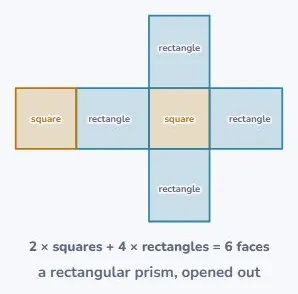
- Cut along enough edges and a 3D shape opens out flat.
- What you get is a net: every surface, in one piece.
- Fold it back up and you have the solid again.
Try it: fold the net
Count the faces first
- To match a solid to its net, count faces before anything else.
- A cube needs 6 squares. Four squares cannot be a cube.
- Then check the shapes of the pieces, and only then the folding.
| solid | faces | so the net has |
|---|---|---|
| cube | 6 | 6 squares |
| triangular prism | 5 | 2 triangles, 3 rectangles |
| square pyramid | 5 | 1 square, 4 triangles |
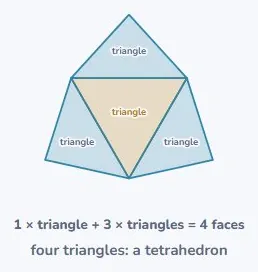
| tetrahedron | 4 | 4 triangles |
Same pieces, different solid
- Four triangles fold into a tetrahedron.
- But a square pyramid also uses triangles, four of them.
- The difference is the base. So count, then look.
A translation is a slide
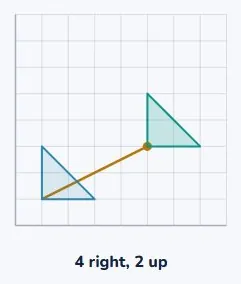
- The shape slides. It does not turn and it does not flip.
- Every point moves the same distance in the same direction.
- To describe it: how far, and which way. 4 right and 2 up.
A reflection is a flip
- The shape flips over a line and becomes a mirror image.
- You must say which line, or the instruction means nothing.
- Here the mirror is the vertical line through 4.
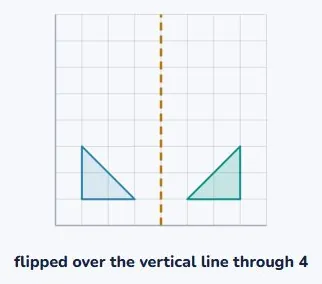
How to check a reflection
- Every point ends up as far from the line as it started.
- On the other side of it. So measure, do not eyeball.
- And a point sitting on the line does not move at all.
| point | distance from the line | image |
|---|---|---|
| 3 squares left | 3 | 3 squares right |
| 1 square left | 1 | 1 square right |
| on the line | 0 | stays put |
A rotation is a turn
- The shape turns around a fixed point, called the centre.
- The centre can be on the shape, or off it entirely.
- Here: 90° anticlockwise about the corner of the triangle.
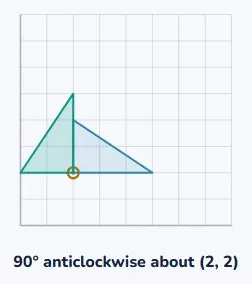
A rotation needs three things
- The centre it turns about. The angle. And the direction.
- Clockwise and anticlockwise land in different places.
- Miss any one of the three and nobody can follow you.
| transformation | in plain words | you must also say |
|---|---|---|
| translation | a slide | how far, and which way |
| reflection | a flip | where the mirror line is |
| rotation | a turn | the centre, the angle, the direction |
Try it: flip, slide and turn
What none of them change
- All three move a shape without resizing it.
- So the side lengths and the angles are untouched.
- If your image is a different size, something went wrong.
| does it change? | answer |
|---|---|
| size | never |
| shape | never |
| position | always |
| which way it faces | only for a flip or a turn |
Two moves, one after the other
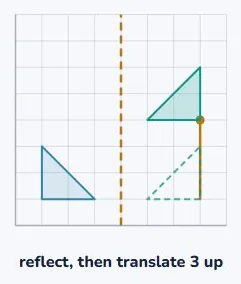
- First flip it over the line through 4.
- Then slide that image 3 squares up.
- Here the order does not matter, because the slide goes the same way as the mirror line. A sideways slide would change the answer.
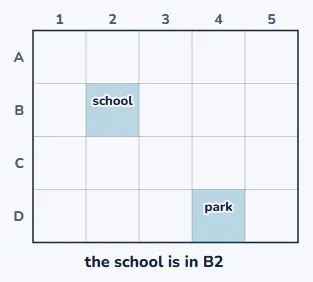
Naming a square on a map
- The rows get letters and the columns get numbers.
- So a reference is a letter then a number: B2.
- And it names a whole square, not a single point.
Describing a route
- Give the squares in order, or give the directions.
- From A1: go east 2, then south 2, then east 2.
- North, south, east and west beat "left" and "right" on a map.
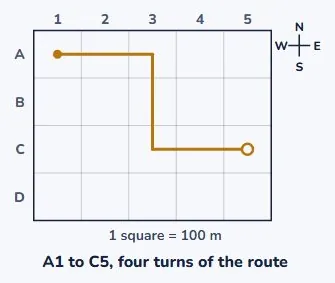
Try it: say exactly how it moved
Common mistakes
- The triangle was rotated 90°.Give all three: the centre, the angle and the direction, e.g. 90° anticlockwise about the corner of the triangle.
- These 5 squares fold into a cube.Count the faces first: a cube has 6 square faces, so a net with only 5 squares cannot be a cube.
- The point 3 squares left of the mirror line lands 1 square right of it.Every point ends up as far from the mirror line as it started, so it lands 3 squares right.
- From A1, go left 2, then down 2.On a map use compass points, east 2 then south 2, because left and right change with the way you face.
Your turn
How many squares in the net of a cube? And of a cuboid?
What is missing from "reflect the triangle"?
A shape slides 3 left and 1 down. Name the transformation.
On a 5-column grid, which square is two east of B1?
A net is made of 4 triangles and nothing else. Which solid does it fold into?
A point is 2 squares left of a mirror line. Where is its image after the reflection?
"Rotate it 90°" is half an instruction. What three things does a rotation need?
On a grid map, row A is furthest north, then rows B and C going south; columns 1, 2, 3 go east. From A1, go east 2 then south 2. Which square?
Show answer
1. Six squares for a cube; a cuboid also needs 6 rectangles. 2. The mirror line. 3. A translation, and "3 left, 1 down" is the description. 4. B3. 5. A tetrahedron. It has 4 triangle faces; a square pyramid also needs a square base. 6. 2 squares right of the line: the same distance from the line, on the other side. 7. The centre, the angle and the direction. Clockwise and anticlockwise land in different places, so all three are needed. 8. C3. East 2 moves from column 1 to column 3 (A3), then south 2 moves from row A to row C.
What to take away
- A net is every face of a solid, laid out flat.
- Slide, flip, turn. And each needs its own extra detail.
- A grid reference is a letter and a number, naming a square.
| job | the move |
|---|---|
| match a net | count the faces first |
| translation | say how far and which way |
| reflection | say where the mirror line is |
| rotation | say centre, angle and direction |
Challenge
A map grid has rows A to H from north to south and columns 1 to 8 from west to east. Tui puts a counter on a square. She slides it 3 squares east and 2 squares south. Then she flips it in a mirror line that runs north to south between columns 4 and 5. It ends up in square E2. Which square did it start in? If she had done the flip first and then the slide, where would it have ended?
Hint
Work backwards: undo the flip first, then undo the slide by going the opposite way.
Answer
It started in C4. Flipping first and then sliding would end in E8.
Step by step
- The mirror line is between columns 4 and 5, so column 1 swaps with 8, 2 with 7, 3 with 6 and 4 with 5.
- Undo the flip: E2 came from E7.
- Undo the slide: go 3 west and 2 north from E7, which is C4.
- Now flip first: C4 becomes C5.
- Then slide 3 east and 2 south: C5 becomes E8. The order of the moves matters here.
Full working
- column c swaps with column 9 − cthe mirror between 4 and 5
- E2 came from E7undo the flip
- 7 − 3 = 4, and 2 rows north of E is Cundo the slide
- C4 → E7 → E2check the start, C4
- C4 → C5 → E8flip first, then slide
- Start C4; flip first ends at E8
A park map has rows A to C from north to south and columns 1 to 5 from west to east. Kahu starts in square A1 and wants to reach square C5, moving one square at a time, only east or south. Square B3 is a pond and he cannot go in it. How many different routes can he take?
Hint
Write in each square the number of ways to reach it. You can only arrive from the square to the west or the square to the north.
Answer
6 routes
Step by step
- Every square in row A and in column 1 can be reached in only 1 way.
- Any other square is reached from the west or the north, so add those two numbers.
- Put 0 in the pond, B3.
- Row B becomes 1, 2, 0, 1, 2 and row C becomes 1, 3, 3, 4, 6.
- So there are 6 routes to C5. Without the pond there would be 15, so 9 routes went through the pond.
Full working
- row A: 1, 1, 1, 1, 1only by going east
- row B: 1, 1 + 1 = 2, 0 (pond), 0 + 1 = 1, 1 + 1 = 2add west and north
- row C: 1, 1 + 2 = 3, 3 + 0 = 3, 3 + 1 = 4, 4 + 2 = 6add west and north
- 15 routes with no pond, 3 × 3 = 9 through B3, 15 − 9 = 6check
- 6 routes
On a map grid, rows A to E run from north to south and columns 1 to 5 run from west to east. An L-shaped tile covers squares C2, C3, C4 and B4. Rewa rotates it 90° clockwise about the centre of square C2. Which four squares does it cover now? Her friend says a single reflection in some mirror line could have moved the tile to exactly the same four squares. Is the friend right?
Hint
Turning clockwise on a map, east becomes south and north becomes east. Then walk along the tile and check which way the short arm turns.
Answer
It covers C2, D2, E2 and E3. The friend is wrong: a reflection would turn the L the other way round.
Step by step
- C2 is the centre, so it stays put.
- C3 is 1 east of the centre and C4 is 2 east. After a clockwise quarter turn east becomes south, so they go to D2 and E2.
- B4 is 2 east and 1 north. 2 east becomes 2 south, and 1 north becomes 1 east, so it goes to E3.
- Walk along the long arm from C2. Before, you go east and the short arm is on your left. After, you go south and E3 is on your left again.
- A mirror swaps left and right, so any reflection would put the short arm on the right. No reflection can do it.
Full working
- C2 → C2the centre does not move
- C3: 1 east → 1 south = D2clockwise quarter turn
- C4: 2 east → 2 south = E2clockwise quarter turn
- B4: 2 east, 1 north → 2 south, 1 east = E3turn each part
- short arm on the left before and aftera turn keeps left and right
- C2, D2, E2, E3; the friend is wrong
Practise this
Report a mistake
More in Geometry
Is your child on track?
Take the free placement test