Simultaneous linear equations
What this lesson covers
- Elimination adds or subtracts equations to remove a variable.
- Substitution puts one equation into the other.
- Check the answer in both equations.
Two methods
- Elimination: match the coefficients of one variable, then add or subtract.
- Substitution: make one variable the subject, then replace it.
Elimination
- 2x + y = 7 and x − y = 2.
- 3x = 9add the equations
- x = 3
- 3 − y = 2
- y = 1
Try it: one line at a time
The solution is the crossing
- 2x + y = 7 and x − y = 2 meet at (3, 1).
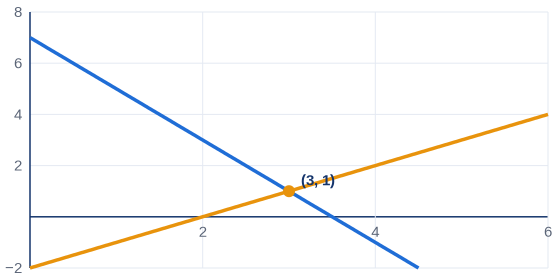
Try it: move the lines
- Change the gradients and intercepts, and find where the lines cross.
Graphing calculator
Common mistakes
- Subtracting when the signs differ.Opposite signs cancel by adding.
- Stopping after finding x.Find both values and check them.
Try it: remove a letter, then check
Your turn
Solve x + y = 5 and x − y = 1.
Solve 2x + y = 8 with y = 2.
Solve y = 2x and x + y = 9.
Solve 3x + 2y = 12 and x + 2y = 8.
Which point satisfies both 5x − 2y = 1 and 3x + y = 5?
To solve 3x + y = 10 and x + y = 4, Sam adds the equations and gets 4x + 2y = 14. What should he do?
At a Wellington café, 2 coffees and 1 muffin cost $14, and 1 coffee and 1 muffin cost $9.50. What does one coffee cost?
Solve 2x + 3y = 19 and 3x − y = 1.
Show answer
1. (3, 2) 2. x = 3 3. (3, 6) 4. (2, 3) 5. (1, 2). Check: 5 − 4 = 1 and 3 + 2 = 5. Each other point fits only one of the equations. 6. Subtract, because the y terms have the same sign: 2x = 6, so x = 3 and y = 1. 7. $4.50. Subtracting the equations removes the muffin: 2c − c = 14 − 9.50 = 4.50. 8. (2, 5). Multiply the second by 3 to get 9x − 3y = 3, add to get 11x = 22, so x = 2 and y = 3 × 2 − 1 = 5.
Sample question: Achieved
Solve 3x + 2y = 16 and x − y = 2.
Hint
Make x the subject of the second equation and substitute it into the first.
Answer
x = 4, y = 2
Step by step
- Two equations, two unknowns. Choose the method that makes the working short.
- The second equation has x on its own with a coefficient of 1, so substitution is quick: x = y + 2.
- Replace x in the first equation: 3(y + 2) + 2y = 16.
- Expand and collect: 3y + 6 + 2y = 16, so 5y = 10 and y = 2.
- Put y = 2 back into x = y + 2: x = 4.
- The classic mistake is to stop after finding y. The answer needs both values.
- Check in both equations: 3 × 4 + 2 × 2 = 16 and 4 − 2 = 2. Both work.
Full working
- x = y + 2from the second equation
- 3(y + 2) + 2y = 16substitute
- 5y = 10, y = 2
- x = 2 + 2 = 4check: 12 + 4 = 16
- x = 4, y = 2
Sample questions: Merit
Solve 4x − 3y = 5 and 6x + 5y = 17.
Hint
No coefficient is 1, so use elimination. Multiply so the x terms match: the first by 3, the second by 2.
Answer
x = 2, y = 1
Step by step
- No variable is on its own, so substitution would bring fractions. Elimination is cleaner.
- Choose a variable to remove. The x coefficients are 4 and 6, and both go into 12.
- Multiply the first equation by 3: 12x − 9y = 15.
- Multiply the second equation by 2: 12x + 10y = 34.
- The x terms have the same sign, so subtract: (12x + 10y) − (12x − 9y) = 34 − 15, which gives 19y = 19.
- So y = 1.
- Substitute into the first equation: 4x − 3 = 5, so 4x = 8 and x = 2.
- The classic mistake is a sign slip when subtracting: 10y − (−9y) is 19y, not y.
- Check in the second equation, the one not used to find x: 6 × 2 + 5 × 1 = 17. Correct.
Full working
- 12x − 9y = 15first × 3
- 12x + 10y = 34second × 2
- 19y = 19, y = 1subtract to remove x
- 4x − 3 = 5, x = 2
- check: 6 × 2 + 5 × 1 = 17
- x = 2, y = 1
Solve x2 + y3 = 4 and x4 − y6 = 0.
Hint
Clear the fractions first: multiply each equation by the lowest common denominator of its fractions.
Answer
x = 4, y = 6
Step by step
- Fractions make elimination messy, so clear them first.
- First equation: the denominators are 2 and 3, so multiply every term by 6: 3x + 2y = 24.
- Second equation: the denominators are 4 and 6, so multiply every term by 12: 3x − 2y = 0.
- Now the y terms are 2y and −2y, opposite signs, so add the equations: 6x = 24.
- So x = 4.
- Substitute into 3x − 2y = 0: 12 − 2y = 0, so y = 6.
- The classic mistake is to multiply only the fractions and forget the right-hand side. The 4 must become 24 too.
- Check in the original equations: 42 + 63 = 2 + 2 = 4, and 44 − 66 = 1 − 1 = 0. Both work.
Full working
- 3x + 2y = 24first × 6
- 3x − 2y = 0second × 12
- 6x = 24, x = 4add to remove y
- 12 − 2y = 0, y = 6
- check: 42 + 63 = 4
- x = 4, y = 6
Sample questions: Excellence
Solve 2x + 3y = 2 and 4x − 3y = 1.
Hint
The equations are not linear in x and y, but they are linear in 1x and 1y. Let u = 1x and v = 1y.
Answer
x = 2, y = 3
Step by step
- These are not straight-line equations in x and y, because x and y are in the denominators.
- But 2x is 2 × 1x. So if we write u = 1x and v = 1y, the equations become linear: 2u + 3v = 2 and 4u − 3v = 1.
- The v terms are 3v and −3v, so add: 6u = 3 and u = 12.
- Substitute into 2u + 3v = 2: 1 + 3v = 2, so v = 13.
- Now undo the substitution. u = 1x = 12, so x = 2. v = 1y = 13, so y = 3.
- The classic mistake is to stop at u and v and give 12 and 13 as the answer.
- Note x and y cannot be 0, because we divide by them. Our answers are not 0, so they are allowed.
- Check in the original equations: 22 + 33 = 1 + 1 = 2, and 42 − 33 = 2 − 1 = 1. Both work.
Full working
- u = 1x, v = 1ymakes the system linear
- 2u + 3v = 2 and 4u − 3v = 1
- 6u = 3, u = 12add to remove v
- 1 + 3v = 2, v = 13
- x = 1u = 2, y = 1v = 3check: 22 + 33 = 2
- x = 2, y = 3
The lines 2x + y = 7, x − y = 2 and ax + 3y = 15 all pass through the same point. Find a. Then find the area of the triangle formed by the first two lines and the y-axis.
Hint
The common point is where the first two lines cross. For the area, find where each of the first two lines meets the y-axis.
Answer
a = 4; area = 13.5 square units
Step by step
- All three lines share one point, and the first two lines alone fix that point. So solve them first.
- Add 2x + y = 7 and x − y = 2: 3x = 9, so x = 3. Then 3 − y = 2, so y = 1. The point is (3, 1).
- The third line must pass through (3, 1) too, so substitute: 3a + 3 = 15, so 3a = 12 and a = 4.
- Now the triangle. Its corners are (3, 1) and the two points where the lines cross the y-axis.
- On the y-axis x = 0. First line: y = 7, so (0, 7). Second line: 0 − y = 2, so y = −2 and the point is (0, −2).
- Take the base along the y-axis, from −2 up to 7. Its length is 7 − (−2) = 9.
- The height is the horizontal distance from the y-axis to (3, 1), which is 3.
- Area = 12 × base × height = 12 × 9 × 3 = 13.5 square units.
- The classic mistake is a base of 7 − 2 = 5. The second intercept is −2, so the base crosses zero.
- Check a: 4 × 3 + 3 × 1 = 15. Correct.
Full working
- 3x = 9, x = 3, y = 1add the first two equations
- 3a + 3 = 15, a = 4the third line passes through (3, 1)
- y-intercepts: (0, 7) and (0, −2)set x = 0
- base = 7 − (−2) = 9, height = 3
- area = 12 × 9 × 3 = 13.5
- a = 4; area = 13.5 square units
What to take away
- Line up the equations and remove one variable.
- Check in both originals.
Challenge
Solve 37x + 13y = 137 and 13x + 37y = 113, without multiplying either equation by 13 or 37.
Hint
Look at how the coefficients are arranged. Adding the equations, and subtracting them, each gives something with a common factor.
Answer
x = 3, y = 2
Step by step
- The coefficients swap places between the equations, so adding and subtracting both give tidy results.
- Add: 50x + 50y = 250, so x + y = 5.
- Subtract the second from the first: 24x − 24y = 24, so x − y = 1.
- Now solve the easy pair: adding gives 2x = 6, so x = 3 and y = 2.
- Check: 37 × 3 + 13 × 2 = 111 + 26 = 137 and 13 × 3 + 37 × 2 = 39 + 74 = 113.
Full working
- 50x + 50y = 250, so x + y = 5add
- 24x − 24y = 24, so x − y = 1subtract
- 2x = 6, x = 3, y = 2add the new pair
- check: 111 + 26 = 137, 39 + 74 = 113
- x = 3, y = 2
A food truck sells pies at one fixed price and sausage rolls at another. Four receipts read: 3 pies and 2 sausage rolls, $26.50; 2 pies and 5 sausage rolls, $30.50; 4 pies and 3 sausage rolls, $36.50; 5 pies and 4 sausage rolls, $46.00. One receipt was printed with the wrong total. (a) Find the price of a pie and of a sausage roll, say which receipt is wrong, and give its correct total. (b) Suppose only the first, second and fourth receipts had been kept. Show that you could then not be sure which one was wrong.
Hint
Any two receipts give a pair of simultaneous equations with exactly one solution. A pair of prices is only believable if it also fits the other receipts.
Answer
(a) A pie costs $6.50 and a sausage roll $3.50. The fourth receipt is wrong: it should be $46.50. (b) Receipts 1 and 2 give $6.50 and $3.50 (so receipt 4 is wrong), but receipts 1 and 4 give $7.00 and $2.75 (so receipt 2 is wrong). Both are sensible prices that fit two of the three receipts, so you cannot tell which receipt is wrong.
Step by step
- Let a pie cost p dollars and a sausage roll s dollars, and solve the first two receipts by elimination.
- Test that answer on the other two receipts: one fits and one does not, so three receipts agree and the odd one out is wrong.
- For (b), solve each pair of the three remaining receipts.
- Each pair gives prices that fail the third receipt, and two of the pairs give believable prices, so there is no way to choose.
Full working
- 3p + 2s = 26.50 and 2p + 5s = 30.50receipts 1 and 2
- 15p + 10s = 132.50 and 4p + 10s = 61.00× 5 and × 2
- 11p = 71.50, so p = 6.50; s = (26.50 − 19.50) ÷ 2 = 3.50subtract
- receipt 3: 4 × 6.50 + 3 × 3.50 = 36.50fits
- receipt 4: 5 × 6.50 + 4 × 3.50 = 46.50, not 46.00wrong
- (b) receipts 1 and 4: 3p + 2s = 26.50 and 5p + 4s = 46.00 give p = 7.00, s = 2.75
- check receipt 2: 2 × 7.00 + 5 × 2.75 = 27.75, not 30.50receipt 2 would be wrong
- receipts 2 and 4 give p ≈ 6.35, s ≈ 3.56, not whole centsreceipt 1 is probably right
- pie $6.50, sausage roll $3.50; receipt 4 should be $46.50
Consider the system (k − 1)x + 2y = 6 and 4x + (k + 1)y = k + 9. (a) Find the values of k for which the system has no unique solution, and say for each whether there are no solutions or infinitely many. (b) Find the value of k for which the system has a unique solution with x = y, and give that solution.
Hint
Two lines fail to have a unique crossing point when they are parallel, that is when one left-hand side is a multiple of the other. For (b), put y = x into both equations and set the two expressions for x equal.
Answer
(a) k = 3 gives infinitely many solutions (both equations are x + y = 3); k = −3 gives no solutions (parallel lines). (b) k = −7, with x = y = −1
Step by step
- The lines are parallel when the coefficients are in the same ratio: (k − 1) ÷ 4 = 2 ÷ (k + 1), so (k − 1)(k + 1) = 8 and k² = 9.
- k = 3: the equations are 2x + 2y = 6 and 4x + 4y = 12. Both are x + y = 3, the same line, so there are infinitely many solutions.
- k = −3: the equations are −4x + 2y = 6 and 4x − 2y = 6. The first says 4x − 2y = −6, so the lines are parallel and never meet: no solutions.
- (b) Put y = x: the first gives (k + 1)x = 6 and the second gives (k + 5)x = k + 9. So 6 ÷ (k + 1) = (k + 9) ÷ (k + 5), which becomes k² + 4k − 21 = 0, so k = −7 or k = 3.
- k = 3 is the twist: there x = y = 32 is a solution, but not the only one, since the lines are the same. So k = −7, giving x = 6 ÷ (−6) = −1 and y = −1.
Full working
- (k − 1)(k + 1) = 2 × 4, so k² = 9parallel: coefficients in proportion
- k = 3: x + y = 3 twicesame line, infinitely many
- k = −3: 4x − 2y = −6 and 4x − 2y = 6parallel, no solutions
- (k + 1)x = 6 and (k + 5)x = k + 9(b) put y = x
- 6(k + 5) = (k + 9)(k + 1), so k² + 4k − 21 = 0, k = −7 or 3
- k = 3 rejected: not a unique solution
- check k = −7: (−8)(−1) + 2(−1) = 6 and 4(−1) + (−6)(−1) = 2
- (a) k = 3 infinitely many, k = −3 none; (b) k = −7, x = y = −1
Practise this
Report a mistake
More in AS 91269
Is your child on track?
Take the free placement test