Turning points: finding and proving max or min
What this lesson covers
- At a turning point the gradient is zero.
- Whether it is a maximum or a minimum is proved by the second derivative or the gradients either side.
Where a curve turns
- At a turning point the curve is flat.
- Flat means the gradient is zero.
- So solve f′(x) = 0.
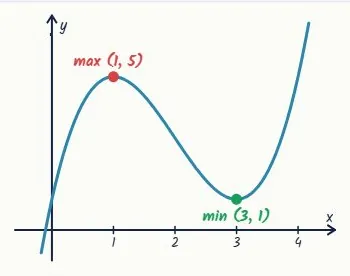
f(x) = x³ − 6x² + 9x + 1
- It rises, turns, falls, then turns again.
- A maximum at x = 1.
- A minimum at x = 3.
Finding them
- Set f′(x) = 0.
- Heights from f, not f′.
- f′(x) = 3x² − 12x + 9differentiate
- 3x² − 12x + 9 = 0gradient zero
- 3(x² − 4x + 3) = 0take out 3
- 3(x − 1)(x − 3) = 0factorise
- x = 1 or x = 3
- f(1) = 1 − 6 + 9 + 1 = 5heights from f
- f(3) = 27 − 54 + 27 + 1 = 1
- (1, 5) and (3, 1)
Try it: slide the tangent
Method 1: the second derivative
- f″ < 0: a maximum.
- f″ > 0: a minimum.
- f″(x) = 6x − 12differentiate again
- f″(1) = 6 − 12 = −6 < 0a maximum
- f″(3) = 18 − 12 = 6 > 0a minimum
- max (1, 5), min (3, 1)
Try it: where f′ is zero
Method 2: the gradient either side
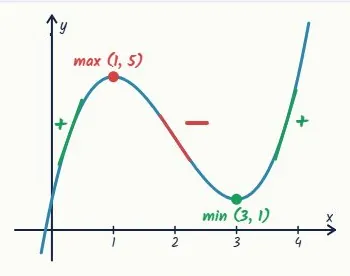
- Before x = 1 the gradient is positive; after, negative.
- Up then down: a maximum.
- Down then up at x = 3: a minimum.
The gradient test, in numbers
- Test either side.
- The signs give the nature.
- f′(x) = 3x² − 12x + 9
- f′(0) = 0 − 0 + 9 = 9 > 0rising
- f′(2) = 12 − 24 + 9 = −3 < 0falling
- f′(4) = 48 − 48 + 9 = 9 > 0rising
- x = 1: + then −, a maximum
- x = 3: − then +, a minimum
A quadratic: y = −2x² + 8x − 3
- One turning point.
- y″ < 0: a maximum.
- dy/dx = −4x + 8differentiate
- −4x + 8 = 0, so x = 2
- y = −2(2)² + 8(2) − 3the height
- = −8 + 16 − 3 = 5
- y″ = −4 < 0a maximum
- maximum at (2, 5)
Always justify the nature
- "It is a maximum" needs a reason.
- A second derivative, a gradient test or a sketch.
- Excellence answers do this unasked.
Another cubic: y = x³ − 3x²
- Factorise y′.
- Classify each with y″.
- y′ = 3x² − 6x = 3x(x − 2)factorise
- 3x(x − 2) = 0: x = 0 or 2
- x = 0: y = 0the height
- x = 2: y = 8 − 12 = −4
- y″ = 6x − 6
- x = 0: y″ = −6 < 0max (0, 0)
- x = 2: y″ = 6 > 0min (2, −4)
When there are no turning points
- y = x³ + 3x has y′ = 3x² + 3.
- 3x² + 3 is never zero: it is always at least 3.
- So the curve never turns: it always rises.
Graphing calculator
Try it: prove each turning point
Where the marks are
- Achieved: find where the gradient is zero.
- Merit: the coordinates of each point.
- Excellence: the nature, justified.
What to take away
- Find, then prove, every turning point.
| Find | set f′(x) = 0 and solve |
| Height | substitute into f, not f′ |
| f″ < 0 | maximum |
| f″ > 0 | minimum |
| Either side | + then − is max, − then + is min |
| Always | state the nature, with a reason |
Common mistakes
- f′(x) = 0 at x = 1, so the turning point is (1, 0).Get the height from f, not f′: f(1) = 1 − 6 + 9 + 1 = 5, so the point is (1, 5).
- (1, 5) is a maximum.State the nature with a reason: f″(1) = 6 − 12 = −6 < 0, so (1, 5) is a maximum.
- f″(3) = 6 is positive, so (3, 1) is a maximum.f″ > 0 means the gradient goes from − to +, falling then rising, so (3, 1) is a minimum.
- y′ = 3x² − 6x = 0, divide by x: 3x − 6 = 0, so x = 2 only.Factorise instead of dividing by x: 3x(x − 2) = 0 gives x = 0 or x = 2, two turning points.
Your turn: eight questions
- Give coordinates and the nature.
- Justify with a reason every time.
Find the turning point of y = x² − 10x + 4.
Find both turning points of y = x³ − 12x.
Use the second derivative to classify the one at x = 2.
Find and classify the turning point of y = −x² + 6x.
f′(x) = 0 at x = 2. Just before x = 2 the gradient is −3; just after it is +2. What is the turning point at x = 2?
For f(x) = x³ − 3x + 4 a student solves f′(x) = 0, gets x = 1, and writes the turning point as (1, 0). What is the correct point?
Which curve has no turning points?
Find and classify both turning points of y = 2x³ − 3x² − 12x + 5.
Show answer
1. 2x − 10 = 0, x = 5, y = 25 − 50 + 4 = −21: a minimum at (5, −21), since y″ = 2 > 0. 2. 3x² − 12 = 0, x = ±2: (−2, 16) and (2, −16). 3. y″ = 6x = 12 at x = 2, positive, so (2, −16) is a minimum (and (−2, 16) a maximum). 4. −2x + 6 = 0, x = 3, y = 9: a maximum, since y″ = −2 < 0. 5. A minimum, since f′ goes − then +: the curve falls, then rises. 6. (1, 2). The height comes from f, not f′: f(1) = 1 − 3 + 4 = 2. 7. y = x³ + 6x, since y′ = 3x² + 6 is always at least 6, so it is never zero. 8. Max at (−1, 12), min at (2, −15). y′ = 6(x − 2)(x + 1) = 0 at x = −1 and 2; y″ = 12x − 6 is −18 < 0 at x = −1 and 18 > 0 at x = 2.
The answers: questions 1 and 2
- 1. dy/dx = 2x − 10 = 0, x = 5
- y = 25 − 50 + 4 = −21
- y″ = 2 > 0: min (5, −21)
- 2. dy/dx = 3x² − 12 = 0
- 3x² = 12, x² = 4, x = ±2
- x = −2: y = −8 + 24 = 16
- x = 2: y = 8 − 24 = −16
- (−2, 16) and (2, −16)
The answers: questions 3 and 4
- 3. y″ = 6xdifferentiate 3x² − 12
- x = 2: y″ = 12 > 0min (2, −16)
- x = −2: y″ = −12 < 0max (−2, 16)
- 4. dy/dx = −2x + 6 = 0, x = 3
- y = −9 + 18 = 9
- y″ = −2 < 0: max (3, 9)
Sample question: Achieved
Find the turning point of y = −2x² + 12x − 7 and state, with a reason, whether it is a maximum or a minimum.
Hint
Differentiate and set dydx = 0. Use the second derivative, or the gradient either side, to decide its nature.
Answer
(3, 11), a maximum
Step by step
- At a turning point the tangent is flat, so the gradient is zero.
- Differentiate: dydx = −4x + 12.
- Set it to zero: −4x + 12 = 0, so x = 3.
- Find y from the original curve: y = −2 × 9 + 36 − 7 = −18 + 36 − 7 = 11. The turning point is (3, 11).
- Nature: the second derivative is d²ydx² = −4. It is negative, so the turning point is a maximum.
- Classic mistake: stating 'maximum' with no reason. The mark needs the justification, here the negative second derivative.
- It also makes sense: the x² coefficient is −2, so the parabola is ∩-shaped and its only turning point is its top.
- Check: y(2) = 9 and y(4) = 9, both below 11. Correct.
Full working
- dydx = −4x + 12 = 0, so x = 3
- y(3) = −18 + 36 − 7 = 11
- d²ydx² = −4 < 0maximum
- (3, 11), a maximum
Sample questions: Merit
Find the coordinates of the turning points of f(x) = 2x³ − 9x² + 12x − 4, and use the second derivative to prove the nature of each.
Hint
Solve f′(x) = 0 by taking out a common factor and factorising. Then find the sign of f″(x) at each x.
Answer
(1, 1) is a local maximum and (2, 0) is a local minimum
Step by step
- Turning points have gradient zero. Differentiate: f′(x) = 6x² − 18x + 12.
- Set f′(x) = 0 and take out the common factor 6: 6(x² − 3x + 2) = 0.
- Factorise: 6(x − 1)(x − 2) = 0, so x = 1 or x = 2.
- Find each y from f, not f′. f(1) = 2 − 9 + 12 − 4 = 1. f(2) = 16 − 36 + 24 − 4 = 0.
- Differentiate again for the second derivative: f″(x) = 12x − 18.
- At x = 1: f″(1) = 12 − 18 = −6, negative, so (1, 1) is a local maximum.
- At x = 2: f″(2) = 24 − 18 = 6, positive, so (2, 0) is a local minimum.
- Classic mistake: mixing up the signs. Negative second derivative means the curve bends down like ∩, so it is a maximum.
- Check it makes sense: the maximum's y value (1) is higher than the minimum's (0).
Full working
- f′(x) = 6x² − 18x + 12 = 6(x − 1)(x − 2) = 0
- x = 1, 2; f(1) = 1, f(2) = 0
- f″(x) = 12x − 18
- f″(1) = −6 < 0: maximum; f″(2) = 6 > 0: minimum
- Maximum (1, 1), minimum (2, 0)
The curve y = x³ − 3x² + kx has a turning point at x = 3. Find k. Then find the other turning point, and prove the nature of both.
Hint
At x = 3 the gradient is zero, so substitute x = 3 into dydx = 0 to find k.
Answer
k = −9; (−1, 5) is a local maximum and (3, −27) is a local minimum
Step by step
- Differentiate, keeping k as a letter: dydx = 3x² − 6x + k.
- A turning point at x = 3 means the gradient is zero there: 27 − 18 + k = 0, so k = −9.
- Classic mistake: putting x = 3 into y instead of dydx. The fact we know is about the gradient.
- Now dydx = 3x² − 6x − 9 = 3(x² − 2x − 3) = 3(x − 3)(x + 1). So the other turning point is at x = −1.
- Find the y values with k = −9: y(−1) = −1 − 3 + 9 = 5 and y(3) = 27 − 27 − 27 = −27.
- Second derivative: d²ydx² = 6x − 6.
- At x = −1: −6 − 6 = −12, negative, so (−1, 5) is a local maximum.
- At x = 3: 18 − 6 = 12, positive, so (3, −27) is a local minimum.
- Check: the gradient at x = 0 is −9 (falling between the two), which fits a maximum followed by a minimum.
Full working
- dydx = 3x² − 6x + k
- 27 − 18 + k = 0, so k = −9gradient zero at x = 3
- 3(x − 3)(x + 1) = 0, so x = −1 is the other
- y(−1) = 5, y(3) = −27
- d²ydx² = 6x − 6: −12 at x = −1 (max), 12 at x = 3 (min)
- k = −9; maximum (−1, 5), minimum (3, −27)
Sample questions: Excellence
Find the stationary points of y = x⁴ − 4x³ (the points where dydx = 0). Explain why the second derivative cannot decide the nature of one of them, and use the gradient either side to decide. Which of them are turning points?
Hint
Factorise dydx = 4x³ − 12x². At a point where the second derivative is 0, test the sign of the gradient just before and just after.
Answer
Stationary points at (0, 0) and (3, −27); (3, −27) is a minimum; (0, 0) is not a turning point, because the gradient is negative on both sides of it
Step by step
- Differentiate: dydx = 4x³ − 12x². Take out the common factor 4x²: 4x²(x − 3) = 0.
- So x = 0 or x = 3. Find y: y(0) = 0 and y(3) = 81 − 108 = −27. The stationary points are (0, 0) and (3, −27).
- Classic mistake: dividing 4x³ = 12x² by x², which loses x = 0. Always factorise instead of dividing.
- Second derivative: d²ydx² = 12x² − 24x.
- At x = 3: 108 − 72 = 36 > 0, so (3, −27) is a minimum.
- At x = 0: the second derivative is 0. Zero tells you nothing about the nature, so this test cannot decide.
- Use the gradient either side of x = 0. At x = −1: 4(1)(−4) = −16. At x = 1: 4(1)(−2) = −8.
- The gradient is negative before and after x = 0. The curve falls, flattens for an instant at (0, 0), then keeps falling.
- A turning point needs the gradient to change sign. It does not here, so (0, 0) is not a turning point. It is a horizontal point of inflection.
- For completeness, at x = 3 the gradient goes from −16 (at x = 2) to 64 (at x = 4), falling then rising, which confirms the minimum.
- So there is one turning point, the minimum (3, −27), and it is the lowest point of the whole curve.
Full working
- dydx = 4x³ − 12x² = 4x²(x − 3) = 0factorise, do not divide
- x = 0 or 3; y(0) = 0, y(3) = −27
- d²ydx² = 12x² − 24x: 36 > 0 at x = 3 (min), 0 at x = 0 (no decision)
- dydx at x = −1: −16; at x = 1: −8negative both sides of 0
- (0, 0) is not a turning pointthe gradient does not change sign
- Minimum (3, −27); (0, 0) is stationary but not a turning point
The curve y = x³ + ax² + bx + 1 has a turning point at (1, −2). Find a and b. Then find the other turning point exactly, and prove the nature of both turning points.
Hint
Two unknowns need two equations: the point is on the curve, and the gradient there is zero.
Answer
a = 1, b = −5; (1, −2) is a local minimum and (−53, 20227) is a local maximum
Step by step
- Two facts give two equations. Fact 1: (1, −2) is on the curve. Fact 2: the gradient at x = 1 is zero.
- Fact 1: 1 + a + b + 1 = −2, so a + b = −4.
- Fact 2: dydx = 3x² + 2ax + b, so at x = 1: 3 + 2a + b = 0, which gives 2a + b = −3.
- Subtract the first equation from the second: a = −3 − (−4) = 1. Then b = −4 − 1 = −5.
- Classic mistake: using only the gradient fact. With two unknowns you need both facts.
- The curve is y = x³ + x² − 5x + 1 and dydx = 3x² + 2x − 5.
- Factorise: 3x² + 2x − 5 = (3x + 5)(x − 1). So the turning points are at x = 1 and x = −53.
- y at x = −53: −12527 + 259 + 253 + 1. Over 27: −125 + 75 + 225 + 2727 = 20227.
- Second derivative: d²ydx² = 6x + 2.
- At x = 1 it is 8 > 0, so (1, −2) is a local minimum.
- At x = −53 it is −10 + 2 = −8 < 0, so (−53, 20227) is a local maximum.
- Check: the maximum's y value, 20227 ≈ 7.48, is above the minimum's −2. And y(1) = 1 + 1 − 5 + 1 = −2. Both fit.
Full working
- 1 + a + b + 1 = −2, so a + b = −4(1, −2) on the curve
- 3 + 2a + b = 0, so 2a + b = −3gradient zero at x = 1
- a = 1, b = −5
- 3x² + 2x − 5 = (3x + 5)(x − 1) = 0, so x = −53
- y(−53) = −125 + 75 + 225 + 2727 = 20227
- d²ydx² = 6x + 2: 8 at x = 1 (min), −8 at x = −53 (max)
- a = 1, b = −5; minimum (1, −2), maximum (−53, 20227)
Challenge
For a constant k > 0, the curve y = x⁴ − 2kx² has three turning points. Find them in terms of k and prove the nature of each. Find the value of k for which the three turning points are the corners of a right-angled triangle. Then explain why the curve has only one turning point when k ≤ 0, and state its nature, including the case k = 0, where y″ = 0 at that point.
Hint
Factorise dydx = 4x³ − 4kx completely. For the triangle, it is isosceles, so think about where the right angle has to be, and use gradients that multiply to −1. For k ≤ 0, look at the sign of x² − k.
Answer
(0, 0) is a maximum and (√k, −k²) and (−√k, −k²) are minima; k = 1, giving (0, 0), (1, −1) and (−1, −1); for k ≤ 0, dydx = 0 only at x = 0, where the gradient goes from negative to positive, so (0, 0) is a minimum
Step by step
- dydx = 4x³ − 4kx = 4x(x² − k) = 4x(x − √k)(x + √k), which is zero at x = 0, √k and −√k.
- The heights: y(0) = 0 and y(±√k) = k² − 2k × k = −k². So the turning points are (0, 0), (√k, −k²) and (−√k, −k²).
- y″ = 12x² − 4k. At x = 0 it is −4k < 0, so (0, 0) is a maximum. At x = ±√k it is 12k − 4k = 8k > 0, so both are minima.
- The two minima are mirror images in the y-axis, so the triangle is isosceles with equal base angles. Two angles of 90° are impossible, so the right angle must be at O.
- Gradient of O to (√k, −k²) is −k² ÷ √k = −k√k; to (−√k, −k²) it is k√k. Perpendicular: (−k√k)(k√k) = −k³ = −1, so k³ = 1 and k = 1. Check: (1, −1) and (−1, −1) give gradients −1 and 1, product −1.
- If k ≤ 0, then x² − k ≥ x² and is zero only when x = 0 and k = 0, so x² − k > 0 for every x ≠ 0. dydx = 4x(x² − k) has the same sign as x: negative before 0, positive after. The only stationary point is x = 0, and the gradient goes from − to +, so (0, 0) is a minimum.
- When k = 0, y = x⁴ and y″ = 12x² = 0 at x = 0, so the second derivative cannot decide. The gradient test above still works and shows a minimum.
Full working
- dydx = 4x(x − √k)(x + √k) = 0: x = 0, ±√kfactorise fully
- (0, 0), (√k, −k²), (−√k, −k²)heights from y
- y″ = 12x² − 4k: −4k < 0 at 0 (max), 8k > 0 at ±√k (minima)
- isosceles, so the right angle is at Oequal base angles
- (−k√k)(k√k) = −k³ = −1, so k = 1perpendicular gradients
- k ≤ 0: x² − k > 0 for x ≠ 0, so dydx goes − then + at x = 0gradient test, also when y″(0) = 0
- max (0, 0), minima (±√k, −k²); k = 1; for k ≤ 0 one turning point, a minimum at (0, 0)
A cubic y = ax³ + bx² + cx + d has a local maximum at (−1, 6) and a local minimum at (1, 2). Find a, b, c and d, and confirm the nature of both points with the second derivative.
Hint
That is four facts for four unknowns: the gradient is zero at x = −1 and at x = 1, and the curve passes through both points. Subtracting pairs of equations makes letters vanish.
Answer
a = 1, b = 0, c = −3, d = 4, so y = x³ − 3x + 4; y″ = −6 at x = −1 (maximum) and 6 at x = 1 (minimum)
Step by step
- dydx = 3ax² + 2bx + c. Zero at x = 1 and x = −1 gives 3a + 2b + c = 0 and 3a − 2b + c = 0.
- Subtract them: 4b = 0, so b = 0, and then c = −3a.
- The points: y(1) = a + b + c + d = 2 and y(−1) = −a + b − c + d = 6. Subtract: 2a + 2c = −4, so a + c = −2.
- With c = −3a: a − 3a = −2, so a = 1 and c = −3. Then 1 + 0 − 3 + d = 2 gives d = 4.
- y″ = 6x. At x = −1 it is −6 < 0, a maximum; at x = 1 it is 6 > 0, a minimum. Both match the question, so the cubic is y = x³ − 3x + 4.
Full working
- 3a + 2b + c = 0 and 3a − 2b + c = 0dydx = 0 at x = ±1
- b = 0, c = −3asubtract, then substitute
- a + c + d = 2 and −a − c + d = 6through (1, 2) and (−1, 6)
- 2a + 2c = −4, so a − 3a = −2, a = 1, c = −3, d = 4subtract
- y″ = 6x: y″(−1) = −6 < 0, y″(1) = 6 > 0max then min
- y = x³ − 3x + 4
For each non-zero value of k, the curve y = x³ − 3kx² has two turning points. Show that both turning points always lie on the curve y = −x³2. Decide the nature of each turning point in terms of k. Then find every value of k for which the maximum is 32 units higher than the minimum.
Hint
Find the turning points with k left as a letter. For the nature, the sign of y″ depends on the sign of k, so look at k > 0 and k < 0 separately.
Answer
The turning points are (0, 0) and (2k, −4k³), and −(2k)³2 = −4k³; for k > 0, (0, 0) is the maximum and (2k, −4k³) the minimum, and for k < 0 it is the other way round; k = 2 or k = −2
Step by step
- dydx = 3x² − 6kx = 3x(x − 2k), which is zero at x = 0 and x = 2k. These differ because k ≠ 0.
- The heights: y(0) = 0 and y(2k) = 8k³ − 12k³ = −4k³. So the points are (0, 0) and (2k, −4k³).
- On y = −x³2: x = 0 gives 0, and x = 2k gives −8k³2 = −4k³. Both points fit, for every k.
- y″ = 6x − 6k. At x = 0 it is −6k; at x = 2k it is 6k. If k > 0, (0, 0) is a maximum and (2k, −4k³) a minimum. If k < 0 the signs swap.
- The gap between the heights is |−4k³ − 0| = 4|k|³ in either case. Setting 4|k|³ = 32 gives |k|³ = 8, so k = 2 or k = −2.
- Check: k = 2 gives max (0, 0), min (4, −32); k = −2 gives min (0, 0), max (−4, 32). Both gaps are 32.
Full working
- dydx = 3x(x − 2k) = 0, so x = 0 or x = 2kgradient zero
- y(0) = 0, y(2k) = 8k³ − 12k³ = −4k³heights from y
- −(2k)³2 = −4k³ and −0³2 = 0both on y = −x³2
- y″ = 6x − 6k: −6k at x = 0, 6k at x = 2knature depends on the sign of k
- k > 0: 0 − (−4k³) = 32; k < 0: −4k³ − 0 = 32max minus min
- k³ = 8 or k³ = −8solve each case
- k = 2 or k = −2
Practise this
Report a mistake
More in AS 91262
 The derivative: what the gradient function means6 min
 Differentiating polynomials, fractions and all7 min
 Equation of a tangent to a curve, step by step8 minTurning points: finding and proving max or min8 min
 Sketching the gradient graph of a function7 min
 Optimisation with calculus: the biggest box8 min
 Anti-differentiation and why you need + c7 min
 Kinematics: displacement, velocity and acceleration8 min
 The derivative: 7 exam questions solved step by step11 min
 Differentiating: 7 exam questions solved step by step11 min
 Tangents: 7 exam questions solved step by step11 min
 Turning points: 7 exam questions solved step by step12 min
 Gradient graphs: 7 exam questions solved step by step12 min
 Optimisation: 7 exam questions solved step by step11 min
 Anti-differentiation: 7 exam questions solved step by step11 min
 Kinematics: 7 exam questions solved step by step11 min
Is your child on track?
Take the free placement test