Parallel and perpendicular lines
What this lesson covers
- Parallel lines have equal gradients.
- Perpendicular gradients are negative reciprocals.
- A perpendicular bisector goes through the midpoint at right angles.
The two gradient rules
- Parallel: m₁ = m₂.
- Perpendicular: m₁ × m₂ = −1, so flip the fraction and change the sign.
- A gradient of 2 pairs with −1/2. A gradient of −3/4 pairs with 4/3.
Try it: the two gradient rules
Lines related to y = 2x + 1
- Find the parallel line through (3, 4), then the perpendicular line through (2, 5).
- parallel: y − 4 = 2(x − 3), so y = 2x − 2
- perpendicular gradient = −1/2
- y − 5 = −(1/2)(x − 2)
- y = −(1/2)x + 6
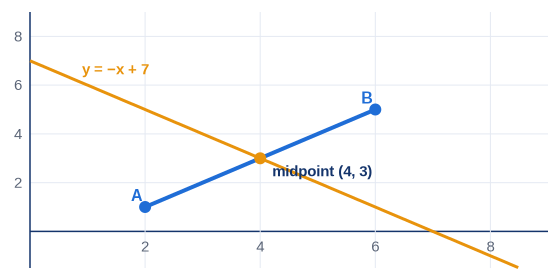
Perpendicular bisector of A(2, 1) and B(6, 5)
- It needs the midpoint and the perpendicular gradient.
- midpoint = (4, 3)
- gradient AB = 4 ÷ 4 = 1
- perpendicular gradient = −1
- y − 3 = −1(x − 4)
- y = −x + 7
Try it: a perpendicular bisector
A perpendicular bisector
- It cuts AB in half, at right angles.
Proving a right angle
- Show that A(1, 1), B(4, 2) and C(2, −2) make a right angle at A.
- gradient AB = 1/3
- gradient AC = −3
- (1/3) × (−3) = −1
- AB is perpendicular to AC
Try it: perpendicular gradients
Common mistakes
- Taking the reciprocal and keeping the sign.Do both: the perpendicular of 2 is −1/2, not 1/2.
- Using A or B as the point on a perpendicular bisector.The bisector goes through the midpoint, not through A or B.
Your turn
Find the gradient perpendicular to 3.
Find the gradient perpendicular to −2/5.
Find the line parallel to y = 4x − 1 through (0, 2).
Gradients are 1/2 and −2. How do the lines relate?
Find the line perpendicular to y = 3x − 2 through (6, 1).
Which line is perpendicular to 2x + 3y = 6?
Find the perpendicular bisector of A(0, 1) and B(4, 9).
P(0, 0), Q(4, 2) and R(3, k). Find k so that the angle PQR is a right angle.
Show answer
1. −1/3 2. 5/2 3. y = 4x + 2 4. Their product is −1, so perpendicular 5. y = −(1/3)x + 3. The perpendicular gradient is −1/3, so y − 1 = −(1/3)(x − 6) = −(1/3)x + 2, giving y = −(1/3)x + 3. 6. 3x − 2y = 4. 2x + 3y = 6 has gradient −2/3, so a perpendicular needs 3/2, and 3x − 2y = 4 gives y = (3/2)x − 2. 7. y = −(1/2)x + 6. Midpoint (2, 5), gradient AB = 8 ÷ 4 = 2, so the gradient is −1/2: y − 5 = −(1/2)(x − 2) gives y = −(1/2)x + 6. 8. k = 4. Gradient PQ = 1/2, so QR needs gradient −2: (k − 2) ÷ (3 − 4) = −2 gives k − 2 = 2, so k = 4.
Sample question: Achieved
Find the equation of the line through (4, −1) that is perpendicular to 2x + 3y = 6.
Hint
Rearrange 2x + 3y = 6 to read its gradient, then flip it and change its sign.
Answer
y = (32)x − 7
Step by step
- First find the gradient of 2x + 3y = 6 by making y the subject: 3y = −2x + 6, so y = −(23)x + 2.
- Its gradient is −23.
- Perpendicular gradients are negative reciprocals: flip 23 to 32 and change the sign. So m = 32.
- Through (4, −1): y − (−1) = (32)(x − 4), so y + 1 = (32)x − 6.
- y = (32)x − 7.
- Check: (−23) × (32) = −1, and x = 4 gives y = 6 − 7 = −1. Both correct.
Full working
- y = −(23)x + 2make y the subject
- perpendicular gradient = 32negative reciprocal
- y + 1 = (32)(x − 4)
- y = (32)x − 7
Sample questions: Merit
A(−2, 1), B(2, 3) and C(3, 1) are the corners of a triangle. Show that the triangle has a right angle, say at which corner, and find its area.
Hint
Find the gradients of all three sides. Two gradients that multiply to −1 meet at the right angle.
Answer
Gradients AB = 12 and BC = −2 multiply to −1, so the right angle is at B; area = 5 square units
Step by step
- You do not know which corner is the right angle, so find all three gradients.
- AB: (3 − 1) ÷ (2 − (−2)) = 24 = 12.
- BC: (1 − 3) ÷ (3 − 2) = −2.
- AC: (1 − 1) ÷ (3 − (−2)) = 0, a horizontal side.
- (12) × (−2) = −1, so AB is perpendicular to BC. The right angle is where they meet: at B.
- For the area, the two sides at the right angle are base and height: AB = √(16 + 4) = √20 and BC = √(1 + 4) = √5.
- Area = ½ × √20 × √5 = ½ × √100 = ½ × 10 = 5.
- Classic mistake: using AC as a base with AB as height. Only the two sides at the right angle can be base and height.
- Check another way: AC is horizontal with length 5, and B is 2 units above it, so area = ½ × 5 × 2 = 5. It matches.
Full working
- m(AB) = 24 = 12
- m(BC) = −21 = −2
- m(AC) = 0
- (12) × (−2) = −1AB ⊥ BC, right angle at B
- area = ½ × √20 × √5 = ½ × 10
- right angle at B, area 5 square units
Find the perpendicular bisector of A(−1, 4) and B(5, 0). Find where it crosses the y-axis, and show that this point is the same distance from A and from B.
Hint
A perpendicular bisector goes through the midpoint of AB with the negative reciprocal of AB's gradient.
Answer
y = (32)x − 1; it crosses the y-axis at (0, −1), which is √26 from both A and B
Step by step
- A perpendicular bisector needs two things: the midpoint, and the perpendicular gradient.
- Midpoint of AB: ((−1 + 5) ÷ 2, (4 + 0) ÷ 2) = (2, 2).
- Gradient AB = (0 − 4) ÷ (5 − (−1)) = −46 = −23.
- Perpendicular gradient: flip and change sign, giving 32.
- Line: y − 2 = (32)(x − 2), so y = (32)x − 1.
- The y-axis is where x = 0, so y = −1. The point is (0, −1).
- Distance to A: √((0 + 1)² + (−1 − 4)²) = √(1 + 25) = √26.
- Distance to B: √((0 − 5)² + (−1 − 0)²) = √(25 + 1) = √26. The same.
- This is no accident: every point on the perpendicular bisector is equally far from A and B.
Full working
- M = (2, 2)midpoint
- m(AB) = −23, so the perpendicular gradient is 32
- y − 2 = (32)(x − 2), so y = (32)x − 1
- x = 0 gives (0, −1)y-axis crossing
- √(1 + 25) = √26 and √(25 + 1) = √26equal distances
- y = (32)x − 1; (0, −1) is √26 from A and from B
Sample questions: Excellence
Find the centre and the exact radius of the circle through A(1, 7), B(7, 5) and C(−1, 1).
Hint
The centre is equally far from all three points, so it lies on the perpendicular bisector of AB and of AC. Find where those two lines meet.
Answer
Centre (3, 3), radius √20 = 2√5
Step by step
- The centre is the same distance from A and B, so it is on the perpendicular bisector of AB. The same goes for AC.
- Bisector of AB: midpoint (4, 6). Gradient AB = (5 − 7) ÷ (7 − 1) = −13, so the perpendicular gradient is 3.
- That line: y − 6 = 3(x − 4), which is y = 3x − 6.
- Bisector of AC: midpoint (0, 4). Gradient AC = (1 − 7) ÷ (−1 − 1) = 3, so the perpendicular gradient is −13.
- That line: y = −(13)x + 4.
- The centre is where they meet: 3x − 6 = −(13)x + 4. Multiply by 3: 9x − 18 = −x + 12, so 10x = 30 and x = 3.
- y = 3(3) − 6 = 3. The centre is (3, 3).
- Radius = distance to A: √((1 − 3)² + (7 − 3)²) = √(4 + 16) = √20 = 2√5.
- Check with the other points: to B is √(16 + 4) = √20, to C is √(16 + 4) = √20. All equal.
- Classic mistake: averaging the three points. That gives (73, 133), which is not equally far from all three.
Full working
- AB: midpoint (4, 6), m = −13, bisector y = 3x − 6
- AC: midpoint (0, 4), m = 3, bisector y = −(13)x + 4
- 3x − 6 = −(13)x + 4, so x = 3, y = 3centre
- r = √(2² + 4²) = √20distance to A
- OB = √(4² + 2²) = √20, OC = √(4² + 2²) = √20check
- centre (3, 3), radius 2√5
The lines (k + 1)x + 2y = 4 and 3x + (k − 4)y = 1 depend on k. Find the value of k that makes them perpendicular, and the values of k that make them parallel. Check that the parallel lines are not the same line.
Hint
Write both gradients in terms of k. Perpendicular: the product is −1. Parallel: the gradients are equal.
Answer
Perpendicular when k = 1; parallel when k = 5 or k = −2, and in both cases the lines are distinct
Step by step
- Make y the subject of each line to read its gradient.
- First line: 2y = −(k + 1)x + 4, so m₁ = −k + 12.
- Second line: (k − 4)y = −3x + 1, so m₂ = −3k − 4, as long as k ≠ 4.
- Perpendicular: m₁ × m₂ = −1. The two minus signs cancel: 3(k + 1)2(k − 4) = −1.
- Cross-multiply: 3k + 3 = −2k + 8, so 5k = 5 and k = 1. Check: the lines become 2x + 2y = 4 (gradient −1) and 3x − 3y = 1 (gradient 1). Product −1.
- Parallel: m₁ = m₂, so k + 12 = 3k − 4.
- Cross-multiply: (k + 1)(k − 4) = 6, so k² − 3k − 4 = 6 and k² − 3k − 10 = 0.
- Factorise: (k − 5)(k + 2) = 0, so k = 5 or k = −2.
- k = 5: 6x + 2y = 4 is 3x + y = 2, and 3x + y = 1. Same slope, different lines.
- k = −2: −x + 2y = 4 is x − 2y = −4, and 3x − 6y = 1 is x − 2y = 13. Same slope, different lines.
- Why check? Equal gradients could also mean the same line twice, and the same line is not called parallel.
- k = 4 is not a solution either: then the second line is vertical and the first is not.
Full working
- m₁ = −k + 12, m₂ = −3k − 4make y the subject
- 3(k + 1)2(k − 4) = −1perpendicular
- 3k + 3 = −2k + 8, so k = 1
- k + 12 = 3k − 4parallel
- k² − 3k − 10 = 0, so (k − 5)(k + 2) = 0
- k = 5: 3x + y = 2 and 3x + y = 1; k = −2: x − 2y = −4 and x − 2y = 13distinct
- perpendicular: k = 1; parallel: k = 5 or k = −2
What to take away
- Same gradient means parallel.
- Negative reciprocal means perpendicular.
- A bisector always starts from the midpoint.
Challenge
Triangle ABC has A(−3, 0), B(6, 3) and C(4, 7). An altitude is the line from a corner that meets the opposite side at right angles. Find the equations of the altitudes from A and from C, find where they meet, and prove that the altitude from B passes through the same point.
Hint
Each altitude is perpendicular to the opposite side, so start with the gradients of BC, AB and CA.
Answer
Altitude from A: y = (12)x + 32; from C: y = −3x + 19; they meet at (5, 4); the altitude from B, y = −x + 9, also passes through (5, 4)
Step by step
- Gradients of the sides: BC = 4 ÷ (−2) = −2, AB = 3 ÷ 9 = 13, CA = 7 ÷ 7 = 1.
- The altitude from A is perpendicular to BC, so its gradient is 12. Through A(−3, 0): y = (12)(x + 3) = (12)x + 32.
- The altitude from C is perpendicular to AB, so its gradient is −3. Through C(4, 7): y − 7 = −3(x − 4), so y = −3x + 19.
- Solve together: (12)x + 32 = −3x + 19. Multiply by 2: x + 3 = −6x + 38, so 7x = 35, x = 5 and y = 4.
- The altitude from B is perpendicular to CA, so its gradient is −1. Through B(6, 3): y = −x + 9.
- At x = 5 this gives y = 4, so the third altitude also passes through (5, 4). All three altitudes meet at one point.
Full working
- m(BC) = −2, m(AB) = 13, m(CA) = 1side gradients
- from A: m = 12, y = (12)x + 32perpendicular to BC
- from C: m = −3, y = −3x + 19perpendicular to AB
- x + 3 = −6x + 38, so x = 5, y = 4solve together
- from B: m = −1, y = −x + 9; x = 5 gives y = 4perpendicular to CA
- all three altitudes meet at (5, 4)
A mirror line M has equation x − 2y + 6 = 0. Find the reflection P′ of the point P(7, −1) in M. A laser beam travels along the line y = −x + 6, which passes through P, and is reflected in M. Find the equation of the reflected line.
Hint
P and P′ are joined by a line perpendicular to M, and the point where that line meets M is the midpoint of PP′. A line and its reflection meet on the mirror.
Answer
P′ = (1, 11); the reflected line is y = −7x + 18
Step by step
- M rearranges to y = (12)x + 3, gradient 12. So PP′ has gradient −2.
- Line through P(7, −1) with gradient −2: y = −2x + 13.
- Meet M: (12)x + 3 = −2x + 13, so 2.5x = 10, x = 4 and y = 5. F(4, 5) is the midpoint of PP′.
- P′ is as far past F as P is before it: P′ = (2 × 4 − 7, 2 × 5 − (−1)) = (1, 11).
- The beam y = −x + 6 meets M where −x + 6 = (12)x + 3, so x = 2, y = 4. This point is on the mirror, so it stays put.
- P is on the beam, so P′ is on the reflected beam. The line through (2, 4) and (1, 11) has gradient 7 ÷ (−1) = −7: y − 4 = −7(x − 2), so y = −7x + 18.
Full working
- M: y = (12)x + 3, so PP′ has gradient −2negative reciprocal
- y = −2x + 13through P(7, −1)
- (12)x + 3 = −2x + 13, so F = (4, 5)foot on the mirror
- P′ = (2 × 4 − 7, 2 × 5 + 1) = (1, 11)F is the midpoint of PP′
- −x + 6 = (12)x + 3, so (2, 4)beam meets mirror
- m = 11 − 41 − 2 = −7through (2, 4) and P′
- P′(1, 11); reflected line y = −7x + 18
ABCD is a trapezium with AB parallel to DC and a right angle at A. A is (0, 0), B is (8, 4) and C is (3, 9). Find D, show that the trapezium is not a rectangle, and find its exact area.
Hint
D lies on two lines: the line through A perpendicular to AB, and the line through C parallel to AB. The area of a trapezium is half the sum of the parallel sides times the distance between them.
Answer
D = (−3, 6); DC = 3√5 but AB = 4√5, so it is not a rectangle; area = 52.5 square units
Step by step
- Gradient AB = 4 ÷ 8 = 12. The side AD is perpendicular to AB, so it has gradient −2 through A: y = −2x.
- DC is parallel to AB, so it has gradient 12 through C(3, 9): y = (12)x + 152.
- Solve: −2x = (12)x + 152, so −5x = 15, x = −3 and y = 6. D = (−3, 6).
- AB = √(64 + 16) = √80 = 4√5 and DC = √(36 + 9) = √45 = 3√5. Opposite sides of a rectangle are equal, and these are not, so ABCD is not a rectangle.
- AD is perpendicular to both parallel sides, so it is the height: AD = √(9 + 36) = √45 = 3√5.
- Area = ½ × (4√5 + 3√5) × 3√5 = ½ × 7√5 × 3√5 = ½ × 105 = 52.5.
Full working
- m(AB) = 12
- AD: y = −2xperpendicular through A
- DC: y − 9 = (12)(x − 3)parallel through C
- −2x = (12)x + 152, so D = (−3, 6)
- AB = 4√5, DC = 3√5, AD = 3√5AB ≠ DC, not a rectangle
- area = ½ × (4√5 + 3√5) × 3√5 = 105 ÷ 2
- D(−3, 6); area 52.5 square units
Practise this
Report a mistake
More in AS 91256
Is your child on track?
Take the free placement test