Comparing groups: 6 questions solved step by step
What this lesson covers
- Comparing two groups means comparing their whole distributions, not one number from each.
- Shift, overlap, spread and shape together decide how strong a comparison is.
Comparing two groups, step by step
- Put each group's values in order.
- Find the median, quartiles and IQR of each.
- Describe the shift, the overlap and the spread.
- Then decide if one group tends to be bigger.
Question 1 · Achieved
- Minutes to get to school (10 students):
- 12, 25, 8, 15, 30, 18, 10, 22, 14, 20
- Find the median and the IQR.
Q1: median and IQR
- Sort before anything.
- Quartiles: middle of halves.
- 8, 10, 12, 14, 15lower half, sorted
- 18, 20, 22, 25, 30upper half
- n = 10: median between 5th, 6th
- median = (15 + 18) ÷ 2 = 16.5
- Q1 = 12middle of lower half
- Q3 = 22middle of upper half
- IQR = 22 − 12 = 10 minutesQ3 − Q1
- median 16.5 min, IQR 10 min
Try it: median and spread
Question 2 · Achieved
- Hours of part-time work (8 students):
- 6, 15, 9, 12, 4, 10, 18, 8
- Find the five-number summary and IQR.
Q2: five-number summary
- n = 8: medians of pairs.
- A quartile can fall between.
- 4, 6, 8, 9, 10, 12, 15, 18sorted
- min = 4, max = 18
- median = (9 + 10) ÷ 2 = 9.5n = 8: 4th and 5th
- lower half: 4, 6, 8, 9
- Q1 = (6 + 8) ÷ 2 = 7
- upper half: 10, 12, 15, 18
- Q3 = (12 + 15) ÷ 2 = 13.5
- IQR = 13.5 − 7 = 6.5 hoursQ3 − Q1
- 4, 7, 9.5, 13.5, 18 (hours)
Question 3 · Merit
- Screen time on a school day (hours)
- Year 9: 2, 3, 3, 4, 5, 6, 6, 9
- Year 13: 3, 5, 6, 6, 7, 7, 8, 12
- Medians, IQRs, then shift and spread.
Q3: both groups
- Lists already sorted.
- Same steps for each group.
- Year 9: 2, 3, 3, 4, 5, 6, 6, 9
- median = (4 + 5) ÷ 2 = 4.5
- Q1 = 3, Q3 = 6(3 + 3) ÷ 2, (6 + 6) ÷ 2
- IQR = 6 − 3 = 3 hours
- Year 13: 3, 5, 6, 6, 7, 7, 8, 12
- median = (6 + 7) ÷ 2 = 6.5
- Q1 = 5.5, Q3 = 7.5(5 + 6) ÷ 2, (7 + 8) ÷ 2
- IQR = 7.5 − 5.5 = 2 hours
Q3: shift and spread
- Shift, then spread.
- Too few to make a call.
- Year 9: median 4.5, IQR 3
- Year 13: median 6.5, IQR 2
- 6.5 − 4.5 = 2 hoursshift
- Year 13 sits about 2 h higher
- IQR 2 h < IQR 3 hspread
- Year 13 middle half less spread
- Year 13: typically 2 h a day more
- 8 per group: too few for a call
Question 4 · Merit
- Resting pulse, 30 Year 11s per group.
- Breakfast: median 72, box 67 to 78
- Skipped breakfast: median 75, box 70 to 81
- Can you make a call?
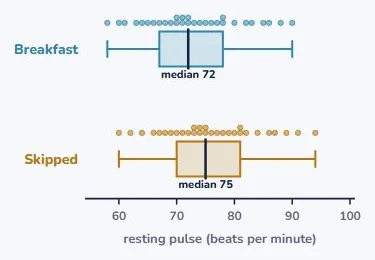
Q4: is there a call?
- Each median vs other box.
- Inside both: no call.
- Rule: median outside other box
- 72 vs no-breakfast box 70 to 81
- 72 is inside
- 75 vs breakfast box 67 to 78
- 75 is inside
- medians 3 bpm apart
- boxes overlap from 70 to 78
- No call can be made
Try it: is there a call?
Question 5 · Merit, in context
- Sleep on a school night, 30 per group.
- Phone in the bedroom at night, or not.
- Make a call if you can, then write it.
| Sleep (h) | Phone | No phone |
|---|---|---|
| Minimum | 5 | 5.5 |
| Q1 | 6.5 | 7 |
| Median | 7 | 8 |
| Q3 | 7.5 | 8.5 |
| Maximum | 9.5 | 10 |
Q5: can we make a call?
- Median outside the box?
- Then state the overlap.
- Medians: phone 7 h, no phone 8 h
- Phone box: 6.5 h to 7.5 h
- 8 > 7.5: outside the phone box
- So I can make a call
- 8 − 7 = 1 hourdifference of medians
- Boxes overlap 7 h to 7.5 h
Q5: write the comparison
- Claim, population, evidence.
- Say "tend to".
- I think Year 11s at this school
- with no phone in the bedroom
- tend to sleep longer on a school
- night than those with one.
- Medians 8 h vs 7 h: 1 h more
- Boxes overlap: so "tend to"
- Observed only: not proof of cause
Try it: summarise, call, write
Question 6 · Excellence
- Kahikatea seedlings, 10 in each group.
- Compare the two groups fully.
- Make a call if you can.
| Group | Height after 6 weeks (cm) |
|---|---|
| Sun | 22, 15, 19, 26, 17, 21, 14, 24, 18, 22 |
| Shade | 16, 11, 23, 13, 18, 10, 14, 19, 12, 15 |
Q6: sun and shade
- Sort, then split in halves.
- Quartile: middle of a half.
- Sun: 14, 15, 17, 18, 19,
- 21, 22, 22, 24, 26
- median = (19 + 21) ÷ 2 = 20
- Q1 17, Q3 22, IQR 22 − 17 = 5
- Shade: 10, 11, 12, 13, 14,
- 15, 16, 18, 19, 23
- median = (14 + 15) ÷ 2 = 14.5
- Q1 12, Q3 18, IQR 18 − 12 = 6
Q6: compare and call
- Shift, overlap, spread.
- Call, but say how sure.
- Sun: median 20, IQR 5
- Shade: median 14.5, IQR 6
- 20 − 14.5 = 5.5 cmshift
- boxes overlap 17 to 18 cmoverlap
- IQR 5 and 6: similarspread
- 20 > 18: outside shade boxso make a call
- I think kahikatea grown in sun
- tend to be taller than in shade
- Only 10 each: a tentative call
Common mistakes
- 12, 25, 8, 15, 30, 18, 10, 22, 14, 20: median = (30 + 18) ÷ 2 = 24Sort first: 8, 10, 12, 14, 15, 18, 20, 22, 25, 30, so the median is (15 + 18) ÷ 2 = 16.5 minutes.
- Sun seedlings: IQR = 26 − 14 = 12 cm26 − 14 is the range; the IQR is Q3 − Q1 = 22 − 17 = 5 cm, the spread of the middle half.
- Median 72 is less than 75, so students who eat breakfast have lower pulse rates.Each median lies inside the other group's box, so no call can be made from these samples.
- Students with no phone in the bedroom sleep 1 hour longer.Say Year 11s at this school with no phone "tend to" sleep longer, medians 8 h vs 7 h, since the boxes overlap and it is not proof of cause.
The method that solved all six
- Sort, summarise, describe, then call.
| Step | How |
|---|---|
| Sort | smallest to largest first |
| Median | middle, or mean of the two |
| Quartiles | medians of the two halves |
| IQR | Q3 minus Q1 |
| Describe | shift, overlap, spread |
| Call | median outside other box |
| Write | tend to, units, population |
Challenge
Eight Year 11s at a Hamilton school timed their walk to school, in minutes. One value was smudged, so the list reads: 14, 9, 22, 11, 17, 25, 13 and one unknown time. The teacher remembers that the median was 15.5 minutes and the IQR was 9 minutes. Find the missing time, and show that it is the only value that works.
Hint
Sort the seven known values: 9, 11, 13, 14, 17, 22, 25. With 8 values the median is the mean of the 4th and 5th. Try the missing value below 14, between 14 and 17, and above 17, and see which can give 15.5. Then use the IQR.
Answer
20 minutes
Step by step
- With 8 values, the median is the mean of the 4th and 5th values.
- If the missing time were less than 17, the 4th and 5th values would average less than 15.5, so it must be at least 17; then the median is (14 + 17) ÷ 2 = 15.5.
- The lower half is then 9, 11, 13, 14, so Q1 = 12 and Q3 must be 12 + 9 = 21.
- If the missing time is between 17 and 22, the upper half is 17, x, 22, 25 and Q3 = (x + 22) ÷ 2 = 21, so x = 20, which fits.
- If it were between 22 and 25 the same rule gives 20, which is not in that range; if it were 25 or more, Q3 would be 23.5 and the IQR 11.5. So 20 is the only answer.
Full working
- 9, 11, 13, 14, 17, 22, 25 plus x8 values: median = mean of 4th and 5th
- x < 17 gives a median below 15.5e.g. x = 15 gives (14 + 15) ÷ 2 = 14.5
- x ≥ 17: median = (14 + 17) ÷ 2 = 15.5matches
- Q1 = (11 + 13) ÷ 2 = 12, so Q3 = 12 + 9 = 21IQR = Q3 − Q1
- upper half 17, x, 22, 25: (x + 22) ÷ 2 = 216th and 7th values
- x = 42 − 22 = 20check: 17 ≤ 20 ≤ 22
- the missing time is 20 minutes
A PE teacher timed 100 m sprints, in seconds, for 10 Year 11s who train with an athletics club and 10 who do not. Club: 12.8, 13.1, 13.4, 13.5, 13.9, 14.0, 14.2, 14.6, 15.0, 15.3. No club: 13.2, 13.7, 13.9, 14.4, 14.6, 15.2, 15.4, 15.9, 16.8, 1.63. A student drew box plots straight from these numbers and said no call can be made. (a) Show that, with the data exactly as typed, no call can be made. (b) Find the error, fix it, and decide again. Write the comparison.
Hint
Find Q1, the median and Q3 for each group as typed, and check each median against the other group's box. Then look hard at the no-club data: is every value possible for a 100 m sprint?
Answer
(a) Each median lies inside the other box, so no call. (b) 1.63 s is impossible and should be 16.3 s; then the no-club median, 14.9 s, is above the club box, so a call can be made: club members tend to run faster (medians 13.95 s vs 14.9 s), a tentative call with only 10 each.
Step by step
- Club, already sorted: Q1 = 13.4, median = (13.9 + 14.0) ÷ 2 = 13.95, Q3 = 14.6.
- No club as typed, sorted: 1.63, 13.2, 13.7, 13.9, 14.4, 14.6, 15.2, 15.4, 15.9, 16.8, so Q1 = 13.7, median 14.5, Q3 = 15.4.
- 13.95 is inside 13.7 to 15.4 and 14.5 is inside 13.4 to 14.6, so as typed no call can be made.
- Nobody runs 100 m in 1.63 s; it is a typing slip for 16.3 s (check the original sheet, then fix it).
- Corrected no club: Q1 = 13.9, median = (14.6 + 15.2) ÷ 2 = 14.9, Q3 = 15.9. The no-club median 14.9 is above the club Q3 of 14.6, so a call can be made.
- I think Year 11s at this school who train with a club tend to run 100 m faster than those who do not; medians 13.95 s vs 14.9 s, the boxes overlap from 13.9 to 14.6 s, and with 10 per group the call is tentative.
Full working
- club: Q1 13.4, median 13.95, Q3 14.6middles of halves
- no club as typed: Q1 13.7, median 14.5, Q3 15.41.63 sorts to the bottom
- 13.4 ≤ 14.5 ≤ 14.6 and 13.7 ≤ 13.95 ≤ 15.4both inside: no call
- 1.63 s is impossible, fix to 16.3 styping slip
- no club fixed: 13.2, 13.7, 13.9, 14.4, 14.6, 15.2, 15.4, 15.9, 16.3, 16.8sorted
- Q1 13.9, median (14.6 + 15.2) ÷ 2 = 14.9, Q3 15.9new box
- 14.9 > 14.6no-club median is outside the club box
- Call: club members tend to be faster, 13.95 s vs 14.9 s (tentative)
Minutes spent on homework on one school night at a kura. Year 11 (10 students): 20, 25, 30, 30, 35, 40, 45, 50, 55, 60. Year 13 (10 students): 25, 30, 35, 44, 46, 60, 65, 70, 80 and Rangi, whose time k minutes was not recorded. Use the rule "make a call if either group's median lies outside the other group's box", where a median exactly on the end of a box counts as inside. For which whole numbers of minutes k can a call be made?
Hint
Year 11's box does not change. Work out where Year 11's median sits against Year 13's box for any k, then write Year 13's median for k small, k in the middle and k large.
Answer
k ≥ 55 minutes
Step by step
- Year 11: Q1 = 30, median = (35 + 40) ÷ 2 = 37.5, Q3 = 50.
- Year 13's Q1 is the 3rd value, at most 35, and its Q3 is the 8th value, at least 65, so Year 11's median of 37.5 is always inside Year 13's box.
- So a call needs Year 13's median to be above 50. Its median is the mean of the 5th and 6th values.
- If k is 46 or less, the median is at most (46 + 46) ÷ 2 = 46: no call. If k is 60 or more, the median is (46 + 60) ÷ 2 = 53: call.
- If k is between 46 and 60, the median is (46 + k) ÷ 2, which is above 50 when k is above 54. At k = 54 the median is exactly 50, on the end of the box, so no call.
- So a call can be made exactly when k is 55 minutes or more.
Full working
- Year 11: Q1 30, median 37.5, Q3 50fixed
- Year 13: Q1 ≤ 35, Q3 ≥ 65 for every k37.5 always inside
- need Year 13 median > 50the only way to make a call
- k ≤ 46: median ≤ 46no call
- 46 ≤ k ≤ 60: median = (46 + k) ÷ 2 > 50so k > 54
- k ≥ 60: median = (46 + 60) ÷ 2 = 53 > 50call
- k = 54 gives median 50, on the box endno call
- a call can be made when k ≥ 55 minutes
Practise this
Report a mistake
More in AS 91944
 Statistical enquiry: PPDAC and investigative questions6 min
 Planning data collection and sources of variation6 min
 Comparing groups: box plots, shift and overlap6 min
 Scatter plots: describing a relationship between two variables6 min
 Writing a statistics conclusion: Achieved to Excellence6 min
 Statistical enquiry: 7 questions solved step by step10 minComparing groups: 6 questions solved step by step11 min
 Scatter plots: 7 questions solved step by step10 min
Is your child on track?
Take the free placement test