Bacteria, fungi and viruses: how microorganisms live

What this lesson covers
- Bacteria, fungi and viruses differ in structure and size, from a virus far too small for a light microscope to a mould you can see on bread.
- Microorganisms carry out life processes such as nutrition, respiration, excretion and reproduction.
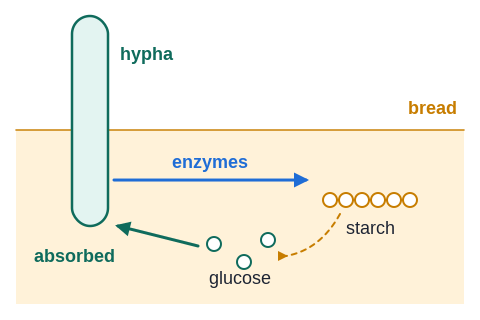
- Fungi feed saprophytically: their hyphae release enzymes onto the food and absorb the small molecules made.
- Bacteria reproduce by binary fission, moulds by spores and yeast by budding, while a virus is only copied inside a host cell.
- A virus is not fully living, because replication is its only life-like process and it needs a host cell for it.
- Temperature, pH, moisture, nutrients and oxygen control how fast a microorganism grows, through its enzymes.
Three kinds of microorganism
- Microorganisms are living things, and near-living particles, too small to see one at a time without a microscope. The three groups you need are bacteria, fungi and viruses.
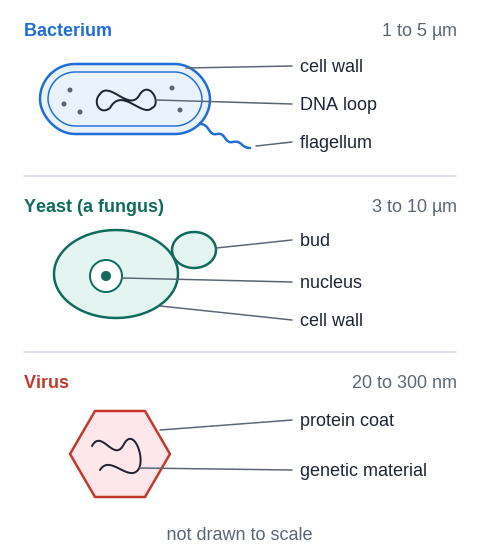
- Bacteria are single cells with a cell wall, a cell membrane, cytoplasm and ribosomes. There is no nucleus: their DNA is one loop lying free in the cytoplasm, and many also have small extra rings called plasmids and a whip-like flagellum for swimming.
- Fungi are made of cells with a nucleus and a cell wall made of chitin. Yeast lives as single oval cells; moulds such as Rhizopus on bread grow as long threads called hyphae, which tangle into a mat called a mycelium.
- Viruses are not cells at all. A virus is genetic material (DNA or RNA) inside a protein coat called a capsid, sometimes wrapped in an outer envelope.
- Sizes differ hugely: a bacterium is usually 1 to 5 micrometres (µm) long and a yeast cell 3 to 10 µm, but most viruses are 20 to 300 nanometres, so you need an electron microscope to see them.
| Bacteria | Fungi | Viruses | |
|---|---|---|---|
| Made of cells? | Yes, one cell | Yes: one (yeast) or many (moulds) | No, a particle |
| Genetic material | DNA loop, no nucleus | DNA in a nucleus | DNA or RNA in a protein coat |
| Typical size | 1 to 5 µm | Yeast cell 3 to 10 µm | 20 to 300 nm |
| Reproduction | Binary fission | Spores; yeast also buds | Copied inside a host cell |
| Example | Lactobacillus in yoghurt | Baker's yeast, bread mould | Influenza virus |
Try it: bacteria, fungi or virus?
Life processes, and what AS 92020 asks for
- Living things carry out the life processes, often remembered as MRS GREN: movement, respiration, sensitivity, growth, reproduction, excretion and nutrition.
- For AS 92020 you describe one life process of one microorganism in real detail, so choose one you can connect to an environment, such as respiration in yeast or nutrition in a mould.
- A good description names the process, says what goes in and what comes out, and says where and how it happens in the microorganism.
- Writing 'bread mould feeds on bread' is too thin. Writing 'Rhizopus hyphae release enzymes onto the bread that break starch into glucose, and the hyphae absorb the glucose' describes the process.
Cell explorer
Nutrition: digesting food outside the body
- Fungi and most bacteria cannot make their own food, so they take it from their surroundings.
- Most fungi and many bacteria are saprophytes: they feed on dead or decaying material such as fallen leaves, bread or old fruit.
- A fungus digests its food outside its body. The hyphae release enzymes into the food, the enzymes break large molecules (starch, protein, cellulose) into small soluble ones (glucose, amino acids), and the hyphae absorb them.
- This is extracellular digestion, and it needs moisture: the enzymes and the small molecules move through a film of water.
- Hyphae keep growing and branching through the food, which gives them a huge surface area for releasing enzymes and absorbing nutrients.
- Some microorganisms are parasites instead, taking food from a living host, such as the water mould that causes kauri dieback feeding in kauri roots.
Respiration: aerobic and anaerobic
- Respiration releases energy from glucose inside every living cell, bacteria and fungi included.
- Aerobic respiration uses oxygen and releases the most energy.
- When oxygen runs out, many microorganisms switch to anaerobic respiration, also called fermentation, which releases much less energy.
- Yeast fermentation makes ethanol and carbon dioxide: the gas makes bread rise and the ethanol is the alcohol in beer and wine.
- Lactic acid bacteria such as Lactobacillus ferment sugar into lactic acid, which sours milk and thickens it into yoghurt.
- glucose + oxygen → carbon dioxide + water (+ a lot of energy)aerobic, in yeast and many bacteria
- C₆H₁₂O₆ + 6O₂ → 6CO₂ + 6H₂Othe same reaction as a balanced symbol equation
- glucose → ethanol + carbon dioxide (+ a little energy)anaerobic, in yeast
- glucose → lactic acid (+ a little energy)anaerobic, in lactic acid bacteria
Excretion: getting rid of waste
- Excretion is removing the waste products of the cell's own chemical reactions.
- The wastes of respiration are carbon dioxide and water, or ethanol or lactic acid, depending on the microorganism and whether oxygen is present.
- Bacteria also excrete other substances, such as ammonia when they break down proteins, and some release toxins.
- The wastes pass out through the cell membrane and build up in the surroundings. That is how microorganisms change their environment: lactic acid lowers the pH of milk, and ethanol builds up in a brew.
- A build-up of their own waste can end up slowing the microorganisms themselves, which is part of the story of a growth curve.
Reproduction: fission, spores and budding
- Bacteria reproduce asexually by binary fission: the cell copies its DNA loop, grows, and splits into two identical daughter cells.
- In ideal conditions some bacteria divide every 20 minutes or so, so the numbers double again and again.
- Moulds such as Rhizopus grow upright hyphae topped with sporangia, round cases that each release thousands of tiny spores. The spores drift on air, water or animals and grow into new hyphae where they land on damp food.
- Yeast can also reproduce by budding: a small bud grows out of the parent cell, gets a copy of the nucleus, and pinches off.
- Spores are tough. Many survive drying out, and some bacteria make resting endospores that survive boiling, which is why canned food is heated under pressure.
Example: how fast can bacteria multiply?
- A bacterium on a chicken sandwich left in a warm car divides by binary fission every 20 minutes.
- Starting from one cell, how many bacteria are there after 3 hours, if none die and the food does not run out?
- 3 hours = 180 minuteswork in the same unit as the dividing time
- 180 ÷ 20 = 9 divisionshow many times the number doubles
- 2⁹ = 2 × 2 × 2 × 2 × 2 × 2 × 2 × 2 × 2 = 512each division doubles the number
- 512 bacteria from one cell in 3 hours
- after 1 hour (3 divisions) there are 8, and 8 × 8 × 8 = 512
- warmth, moisture and food let binary fission run fast, which is why food is kept in the fridgelinking the life process to its conditions
Try it: a growth curve
How a virus replicates
- A virus has no cytoplasm, no ribosomes and no enzymes for respiration, so on its own it does nothing at all.
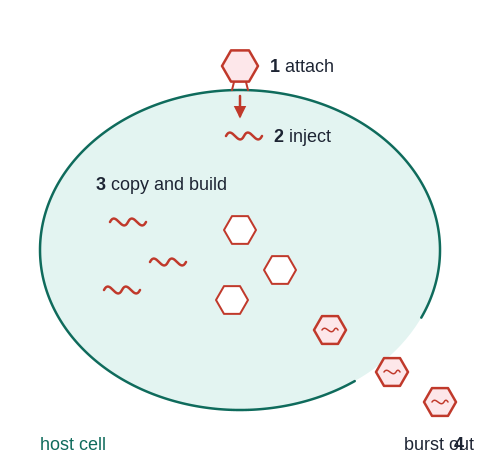
- To replicate, it attaches to a particular kind of host cell and injects its genetic material, or the whole virus is taken into the cell.
- The viral genes take over the cell, which then makes copies of the viral genetic material and the coat proteins, using its own raw materials and energy.
- The new parts assemble into new viruses, which leave by bursting the cell open or by budding out through its membrane, ready to infect more cells.
- Viruses that infect bacteria are called bacteriophages; influenza and cold viruses infect the cells lining your airways.
Try it: what happens next?
Why a virus is not fully living
- A virus is not a cell, and it does not feed, respire, excrete, grow or respond to its surroundings.
- Its one life-like process, replication, happens only inside a host cell, using the host's machinery and energy.
- Outside a host it is an inert particle, which is why antibiotics, which attack bacterial cells, do nothing to a virus.
- It does carry genes and it changes over time by mutation, which is why biologists place it on the border of living, and why AS 92020 lets you study a virus through its replication.
What microorganisms need to grow
- Every life process runs on enzymes, so a microorganism grows fastest when conditions suit its enzymes.
- Temperature: cold slows enzymes down, warmth speeds them up to an optimum, and too much heat denatures them (changes their shape for good), which can kill the cell.
- PH: each species has a pH it grows best at. Most bacteria prefer close to neutral, while many fungi cope with acidic food such as fruit.
- Moisture: enzymes and dissolved nutrients need water, so dried food keeps.
- Nutrients and oxygen: they need a food source for energy and raw materials, and some need oxygen, some are harmed by it, and many, such as yeast, manage either way.
| Factor | Effect on growth | Used to keep food safe |
|---|---|---|
| Temperature | Slow when cold, fastest at the optimum, enzymes denature when too hot | Fridge slows growth; cooking kills |
| pH | Best at the species' optimum; strong acid stops most bacteria | Pickling in vinegar |
| Moisture | No water, so no digestion or absorbing | Drying, salting, sugaring |
| Nutrients | Food gives energy and raw materials | Clean surfaces, covered food |
| Oxygen | Aerobes need it; anaerobes do not | Vacuum packing stops aerobes |
Example: describing a life process well
- Task: describe nutrition in the bread mould Rhizopus, and one factor that affects it, using observations.
- A class sealed slices of damp and dry bread in zip-lock bags at school, kept them closed, and checked them after 5 days. The damp bread was half covered in grey fuzz; the dry bread had none.
- Bread mould eats the bread and grows on it.too thin: no process, no enzymes, no observation
- Rhizopus is a saprophytic fungus. Its hyphae grow into the bread and release enzymes such as amylase, which digest starch into glucose outside the hyphae. The glucose dissolves in the moisture and is absorbed into the hyphae, where it is used in respiration.names the process, what goes in and out, and where
- Moisture affects this: after 5 days the damp bread was half covered in mould, but the dry bread had none.a factor, backed by an observation
Common mistakes
- Viruses are just very small bacteria.Viruses are not cells at all: they are genetic material in a protein coat, many times smaller than a bacterium.
- Fungi take in their food and digest it inside, like animals do.Fungi release enzymes onto the food and absorb the digested small molecules through their hyphae, which is extracellular digestion.
- At high temperatures the enzymes die.Enzymes are proteins, not living things; heat denatures them, changing their shape so they stop working.
- Yeast only makes carbon dioxide when it ferments.Yeast makes carbon dioxide in both aerobic and anaerobic respiration; only the anaerobic route also makes ethanol.
Feed the yeast
You need: 2 teaspoons of dried baker's yeast, sugar, 3 small empty plastic drink bottles, 3 balloons, warm tap water, a measuring jug and a teaspoon, string and a ruler
- Stretch each balloon a few times so it blows up easily, and label the bottles 0, 1 and 3.
- Pour 200 mL of warm tap water (about bath temperature) into each bottle and add a level third of a teaspoon of yeast to each.
- Add no sugar to bottle 0, one teaspoon to bottle 1 and three teaspoons to bottle 3, swirl to mix, and stretch a balloon over each neck straight away.
- Stand the bottles together somewhere warm for 30 minutes, then measure round the widest part of each balloon with the string and a ruler.
- Look for: the balloons on the sugar bottles fill with carbon dioxide from the yeast's respiration while bottle 0 barely changes, because sugar is the yeast's food; more sugar gives more gas in the same time.
Safety: The yeast mixture is not a drink, so tip it down the sink afterwards, and use zip-lock bags instead of balloons if anyone at home is allergic to latex.
Your turn
Give two differences in structure between a bacterium and a yeast cell.
A bacterium divides every 30 minutes. Starting from one cell, how many cells are there after 4 hours?
Write the word equation for anaerobic respiration in yeast, and say which product makes bread rise.
Explain why a virus is described as not fully living.
Explain why dried apricots keep for months but fresh apricots go mouldy within a week or two.
Show answer
1. A yeast cell has a nucleus, but a bacterium has its DNA as a loop free in the cytoplasm; the yeast cell wall is made of chitin; a yeast cell is also bigger (3 to 10 µm against 1 to 5 µm). 2. 4 hours = 240 minutes, 240 ÷ 30 = 8 divisions, 2⁸ = 256 cells. 3. glucose → ethanol + carbon dioxide; the carbon dioxide makes bread rise. 4. A virus is not a cell and carries out no life processes on its own: it can only replicate, and only inside a host cell using the host's machinery. 5. Mould needs water: without moisture, the enzymes released by the hyphae cannot digest the fruit and the hyphae cannot absorb nutrients, and spores cannot germinate, so the dried fruit keeps.
Recap
- Bacteria are cells with no nucleus, fungi are cells with a nucleus, and viruses are not cells at all.
- Fungi feed by extracellular digestion: hyphae release enzymes and absorb the small molecules.
- Respiration can be aerobic (carbon dioxide and water) or anaerobic (ethanol and carbon dioxide in yeast, lactic acid in bacteria).
- Wastes pass out into the surroundings, which is how microorganisms change their environment.
- Bacteria divide by binary fission, moulds release spores, yeast buds, and viruses replicate only inside host cells.
- Temperature, pH, moisture, nutrients and oxygen set how fast the enzymes, and so the microorganism, can work.
| Life process | In a microorganism |
|---|---|
| Nutrition | Enzymes out, small molecules absorbed |
| Respiration | Aerobic or anaerobic (fermentation) |
| Excretion | CO₂, ethanol, lactic acid, ammonia out |
| Reproduction | Binary fission, spores, budding |
| Replication (virus) | Only inside a host cell |
Challenge
A container of cooked rice is left on a warm kitchen bench for 2 hours. A food lab then finds 6400 bacteria in each gram. In those conditions this bacterium divides by binary fission every 20 minutes. (a) How many bacteria were in each gram when the rice was put on the bench? (b) In a fridge the same bacterium divides only once every 2 hours. How many bacteria per gram would there have been after 2 hours in the fridge instead? (c) Explain, using enzymes, why the fridge makes such a big difference.
Hint
Work backwards: 2 hours is how many 20-minute divisions? Each division doubles the number, so undo the doublings by halving. In the fridge, count the divisions again.
Answer
(a) 100 bacteria per gram. (b) 200 bacteria per gram. (c) Cold slows the enzymes that run every life process (nutrition, respiration, copying DNA), so fission happens far less often; the rice gets 1 doubling instead of 6.
Step by step
- 2 hours is 120 minutes, which is 6 divisions of 20 minutes.
- Six doublings multiply the number by 2⁶ = 64.
- Undo that: 6400 ÷ 64 = 100 bacteria per gram at the start.
- In the fridge there is only 1 division in 2 hours, so 100 becomes 200.
- Cold means slower enzymes, so less food is digested and respired, less energy is released and the cell takes longer to grow and split.
Full working
- 2 hours = 120 minutessame unit as the dividing time
- 120 ÷ 20 = 6 divisionsnumber of doublings on the bench
- 2⁶ = 64each division doubles the number
- start = 6400 ÷ 64 = 100work backwards
- fridge: 120 ÷ 120 = 1 division, so 100 × 2 = 200one doubling only
- 100 per gram at the start; 200 per gram after 2 hours in the fridge, against 6400 on the bench
A home brewer puts grape juice and yeast in a glass jar and fits an airlock, which lets gas out but nothing in. Her notes: day 0 to 1, a few slow bubbles and an oxygen sensor in the jar falls to zero; days 2 to 6, fast bubbling and the juice starts to smell of alcohol; day 10, bubbling stops even though a test shows sugar is still left. Over the 10 days the jar loses 44 g. You are told that every 180 g of glucose fermented makes 92 g of ethanol and 88 g of carbon dioxide. (a) Explain each stage using the type of respiration. (b) Assuming all 44 g lost is carbon dioxide from fermentation, find the mass of glucose fermented and the mass of ethanol made. (c) Suggest why the yeast stops with sugar still left.
Hint
Which kind of respiration needs oxygen, and what does yeast do when the oxygen is gone? For (b), 44 g is what fraction of 88 g? Scale the glucose and the ethanol by the same fraction. For (c), think about waste products building up.
Answer
(a) Days 0 to 1: aerobic respiration uses up the oxygen in the jar, making CO₂ and water. Days 2 to 6: with no oxygen the yeast ferments, glucose → ethanol + carbon dioxide, so CO₂ bubbles out and ethanol builds up. (b) 90 g of glucose and 46 g of ethanol. (c) Ethanol is an excretion product that stays in the jar; as it builds up it harms the yeast and slows its enzymes until the yeast stops, so sugar is left over.
Step by step
- At the start there is oxygen, so yeast respires aerobically; the oxygen reading drops to zero as it is used.
- Without oxygen the yeast switches to fermentation, which makes ethanol and carbon dioxide; the CO₂ leaves through the airlock as bubbles.
- The jar's mass falls only because CO₂ gas escapes; the atoms are not destroyed.
- 44 g is half of 88 g, so half of 180 g of glucose was fermented, making half of 92 g of ethanol.
- Ethanol is a waste the yeast cannot get rid of in a closed jar; at high levels it stops the yeast, which is the end of its growth curve.
Full working
- glucose → ethanol + carbon dioxidefermentation, no oxygen
- 180 g → 92 g + 88 g, and 92 + 88 = 180mass is conserved
- 44 ÷ 88 = ½the fraction of the reaction that happened
- glucose = ½ × 180 = 90 gsame fraction
- ethanol = ½ × 92 = 46 gsame fraction
- check: 46 + 44 = 90 gproducts equal the glucose used
- 90 g of glucose fermented, making 46 g of ethanol; yeast stops because its own ethanol builds up
A culture contains 1 000 000 bacteria, which divide every 30 minutes. One bacteriophage (a virus that infects bacteria) is added. It enters a bacterium, and 30 minutes later the cell bursts and releases 100 new phages, each of which infects a new bacterium straight away and bursts it 30 minutes later. Assume the cells killed are too few to matter until the phages outnumber the bacteria. (a) After how many minutes do the phages first outnumber the bacteria? Show the numbers. (b) Explain why a phage multiplies by 100 each cycle while the bacteria only double. (c) A student adds an antibiotic that kills these bacteria to a flask of phages with no bacteria in it. Explain why the number of phages does not change at all.
Hint
Make a table every 30 minutes: phages × 100, bacteria × 2. For (b), think about whose ribosomes, raw materials and energy make the new viruses. For (c), what does a virus do on its own, and what does an antibiotic attack?
Answer
(a) After 120 minutes: 100 000 000 phages against 16 000 000 bacteria (at 90 minutes it is 1 000 000 phages against 8 000 000 bacteria). (b) The phage takes over the host cell, which uses its own ribosomes, raw materials and energy to copy the viral genes and coat proteins many times, so one cell makes 100 phages; a bacterium only copies its DNA once and splits into two. (c) With no host cells the phages cannot replicate, because a virus has no ribosomes or respiration enzymes of its own, so the number stays the same; the antibiotic attacks bacterial cells, and a virus is not a cell, so it has no effect on the phages.
Step by step
- Each 30-minute cycle multiplies the phages by 100 and the bacteria by 2.
- At 90 minutes there are 1 000 000 phages and 8 000 000 bacteria, so the bacteria are still ahead.
- At 120 minutes there are 100 000 000 phages and 16 000 000 bacteria, so the phages are ahead.
- A virus replicates using the host's machinery, so one infected cell can make many copies; binary fission only ever makes two cells.
- Outside a host a virus is an inert particle, so it neither replicates nor is harmed by a drug that targets cells.
Full working
- 30 min: phages 1 × 100 = 100, bacteria 2 000 000one cycle
- 60 min: phages 10 000, bacteria 4 000 000× 100 and × 2
- 90 min: phages 1 000 000, bacteria 8 000 000bacteria still more
- 120 min: phages 100 000 000, bacteria 16 000 000phages now more
- 100 000 000 ÷ 16 000 000 = 6.25phages over 6 times the bacteria
- the phages first outnumber the bacteria after 120 minutes
Report a mistake
How is NCEA Level 1 maths going?
See the NCEA Level 1 maths guide