Microbes and their environment: gut, food and soil

What this lesson covers
- An interconnected environment, such as the human gut, a food process or a forest soil, is a system where a microorganism lives alongside other living and non-living things.
- Abiotic factors are non-living (temperature, pH, water, oxygen, nutrients); biotic factors are living (a host, other microbes).
- A change in a factor speeds up or slows down a life process, and observations show by how much.
- A life process changes the environment in turn: respiration uses oxygen, excreted acid lowers pH, decomposition returns nutrients to the soil.
- A growth curve has lag, log, stationary and death phases, each with a reason.
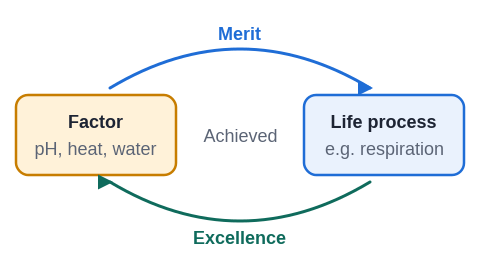
- Achieved describes, Merit links a change in a factor to a life process, and Excellence shows how the life process changes the environment.
A two-way relationship
- AS 92020 is about a relationship that runs both ways: the environment affects what a microorganism does, and what the microorganism does changes its environment.
- The environment is an interconnected one: a system where the microorganism lives among other things and affects them, such as the human body, a food production process or a forest ecosystem.
- Abiotic factors are the non-living parts: temperature, pH, moisture, oxygen, nutrients and salt.
- Biotic factors are the living parts: a host plant or animal, other microorganisms competing for food, or partner microbes such as the yeast and bacteria in a sourdough starter.
- Your observations can be primary data from your own experiment, or secondary data such as graphs, tables and reports made by others.
| Environment | Microorganism | Life process | Factors to study |
|---|---|---|---|
| Human gut | Gut bacteria such as Bifidobacterium | Nutrition (fermenting fibre) | Diet, antibiotics |
| Yoghurt making | Lactobacillus | Anaerobic respiration | Temperature |
| Sourdough | Yeast and lactic acid bacteria | Respiration | Temperature, oxygen |
| Kombucha | Yeast and acetic acid bacteria | Respiration, excretion | Sugar, oxygen |
| Forest floor | Saprophytic fungi | Nutrition (decomposing) | Moisture, temperature |
| Kauri forest | Phytophthora agathidicida | Reproduction (swimming spores) | Soil water, the kauri host |
What each grade asks for
- Achieved: describe one life process of the microorganism, and describe a factor of its environment that affects that process, backed by observations.
- Merit: link a change in the factor to what happens to the life process, with the observations as evidence and the reason inside the cells (usually enzymes).
- Excellence: turn the arrow round and examine how the life process alters a factor of the environment, again using observations, and what that alteration means for the system.
- Keep the life process at the centre. Linking a change in a person's immune system to the microbe as a whole does not reach Merit; it has to be a life process that changes.
- For Excellence, the symptoms a microbe causes are not enough. Show how a life process, such as the acid it excretes or the oxygen it uses, changes a factor such as pH or oxygen level.
The human gut
- Your large intestine is warm (about 37 °C), moist and low in oxygen, and it holds trillions of bacteria fed by whatever you eat.
- Many gut bacteria ferment dietary fibre, which your own enzymes cannot digest, and excrete short-chain fatty acids.
- Those acids feed the cells lining the colon and lower the pH there, which makes it harder for some harmful bacteria to grow: a life process changing both an abiotic factor (pH) and a biotic one (other microbes).
- A course of antibiotics changes the environment in the other direction: it kills many gut bacteria, so less fibre is fermented, and other microbes can move into the space.
Food production: yoghurt, bread and kombucha
- Yoghurt: milk is heated to kill other microbes, cooled to about 40 to 45 °C, and starter bacteria are added. They respire anaerobically, turning lactose (milk sugar) into lactic acid.
- The lactic acid lowers the pH from about 6.7 towards 4.5, which makes the milk protein casein clump into a gel, so the milk thickens and tastes sour, and the acid holds back most spoilage bacteria.
- Bread: yeast respires the sugars in dough, and the carbon dioxide is trapped as bubbles so the dough rises; baking then kills the yeast and drives off the ethanol.
- Sourdough: wild yeast and lactic acid bacteria live together in a starter. The bacteria's lactic acid gives the sour taste, and the low pH keeps many other microbes out.
- Kombucha: yeast turns the sugar in sweet tea into ethanol and carbon dioxide; then acetic acid bacteria use that ethanol and oxygen from the air to make acetic acid, and they also build the rubbery cellulose mat on top.
Soil, decomposition and kauri dieback
- On a forest floor, saprophytic fungi and bacteria are the decomposers: their hyphae and enzymes break down fallen leaves, wood and dead animals.
- Their feeding and respiration release carbon dioxide into the air and nutrients such as nitrogen compounds into the soil, where plant roots take them up again.
- Decomposition is fastest when soil is warm, moist and has oxygen; in cold, waterlogged peat bogs it almost stops, so dead plant material piles up.
- Kauri dieback is caused by Phytophthora agathidicida, a fungus-like water mould. Its swimming spores (zoospores) travel through the water in wet soil to kauri roots, where its threads grow into and destroy the root tissue.
- So soil water (abiotic) and the kauri host (biotic) control how it reproduces and spreads, and its feeding in the roots in turn starves the canopy of water, thinning it and changing the whole forest beneath.
- Mana whenua such as Te Kawerau ā Maki have placed rāhui over affected forest as an act of kaitiakitanga; staying on tracks and cleaning footwear stops infected soil from moving.
Growth curves
- A growth curve plots the number of microorganisms against time in a closed container, such as a flask of sugar solution.
- Lag phase: few new cells at first, while the cells adjust to the new conditions and make the enzymes they need.
- Log (exponential) phase: every cell divides at a steady rate, so the numbers double again and again and the curve climbs steeply.
- Stationary phase: food runs low and wastes such as ethanol or acid build up, so new cells are made only as fast as others die and the curve flattens.
- Death phase: with food gone and wastes toxic, cells die faster than they divide and the count falls.
- The curve shows the two-way link: the microbes' feeding and excretion change their environment, and the changed environment then slows their reproduction.
Try it: lag, log, stationary, death
Example: reading a yeast growth curve
- Room 14's Year 11 class added a pinch of yeast to a flask of sugar solution at 30 °C, then counted the yeast cells in one square of a counting slide every 6 hours.
- Name the phases, give the times of each, and explain the last two.
| Time (h) | 0 | 6 | 12 | 18 | 24 | 30 | 36 | 42 | 48 |
|---|---|---|---|---|---|---|---|---|---|
| Cells per square | 5 | 6 | 20 | 75 | 160 | 190 | 195 | 180 | 140 |
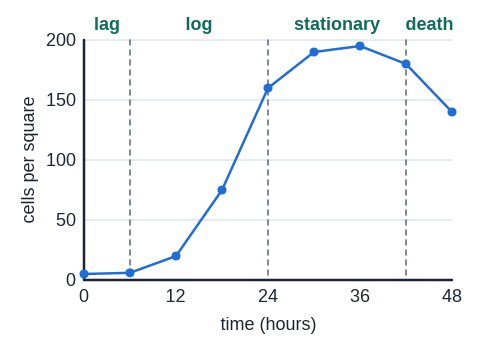
- lag: 0 to 6 h, 5 → 6 cellsalmost no change while the yeast makes its enzymes
- log: 6 to 24 h, 6 → 160 cellsthe steepest rise: budding at a steady rate
- stationary: 24 to 42 h, levelling between 160 and 195new cells only as fast as others die
- death: 42 to 48 h, 180 → 140more cells dying than being made
- the yeast's own respiration used up the sugar and excreted ethanol, which first slowed and then reversed its growth
Example: one investigation written up at each grade
- Ms Ngata's class stirred a spoonful of live yoghurt into jars of milk (pH 6.6), kept them at four temperatures for 8 hours, then measured the pH and checked the texture.
- The three paragraphs below build on each other: each grade keeps what the one before it said.
| Temperature | pH after 8 h | Texture |
|---|---|---|
| 4 °C | 6.6 | Runny |
| 20 °C | 5.9 | Slightly thick |
| 43 °C | 4.5 | Set |
| 60 °C | 6.6 | Runny |
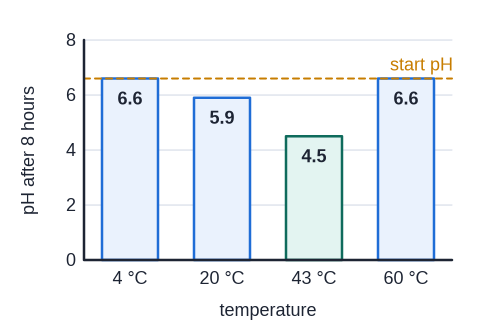
- Lactobacillus carries out anaerobic respiration: it breaks down lactose from the milk into lactic acid, releasing a little energy. Temperature affects this: the jar at 43 °C set into yoghurt in 8 hours, but the jar at 4 °C stayed runny.Achieved: a life process and a factor, with observations
- As the temperature rose from 4 °C to 43 °C, the pH after 8 hours fell further (6.6, then 5.9, then 4.5), so respiration sped up: the bacteria's enzymes and the lactose move faster and meet more often. At 60 °C the pH stayed at 6.6 because the heat denatured the enzymes, so respiration stopped.Merit: how the rising temperature changed the rate of respiration
- The lactic acid excreted during respiration changes the milk itself: at 43 °C the pH fell from 6.6 to 4.5, which made the casein clump into a gel, so the milk set and soured. The low pH then stops most spoilage bacteria, so yoghurt keeps longer than milk, and as acid keeps building it slows the Lactobacillus too.Excellence: how respiration changes a factor (pH) of the environment
Try it: yoghurt gets more acidic
Writing it up
- Name the microorganism (genus and species if you can), say what kind it is, and name the interconnected environment.
- Describe one life process in detail, with a word equation where it fits.
- Quote observations with numbers and units, such as 'pH fell to 4.5' or 'rose 25 mm', never just 'grew a lot'.
- For Merit, build a because chain: the change in the factor, what it does to the enzymes or cells, what that does to the life process, and the observation that shows it.
- For Excellence, run the chain the other way: the life process, what it makes or uses up, the factor that changes, the observation that shows it, and what that change means for the rest of the system, the microbe included.
- Keep every link on the life process you described; jumping to symptoms, or to the microbe simply 'dying', breaks the link.
Try it: which way does the arrow run?
Common mistakes
- The bacteria respired faster at 43 °C because it was warmer.Give the reason in the cells: near 43 °C their enzymes work close to their best, so lactic acid builds faster, as the pH falling to 4.5 shows.
- In the stationary phase the yeast has stopped reproducing.Cells are still dividing, but about as many die as are made, because food is running low and wastes are building up.
- For Excellence I explained how E. coli gives people diarrhoea.Symptoms are about the microbe as a whole; Excellence needs how a life process, such as the acid or gas it excretes, changes a factor of the environment.
- My graph shows the yeast grew best at 35 °C, so I don't need numbers in my writing.Quote the observations in your sentences, with units, because the grade depends on linking the evidence, not just pointing to it.
Make yoghurt warm and cold
You need: 500 mL of UHT (long-life) milk, 2 tablespoons of plain yoghurt labelled live cultures, 2 clean plastic containers with lids, a hot water bottle, a chilly bin or a thick towel, a tablespoon
- Pour 250 mL of UHT milk into each container; UHT milk has already been heated to kill microbes, so mostly the bacteria you add will grow.
- Stir a tablespoon of live yoghurt into each, put the lids on, and label one Warm and one Cold.
- Put Cold in the fridge. Fill the hot water bottle from the hot tap and put it with Warm in the chilly bin (or wrap them together in the towel), refilling it after about 4 hours.
- After 8 to 10 hours, tip each container gently and compare how thick the milk is and how it smells.
- Look for: the warm milk has set into thick, sour-smelling yoghurt while the cold milk is still runny, because warmth sped up the bacteria's anaerobic respiration and the lactic acid they excreted lowered the pH until the milk protein set.
Safety: Do not eat either container: kept warm for hours in a home container, other microbes may have grown too, so tip both down the sink and wash the containers in hot soapy water.
Your turn
Name the four phases of a growth curve in order, and give one reason for the stationary phase.
Room 9 measured the pH of a kombucha brew: day 0, pH 5.0; day 4, pH 3.8; day 8, pH 3.2; day 12, pH 2.9. Describe the change and explain it with a life process.
Bread dough was left for an hour at 5 °C, 30 °C and 70 °C, and rose 2 mm, 25 mm and 0 mm. Explain how changing the temperature changed the rate of respiration in the yeast.
For kauri dieback, sort these factors into abiotic or biotic, in order: soil moisture, the kauri tree, feral pigs, temperature.
A student writes: 'Phytophthora makes kauri leaves turn yellow, so it changes the forest.' Explain why this does not reach Excellence.
Show answer
1. Lag, log (exponential), stationary, death. In the stationary phase food is running low and wastes are building up, so cells are made only as fast as they die. 2. The pH fell by 2.1 over 12 days (5.0 to 2.9), quickly at first and then more slowly. Yeast respires the sugar into ethanol, and acetic acid bacteria use the ethanol and excrete acetic acid, which lowers the pH of the brew. 3. From 5 °C to 30 °C the dough rose more (2 mm to 25 mm) because the yeast's enzymes worked faster as particles moved faster and collided more often, so respiration made more carbon dioxide. At 70 °C it rose 0 mm because the heat denatured the enzymes, so respiration stopped. 4. Abiotic, biotic, biotic, abiotic. 5. It describes a symptom of the disease, the microbe acting as a whole, not how one of its life processes changes a factor. Better: its threads feeding in the roots (nutrition) destroy root tissue, so less water reaches the canopy, which thins and lets more light and heat reach the forest floor.
Recap
- A microorganism and its interconnected environment change each other: factors change life processes, and life processes change factors.
- Abiotic factors are non-living (temperature, pH, water, oxygen, nutrients); biotic factors are living (hosts, other microbes).
- Gut bacteria ferment fibre and lower the pH; yoghurt and sourdough bacteria excrete lactic acid; yeast makes the carbon dioxide that raises bread; decomposers return nutrients to the soil.
- A growth curve runs lag, log, stationary, death, and the later phases are caused by the microbes' own feeding and waste.
- Achieved describes, Merit links a change in a factor to the life process, and Excellence shows the life process changing the environment, always with observations.
Challenge
A class grows yeast in a flask of sugar solution at 30 °C. During the log phase they count 8 cells per square at 10 h and 64 cells per square at 19 h. (a) How many times did the population double between 10 h and 19 h, and what is the doubling time? (b) If the log phase carried on, how many cells per square would there be at 25 h? (c) At 25 h they actually count 150. Explain the difference using the two-way relationship between the yeast and its environment.
Hint
Keep doubling 8 until you reach 64 and count the steps. In the log phase the doubling time stays the same, so work out how many more doublings fit into the next 6 hours.
Answer
(a) 3 doublings, so a doubling time of 3 hours (b) 256 cells per square (c) the yeast's own respiration used up sugar and excreted ethanol, which slowed its budding as the culture moved towards the stationary phase
Step by step
- 8 doubles to 16, then 32, then 64: three doublings.
- Three doublings in 19 − 10 = 9 hours means one doubling every 3 hours.
- From 19 h to 25 h is 6 hours, two more doublings: 64 → 128 → 256.
- The real count of 150 is well below 256, so reproduction has slowed.
- The yeast's respiration has used up much of the sugar and excreted ethanol into the flask. Less food and more ethanol slow the enzymes and budding, so the culture is leaving the log phase for the stationary phase: the life process has changed the environment, and the changed environment now limits the life process.
Full working
- 8 → 16 → 32 → 643 doublings
- doubling time = 9 ÷ 3 = 3 h10 h to 19 h
- 19 h to 25 h = 6 h = 2 doublingssame doubling time in log phase
- 64 × 2 × 2 = 256predicted cells per square
- observed 150 is less than 256sugar used up, ethanol built up
- (a) 3 doublings, 3 hours each (b) 256 (c) growth slowed because the yeast changed its own environment
A jar of milk with live yoghurt is kept at 43 °C. Its pH is 6.6 at the start, 5.1 at 4 h, 4.5 at 8 h and 4.3 at 12 h. A student says: "The bacteria must have died after 4 hours, because the pH stopped falling as fast." (a) Work out the average fall in pH per hour in each 4-hour block. (b) Use the data to disagree with the student. (c) Explain the slowing, showing how the bacteria's life process changed a factor of their environment and how that factor then affected the life process.
Hint
Divide each 4-hour fall by 4. If the bacteria were dead, what would the pH do between 8 h and 12 h? Then follow the lactic acid: where does it go, and what does it do to the enzymes making it?
Answer
(a) 0.375, 0.15 and 0.05 pH units per hour (b) the pH was still falling in every block, so the bacteria were still respiring, only more slowly (c) anaerobic respiration excreted lactic acid that lowered the pH, and the more acidic milk moved the bacteria's enzymes away from their best pH, slowing respiration
Step by step
- The falls are 1.5, 0.6 and 0.2 pH units over each 4 hours, so 0.375, 0.15 and 0.05 units per hour.
- The pH kept falling all the way to 12 h. Dead bacteria make no lactic acid, so the pH would have stopped changing. The bacteria were alive but working more slowly.
- Lactobacillus respires anaerobically, turning lactose into lactic acid, which it excretes into the milk. That lowers the pH, an abiotic factor of its own environment.
- As the milk becomes more acidic, the bacteria's enzymes work further from their best pH, so lactose is broken down more slowly and less acid is made each hour.
- This is the two-way link: the life process changed the pH, and the changed pH then slowed the life process. The same low pH also sets the casein and keeps out spoilage bacteria.
Full working
- 0 to 4 h: (6.6 − 5.1) ÷ 4 = 0.375 per hourfastest
- 4 to 8 h: (5.1 − 4.5) ÷ 4 = 0.15 per hourslower
- 8 to 12 h: (4.5 − 4.3) ÷ 4 = 0.05 per hourslowest, but still falling
- pH still falling at 12 hbacteria still respiring, not dead
- lactose → lactic acidanaerobic respiration lowers the pH
- lower pH → enzymes slow → less acid per hourthe environment feeds back on the life process
- (a) 0.375, 0.15, 0.05 per hour (b) still respiring (c) excreted acid lowered the pH, which slowed respiration
In an invented study, students bury mesh bags, each holding 20.0 g of dry leaf litter, at three places in a forest for 6 months: a dry ridge, a moist gully and a waterlogged swamp. The bags have fine mesh that keeps out soil animals. Dry mass left after 6 months: ridge 15.0 g, gully 9.0 g, swamp 18.0 g. A coarse-mesh bag in the gully, which lets in earthworms and other invertebrates, had 6.0 g left. (a) Work out the percentage of mass lost in each of the four bags. (b) Explain the pattern for the three fine-mesh bags using the life processes of saprophytic fungi and bacteria. (c) What does the coarse bag show about a biotic factor? (d) For Excellence, explain how the decomposers' life processes change the soil environment of the gully, and why the swamp builds up peat.
Hint
Mass lost is 20.0 minus the mass left, as a percentage of 20.0. Decomposers digest litter with enzymes outside their hyphae and then respire the food; which factor is missing on the ridge, and which in the swamp?
Answer
(a) ridge 25%, gully 55%, swamp 10%, coarse gully bag 70% (b) decomposition needs water and oxygen: the gully has both, the ridge lacks water and the swamp lacks oxygen (c) soil animals added another 15 percentage points of breakdown, a biotic factor (d) the decomposers' feeding and respiration release nutrients into the gully soil and use up oxygen while giving off CO₂; in the swamp, too little oxygen nearly stops decomposition, so dead plant material piles up as peat
Step by step
- Mass lost: ridge 5.0 g, 25%; gully 11.0 g, 55%; swamp 2.0 g, 10%; coarse gully bag 14.0 g, 70%.
- Saprophytic fungi and bacteria release enzymes that digest the litter, absorb the products and respire them. Their enzymes need water, and aerobic respiration needs oxygen.
- The moist gully has water and oxygen, so it lost the most. The dry ridge lacks water, slowing the enzymes; the waterlogged swamp lacks oxygen, so respiration almost stops.
- The coarse bag lost 70% against 55% for the fine bag at the same site, so soil animals, a biotic factor, added 15 percentage points, for example by shredding the litter so microbes have more surface to work on.
- Turning the arrow round: as decomposers feed and respire in the gully, they release nitrogen compounds and other nutrients into the soil for plant roots, use up oxygen and give off CO₂, so the life process changes the soil's nutrients and gases.
- In the swamp the lack of oxygen keeps decomposition very slow, so each year's dead plant material is added faster than it is broken down and builds up as peat, locking up its carbon and nutrients.
Full working
- ridge: (20.0 − 15.0) ÷ 20.0 = 0.2525% lost
- gully: (20.0 − 9.0) ÷ 20.0 = 0.5555% lost
- swamp: (20.0 − 18.0) ÷ 20.0 = 0.1010% lost
- coarse gully: (20.0 − 6.0) ÷ 20.0 = 0.7070% lost
- 70% − 55% = 15 percentage pointseffect of soil animals, a biotic factor
- gully: water + oxygen → fastest decomposition → nutrients and CO₂ releasedlife process changes the soil
- (a) 25%, 55%, 10%, 70% (b) water and oxygen control decomposition (c) soil animals add 15 points (d) decomposers enrich the gully soil; no oxygen in the swamp means peat builds up
The maths behind it
Report a mistake
How is NCEA Level 1 maths going?
See the NCEA Level 1 maths guide