Straight-line graphs, and how many answers
What this lesson covers
- Multiplying or dividing by a negative number reverses an inequality.
- The constant rate of change of a linear graph is the vertical change (how far it goes up or down) divided by the horizontal change (how far it moves sideways).
- Finding square roots of numbers and solving quadratic equations are related but have some differences. Any positive real number has two square roots: one positive (the principal square root) and one negative (e.g. for 16, 4 and −4). The square root operation √ refers specifically to the principal square root (e.g. √16 = 4). There are 0, 1, or 2 real-number solutions to x² = a, where a is a number.
- The zero product property states that if two expressions multiply to be zero, then at least one expression must be zero (e.g. if ab = 0 then either a or b is 0, or if (x − a)(x − b) = 0 then either (x − a) = 0 or (x − b) = 0).
A line only has two properties
- Where it crosses the y-axis, and how steep it is.
- There is nothing else a straight line can be.
- y = mx + c is those two facts written down.
| Part | What it is | Meaning |
|---|---|---|
| y = mx + c | the whole line | |
| c | where it crosses y | the starting height |
| m | the gradient | how steep, and which way |
| That is all | a straight line has | nothing else to know |
Gradient is rise over run
- Pick any two points on the line. How far up, how far across.
- Up four and across two gives a gradient of two.
- Any other pair of points gives the same answer. That is what straight means.
| Idea | Working | Gives |
|---|---|---|
| Gradient | rise ÷ run | |
| From (1,3) to (3,7) | up 4, across 2 | 4 ÷ 2 = 2 |
| Any two points | give the same answer | that is straightness |
| So m = 2 | up 2 for every 1 across |
Try it: rise over run
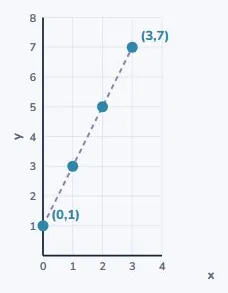
Reading a line off a graph
- This line crosses the y-axis at one, so c is one.
- From there it goes up two for every one across.
- So m is two, and the equation is y equals two x plus one.
Drawing one without a table
- Start at c. That is your first point, on the y-axis.
- Then use m as an instruction: up two, across one.
- Do it twice more and join them. No table of values.
| Step | Doing | Point |
|---|---|---|
| y = 2x + 1 | c is 1 | start at (0,1) |
| m is 2 | up 2, across 1 | (1,3) |
| Again | up 2, across 1 | (2,5) |
| Join them | no table needed |
Comparing steepness
- y equals x climbs one for every one across.
- y equals two x climbs twice as fast. y equals four x, faster again.
- The bigger the size of m, the steeper the line.
| Line | Gradient | What it does |
|---|---|---|
| y = x | m = 1 | up 1 each step |
| y = 2x | m = 2 | twice as steep |
| y = 4x | m = 4 | steeper again |
| Bigger size of m | steeper line | sign is direction |
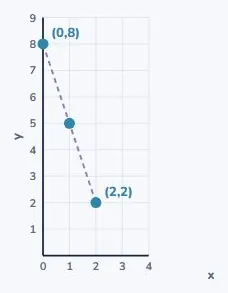
When the gradient is negative
- y equals minus three x plus eight starts at eight.
- Then it falls three for every one across.
- A negative gradient always means a falling line.
Same gradient, parallel lines
- Two lines with the same m climb at the same rate.
- So they never meet, however far you draw them.
- Different c just moves one of them up or down the page.
Graphing calculator
Where gradients come from outside maths
- A tradesperson charges sixty dollars to turn up.
- Then forty-five dollars an hour. That rate is the gradient.
- y equals forty-five x plus sixty, and three hours is 195 dollars.
| In the job | In the equation | Value |
|---|---|---|
| Call-out fee $60 | that is c | cost at zero hours |
| $45 an hour | that is m | the rate |
| y = 45x + 60 | the whole job | |
| Three hours | 135 + 60 | $195 |
Sixteen has two square roots
- Four squared is sixteen. And minus four squared is also sixteen.
- So both of them are square roots of sixteen.
- But the root sign means the positive one only.
| Statement | Why |
|---|---|
| 16 has two square roots | 4 and −4 |
| Because | 4² = 16 and (−4)² = 16 |
| But √16 means 4 | the sign means the positive one |
| So x² = 16 has two answers | while √16 is one number |
How many answers does x squared equal a have?
- If a is positive, two answers, one of each sign.
- If a is zero, exactly one answer.
- If a is negative, none at all.
| Equation | Answers | Which |
|---|---|---|
| x² = 25 | two | 5 and −5 |
| x² = 0 | one | 0 |
| x² = −4 | none | nothing squares negative |
| Check the sign of a | before you solve |
Multiplying to zero
- If two numbers multiply to zero, one of them is zero.
- There is no other way to do it. No near misses.
- That fact is what makes a factorised quadratic solvable.
| If | Then | |
|---|---|---|
| ab = 0 | then a = 0 or b = 0 | |
| No other way | to multiply to zero | |
| (x − 3)(x + 5) = 0 | so one bracket is 0 | |
| Giving | x = 3 or x = −5 |
Using it
- x minus three, times x plus five, equals zero.
- So either the first bracket is zero or the second one is.
- x is three, or x is minus five.
Why a negative reverses an inequality
- Two is less than three. Nobody disputes that.
- Multiply both by minus one: minus two and minus three.
- Minus two is bigger. The order flipped, so the sign must.
| Step | Result |
|---|---|
| 2 < 3 | plainly true |
| Times both by −1 | −2 and −3 |
| Now −2 > −3 | the order swapped |
| So the sign must turn | every time you do that |
Try it: how many answers?
What to take away
- Seven lines: four about lines, three about answers.
| A straight line has two properties | where it crosses, how steep |
| c | the y-intercept |
| m | the gradient, rise over run |
| Bigger size of m | steeper line |
| x² = a | two answers, one, or none |
| √ means the positive root | only |
| If two things give 0 | one of them is 0 |
Common mistakes
- Gradient from (1, 4) to (5, 16) is (16 − 4) ÷ (1 − 5) = −3Subtract in the same order top and bottom: (16 − 4) ÷ (5 − 1) = 12 ÷ 4 = 3.
- Gradient is run over rise, so up 4 and across 2 gives ½.Gradient is rise ÷ run, up over across, so up 4 and across 2 gives 4 ÷ 2 = 2.
- x² = 49 has one answer: x = 7There are two answers, 7 and −7, because both square to 49; only the √ sign means just the positive root.
- y = −3x + 8 rises 3 for every 1 across.A negative gradient means the line falls: it goes down 3 for every 1 across, starting at 8 on the y-axis.
Your turn: eight questions
- Do all eight.
- Question 1 gives you a point that is already on the y-axis.
- Question 4 wants how many, and what they are.
Gradient 3, through (0, −2). Equation?
Gradient through (1, 4) and (5, 16)?
Solve (x − 7)(x + 2) = 0.
How many answers has x² = 49?
A Wellington plumber charges y = 80x + 50 dollars for x hours. What does the 80 tell you?
What is √81?
Which line is steepest: y = 2x + 5, y = −6x + 1, y = 4x − 3 or y = x + 10?
Which line is parallel to y = 5x − 2?
Show answer
1. y = 3x − 2. The point given is on the y-axis, so its y-value is c directly, and the gradient is m. 2. 3. The rise is 16 − 4, which is 12, and the run is 5 − 1, which is 4. Twelve over four is three. Subtract in the same order on the top and the bottom or the sign comes out wrong. 3. x = 7 or x = −2. One of the two brackets has to be zero. 4. Two: 7 and −7. Both square to 49. Writing only 7 is the standard slip, and it happens because √49 is 7, but the question asked which numbers square to 49, which is a different question. 5. $80 for every hour worked. It is the gradient, the rate; the 50 is the call-out fee at zero hours. 6. 9. 81 has two square roots, 9 and −9, but the √ sign means the positive one only. 7. y = −6x + 1. Its m has size 6, the biggest; the minus sign only means it falls. 8. y = 5x + 7. Parallel lines have the same gradient, here 5; a different c just moves it up the page.
The answers
- y equals three x minus two.
- Twelve over four, so the gradient is three.
- x is seven, or x is minus two.
- Two answers: seven and minus seven.
Graphing Lines
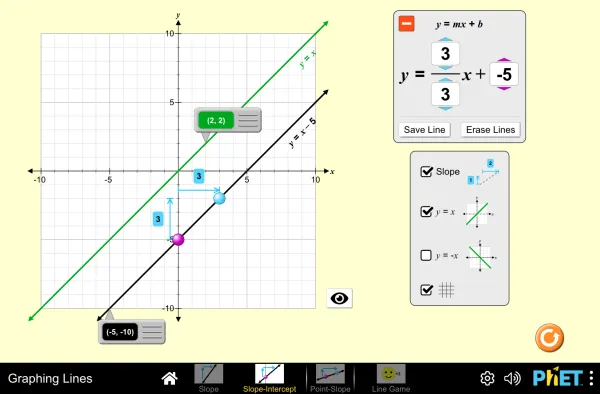
Full screen · PhET Interactive Simulations, University of Colorado Boulder, CC BY 4.0
Challenge
The points A(−1, 2), B(3, 10) and C(k, 20) all lie on the same straight line. Find k, and find where the line crosses the x-axis.
Hint
Use A and B to get the gradient, then find c. Every point on the line fits y = mx + c, including C.
Answer
k = 8, and the line crosses the x-axis at (−2, 0)
Step by step
- From A to B the line goes up 10 − 2 = 8 and across 3 − (−1) = 4, so m = 8 ÷ 4 = 2.
- Put A into y = 2x + c: 2 = 2 × (−1) + c, so c = 4. The line is y = 2x + 4.
- C is on the line, so 20 = 2k + 4. That gives 2k = 16 and k = 8.
- On the x-axis y = 0, so 0 = 2x + 4 and x = −2.
Full working
- m = (10 − 2) ÷ (3 − (−1)) = 8 ÷ 4 = 2rise over run, same order top and bottom
- 2 = 2 × (−1) + c, so c = 4put A in
- y = 2x + 4the line
- 20 = 2k + 4, so 2k = 16, k = 8C is on the line
- 0 = 2x + 4, so x = −2y = 0 on the x-axis
- k = 8; crosses the x-axis at (−2, 0)
Plumber A charges a $60 call-out fee plus $45 an hour. Plumber B charges a $90 call-out fee plus $35 an hour. Write each cost as a straight-line rule, find the job lengths for which B is cheaper, and say how much B saves on a 7-hour job.
Hint
The call-out fee is c and the hourly rate is m. B is cheaper when B's cost is less than A's: write that as an inequality and solve it.
Answer
A: y = 45x + 60, B: y = 35x + 90. B is cheaper for jobs longer than 3 hours; on a 7-hour job B saves $40.
Step by step
- The rate is the gradient and the call-out fee is the starting height, so A is y = 45x + 60 and B is y = 35x + 90.
- B is cheaper when 35x + 90 < 45x + 60.
- Take 35x and 60 off both sides: 30 < 10x, so x > 3.
- At exactly 3 hours both cost $195, which is where the two lines cross.
- For 7 hours: A costs 315 + 60 = $375 and B costs 245 + 90 = $335. B saves $40.
Full working
- A: y = 45x + 60, B: y = 35x + 90m is the rate, c is the call-out fee
- 35x + 90 < 45x + 60B cheaper than A
- 30 < 10xtake 35x and 60 off both sides
- x > 3divide by 10, a positive number, so no flip
- A: 45 × 7 + 60 = 375, B: 35 × 7 + 90 = 335the 7-hour job
- B cheaper for more than 3 hours; saves $40 on 7 hours
Consider the equation (x − 2)² = k − 5. For which values of k does it have two solutions, exactly one solution, or no solutions? Then solve it when k = 21.
Hint
Think of (x − 2) as one number. A square can be positive, zero, or never negative. What does that say about k − 5?
Answer
Two solutions if k > 5, one if k = 5 (x = 2), none if k < 5. When k = 21: x = 6 or x = −2.
Step by step
- Treat x − 2 as a single number being squared. A square is never negative.
- If k − 5 is positive (k > 5), x − 2 has two square roots, one of each sign: two solutions.
- If k − 5 = 0 (k = 5), then x − 2 = 0, so x = 2 is the only solution.
- If k − 5 is negative (k < 5), nothing squares to it, so there are no solutions.
- When k = 21: (x − 2)² = 16, so x − 2 = 4 or x − 2 = −4. That gives x = 6 or x = −2.
Full working
- (x − 2)² = k − 5like x² = a, with x − 2 in place of x
- k − 5 > 0, so k > 5two solutions
- k − 5 = 0, so k = 5one solution, x = 2
- k − 5 < 0, so k < 5no solutions, a square is never negative
- k = 21: (x − 2)² = 16, so x − 2 = 4 or −4both square roots of 16
- x = 6 or x = −2
Practise this
Report a mistake
More in Algebra
Is your child on track?
Take the free placement test