Digestion, part 2: absorbing nutrients and getting rid of waste
What this lesson covers
- How nutrients pass from the small intestine into the blood
- What the body uses nutrients for
- The helpful bacteria that live in the gut
- How the large intestine takes water back into the body
- How waste is stored in the rectum and leaves through the anus
Where part 1 finished
- In part 1, teeth, saliva, the stomach and enzymes broke food down. By the end of the small intestine, much of it has become nutrients: tiny pieces such as sugars and the building blocks of proteins and fats.
- Absorb means to soak up or take in. Absorption is the next big job.
- Nutrients are only useful once they are absorbed into your blood, because blood carries them to every part of your body.
Into the blood: the small intestine
- Most nutrients are absorbed in the small intestine.
- Its inside wall is covered in millions of tiny finger-shaped bumps called villi (say "vil-eye"). One of them is called a villus.
- The villi give the wall a huge surface, so lots of nutrients can be absorbed at once.
- Each villus has a very thin wall with tiny blood vessels just underneath. Nutrients pass through the thin wall into the blood, and the blood carries them away.
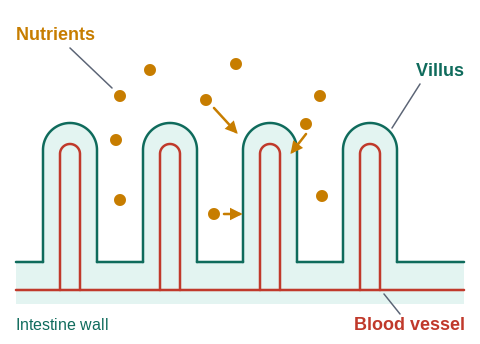
Example: why a bumpy surface soaks up more
- Room 5 cut two strips the same size: one from a smooth cotton cloth and one from a looped bath towel. They dipped each in water, let it drip for 10 seconds, then squeezed it into a measuring cylinder.
- What do the results show, and how does this link to villi?
| Strip | Water held (mL) |
|---|---|
| Smooth cloth | 8 |
| Looped towel | 21 |
- Same size strips, same dipping and drippinga fair test
- The looped towel held 21 mL, the smooth cloth 8 mLmore than double
- The loops give the towel much more surface to hold waterthe reason
- A bumpy surface soaks up more, just as villi let the small intestine absorb more nutrients
What your body does with nutrients
- Blood carries nutrients to all your cells. A cell is one of the tiny living units your body is made of.
- Your body uses nutrients to stay alive, to move, to keep warm, and to grow and repair itself.
| Nutrient | Found in | Used for |
|---|---|---|
| Sugars and starch | Bread, rice, kūmara, fruit | Energy to move, think and keep warm |
| Proteins | Meat, fish, eggs, beans, milk | Growing and repairing muscles and skin |
| Fats | Butter, nuts, avocado | Stored energy and keeping warm |
| Vitamins and minerals | Fruit, vegetables, milk | Keeping bones, blood and skin healthy |
Try it: which nutrient?
Helpful bacteria in your gut
- Bacteria are microorganisms: living things too small to see without a microscope.
- Huge numbers of bacteria live in your digestive system, most of them in the large intestine. Many of them are helpful.
- They break down some parts of food that your own enzymes cannot, such as some of the fibre in vegetables, fruit and wholegrain bread.
- Helpful bacteria also make some vitamins and help keep harmful germs from taking over. Eating plenty of fibre feeds them.
The large intestine takes back water
- What cannot be absorbed in the small intestine moves on into the large intestine. This leftover material is mostly water, fibre and bacteria.
- The large intestine is wider than the small intestine but much shorter.
- Its main job is to absorb water back into the body, so the leftovers slowly become firmer.
- If too little water is taken back, the result is runny poo, called diarrhoea. If the waste moves too slowly and too much water is taken back, it becomes hard, called constipation. Drinking water and eating fibre help keep things moving.
Storing waste and getting rid of it
- The solid waste left at the end is called faeces, or poo.
- It is stored in the rectum, the last short section of the large intestine, until you go to the toilet.
- Getting rid of waste from the body is called excretion. Faeces leave the body through the anus, a ring of muscle at the end of the tube that you can control.
Example: following an apple
- Ella eats an apple. Describe what happens to it in each part of her digestive system, from the mouth to the anus.
| Part | What happens to the apple |
|---|---|
| Mouth | Chewed into small pieces and wetted with saliva |
| Oesophagus | Squeezed down to the stomach |
| Stomach | Churned with acid into a soupy mush |
| Small intestine | Enzymes finish breaking it down; sugars are absorbed into the blood |
| Large intestine | Bacteria break down some fibre; water is taken back |
| Rectum and anus | Leftover fibre and waste are stored, then leave the body |
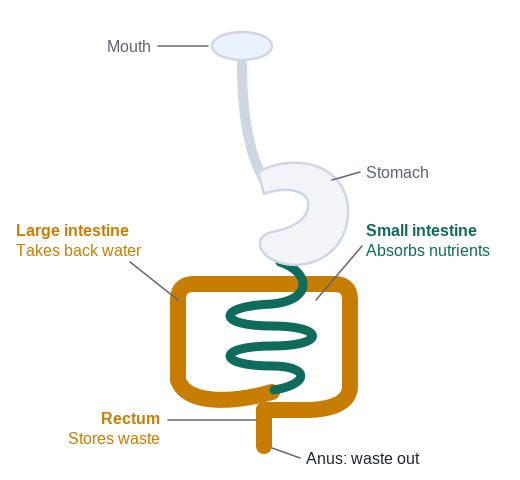
- Sugars from the apple end up in Ella's bloodabsorbed in the small intestine
- Most of the skin's fibre is not absorbedher enzymes cannot break it down
- The apple's sugars feed Ella's body; its leftover fibre and water go on to the large intestine, and the waste leaves through the anus
Try it: where does it happen?
Common mistakes
- Food goes straight from the stomach into the blood.Most nutrients are absorbed through the villi of the small intestine, after the food has been fully broken down.
- All the bacteria in your gut are harmful germs.Many gut bacteria are helpful: they break down some fibre, make some vitamins and help keep harmful germs out.
- The large intestine is longer than the small intestine.The large intestine is wider but much shorter; the small intestine is the longest part.
- The large intestine absorbs most of the nutrients.The small intestine absorbs most nutrients; the large intestine's main job is taking back water.
Which cloth soaks up more?
You need: a face cloth (looped towel), a smooth tea towel, scissors, a bowl of water, a measuring jug, a timer
- With an adult, cut or fold the face cloth and the tea towel so you have two pieces the same size.
- Dip the face cloth piece in the bowl until it is soaked, lift it out and let it drip for 10 seconds.
- Squeeze it over the measuring jug and read how many millilitres came out. Empty the jug.
- Do the same with the tea towel piece.
- Look for this: the looped face cloth usually holds more water, because its loops give it more surface, just as villi give the small intestine more surface to absorb nutrients.
Safety: Ask an adult before cutting any cloth and use only scissors, and mop up spilt water straight away so nobody slips.
Your turn
In which part of the digestive system are most nutrients absorbed?
What is the job of the villi?
What is the main job of the large intestine?
Give one way that helpful bacteria in your gut help you.
Where is waste stored before it leaves the body?
Show answer
1. The small intestine. 2. They give the small intestine a huge surface, so nutrients can pass quickly into the blood. 3. To absorb water back into the body. 4. They break down some fibre that your enzymes cannot (they also make some vitamins and help keep harmful germs out). 5. In the rectum, until it leaves through the anus.
Recap
- Nutrients are absorbed through the villi of the small intestine into the blood.
- The blood carries nutrients to cells, which use them to stay alive, move and grow.
- Helpful gut bacteria break down some fibre, make some vitamins and help keep harmful germs out.
- The large intestine absorbs water from what is left.
- Waste is stored in the rectum and leaves the body through the anus.
Challenge
Some people have coeliac disease. When they eat gluten, a protein in wheat bread and pasta, their small intestine is damaged and many of the villi become short and flat. Even when they eat plenty of food, they can become tired, lose weight and not grow as well as they should. Use what you know about villi to explain why.
Hint
What do villi give the wall of the small intestine? What happens to that when they are flattened, and where do the nutrients need to get to?
Answer
Flat villi give the small intestine much less surface, so far fewer nutrients pass into the blood. The food is eaten and broken down, but much of it is not absorbed, so the cells do not get enough sugars for energy or proteins for growing, and the leftovers pass on as waste.
Step by step
- Normally millions of finger-shaped villi give the small intestine a huge surface.
- Nutrients pass through that surface into the blood, and the blood carries them to the cells.
- Flat villi mean much less surface, so far fewer nutrients get into the blood.
- Eating more food does not fix this, because the problem is absorbing it, not eating it.
- With fewer sugars the cells have less energy, so the person feels tired; with fewer proteins the body cannot grow and repair as well.
Full working
- villi give a huge surfacenormal small intestine
- flattened villi give much less surfacecoeliac damage
- fewer nutrients absorbed into the bloodless surface to pass through
- fewer sugars reach the cellsless energy, so tired
- fewer proteins reach the cellsless growing and repair
- Damaged villi absorb far fewer nutrients, so the body goes short even when plenty of food is eaten
In one adult, on one day, roughly 9 litres of watery liquid enter the small intestine: the water they drank plus the juices their own gut made. The small intestine takes about 7.5 L of it back into the body, and the faeces carry out about 100 mL. (a) How much water does the large intestine take back? (b) Which part takes back more water? (c) On a day with a stomach bug, the small intestine still takes back 7.5 L, but the large intestine only takes back 900 mL. How much water leaves in the faeces, and what is this called?
Hint
Follow the water like money: start with 9 L, take away what each part takes back, and what is left goes on. Change litres into millilitres: 1 L = 1000 mL.
Answer
(a) About 1.4 L (1400 mL). (b) The small intestine, about 7.5 L compared with 1.4 L. (c) About 600 mL, six times as much as usual: runny poo, called diarrhoea.
Step by step
- 9 L go in and the small intestine takes back 7.5 L, so 1.5 L, which is 1500 mL, reaches the large intestine.
- Only 100 mL leaves in the faeces, so the large intestine takes back 1500 − 100 = 1400 mL.
- So the small intestine takes back more water in total. The large intestine's main job is taking back water, and it gets back most of what reaches it.
- On the sick day, 1500 mL still reaches the large intestine, but only 900 mL is taken back.
- That leaves 600 mL in the faeces, six times the usual 100 mL, so the poo is runny: diarrhoea.
Full working
- 9 L − 7.5 L = 1.5 L = 1500 mLwhat reaches the large intestine
- 1500 mL − 100 mL = 1400 mL(a) taken back by the large intestine
- 7500 mL > 1400 mL(b) the small intestine takes back more
- 1500 mL − 900 mL = 600 mL(c) left in the faeces on the sick day
- 600 mL ÷ 100 mL = 6six times as much water as usual
- (a) 1.4 L (b) the small intestine (c) 600 mL, diarrhoea
Antibiotics are medicines that kill bacteria. They are used to cure infections, but they cannot tell harmful bacteria from helpful ones. After a course of antibiotics, some people get diarrhoea for a while. Use ideas from the lesson to suggest why, and suggest what the person could eat afterwards to help their gut get back to normal.
Hint
Where do most of the gut bacteria live, and what three jobs did the lesson give them? Which part of the gut stops the poo being runny?
Answer
The antibiotics also kill many helpful bacteria in the large intestine. With fewer helpful bacteria, harmful germs can take over, and less of the fibre and leftover food is broken down. This upsets the large intestine, so it takes back less water and the faeces are runny. Eating plenty of fibre (vegetables, fruit, wholegrain bread) feeds the helpful bacteria so they can build back up.
Step by step
- Most gut bacteria live in the large intestine, and many of them are helpful.
- Antibiotics cannot tell helpful bacteria from harmful ones, so they kill many helpful ones too.
- Helpful bacteria normally break down some fibre and help keep harmful germs from taking over. With fewer of them, harmful germs can grow and leftovers are not broken down as well.
- This upsets the large intestine, so it takes back less water and the waste stays runny: diarrhoea.
- Fibre feeds helpful bacteria, so fibre-rich food helps them grow back.
Full working
- antibiotics kill bacteria, helpful and harmfulthey cannot tell them apart
- fewer helpful bacteria in the large intestinewhere most gut bacteria live
- harmful germs can take over, less fibre broken downjobs of helpful bacteria lost
- large intestine takes back less waterupset by the change
- runny faeces = diarrhoeatoo little water taken back
- Losing helpful gut bacteria upsets the large intestine; fibre-rich food feeds them back
Report a mistake
How is Year 5 maths going?
See the Year 5 maths guide