Food and nutrients: what your body needs and why
What this lesson covers
- Your body needs nutrients to move, grow and heal
- Carbohydrates give energy, and fats store energy
- Proteins build and repair the body
- Vitamins and minerals keep the body working well, and water is needed every day
- Sorting foods by the main nutrient they give
- Putting together a balanced meal
Why we need food
- Food gives your body nutrients.
- Nutrients are the useful things in food.
- Your body needs them to move, to grow, and to fix itself, like when a cut knee heals.
- Different foods give different nutrients. So we need lots of different foods.
Carbohydrates: energy
- Carbohydrates give you energy to run, play and think.
- Bread, rice, pasta, oats, potatoes and kūmara have lots of carbohydrates.
- Vegetables and grains are good places to get them.
Proteins and fats
- Proteins build your body and fix it when it is hurt.
- Meat, fish, eggs, beans, nuts and milk have protein.
- Fats store energy and help keep you warm.
- Oil, butter, avocado, meat and seeds have fat.
- We need some fat, but not too much.
Vitamins, minerals and water
- Vitamins and minerals help every part of your body work well.
- Fruit and vegetables have lots of them. Meat, nuts and seeds have some too.
- Calcium is a mineral in milk and cheese. It helps build strong bones and teeth.
- Water is in every part of you. Drink water every day, and more when it is hot or you are running around.
Try it: what does each one do?
Example: sort the food
- Most foods have more than one nutrient. We sort each food by the one it has most of.
- Which main nutrient does each food give?
| Food | Main nutrient |
|---|---|
| Potato | Carbohydrate |
| Fish | Protein |
| Butter | Fat |
| Orange | Vitamins |
| Nuts | Protein and fat |
- Potato: a starchy vegetable, so carbohydrate
- Fish: builds muscles, so protein
- Nuts have lots of two nutrients, so they go in two groups
Try it: sort the food
Example: make a lunch balanced
- One easy guide: fill half your plate with vegetables and fruit, a quarter with carbohydrate and a quarter with protein, and drink water.
- Tama's lunch is a white bread roll and a fizzy drink. Is it balanced? What could he add?
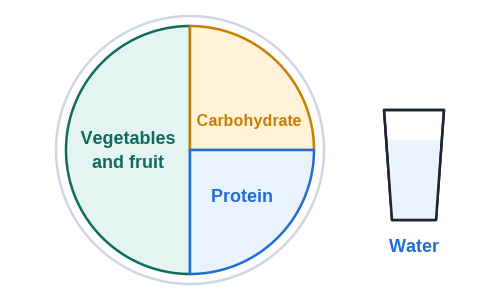
- Bread roll: carbohydrate
- Fizzy drink: lots of sugar, no other nutrients
- Missing: protein, vegetables and fruit, and water
- Not balanced. Add an egg or ham, carrot sticks and an apple, and swap the fizzy drink for water
Common mistakes
- Fat is bad for you, so we should eat none.Your body needs some fat for energy and warmth; we just should not eat too much.
- Fruit juice is just as good as water.Juice has lots of sugar in it; water is the best drink for your body.
- Each food has only one nutrient.Most foods have several nutrients; we sort a food by the one it has most of.
Find the fat with paper
You need: a brown paper bag, scissors, a pencil, a little butter, a slice of apple, a slice of cheese, a cracker
- Cut the paper bag into four squares. Write a food name on each square.
- Rub a little of each food on its own square.
- Leave the squares for 10 minutes so any water can dry.
- Hold each square up to a window.
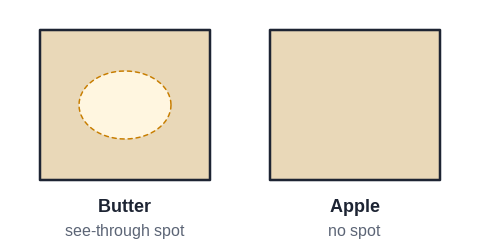
- Look for a see-through, shiny spot. That spot means the food has fat in it. Water dries and leaves no spot, but fat stays.
Safety: Ask an adult before using food from the kitchen and for help with the scissors, and wash your hands after touching the greasy paper.
Your turn
Rice gives you energy. Which nutrient does it have most of?
Which food helps build and fix your body: bread, fish or an apple?
Which nutrient does butter have most of?
What is the best drink on a hot day?
A lunch is a pie and a fizzy drink. What is missing?
Show answer
1. Carbohydrate. 2. Fish, because it has lots of protein. 3. Fat. 4. Water. 5. Fruit and vegetables (vitamins and minerals), and water.
Recap
- Nutrients in food help you move, grow and heal.
- Carbohydrates give energy; fats store energy and keep you warm.
- Proteins build and repair your body.
- Vitamins and minerals keep your body working, and you need water every day.
- A balanced meal has some of each: lots of vegetables and fruit, some carbohydrate, some protein, and water.
Challenge
Three lunchboxes. Box A: a cheese sandwich, an apple and water. Box B: crackers, a bag of chips and a fizzy drink. Box C: a boiled egg, ham and water. Which box is the most balanced? What is missing from each of the other two?
Hint
For each box, sort every food by its main nutrient. Look for carbohydrate, protein, fruit or vegetables, and water.
Answer
Box A is the most balanced. Box B is missing protein and fruit or vegetables. Box C is missing carbohydrate and fruit or vegetables.
Step by step
- Box A: bread is carbohydrate, cheese is protein (and fat), the apple gives vitamins, and there is water.
- Box B: crackers and chips are mostly carbohydrate and fat, and the fizzy drink is mostly sugar and water.
- So Box B has no protein and no fruit or vegetables.
- Box C: egg and ham are protein, and there is water.
- So Box C has no carbohydrate and no fruit or vegetables.
Full working
- A: bread, cheese, apple, watercarbohydrate, protein, vitamins, water
- B: crackers, chips, fizzy drinkcarbohydrate, fat, sugar
- B missingprotein, fruit or vegetables
- C: egg, ham, waterprotein, water
- C missingcarbohydrate, fruit or vegetables
- Box A is the most balanced
A plate holds 8 scoops of food. A balanced plate is half vegetables and fruit, a quarter carbohydrate and a quarter protein. Tama's plate has 3 scoops of rice, 1 scoop of chicken and 4 scoops of vegetables. He may swap just one scoop. What should he swap to make his plate balanced?
Hint
First work out how many scoops of each kind a balanced plate of 8 has.
Answer
Swap 1 scoop of rice for 1 scoop of chicken (or another protein).
Step by step
- Half of 8 is 4, so 4 scoops of vegetables and fruit.
- A quarter of 8 is 2, so 2 scoops of carbohydrate and 2 of protein.
- Tama has 4 vegetables (right), 3 rice (1 too many) and 1 chicken (1 too few).
- Swapping one rice scoop for one protein scoop gives 4, 2 and 2.
Full working
- 8 ÷ 2 = 4half: vegetables and fruit
- 8 ÷ 4 = 2a quarter: carbohydrate
- 8 ÷ 4 = 2a quarter: protein
- Tama: 4 vegetables, 3 rice, 1 chickenrice 1 too many, protein 1 too few
- Swap 1 scoop of rice for 1 scoop of chicken
Mia does the paper test. She rubs butter, cucumber, a peanut and an apple slice on four squares of brown paper. Straight away, all four squares have a dark wet spot. Ten minutes later, only the butter and the peanut squares still have a shiny see-through spot. Which foods have a lot of fat in them? Why should Mia not decide straight away?
Hint
Two things can make a wet-looking spot on paper. Which one dries up?
Answer
The butter and the peanut have a lot of fat. Straight away the water in the foods made every square look wet. Water dries and goes, but fat stays, so only the spots left after 10 minutes show fat.
Step by step
- Foods have water in them, and some have fat too.
- Both water and fat make a dark spot on paper at first.
- Water dries up and leaves no spot. Fat does not dry up.
- After 10 minutes, only the butter and peanut spots were left, so those two have fat.
- If Mia looked straight away, she would wrongly think the cucumber and apple have a lot of fat.
Full working
- straight away: 4 wet spotswater and fat both make spots
- after 10 minutes: water has driedonly fat is left
- butter, peanut: spot staysfat
- cucumber, apple: spot goneit was only water
- Butter and peanut have fat; wait so the water can dry
The maths behind it
Report a mistake
How is Year 3 maths going?
See the Year 3 maths guide