Materials: bendy, stretchy, hard, snappy and soaking
What this lesson covers
- Flexible materials bend and twist easily, most of all when they are thin
- Elastic materials stretch and then spring back to their first shape
- Rigid materials are hard to bend, and brittle ones snap or shatter
- Absorbent materials soak up water; waterproof ones keep it out
- Measuring how far a material stretches
- Choosing the right material for a job
What is a property?
- A material is what a thing is made of.
- Wood, plastic, glass, wool and paper are all materials.
- A property is what a material is like.
- Does it bend? Does it stretch? Does it snap? Does it soak up water?
- We find out by testing it.
Flexible: it bends
- A flexible material bends or twists without breaking.
- Paper, cloth, tinfoil and a plastic straw are flexible.
- Thin things bend more easily than thick things.
- One sheet of paper bends easily. A thick pile of paper does not.
Elastic: it stretches and springs back
- An elastic material stretches when you pull it.
- When you let go, it goes back to its first shape.
- A rubber band, a hair tie and a balloon are elastic.
- Play dough stretches too, but it stays stretched. So play dough is not elastic.
Rigid and brittle
- A rigid material is hard to bend, stretch or break.
- A wooden table leg and a metal spoon are rigid.
- A brittle material does not bend. It snaps or shatters when you bend it or hit it.
- A dry cracker, an eggshell and a glass cup are brittle.
- Rigid and brittle are not the same. A metal spoon is rigid, but it does not shatter when you drop it.
Try it: which property fits best?
Soaks it up or keeps it out
- An absorbent material soaks up water. A paper towel, a sponge and a cotton sock are absorbent.
- A waterproof material keeps water out. A plastic bag, a raincoat and a gumboot are waterproof.
- To test, put a drop of water on it.
- If the drop sinks in, the material is absorbent. If the drop sits on top, it is waterproof.
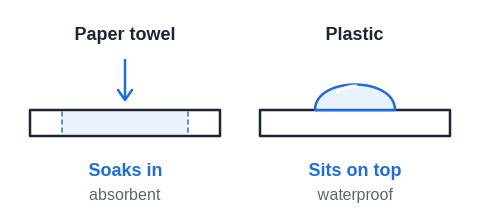
Try it: absorbent or waterproof?
Example: how far does it stretch?
- Room 5 hung the same bag of marbles on three things. They measured each one before and with the bag.
- How far did each one stretch?
| Thing | Before | With the bag |
|---|---|---|
| Rubber band | 8 cm | 12 cm |
| Hair tie | 6 cm | 9 cm |
| String | 10 cm | 10 cm |
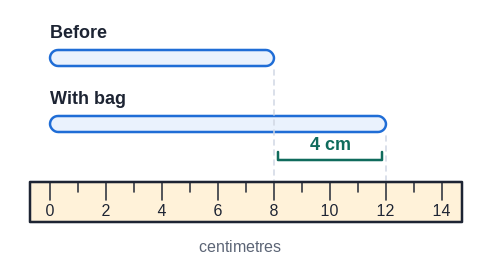
- Rubber band: 12 cm − 8 cm = 4 cmnew length take away first length
- Hair tie: 9 cm − 6 cm = 3 cm
- String: 10 cm − 10 cm = 0 cmstring does not stretch
- The rubber band stretched the most, 4 cm
- With the bag off, the band went back to 8 cm, so it is elastic
Example: the best material for a raincoat
- A raincoat must keep rain out, and it must bend when you move your arms.
- Which is best: paper towel, wool or plastic?
- Paper towel is absorbent, so the rain would soak in
- Wool is flexible, but it soaks up water
- Plastic is flexible and waterproof
Common mistakes
- Play dough is elastic because it stretches.Elastic things go back to their shape when you let go; play dough stays stretched, so it is not elastic.
- Hard things are always brittle.Brittle things snap or shatter. A metal spoon is hard and rigid, but it does not shatter.
- The band reached 12 cm on the ruler, so it stretched 12 cm.The stretch is the new length take away the first length: 12 cm take away 8 cm is 4 cm.
The drip test
You need: a paper towel, a piece of plastic bag, an old cotton sock, a piece of tinfoil, a cup of water, a teaspoon, a tray
- Lay the four materials flat on the tray.
- Guess which ones will soak up water. Say your guess out loud.
- Put one teaspoon of water on each material.
- Count slowly to 20, then lift each one and look underneath.
- Look for where the water went. On absorbent materials it soaks in and spreads. On waterproof ones it sits on top in a round drop.
Safety: Ask an adult to help, and wipe up any spilled water straight away so nobody slips on the wet floor.
Your turn
A hair tie is 6 cm long. When it is stretched it is 10 cm long. How far did it stretch?
You bend a dry cracker and it snaps. Is it flexible or brittle?
Which is best for a bath mat: plastic, a towel or glass?
A balloon is blown up, then let down. It goes back to small. Is it elastic?
Why is a gumboot made of rubber and not cloth?
Show answer
1. 4 cm, because 10 − 6 = 4. 2. Brittle, because it snaps when you bend it. 3. A towel, because it is absorbent and soaks up the drips. 4. Yes, it is elastic, because it goes back to its shape. 5. Rubber is waterproof and bends when you walk; cloth soaks up water.
Recap
- Flexible materials bend; thin ones bend most easily.
- Elastic materials stretch and spring back.
- Rigid materials are hard to bend; brittle ones snap or shatter.
- Absorbent materials soak up water; waterproof ones keep it out.
- To find a stretch, take the first length away from the new length.
- Pick a material for a job by its properties.
Challenge
Ana cuts four squares the same size: sponge, cotton sock, paper towel and plastic bag. She puts each one in its own cup of 100 mL of water, lifts it out and measures the water left. Sponge cup: 30 mL left. The sock soaked up half as much as the sponge. The paper towel cup has 15 mL more left than the sponge cup. The plastic bag cup still has 100 mL. Put the materials in order from most to least absorbent. Which one would make the best raincoat?
Hint
The water soaked up is 100 mL take away the water left. Work out the sponge first.
Answer
Sponge (70 mL), paper towel (55 mL), sock (35 mL), plastic bag (0 mL). The plastic bag makes the best raincoat, because it is waterproof.
Step by step
- The water soaked up is 100 mL take away the water left in the cup.
- Sponge: 100 mL take away 30 mL is 70 mL.
- The sock soaked up half of 70 mL, which is 35 mL.
- The paper towel cup has 30 + 15 = 45 mL left, so the paper towel soaked up 55 mL.
- The plastic bag soaked up nothing, so it is waterproof: the best for a raincoat.
Full working
- 100 mL − 30 mL = 70 mLsponge
- half of 70 mL = 35 mLsock
- 30 mL + 15 mL = 45 mLleft in the paper towel cup
- 100 mL − 45 mL = 55 mLpaper towel
- 100 mL − 100 mL = 0 mLplastic bag, waterproof
- Sponge, paper towel, sock, plastic bag; the plastic bag for a raincoat
Room 6 hangs a bag of marbles on three things, then takes the bag off again. Hair tie: 6 cm, then 10 cm with the bag, then 6 cm with the bag off. Play dough snake: 10 cm, then 15 cm with the bag, then 14 cm with the bag off. String: 12 cm, then 12 cm, then 12 cm. Which one stretched the most? Which one is elastic?
Hint
Find each stretch first. Then look at what happened when the bag came off.
Answer
The play dough stretched the most (5 cm), but only the hair tie is elastic.
Step by step
- Stretch is the length with the bag take away the first length.
- Hair tie 4 cm, play dough 5 cm, string 0 cm. Play dough stretched the most.
- With the bag off, the hair tie went back to 6 cm, its first length.
- The play dough stayed longer (14 cm), so it is not elastic.
- The string did not stretch at all.
Full working
- 10 cm − 6 cm = 4 cmhair tie stretch
- 15 cm − 10 cm = 5 cmplay dough stretch
- 12 cm − 12 cm = 0 cmstring stretch
- hair tie back to 6 cm, play dough stays at 14 cmsprings back or not
- Play dough stretched most; only the hair tie is elastic
A rubber band is 8 cm long. With 1 bag of marbles it is 11 cm long. With 2 bags it is 14 cm long. If the pattern keeps going, how many bags make the band 20 cm long?
Hint
How much longer does the band get each time you add one bag?
Answer
4 bags
Step by step
- 8 cm to 11 cm is 3 cm, and 11 cm to 14 cm is 3 cm.
- So each bag stretches the band 3 cm more.
- 20 cm is 12 cm more than the first 8 cm.
- 12 cm is four lots of 3 cm, so 4 bags.
- Check: 14, 17, 20 for 2, 3 and 4 bags.
Full working
- 11 − 8 = 3, 14 − 11 = 33 cm more for each bag
- 20 − 8 = 12total stretch needed
- 3 + 3 + 3 + 3 = 12four lots of 3 cm
- 8, 11, 14, 17, 200, 1, 2, 3, 4 bags
- 4 bags
The maths behind it
Report a mistake
How is Year 3 maths going?
See the Year 3 maths guide