Sound: vibrations, loudness and high and low
What this lesson covers
- Every sound comes from something vibrating
- Sound travels through air, water and solid materials
- Bigger vibrations make louder sounds
- Frequency: fast vibrations make high sounds, slow ones make low sounds
- Soft, thick materials make sound quieter and less clear
- Testing sounds and comparing what different people hear
Sounds come from vibrations
- Every sound comes from something vibrating, which means moving back and forth very fast.
- Pluck a rubber band and it looks blurry while it vibrates.
- Sound can also make other things vibrate. A very loud truck can make a window rattle.
Rice on a drum
- Room 8 put a few grains of rice on a drum and tapped the side of the drum.
| What they did | The rice | The sound |
|---|---|---|
| Nothing | Stayed still | None |
| Gentle tap | Hopped a little | Quiet |
| Hard hit | Jumped high | Loud |
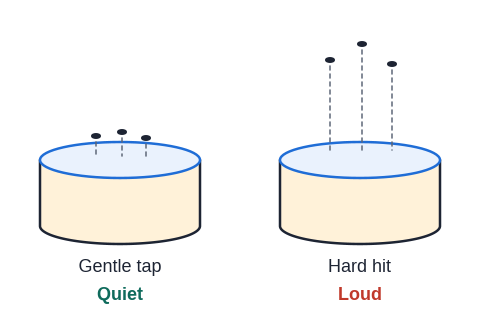
- The rice moved only when there was a soundthe drum skin was vibrating
- Bigger jumps came with the louder soundbigger vibrations
- Sounds are made by vibrations, and big vibrations make loud sounds
Big vibrations, loud sounds
- Volume is how loud or quiet a sound is.
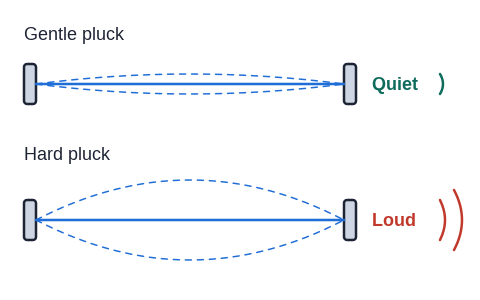
- A big vibration makes a loud sound. A small vibration makes a quiet sound.
- Pluck a guitar string hard and it swings a long way, so the sound is loud. Pluck it gently and it swings a little, so the sound is quiet.
Try it: loud or quiet?
High and low sounds
- Pitch is how high or low a sound is.
- Frequency is how fast something vibrates.
- Fast vibrations, a high frequency, make a high sound, like a whistle.
- Slow vibrations, a low frequency, make a low sound, like a big drum.
- A short, tight rubber band makes a higher sound than a long, loose one.
Try it: high or low?
Sound travels through materials
- Sound moves from the thing that vibrates to your ears.
- It can travel through air, through water, and through solid materials like wood and metal.
- Put your ear on a table and gently tap the far end. The tap sounds clearer through the wood than through the air.
Materials change the sound
- Soft, thick materials like pillows and curtains soak up sound, so it is quieter and muffled.
- Hard, smooth materials like tiles bounce sound around, which is why a bathroom sounds echoey.
- Tap a bowl when it is empty and again when it is full of water. The sounds are different.
- Traditional Māori instruments use vibrating air too: the kōauau is a small flute, and the pūtātara is a shell trumpet.
Does everyone hear the same?
- Room 8 tapped one end of a table. Three children listened at the other end, first with an ear on the table, then with their head up in the air. They also put a hand flat on the table.
| Child | Ear on table | Ear in the air | Felt it in their hand? |
|---|---|---|---|
| Aroha | Clear | Quiet | Yes |
| Ben | Clear | Very quiet | Yes |
| Sione | Clear | Quiet | No |
- All three heard the tap more clearly through the tablesame for everyone
- How quiet it was in the air, and whether they felt it, was a little differentpeople differ
- Sound travels well through wood, but each person hears and feels it a bit differently
Common mistakes
- A whistle is high because it is loud.High or low is pitch, from how fast it vibrates; loud or quiet is volume, from how big the vibrations are.
- Sound can only travel through air.Sound also travels through water and solids, often more clearly than through air.
- Putting a pillow over a speaker makes it louder.Soft, thick materials soak up sound, so the sound gets quieter and muffled.
Make a rubber band guitar
You need: an empty tissue box or small plastic tub, 3 rubber bands of different thickness
- Stretch the three rubber bands around the box so they cross the opening.
- Pluck each band gently and listen.
- Pluck one band hard, then gently, and compare the sounds.
- Press one band down near the end with a finger to make the part you pluck shorter, then pluck it again.
- Look for this: harder plucks are louder, thin or shorter bands sound higher, and thick bands sound lower.
Safety: Ask an adult to help stretch the bands, and keep them away from faces, because a band that slips off can flick into an eye.
Your turn
What has to happen to make any sound?
You pluck a string harder. What happens to the sound?
Which has a higher frequency: a whistle or a big drum?
Which makes a voice from the next room harder to hear: an open door or a thick, closed curtain?
In Room 8's test, was the tap clearer with an ear on the table or in the air?
Show answer
1. Something must vibrate. 2. It gets louder, because the string swings further. 3. The whistle. 4. The thick, closed curtain, because soft, thick materials soak up sound. 5. With an ear on the table.
Recap
- Every sound comes from something vibrating.
- Sound travels through air, water and solids.
- Bigger vibrations make louder sounds.
- Fast vibrations, a high frequency, make high sounds; slow ones make low sounds.
- Soft, thick materials make sound quieter and less clear; hard ones bounce it.
- Different people can hear and feel the same sound a little differently.
Challenge
Sound sorting! Here are four sounds: a mouse's squeak, a lion's roar, a referee's whistle and a cat purring on your lap. Put each one in a box: loud and high, loud and low, quiet and high, or quiet and low. Each box gets one sound.
Hint
Ask two questions about each sound. Is it loud or quiet? That is the volume. Is it high like a whistle or low like a big drum? That is the pitch.
Answer
Loud and high: the whistle. Loud and low: the lion's roar. Quiet and high: the mouse's squeak. Quiet and low: the cat purring.
Step by step
- Loud or quiet is volume. It comes from how big the vibrations are.
- High or low is pitch. It comes from how fast the vibrations are.
- The whistle and the roar are both loud, but the whistle is high and the roar is low.
- The squeak and the purr are both quiet, but the squeak is high and the purr is low.
- So loud does not mean high, and quiet does not mean low.
Full working
- Whistle: big, fast vibrationsloud and high
- Lion's roar: big, slow vibrationsloud and low
- Mouse's squeak: small, fast vibrationsquiet and high
- Cat's purr: small, slow vibrationsquiet and low
- Whistle = loud high, roar = loud low, squeak = quiet high, purr = quiet low
Mia and Tom make a string telephone: two paper cups joined by a long string. When they stand far apart and the string is pulled tight, Mia can hear Tom talking through her cup. Then Tom walks closer, and the string sags down onto the grass. Now Mia hears nothing through her cup, even though Tom is closer. Why?
Hint
Follow the sound from Tom's mouth to Mia's ear. What has to vibrate at each step along the way?
Answer
Tom's voice makes his cup vibrate, and the cup shakes the string. A tight string carries those vibrations all the way to Mia's cup. A floppy string lying on the grass cannot pass the vibrations along, so Mia's cup does not vibrate and she hears nothing through it.
Step by step
- Every sound is a vibration.
- Tom's voice makes the bottom of his cup vibrate.
- The cup shakes the string, and the vibrations travel along the string to Mia's cup.
- A tight string passes the shake along well, like a solid ruler.
- A loose string just flops, and the soft grass soaks up the shake, so the vibrations die out before they reach Mia's cup.
Full working
- Tom talkshis voice vibrates the air in his cup
- Cup bottom vibratesit shakes the string
- Tight stringvibrations travel along it to Mia's cup
- Mia's cup vibratesshe hears Tom
- Sagging string on grassvibrations are lost on the way
- Sound needs the vibrations to travel all the way. A loose string cannot carry them, so Mia hears nothing.
Tama has three glass bottles that are all the same. Bottle A is nearly empty, bottle B is half full of water and bottle C is nearly full. First he taps each bottle with a spoon. Then he blows across the top of each bottle to make a hoot. Which bottle makes the highest sound when he taps? Which makes the highest sound when he blows?
Hint
Ask what is vibrating each time. A tap shakes the glass and the water in it. Blowing shakes the air inside the bottle, above the water. Heavy things vibrate more slowly. A small amount of air can vibrate faster than a big amount.
Answer
Tapping: bottle A (nearly empty) is highest. Blowing: bottle C (nearly full) is highest. The order is turned around.
Step by step
- When Tama taps, the glass vibrates, and the water vibrates with it.
- More water makes the bottle heavier, so it vibrates more slowly and sounds lower. So A is the highest tap and C is the lowest.
- When Tama blows, the air inside the bottle, above the water, vibrates.
- C has only a little air above the water. A small amount of air vibrates fast, so C makes the highest hoot.
- A has lots of air, which vibrates slowly, so A makes the lowest hoot.
Full working
- Tap: glass and water vibratemore water means slower vibrations
- Tap: A fastest, C slowestA highest, C lowest
- Blow: air above the water vibratesless air means faster vibrations
- Blow: C has least air, A has mostC highest, A lowest
- Tapping: A is highest. Blowing: C is highest.
Report a mistake
How is Year 2 maths going?
See the Year 2 maths guide