Breathing, moving and sensing
What this lesson covers
- Muscles move your body by pulling
- A muscle gets shorter to pull, then relaxes
- Breathing in: muscles lift your ribs out and air comes in
- Breathing out: the muscles relax, your ribs move in and air goes out
- Your sense organs pick up light, sound, smells, touch and heat, and your brain works out what they mean
- Testing what each sense organ can pick up
Muscles pull
- Muscles are the parts of your body that make it move.
- A muscle can only pull. To pull, it gets shorter and fatter. This is called contracting.
- When a muscle stops pulling, it relaxes and gets longer again.
- Muscles are joined to bones, so when a muscle pulls, a bone moves.
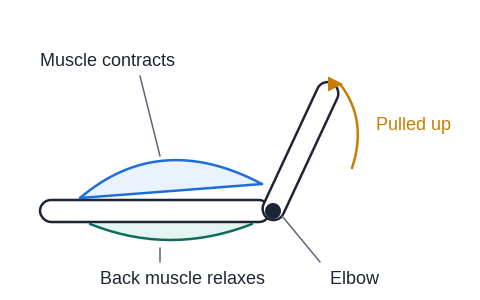
Bend your arm
- Hold your left hand on the front of your right upper arm. Slowly bend your right elbow, then straighten it. What do the muscles do?
- Bending: the front muscle gets shorter and harderit contracts
- It pulls the lower arm upa muscle pulls a bone
- Straightening: the front muscle relaxes, and a muscle at the back pulls insteadmuscles cannot push
- One muscle pulls to bend the arm; another pulls to straighten it
How you breathe
- Your lungs are inside your chest, behind your ribs.
- To breathe in, muscles contract and lift your ribs up and out. Your chest gets bigger, and air rushes in through your nose or mouth.
- To breathe out, the muscles relax. Your ribs drop back in, your chest gets smaller, and air is pushed out.
- Put your hands on your ribs and take a deep breath. Feel them move out, then in.
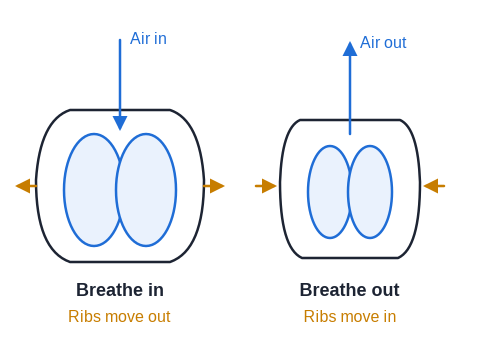
Try it: breathing in or out?
Your senses
- Your senses tell your brain what is around you.
- Each sense organ picks up something different and sends a message to your brain.
- Your brain works out what the message means: bright, loud, smelly, hot or soft.
| Sense organ | Sense | It picks up |
|---|---|---|
| Eyes | Sight | Light and colour |
| Ears | Hearing | Sound |
| Nose | Smell | Strong and faint smells |
| Tongue | Taste | Sweet, salty, sour and bitter |
| Skin | Touch | Light and hard touch, hot and cold |
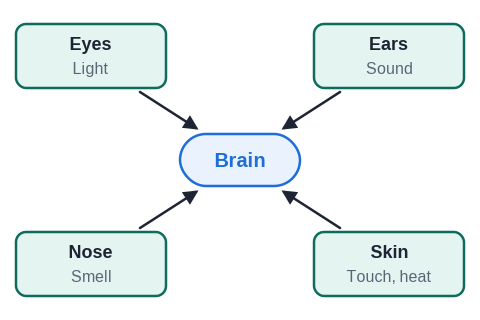
Try it: which sense organ?
Strong and faint smells
- Room 9 put 1 drop of vanilla on one cotton ball and 5 drops on another. Ten children each sniffed both from an arm's length away.
| Cotton ball | Children who smelled it |
|---|---|
| 1 drop | 2 of 10 |
| 5 drops | 9 of 10 |
- 1 drop: 2 of 10 children smelled ita faint smell
- 5 drops: 9 of 10 children smelled ita strong smell
- A stronger smell is easier for the nose to pick up, but people's noses differ
Try it: who smelled the vanilla?
Touch, hot and cold
- Your skin can feel a light touch, like a feather, and a hard press, like a push.
- It can also feel hot and cold.
- Your fingertips and lips feel touch better than your back does.
Common mistakes
- Muscles push bones to move them.Muscles can only pull; to move a bone back, another muscle pulls the other way.
- When I breathe in, the air goes into my stomach.Air goes down into your lungs; your tummy moves because the muscles under your lungs move.
- My eyes do all the seeing by themselves.Your eyes pick up light, but your brain works out what you are looking at.
The three bowls test
You need: 3 bowls, cold tap water, warm tap water, a clock or timer
- Fill one bowl with cold tap water, one with warm tap water, and the middle bowl with a mix of the two.
- Put one hand in the cold bowl and the other hand in the warm bowl.
- Keep them there while you count slowly to 60.
- Now put both hands into the middle bowl together.
- Look for this: the same water feels warm to one hand and cool to the other, because your skin compares it with what it felt before.
Safety: Ask an adult to run the warm water and test it with their own hand first, so it is warm and not hot enough to scald.
Your turn
When a muscle contracts, does it get shorter or longer?
When you breathe in, do your ribs move in or out?
Which sense organ picks up a smell?
Which part of your body works out what your senses pick up?
In Room 9's test, how many children smelled the 5-drop cotton ball?
Show answer
1. Shorter, and fatter. 2. Out. 3. The nose. 4. The brain. 5. 9 of 10 children.
Recap
- Muscles pull on bones to move them; they contract to pull and relax to stop.
- Breathing in, muscles lift your ribs out and air comes into your lungs.
- Breathing out, the muscles relax, your ribs move in and air goes out.
- Eyes, ears, nose, tongue and skin pick up what is around you.
- Your brain works out what your senses are telling it.
Challenge
Ana makes a toy arm from two sticks joined by a hinge, like an elbow. A red string is tied on top of the lower stick, and a blue string is tied underneath it. Strings can only pull, just like muscles. Pulling the red string bends the arm up. How can Ana make the arm straighten again? What does this tell you about your own arm?
Hint
A string cannot push the stick back down. Which string can pull it the other way?
Answer
She lets go of the red string and pulls the blue string. Your arm works the same way: one muscle pulls to bend it, and a different muscle pulls to straighten it, because muscles can only pull.
Step by step
- A string can only pull, so pushing on the red string does nothing.
- Ana must stop pulling the red string, so it goes loose.
- Then she pulls the blue string, and the stick swings back down.
- Your muscles are like the strings: they can only pull.
- So your arm needs two muscles: one to bend it and one to straighten it.
Full working
- Red string pullsthe arm bends up
- Red string cannot pushstrings only pull
- Red string loose, blue string pullsthe arm straightens
- Muscles only pull, like stringsthe same rule
- Front muscle bends the arm, back muscle straightens itone muscle for each way
- Pull the blue string. Your arm needs one muscle to bend and another to straighten.
Sam wraps a tape measure around his chest. He measures once after breathing all the way in, and once after breathing all the way out. One time it says 62 cm and the other time it says 58 cm. Which number was after breathing in? How much bigger did his chest get, and why?
Hint
Think about what your ribs do when you take a big breath in.
Answer
62 cm was after breathing in. His chest got 4 cm bigger, because muscles lifted his ribs up and out so air could rush into his lungs.
Step by step
- When you breathe in, muscles lift your ribs up and out.
- That makes your chest bigger, so the bigger number goes with breathing in.
- 62 is bigger than 58, so 62 cm was breathing in.
- The difference is 62 − 58 = 4 cm.
- Breathing out, the muscles relax, the ribs drop in and the chest gets smaller again.
Full working
- Breathe in: ribs move up and outmuscles contract
- Chest gets biggermore room for air
- 62 cm is more than 58 cmthe bigger number
- 62 − 58 = 4how much bigger
- Breathing in: 62 cm. His chest got 4 cm bigger because his ribs moved out.
Mia pinches her nose shut and closes her eyes. Her friend gives her a strawberry jelly bean. Mia chews it and says, "It is sweet, but I can't tell what flavour." Then she lets go of her nose and shouts, "Strawberry!" Which sense organs helped her each time, and why could she only name the flavour at the end?
Hint
Look back at the table: what tastes can your tongue pick up? Is "strawberry" one of them?
Answer
With her nose pinched, only her tongue was working. A tongue picks up tastes like sweet, salty, sour and bitter, but not "strawberry", so she only knew it was sweet. When she let go, her nose picked up the strawberry smell too, and her brain put the two messages together to work out "strawberry".
Step by step
- Her eyes were shut, so she could not see the colour.
- Her nose was pinched, so smells could not get in.
- Her tongue still worked. A tongue picks up tastes like sweet, salty, sour and bitter, so she knew it was sweet.
- "Strawberry" is not a taste the tongue can pick up on its own.
- When she let go, her nose picked up the strawberry smell.
- Her brain put the taste and the smell together and worked out it was strawberry.
Full working
- Eyes shut, nose pinchedonly the tongue can work
- Tongue: sweet, salty, sour, bittertastes a tongue picks up
- Sweet, but no flavourstrawberry is not a tongue taste
- Nose open: strawberry smell gets inthe nose picks up smells
- Brain joins taste and smellthe brain works out what it means
- First only her tongue (sweet). At the end her nose smelled strawberry and her brain put it together.
The maths behind it
Report a mistake
How is Year 2 maths going?
See the Year 2 maths guide