How hominins spread across the world
What this lesson covers
- Homo erectus as the first hominin to leave Africa, and why it could.
- The Out of Africa (replacement) and multiregional models for Homo sapiens, and the evidence for each.
- Mitochondrial DNA and the Y chromosome as records of maternal and paternal ancestry.
- The serial founder effect: why genetic diversity falls with distance from Africa.
- Interbreeding with Neanderthals and Denisovans, and the DNA they left in living people.
- The settlement of the Pacific and Aotearoa, and the evidence used to trace it.
Out of Africa, the first time: Homo erectus
- All the earliest hominin fossils are African; the oldest hominin fossils outside Africa are Homo erectus, at Dmanisi in Georgia, about 1.8 million years ago, followed by sites in Java and China.
- Homo erectus had long legs and a body built for walking long distances, a larger brain, and Acheulean tools, and probably used fire later in its history, so it could follow game into new habitats.
- A diet with more meat gave it a food source available in many environments, unlike the narrow plant diets of earlier hominins.
- Its descendants in Asia lasted until about 110 000 years ago, and small island hominins such as Homo floresiensis on Flores may descend from it.
Where did Homo sapiens come from? Two models
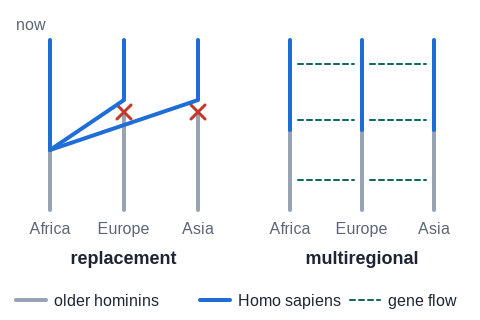
- The Out of Africa (replacement) model says Homo sapiens evolved in Africa only, then spread out across the world and replaced the older hominins (such as Neanderthals) with little or no interbreeding.
- The multiregional model says Homo erectus populations in Africa, Europe and Asia each evolved into modern humans, held together as one species by gene flow between regions.
- The oldest Homo sapiens fossils are African (Jebel Irhoud in Morocco, about 300 000 years ago), and modern humans appear much later elsewhere, which supports an African origin.
- DNA now shows that some interbreeding did happen, so most scientists accept a modified version: a recent African origin with a small amount of mixing with the hominins already outside Africa (sometimes called the assimilation model).
The spread of Homo sapiens
- Small groups left Africa earlier, reaching the Levant by about 180 000 years ago, but the main dispersal that gave rise to all living non-Africans happened about 70 000 to 50 000 years ago.
- People moved along the coast of southern Asia and reached Australia, by boat across open sea, by at least 50 000 years ago; Europe was reached by about 45 000 years ago.
- The Americas were reached across the Bering land bridge from Siberia, by at least 15 000 years ago and possibly earlier.
- Remote Oceania, the islands out of sight of each other, was the last region reached: Aotearoa was settled only about 1250 to 1300 CE, roughly 750 years ago.
Try it: when did it happen?
Evidence from mtDNA and the Y chromosome
- Mitochondrial DNA (mtDNA) is passed only from mother to child, does not recombine, has many copies per cell and mutates fairly fast, so its changes record the maternal line over tens of thousands of years.
- The Y chromosome is passed only from father to son, and most of it does not recombine, so it records the paternal line in the same way.
- All living people's mtDNA traces back to one woman (nicknamed mitochondrial Eve) who lived in Africa roughly 150 000 to 200 000 years ago, and the deepest Y chromosome lineages are also African.
- African populations hold the most diversity in both, and all non-African lineages form one branch inside the African tree, which fits a small group leaving Africa and founding everyone else.
- She was not the only woman alive; other women's mtDNA lines simply died out when they had no daughters, by chance.
Try it: mtDNA or the Y chromosome?
The serial founder effect
- Each time a small group split off and moved on, it carried only part of its parent population's alleles: a founder effect.
- Repeated step after step across the world, this means genetic diversity falls the further a population is from East Africa, measured along likely walking routes.
- Studies of many populations find exactly this pattern, with the lowest diversity in the Americas and the Pacific, the last places settled.
- The same pattern would not appear if modern humans had evolved separately in each region, so it is strong evidence for an African origin.
Example: dating a split with mtDNA
- Two mtDNA lineages differ by 0.60% in a stretch of sequence (practice numbers, not a real study). Lineages diverge at 3.0% per million years in this stretch. Estimate when they shared a common ancestor.
- time = difference ÷ rate
- time = 0.60 ÷ 3.0 = 0.20 million years
- common ancestor about 200 000 years ago
- this fits the age of the oldest Homo sapiens fossils in Africa, so two kinds of evidence agree
Interbreeding with Neanderthals and Denisovans
- Neanderthals lived in Europe and western Asia from about 400 000 to 40 000 years ago; Denisovans are known mostly from DNA, first read from a finger bone in Denisova Cave in Siberia in 2010, and lived across Asia.
- Comparing their genomes with ours shows that people of non-African descent carry about 1 to 2% Neanderthal DNA, so Homo sapiens interbred with Neanderthals soon after leaving Africa, probably in the Middle East.
- People in Papua New Guinea and Aboriginal Australians carry about 4 to 6% Denisovan DNA, and smaller amounts are found across East Asia and among Pacific peoples, including Māori.
- Some inherited alleles were selected because they helped: a Denisovan version of the EPAS1 gene helps Tibetans cope with low oxygen at high altitude, and some immune genes came from Neanderthals.
- A bone from Denisova Cave belonged to a girl with a Neanderthal mother and a Denisovan father, so these groups also met and bred with each other.
Settling the Pacific and Aotearoa
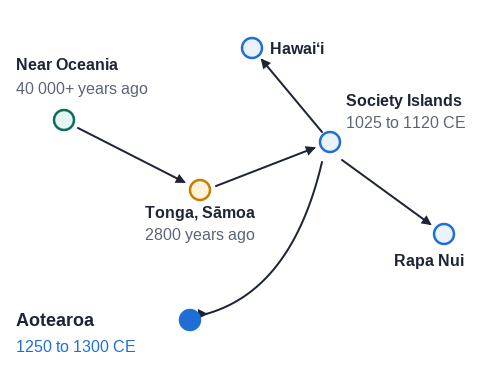
- Near Oceania (New Guinea, the Bismarck Archipelago and the Solomons), where islands are in sight of each other, was settled more than 40 000 years ago.
- By about 2800 years ago, people of the Lapita culture, known from their stamped pottery and speaking Austronesian languages whose roots trace back to Taiwan, had sailed into Remote Oceania and reached Fiji, Tonga and Sāmoa.
- After a gap of about 1800 years, voyagers settled the Society Islands and then, in a rapid burst, the far points of East Polynesia: Hawaiʻi, Rapa Nui and Aotearoa, with Aotearoa reached about 1250 to 1300 CE.
- They sailed double-hulled waka, navigating by stars, swells and birds, and carried kūmara, taro, hue, kiore and kurī.
- The evidence includes radiocarbon dates on short-lived seeds and on kiore-gnawed seeds and bones, the DNA of kiore (which could only travel with people), human mtDNA, pottery and language.
| Islands | First settled (CE) |
|---|---|
| Society Islands | 1025 to 1120 |
| Hawaiʻi and Rapa Nui | 1190 to 1290 |
Example: how long was the voyage?
- Rarotonga, in the southern Cook Islands, is about 3000 km from the north of Aotearoa. Assume a waka averaged 150 km a day.
- Estimate the voyage time and the waka's average speed in km/h.
- time = 3000 ÷ 150 = 20 days
- speed = 150 ÷ 24 = 6.25 km/h, about 6 km/ha brisk walking pace, all day and night
- 20 days needs water and food for everyone aboard, plus plants and animals to start a settlementwhy voyages were planned
- rat DNA and dates fit deliberate voyages with settlers and supplies, not drifting canoes
What Achieved, Merit and Excellence look like
- Achieved describes the evidence; Merit explains what it shows about where people came from; Excellence combines several lines of evidence and judges how far each supports the conclusion.
| Grade | A model answer |
|---|---|
| Achieved | Kiore are Pacific rats that travelled on waka with people. Their bones and the seeds they gnawed can be radiocarbon dated. |
| Merit | Kiore cannot swim between distant islands, so they only arrived with people. Dating kiore bones and kiore-gnawed seeds shows when people first reached each island, and comparing kiore mtDNA between islands shows which islands were linked by voyages. |
| Excellence | Because kiore travelled only with people, their arrival dates the arrival of humans, and short-lived seeds they gnawed give tighter radiocarbon dates than long-lived materials, which pointed to settlement of Aotearoa around 1250 to 1300 CE rather than much earlier. Kiore mtDNA traces repeated voyages between islands, adding to human mtDNA and language evidence that settlers came from East Polynesia. Each line has limits (dates have error ranges, and DNA shows links but not direction), but together they agree on a late, rapid, deliberate settlement. |
Common mistakes
- Homo sapiens was the first hominin to leave Africa.Homo erectus left Africa about 1.8 million years ago, long before Homo sapiens evolved.
- Mitochondrial Eve was the only woman alive at the time.Many women lived then; only her mtDNA line happens to survive, because other lines ended with women who had no daughters.
- Mitochondrial DNA comes from both parents.mtDNA comes only from the mother, through the egg's mitochondria; the Y chromosome traces the father's line.
- The Out of Africa model is wrong because people carry Neanderthal DNA.The origin was still African; the DNA shows a small amount of interbreeding, so the replacement was not complete.
Model the serial founder effect
You need: Lego bricks or buttons in 8 colours, about 15 of each, 2 bowls, a cloth or tea towel to cover a bowl, paper and a pen
- Put 3 pieces of each colour (24 in all) into a bowl: this is the population in Africa. Record that it has 8 colours.
- Without looking, take out 6 pieces: these are the founders who move on. Record how many colours they have.
- Make the next population by putting 4 pieces into the empty bowl for every founder piece, matching colours, so it has 24 pieces again.
- Repeat the founding step four more times, each new population founded from the last, recording the number of colours each time.
- Look for: colours lost at most steps and never regained, so the last population has the fewest. Human genetic diversity falls with distance from Africa in the same way.
Safety: Small bricks and buttons are a choking hazard, so do this away from children under three and count every piece back into the box.
Your turn
Which hominin was the first known to leave Africa, and about when?
From which parent do you inherit your mitochondrial DNA?
A haploid human genome is about 3.1 billion bases. How many bases is 4% Denisovan DNA?
Explain why African populations are the most genetically diverse.
Put these in order of first settlement: Aotearoa, Tonga, the Society Islands.
Show answer
1. Homo erectus, about 1.8 million years ago (Dmanisi, Georgia). 2. Your mother only. 3. 0.04 × 3.1 billion = 0.124 billion = 124 million bases. 4. Humans have lived in Africa longest, so more mutations have built up there, and everyone outside Africa descends from small groups that carried only part of that diversity (founder effects). 5. Tonga (Lapita, about 2800 years ago), the Society Islands (about 1025 to 1120 CE), then Aotearoa (about 1250 to 1300 CE).
Exam-style question: our mixed ancestry
- Fossils show that Homo sapiens lived in Africa from about 300 000 years ago, while Neanderthals lived in Europe and western Asia and Denisovans in Asia. Living people of European and Asian descent carry about 1 to 2% Neanderthal DNA, and Papuans carry about 4 to 6% Denisovan DNA. African populations have the greatest mtDNA diversity of any region.
Describe the Out of Africa (replacement) model.
Explain how mtDNA evidence supports an African origin for Homo sapiens.
Explain why Papuans carry Denisovan DNA but most Europeans do not.
Discuss whether the evidence supports a strict replacement model, the multiregional model, or something between.
Show answer
1. Homo sapiens evolved in Africa only, then spread to the rest of the world and replaced the earlier hominins living there, with little or no interbreeding (Achieved). 2. mtDNA is inherited from the mother without recombination, so lineages can be traced back; all human mtDNA traces to an ancestor in Africa, African populations hold the most diversity because people have lived there longest, and non-African lineages form one branch within the African ones, fitting a small founding group leaving Africa (Merit). 3. The ancestors of Papuans travelled east through Asia, where Denisovans lived, and interbred with them before reaching New Guinea; the ancestors of Europeans moved west, where there were Neanderthals but few or no Denisovans, so they gained Neanderthal DNA but not Denisovan (Merit). 4. The African fossils, the mtDNA tree and the fall in diversity away from Africa support a recent African origin, which the multiregional model cannot explain, because separate regional evolution would not produce a single African-rooted tree or the serial founder pattern. But the 1 to 2% Neanderthal and 4 to 6% Denisovan DNA shows that the replacement was not total: Homo sapiens interbred with the hominins it met. So the evidence supports something between, a mostly African origin with limited interbreeding (assimilation), with the small percentages showing that most of our genome is still African in origin (Excellence).
Recap
- Homo erectus left Africa about 1.8 million years ago; Homo sapiens evolved in Africa and spread out mainly 70 000 to 50 000 years ago.
- Fossils, mtDNA (maternal), the Y chromosome (paternal) and falling diversity with distance all point to an African origin.
- Non-Africans carry 1 to 2% Neanderthal DNA, and Papuans 4 to 6% Denisovan DNA, so the replacement was not complete.
- Remote Oceania was settled last, with Aotearoa reached about 1250 to 1300 CE by deliberate voyaging.
| Event | About when |
|---|---|
| Homo erectus at Dmanisi | 1.8 million years ago |
| Earliest Homo sapiens fossils, Morocco | 300 000 years ago |
| Main dispersal out of Africa | 70 000 to 50 000 years ago |
| Australia reached | At least 50 000 years ago |
| Lapita reach Fiji, Tonga and Sāmoa | By about 2800 years ago |
| Aotearoa settled | About 1250 to 1300 CE |
Challenge
Practice numbers for one stretch of mtDNA: human and chimpanzee sequences differ by 16.9%, and fossils date their split to 6.5 million years ago. (a) Use this to calibrate a divergence rate. (b) The two most different living human lineages (both African) differ by 0.52%, and the lineages found in all non-Africans coalesce with one another at 0.169%. Estimate both dates and say what event each fits. (c) Neanderthal mtDNA differs from every living human lineage by 1.43%. Estimate when the lineages split. (d) Non-Africans carry about 2% Neanderthal DNA in their nuclear genome, yet no living person has Neanderthal mtDNA. Give two explanations.
Hint
First divide the human and chimpanzee difference by the known time to get a rate, then use time = difference ÷ rate. For (d), think about which parent passes on mtDNA, and what happens to a single rare lineage over thousands of generations.
Answer
(a) 2.6% per million years (b) about 200 000 years ago, an African origin of Homo sapiens; about 65 000 years ago, the main dispersal out of Africa (c) about 550 000 years ago (d) the crosses that left descendants may mostly have been Neanderthal fathers with Homo sapiens mothers, so no Neanderthal mtDNA entered; or a few Neanderthal mtDNA lineages did enter but were lost by chance when lines had no daughters (drift), which is likely for something rare carried on a single, non-recombining molecule
Step by step
- A rate is calibrated from a split dated independently by fossils: 16.9% in 6.5 million years.
- Dividing the other differences by that rate turns each one into a time.
- The deepest split among living people, about 200 000 years ago and inside Africa, fits the African origin of Homo sapiens and the date of mitochondrial Eve.
- All non-African lineages meet at about 65 000 years ago, inside the 70 000 to 50 000 year window of the main dispersal, so a small group left Africa and founded everyone else.
- The Neanderthal split, about 550 000 years ago, is older than any Homo sapiens fossil, so the two populations had separated long before they met again.
- Nuclear DNA from both parents is shuffled and spread over many genes, but mtDNA is one maternal unit, so it can be missed entirely through the direction of the crosses or lost by drift.
Full working
- rate = 16.9 ÷ 6.5 = 2.6% per million yearscalibrate with a fossil-dated split
- 0.52 ÷ 2.6 = 0.20 million years = 200 000 yearsdeepest African split
- 0.169 ÷ 2.6 = 0.065 million years = 65 000 yearsnon-African lineages
- 1.43 ÷ 2.6 = 0.55 million years = 550 000 yearsNeanderthal split
- mtDNA from mother only, no recombinationone lineage, easily lost or never entered
- (a) 2.6% per million years (b) 200 000 and 65 000 years ago (c) 550 000 years ago (d) crosses mainly Neanderthal father × modern mother, or lineages lost by drift
In a practice data set, the average genetic diversity (heterozygosity, H) of a population falls with its distance d from Ethiopia, measured in thousands of kilometres along likely land routes: H = 0.76 − 0.0065d. (a) Predict H for a South American population 22.0 thousand km away. (b) A population has H = 0.70. How far along the route is it? (c) Population R lies 8.0 thousand km along the route but has H = 0.74. Compare this with the prediction and suggest a reason. (d) Explain why distance is measured along land routes through places like Cairo and the Bering Strait, not in straight lines, and what pattern the multiregional model would predict instead.
Hint
For (b), rearrange the equation for d. For (c), think about what could add alleles to a population after it was founded. For (d), think about how people actually walked, and what would control diversity if each region had its own long, separate history.
Answer
(a) H ≈ 0.617 (b) about 9.2 thousand km (c) predicted 0.708, so R is 0.032 higher than expected; the likely reason is gene flow from another population (recent migration or admixture), which reintroduces alleles lost in earlier founder events (d) people dispersed overland and along coasts, not across open ocean or deserts in straight lines, so the number of founding steps follows the route; the multiregional model predicts no steady fall with distance from Africa, with diversity set by each region's long-term population size
Step by step
- Substitute d = 22.0: each thousand kilometres removes 0.0065, so 22 thousand km removes 0.143.
- Rearrange: 0.76 − 0.70 = 0.06 lost, and 0.06 ÷ 0.0065 gives the distance.
- At 8.0 thousand km the model predicts 0.708, but R has 0.74, more diverse than its position allows.
- Founder effects only remove alleles, so extra diversity must have come in later, by gene flow from a population with a different set of alleles.
- The gradient fits the number of founding steps, which follows the routes people walked, so route distance fits the data far better than straight-line distance.
- If each region had evolved separately for over a million years, there would be no reason for diversity to fall step by step away from Africa, so the gradient supports an African origin.
Full working
- H = 0.76 − 0.0065 × 22.0 = 0.76 − 0.143 = 0.617substitute d
- 0.76 − 0.0065d = 0.70set H
- d = 0.06 ÷ 0.0065 = 9.2 thousand kmrearrange
- predicted H at d = 8.0: 0.76 − 0.052 = 0.708model
- 0.74 − 0.708 = 0.032 above predictionextra alleles from gene flow
- (a) 0.617 (b) about 9.2 thousand km (c) 0.032 too high, gene flow or admixture (d) founding steps follow land routes; multiregional predicts no such gradient
Practice numbers: Papuan genomes carry 4.0% Denisovan DNA and genomes from Taiwan, near the Austronesian homeland, carry 0.2%. A Polynesian sample carries 1.0%. (a) Assuming Polynesians descend from a mix of these two source groups, estimate the share of their ancestry from each. (b) In the same people, about 94% of mtDNA lineages are of Asian origin but about 65% of Y chromosome lineages are of Near Oceanian (Papuan-related) origin. Explain what this suggests about who mixed with whom as Lapita people moved through Near Oceania. (c) A student says Denisovans must have lived in Polynesia, because Polynesians carry Denisovan DNA. Evaluate this claim.
Hint
In (a), call the Papuan share x; the sample's Denisovan percentage is a weighted average of the two sources. In (b), remember which parent passes on each kind of DNA. In (c), think about when Remote Oceania was first reached by anyone, and how a mixture can carry DNA that is much older than the mixing.
Answer
(a) about 21% Near Oceanian (Papuan-related) and 79% Asian ancestry (b) the maternal line is mainly from Asian (Lapita) women and the paternal line mainly from Near Oceanian men, so the mixing was sex-biased: Near Oceanian men joined Lapita communities (for example, by marrying into groups where couples lived with the wife's family) (c) not supported: Remote Oceania had no people at all before Lapita voyagers about 2800 years ago, while Denisovans are known from Asia tens of thousands of years earlier. The 1.0% fits exactly the amount expected from 21% Papuan-related ancestry, so the Denisovan DNA was inherited second-hand through Near Oceanian ancestors who had interbred with Denisovans long before
Step by step
- The Polynesian percentage is a weighted average: x of the 4.0% source and (1 − x) of the 0.2% source.
- Solving gives x ≈ 0.21, so about a fifth of Polynesian ancestry comes from Near Oceania and four-fifths from Asia.
- mtDNA comes only from mothers and the Y chromosome only from fathers, so they trace women and men separately.
- Mostly Asian mtDNA but mostly Near Oceanian Y chromosomes means incoming men from Near Oceania had children with Asian-descended women far more often than the reverse.
- Denisovan DNA entered Papuan ancestors when they met Denisovans in Asia, more than 40 000 years ago; that DNA was then carried into Polynesians when Lapita people mixed with Near Oceanians.
- The Denisovan share matches the Papuan ancestry share, which is exactly what indirect inheritance predicts, and no hominin fossils or sites exist in Remote Oceania before about 2800 years ago.
Full working
- 4.0x + 0.2(1 − x) = 1.0weighted average of the two sources
- 3.8x = 0.8expand and collect
- x = 0.8 ÷ 3.8 = 0.21Near Oceanian share
- 1 − 0.21 = 0.79Asian share
- check: 4.0 × 0.21 + 0.2 × 0.79 = 1.0%matches the sample
- mtDNA 94% Asian, Y 65% Near Oceanianwomen mostly Asian, men mostly Near Oceanian
- (a) about 21% Near Oceanian, 79% Asian (b) sex-biased mixing: Near Oceanian men, Lapita women (c) claim fails: Denisovan DNA came second-hand through Near Oceanian ancestors
Report a mistake
How is NCEA Level 3 maths going?
See the NCEA Level 3 maths guide