Relationships within a species: territories, hierarchies, mating
What this lesson covers
- Intraspecific competition for resources: scramble and contest competition.
- Territoriality, its costs and benefits, and when defending a territory pays.
- Dominance hierarchies and ritualised agonistic behaviour.
- Cooperative behaviour, altruism and kin selection, including Hamilton's rule.
- Courtship and mating systems: monogamy, polygyny, polyandry and promiscuity, including leks.
- Writing an Excellence answer that links the process, the response and the selective advantage.
Why members of one species interact
- Members of the same species need exactly the same resources, so intraspecific competition is usually more intense than competition between species.
- They also share genes and need each other to breed, so the same population shows competition, cooperation and courtship side by side.
- For every behaviour, ask what it costs the individual in energy, time and risk, and what it gains in survival and offspring.
| Behaviour | What happens | New Zealand example |
|---|---|---|
| Territoriality | An area is defended against others of the species | Toutouwai (robin) pairs hold patches of bush all year |
| Hierarchy | Rank decides access to food and mates | Red deer stags during the autumn roar |
| Cooperation | Individuals help others raise young or find food | Pūkeko groups sharing one nest |
| Courtship | Displays before mating | Kākāpō males booming from bowls |
Try it: which behaviour?
Scramble and contest competition
- In scramble competition everyone takes what they can and the resource is shared out unevenly by luck and speed, so when it runs short, many individuals get too little and all may suffer.
- In contest competition individuals fight or display for the resource, so winners get enough and losers get little or nothing; territories and hierarchies are forms of contest.
- Both are density-dependent: the more individuals there are, the less each gets, which slows population growth as numbers rise.
- Contest is often an advantage to the population's survival in hard times, because at least some individuals get enough to breed.
Territories: when defence pays
- A territory is an area an individual, pair or group defends against others of its species, using songs, displays, scent marks and, when those fail, chases.
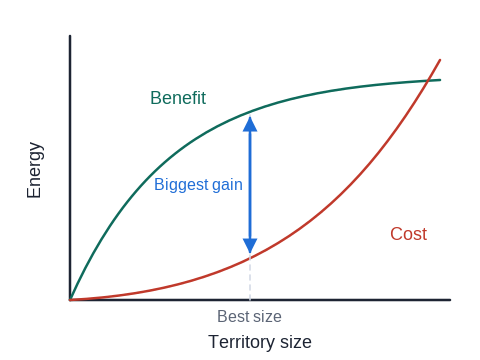
- Benefits include a reliable food supply, a safe nest site and mates attracted to a good territory; costs are the energy and time spent defending and the risk of injury.
- A larger territory holds more food, but the benefit levels off while defence costs keep climbing as the border gets longer and intruders more frequent.
- Territories are only worth defending when the resource is valuable and predictable enough; tūī defend a single flowering kōwhai, but leave it once the flowers are gone.
Example: why a robin defends its patch
- Toutouwai (North Island and South Island robins) live in pairs that defend the same territory of about one to a few hectares of forest all year round.
- Males sing long bouts from perches at the edges, especially in spring, and chase intruders; neighbours that know each other's boundaries rarely fight.
- Process: song and display signal ownership. Response: intruders turn back, so the owners keep a known patch with insects in the leaf litter. Advantage: the pair can feed chicks quickly in the breeding season and survive winter on a food supply they know well.
- The cost is the energy of singing and chasing, which is why disputes between familiar neighbours are settled by song rather than fights.
Dominance hierarchies
- A hierarchy ranks individuals in a group, so higher-ranked ones get first access to food, shelter and mates.
- Rank is set and kept by agonistic behaviour: threats, displays and submission signals, with real fights mostly between animals of similar strength.
- Red deer stags in the autumn roar compete by roaring contests and parallel walks, judging each other's size and stamina; only closely matched stags lock antlers.
- Ritualised contests reduce injury for both: the loser keeps its life and can breed later, and the winner avoids wounds; even low-ranked animals gain group protection from predators.
Cooperation and kin selection
- Cooperative behaviours include group hunting, alarm calls, mobbing predators and helping to raise young that are not your own.
- Pūkeko often live in groups with several breeding adults sharing one nest, and helpers, usually young from earlier seasons, incubate eggs and feed the chicks.
- Helping relatives is explained by kin selection: an individual can pass on copies of its alleles through relatives' offspring as well as its own.
- Hamilton's rule says helping is favoured when r × B > C, where r is the relatedness to those helped, B the extra offspring they raise and C the offspring the helper gives up.
Example: should a young pūkeko help or breed?
- A young pūkeko can stay and help its parents, adding 1.2 surviving full siblings, or leave and breed alone in poor habitat, raising on average 0.4 surviving chicks of its own.
- Its relatedness to its full siblings is 0.5. Use Hamilton's rule to decide whether helping is favoured.
- r × B = 0.5 × 1.2 = 0.6relatedness × extra siblings raised
- C = 0.4 chicks given up by not breedingthe helper's own offspring, not multiplied by r
- 0.6 > 0.4, so r × B > C and helping is favoured
- in good habitat with a territory free, breeding alone could win
Try it: compete, defend or help?
Courtship
- Courtship displays make sure the mate is the right species, show the mate's quality, synchronise both partners' breeding condition, and in pairs that stay together, build the pair bond.
- Tākapu (Australasian gannets) at Muriwai greet their partner with sky-pointing, bowing and fencing bills, rituals that keep the same pair together across seasons.
- Kākāpō males gather on ridges in a lek, each digging a track-and-bowl system and booming at night for months; females walk in, listen and choose a male, then raise the chicks alone.
- Displays that are costly to produce, such as nights of booming, are honest signals: only males in good condition can keep them up, so females choosing them get good genes for their chicks.
Mating systems
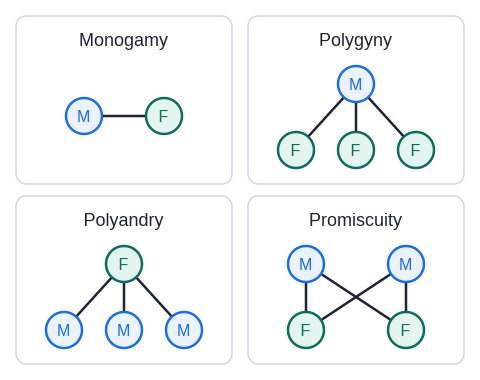
- Monogamy (one male, one female) is favoured when chicks need two parents: toroa (royal albatross) pairs stay together for life and share a year-long breeding effort.
- Polygyny (one male, several females) happens when a male can control females or the places they gather: kekeno (fur seal) bulls hold beach territories holding several females.
- Polyandry (one female, several males) is rare and usually means males do most of the parental care.
- In promiscuity both sexes mate with several partners; pūkeko groups and hihi, where many chicks are fathered by males outside the pair, show how mixed real systems can be.
Try it: name the mating system
Writing the Excellence answer
- Describe the behaviour, then explain how it happens (the process: what signal, what response), then why it helps (survival or reproduction), and link that to this species' niche.
- Give the cost as well as the benefit and say why the benefit is bigger in this situation; comparing with the alternative, such as living alone, is often the link that earns Excellence.
- Name the selective advantage in genetic terms: individuals with the behaviour leave more offspring, so the alleles for it become more common.
- Use the example's details: the species, its food, its predators and what the question tells you, rather than a general answer that would fit any animal.
What Achieved, Merit and Excellence look like
- The three answers below are to the same question; each grade adds the next link in the chain.
| Grade | A model answer |
|---|---|
| Achieved | The robin sings and chases other robins away so it keeps its own area with food in it. |
| Merit | Singing from the edge of its territory warns other males the area is taken, so they turn away without a fight. The pair keeps the insects in that patch, so it has enough food to feed its chicks. |
| Excellence | Robins feed on insects in the leaf litter, which are spread evenly and available all year, so a fixed patch can be defended cheaply and supplies food in every season. Song signals ownership and lets known neighbours settle boundaries without fighting, keeping the cost low. A male with a territory attracts a mate and can feed chicks close to the nest, so he raises more young than a male without one, and the alleles for territorial behaviour spread. |
Common mistakes
- Helpers raise their siblings for the good of the species.Kin selection works at the level of alleles: helping relatives passes on copies of the helper's own alleles.
- Low-ranked animals gain nothing from a hierarchy.They avoid costly fights, keep group protection from predators and may rise in rank and breed later.
- A territory is wherever an animal lives and feeds.That is a home range; a territory is the part that is actively defended against others of the same species.
- The kākāpō male booms so that it attracts a female.Say why that works: booming is costly, so only fit males can keep it up, and females choosing them get chicks with better survival.
Record a pecking order
You need: a bird bath, feeder or lawn where birds feed, a notebook and pen, binoculars, if you have them, a phone timer
- Sit quietly 5 to 10 metres from a place where several birds of one species, such as sparrows or mynas, feed together.
- For 20 minutes, record every displacement: one bird flies or hops at another and the other moves away.
- If birds have marks you can tell apart (a missing feather, a pale patch), give each a letter; otherwise record which species or which sex won.
- Make a table of winners against losers and count wins for each bird.
- Look for: a clear order where A displaces B, B displaces C and so on, and fewer contests once the order is settled.
Safety: Do not handle wild birds or their droppings, and wash your hands if you touch a bird bath or feeder.
Your turn
Tadpoles in a drying puddle all feed on the same algae until it runs out. Is this scramble or contest competition?
A helper raises 2 extra full siblings (r = 0.5), or could breed alone and raise 0.6 chicks. Use Hamilton's rule to decide whether helping is favoured.
Why do most red deer contests end in roaring and walking rather than antler fights?
A kekeno bull holds a beach territory where several females give birth and mate with him. Name the mating system.
State Hamilton's rule and say what each letter stands for.
Show answer
1. Scramble competition: no tadpole defends the algae; all share it until it runs out. 2. r × B = 0.5 × 2 = 1.0, and C = 0.6 chicks given up; 1.0 > 0.6, so helping is favoured. 3. Ritualised displays let stags judge each other's strength, so the weaker one withdraws without injury and the winner avoids wounds; fights happen only between closely matched stags. 4. Polygyny. 5. r × B > C: r is the relatedness to the individuals helped, B the extra offspring they raise because of the help, and C the offspring the helper gives up.
Exam-style question: kākāpō leks
- Kākāpō breed only in years when rimu trees fruit heavily. In those summers males walk to ridgetops, each clears a track-and-bowl system, and booms from its bowl for up to eight hours a night for three to four months. Females travel several kilometres to the lek, mate with one male and raise the chicks alone.
Describe what a lek is and identify the mating system shown.
Explain how booming leads to a female choosing a male.
Discuss why lek mating gives an advantage to the females and to the successful males, compared with males that do not display.
Show answer
1. A lek is a gathering of males at display sites, where they compete only by display and females come to choose; males give no parental care, and a few males mate with many females, so it is a form of polygyny (Achieved). 2. The bowl acts as an amplifier, so the low-frequency boom carries several kilometres at night and leads females to the lek; females compare booming males and choose one, probably on how long and how strongly he can keep booming (Merit). 3. Booming for months costs a male a lot of body fat, so only males in the best condition can keep it up: it is an honest signal. Females raise chicks alone in a rare mast year, so choosing a high-quality male gives chicks better genes for survival; they gain nothing else from males. Successful males father many chicks while weak or silent males father none, so alleles for strong booming spread despite the cost (Excellence links signal, choice and reproductive success).
Recap
- Competition within a species is scramble (shared out) or contest (won by some); territories and hierarchies are contests.
- Defend a territory only when the benefit outweighs the rising cost; ritualised displays keep contests cheap.
- Kin selection explains helping relatives: help when r × B > C.
- Courtship and mating systems follow who cares for the young; Excellence links process, response and reproductive advantage.
| Behaviour | Advantage to the individual | Cost |
|---|---|---|
| Territory | Reliable food and nest site, attracts mates | Energy and risk of defence |
| Hierarchy | Fewer fights, group protection | Low rank eats and breeds last |
| Helping kin | Alleles passed on through relatives | Own breeding delayed |
| Lek display | Many matings for the fittest males | Months of costly booming |
Challenge
A tūī can defend a patch of flowering harakeke of 1 to 5 units of area. The nectar it gets each day from a patch of 1, 2, 3, 4 and 5 units is 100, 160, 200, 220 and 230 kJ. With the usual number of intruders, defending costs 25 kJ per unit of area per day. A tūī that defends nothing and roams between plants gets a net 70 kJ per day. (a) Which patch size gives the greatest net gain, and is defending worth it? (b) In a year when many tūī crowd into the area, intruders double and the defence cost becomes 50 kJ per unit per day. Find the best patch size now and decide whether the tūī should still defend. (c) Explain the pattern in terms of costs and benefits.
Hint
Net gain = nectar gained minus defence cost for each size. Then compare the best net gain with the 70 kJ a roaming bird gets.
Answer
(a) 3 units, net 125 kJ per day, which beats 70 kJ, so defend. (b) Best is 2 units, net 60 kJ per day, which is less than 70 kJ, so the tūī should stop defending and roam. (c) Nectar gained levels off as the patch grows while defence cost keeps rising, so the best size is moderate; when intruders increase, the cost rises for every size, the best territory shrinks, and at high density no territory pays, so contest gives way to scramble competition.
Step by step
- Work out net gain for each size: nectar minus cost.
- Pick the largest net gain and compare it with the roaming bird's 70 kJ.
- Repeat with the doubled cost.
- The benefit curve flattens while the cost line keeps climbing, so the peak moves to a smaller size as cost rises.
- When even the peak is below the roaming value, defending loses, so territoriality breaks down at high density.
Full working
- usual cost: 100 − 25 = 75, 160 − 50 = 110, 200 − 75 = 125, 220 − 100 = 120, 230 − 125 = 105net gain in kJ per day for 1 to 5 units
- best = 125 kJ at 3 units, and 125 > 70defending pays
- doubled cost: 100 − 50 = 50, 160 − 100 = 60, 200 − 150 = 50, 220 − 200 = 20, 230 − 250 = −20net gain with twice the intruders
- best = 60 kJ at 2 units, and 60 < 70roaming now gives more
- rising cost shrinks the best territory, then makes defence not worth itwhy territories break down when crowded
- (a) defend 3 units, 125 kJ per day; (b) best 2 units at 60 kJ, below 70 kJ, so stop defending
In a pūkeko group, the breeding female mates with several males, so a young helper's nest-mates are a mix: 40% are its full siblings (r = 0.5) and 60% are half-siblings (r = 0.25). If it stays and helps, the group raises 1.5 extra surviving chicks. If it leaves, it has a 0.6 chance of winning a territory, and with one it raises 1.2 surviving chicks on average. (a) Find the helper's average relatedness to the chicks it helps. (b) Use Hamilton's rule in the form r × B > C to decide whether helping is favoured. (c) What is the smallest percentage of full siblings among the chicks that would make helping favoured? (d) Explain what this suggests about how the mating system affects cooperative breeding.
Hint
Average r is a weighted mean of 0.5 and 0.25. The cost C is the chicks it would expect to raise by leaving, so include the chance of getting a territory.
Answer
(a) r = 0.35. (b) r × B = 0.525 and C = 0.72, so 0.525 < 0.72 and leaving is favoured. (c) More than 92% full siblings. (d) When the female mates with several males, the helper's relatedness to the chicks falls, so kin selection gives less benefit; helping is most strongly favoured when parents are monogamous (all chicks full siblings) or when the chance of breeding alone is very poor.
Step by step
- Average the relatedness, weighting by the share of each kind of sibling.
- Multiply by the extra chicks raised to get r × B.
- C is the expected chicks given up: chance of a territory times chicks raised with one.
- For (c), find the r that makes r × B equal C, then find the mix of siblings that gives that r.
- Mating with several males lowers r, which weakens the kin-selected advantage of helping.
Full working
- r = 0.4 × 0.5 + 0.6 × 0.25 = 0.20 + 0.15 = 0.35weighted mean relatedness
- r × B = 0.35 × 1.5 = 0.525benefit in the rule
- C = 0.6 × 1.2 = 0.72expected chicks given up by not leaving
- 0.525 < 0.72Hamilton's rule not met, so leaving is favoured
- need r > 0.72 ÷ 1.5 = 0.48r needed for helping
- 0.25 + 0.25f > 0.48, so f > 0.92f = fraction of full siblings
- (a) 0.35; (b) leave, since 0.525 < 0.72; (c) more than 92% full siblings
Model kākāpō males at a lek in a rimu mast year. A male in good condition can boom strongly all season: he averages 4 matings, but the fat he burns lowers his chance of surviving to the next mast year to 0.7. If he booms weakly, he averages 0.5 matings and his survival is 0.9. Each mating leads to 1.5 fledged chicks. Assume a surviving male gets the same result in the next mast year, and count only these two years. (a) Find the expected chicks for a good-condition male using each strategy. (b) A male in poor condition cannot keep strong booming going: if he tries, he stops before females arrive, gets no matings, and his survival falls to 0.5; next mast year he can only boom weakly. Booming weakly, his results are the same as a good male booming weakly. Which strategy should he use? (c) Use your answers to explain why booming is an honest signal and why female choice spreads the alleles for strong booming.
Hint
Expected chicks = chicks this year + (chance of surviving × chicks next year). Work out the poor male's two options separately.
Answer
(a) Strong booming 10.2 chicks; weak booming 1.425 chicks. (b) Weak booming: 1.425 chicks, against only 0.375 if he tries strong booming. (c) Strong booming pays only for males in good condition; for a poor male the cost is too high, so he does better booming weakly. Because only fit males can afford to boom strongly, the boom reliably shows condition (an honest signal). Females choosing strong boomers get chicks fathered by high-quality males, those males father many more chicks, and alleles for strong booming and for the preference become more common.
Step by step
- For each strategy, add this year's chicks to next year's chicks multiplied by the survival chance.
- The good male gains far more by booming strongly despite the higher risk of death.
- The poor male gets nothing this year if he tries and fails, and is more likely to die.
- So each male's best choice depends on his condition, and the signal cannot be faked cheaply.
- Selection then favours alleles for strong booming in fit males and for choosing such males in females.
Full working
- strong: 4 × 1.5 = 6 chicks this yeargood male
- 6 + 0.7 × 6 = 6 + 4.2 = 10.2 chicksadding the next mast year
- weak: 0.5 × 1.5 = 0.75; 0.75 + 0.9 × 0.75 = 1.425 chicksgood or poor male booming weakly
- poor male trying strong: 0 + 0.5 × 0.75 = 0.375 chicksno matings now, weak booming next time
- 0.375 < 1.425the poor male should boom weakly
- (a) strong 10.2, weak 1.425; (b) weak booming, 1.425 against 0.375; strong booming is affordable only for fit males, so it is honest
Report a mistake
How is NCEA Level 3 maths going?
See the NCEA Level 3 maths guide