Modern physics: photons, energy levels and the nucleus
What this lesson covers
- How this internal is assessed, and what lifts an answer from Achieved to Excellence.
- Photons: E = hf = hc/λ, and energies in joules and electronvolts.
- The photoelectric effect, the work function and threshold frequency, and why it shows light behaves as particles.
- The Bohr model of hydrogen, energy levels, ionisation, and emission and absorption line spectra.
- The strong interaction, mass defect and binding energy, and why both fission and fusion release energy.
- Wave-particle duality for light and for electrons, with the de Broglie wavelength λ = h/p.
How this internal works
- Your school assesses this standard, usually with a written test or task in class on situations you have not met before, using the formulas and constants it gives you.
- Achieved shows awareness of a simple facet: a correct calculation or a correct statement about what happens.
- Merit explains: it says why, using the model (photons, energy levels, binding energy) in a full chain of reasoning.
- Excellence connects ideas: for example linking photon energy, the work function and energy conservation to explain exactly what an experiment shows and what it rules out.
Photons and the electronvolt
- Light is emitted and absorbed in packets called photons; each carries energy E = hf = hc/λ, where h = 6.63 × 10⁻³⁴ J s is Planck's constant.
- Higher frequency (shorter wavelength) means more energy per photon: a 300 nm ultraviolet photon has more than twice the energy of a 650 nm red one.
- Atomic energies are tiny in joules, so we also use the electronvolt: 1 eV = 1.60 × 10⁻¹⁹ J, the energy an electron gains across 1 V.
- Brighter light of the same colour means more photons per second, not more energetic photons.
Try it: photon energy across the spectrum
The photoelectric effect
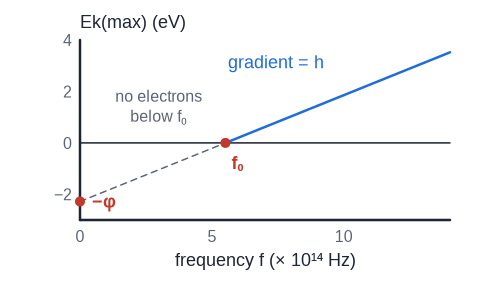
- Light on a clean metal surface can eject electrons, but only if its frequency is above a threshold f₀ for that metal; below f₀ nothing comes off, however bright the light.
- Above f₀ electrons come off at once, even in very dim light, and their maximum kinetic energy rises with frequency but not with brightness.
- A wave model predicts the opposite (bright light of any colour should work, given time), so these results show light arrives as photons.
- Each electron absorbs one photon: Ek(max) = hf − φ, where the work function φ is the least energy needed to free an electron from the surface, and φ = hf₀.
- Brighter light gives more photons, so more electrons per second and a bigger current, but the same maximum energy for each.
Try it: change the work function
Example: ultraviolet on sodium
- Light of wavelength 300 nm falls on sodium, which has a work function of 2.28 eV.
- Find the photon energy, the maximum kinetic energy of the electrons and the threshold wavelength.
- E = hc ÷ λ = (6.63 × 10⁻³⁴ × 3.00 × 10⁸) ÷ (300 × 10⁻⁹) = 6.63 × 10⁻¹⁹ J
- φ = 2.28 × 1.60 × 10⁻¹⁹ = 3.648 × 10⁻¹⁹ Jconvert eV to J before subtracting
- Ek(max) = 6.63 × 10⁻¹⁹ − 3.648 × 10⁻¹⁹ = 2.98 × 10⁻¹⁹ J = 1.86 eV
- f₀ = φ ÷ h = 3.648 × 10⁻¹⁹ ÷ 6.63 × 10⁻³⁴ = 5.50 × 10¹⁴ Hz
- λ₀ = c ÷ f₀ = 3.00 × 10⁸ ÷ 5.50 × 10¹⁴ = 5.45 × 10⁻⁷ m = 545 nmgreen light or anything bluer will work
Energy levels and line spectra
- In the Bohr model the electron in a hydrogen atom can only have certain energies, En = −13.6/n² eV, with n = 1 the ground state.
- The energies are negative because the electron is bound: 0 eV means just free, so 13.6 eV is the ionisation energy of hydrogen from the ground state.
- An electron dropping from a higher level to a lower one emits a single photon with exactly the energy difference: hf = E_upper − E_lower.
- Because only certain differences exist, a hot gas emits only certain wavelengths: a line spectrum, a fingerprint of the element.
- Shine white light through a cool gas and it absorbs the same wavelengths, lifting electrons up: dark lines in a continuous spectrum, which is how we know what the Sun is made of.
Example: hydrogen's red line
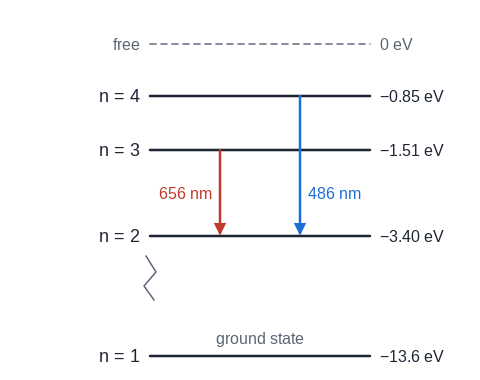
- An electron in hydrogen falls from n = 3 to n = 2.
- Find the energy of the photon in eV and in J, and its wavelength.
- E₃ = −13.6 ÷ 9 = −1.51 eV, E₂ = −13.6 ÷ 4 = −3.40 eV
- ΔE = −1.51 − (−3.40) = 1.89 eV
- ΔE = 1.89 × 1.60 × 10⁻¹⁹ = 3.02 × 10⁻¹⁹ J
- λ = hc ÷ ΔE = 1.989 × 10⁻²⁵ ÷ 3.02 × 10⁻¹⁹ = 6.58 × 10⁻⁷ m
- λ = 658 nm, red
- the measured line is 656 nm; the small gap comes from rounding h, c and the energies
Binding energy and mass defect
- Protons in a nucleus repel each other electrically (Coulomb repulsion), but the strong interaction, a very short-range attraction between all nucleons, holds the nucleus together.
- A nucleus has less mass than its separate protons and neutrons; this mass defect Δm is the binding energy, by E = Δmc², the energy needed to pull it apart.
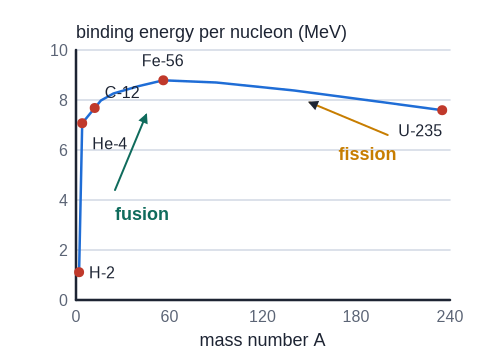
- Binding energy per nucleon shows how tightly each nucleon is held; it peaks near iron-56 at about 8.8 MeV.
- Any reaction that moves nuclei towards the peak releases energy: splitting a heavy nucleus (fission) or joining light ones (fusion).
- Mass-energy is conserved: the products have less mass than the reactants, and the missing mass appears as kinetic energy of the products and as gamma rays.
Example: binding energy of helium-4
- A helium-4 nucleus has a mass of 4.00151 u. A proton has a mass of 1.00728 u and a neutron 1.00866 u, with 1 u = 1.661 × 10⁻²⁷ kg.
- Find the mass defect, the binding energy and the binding energy per nucleon.
- separate nucleons: 2 × 1.00728 + 2 × 1.00866 = 4.03188 u
- Δm = 4.03188 − 4.00151 = 0.03037 u = 0.03037 × 1.661 × 10⁻²⁷ = 5.044 × 10⁻²⁹ kg
- E = Δmc² = 5.044 × 10⁻²⁹ × (3.00 × 10⁸)² = 4.54 × 10⁻¹² J
- in MeV: 4.54 × 10⁻¹² ÷ 1.60 × 10⁻¹³ = 28.4 MeV1 MeV = 1.60 × 10⁻¹³ J
- per nucleon: 28.4 ÷ 4 = 7.1 MeV
Fission and fusion
- Fission: a slow neutron is absorbed by uranium-235, which splits into two medium nuclei and two or three neutrons, releasing about 200 MeV; the neutrons can trigger further splits in a chain reaction.
- Fusion: very light nuclei such as deuterium and tritium join to make helium-4 and a neutron, releasing 17.6 MeV; it needs temperatures of tens of millions of degrees or more so the nuclei move fast enough to get close despite their repulsion.
- Per kilogram of fuel, fusion releases several times more energy than fission, because the binding energy curve rises so steeply at the light end.
- The Sun runs on fusion; nuclear power stations run on fission, though Aotearoa New Zealand has never built one.
| Fission | Fusion | |
|---|---|---|
| Nuclei | one heavy splits | two light join |
| Example | U-235 + n → Ba-141 + Kr-92 + 3n | H-2 + H-3 → He-4 + n |
| Energy per reaction | about 200 MeV | 17.6 MeV |
| Why energy is released | products nearer the iron peak | product far higher on the curve |
Try it: fission or fusion?
Wave-particle duality
- Light interferes and diffracts like a wave (the double slit), but is emitted and absorbed in photons like particles (the photoelectric effect); it needs both models.
- De Broglie proposed that matter behaves the same way, with wavelength λ = h/p = h/(mv); electrons fired at a crystal diffract into rings, confirming it.
- An electron at 2.00 × 10⁶ m s⁻¹ has λ = 6.63 × 10⁻³⁴ ÷ (9.11 × 10⁻³¹ × 2.00 × 10⁶) = 3.64 × 10⁻¹⁰ m, about the spacing of atoms, which is why crystals diffract electrons.
- Electron microscopes use this: electron wavelengths are many thousands of times shorter than visible light, so they resolve far finer detail.
- Which behaviour you see depends on the experiment: travelling and interfering, the wave model; arriving and transferring energy, the particle model.
Example: one question at three grades
- Question: red light, however bright, ejects no electrons from zinc, but dim ultraviolet does. Explain why.
- Notice how Excellence ties together photon energy, the one-photon-one-electron rule and the work function, and says why brightness cannot help.
| Grade | A model answer |
|---|---|
| Achieved | Red light's frequency is below zinc's threshold frequency, so no electrons are emitted. |
| Merit | Light comes as photons with E = hf. A red photon has less energy than zinc's work function, so it cannot free an electron; an ultraviolet photon has more, so it can. |
| Excellence | Each electron absorbs a single photon, of energy hf. A red photon's energy is less than zinc's work function, so no electron gets enough to escape. Brighter red light only means more photons, each still too weak, and an electron cannot add the energy of two. Ultraviolet photons each carry more than the work function, so even dim UV ejects electrons at once, with Ek = hf − φ. |
Common mistakes
- Brighter light gives the photoelectrons more kinetic energy.Brightness changes the number of photons; each electron's maximum energy depends only on frequency, Ek = hf − φ.
- Ek = 6.63 × 10⁻¹⁹ − 2.28 = 6.63 × 10⁻¹⁹ J.Put both in the same unit first: 2.28 eV = 3.65 × 10⁻¹⁹ J, then subtract.
- The electron drops from n = 3 to n = 2, so the photon has 13.6 ÷ 3 − 13.6 ÷ 2 eV.Levels go as 1/n²: E₃ − E₂ = −13.6/9 − (−13.6/4) = 1.89 eV.
- Fission releases energy because the nucleus has extra energy stored in it.The products have greater binding energy per nucleon, so less total mass; the missing mass becomes energy.
See line spectra with a CD
You need: an old CD or DVD, a fluorescent or compact fluorescent lamp if you have one, an ordinary LED torch or bulb, a darkened room
- Stand about 2 m from a fluorescent lamp in a darkened room and hold the CD close to your eye, tilted so you see the lamp's light reflected off the shiny side.
- Tilt it until the colours spread out beside the reflection, then look closely for bright separate lines in green, orange and violet.
- Do the same with a white LED torch shone at a wall, looking at the patch of light on the wall rather than the torch.
- Compare the two spectra and sketch where the bright lines are.
- Look for: the fluorescent lamp shows sharp bright lines (from atoms in the lamp, mainly mercury, dropping between energy levels) on top of its glow, while the LED gives a smooth band of colour.
Safety: Never look at the Sun or straight into an LED torch through the disc, because focused bright light can damage your eyes.
Your turn
Find the energy in joules of a 450 nm photon. Use h = 6.63 × 10⁻³⁴ J s and c = 3.00 × 10⁸ m s⁻¹.
Give that energy in electronvolts.
Those photons fall on a metal with a work function of 2.10 eV. Find the electrons' maximum kinetic energy in eV.
An electron in hydrogen falls from n = 4 to n = 2. Find the photon energy in eV.
The deuterium nucleus has a mass defect of 0.002388 u. Find its binding energy in MeV, using 1 u = 931.5 MeV.
Show answer
1. E = hc ÷ λ = 1.989 × 10⁻²⁵ ÷ 450 × 10⁻⁹ = 4.42 × 10⁻¹⁹ J. 2. 4.42 × 10⁻¹⁹ ÷ 1.60 × 10⁻¹⁹ = 2.76 eV. 3. Ek(max) = 2.76 − 2.10 = 0.66 eV. 4. E₄ = −13.6 ÷ 16 = −0.85 eV, E₂ = −3.40 eV, so ΔE = −0.85 − (−3.40) = 2.55 eV (a blue-green line at 486 nm). 5. E = 0.002388 × 931.5 = 2.22 MeV.
Rutherford Scattering
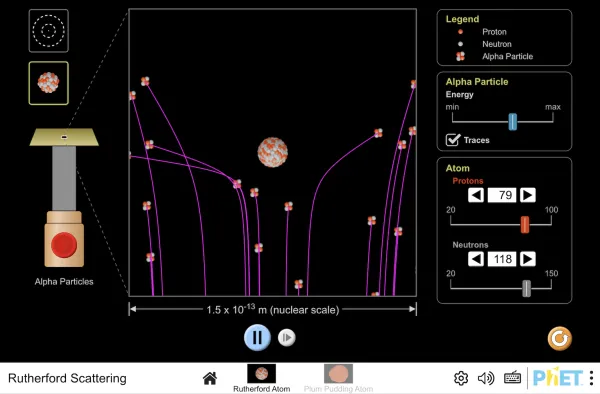
Full screen · PhET Interactive Simulations, University of Colorado Boulder, CC BY 4.0
Recap
- Photons: E = hf = hc/λ; brightness is the number of photons, frequency is the energy of each.
- Photoelectric effect: one photon per electron, Ek(max) = hf − φ, nothing below f₀ however bright.
- Hydrogen: En = −13.6/n² eV; each drop between levels emits one photon of the energy difference, giving line spectra.
- Binding energy = Δmc²; fission and fusion both move nuclei towards the iron peak and release energy.
- Light and electrons are both waves and particles: λ = h/p.
| Formula | Use it for |
|---|---|
| E = hf = hc/λ | photon energy |
| Ek(max) = hf − φ | photoelectric effect |
| En = −13.6/n² eV | hydrogen energy levels |
| E = Δmc² | binding energy, energy released |
| λ = h/p | de Broglie wavelength |
Challenge
A tube of hydrogen gas, with every atom in the ground state, is lit with ultraviolet photons of one single energy. Afterwards the gas is seen to emit exactly six different wavelengths of light. Find the level the electrons were lifted to, the energy and wavelength of the absorbed photons, and how many of the six emitted lines are visible (400 nm to 700 nm). Use En = −13.6n² eV, h = 6.63 × 10⁻³⁴ J s, c = 3.00 × 10⁸ m s⁻¹ and 1 eV = 1.60 × 10⁻¹⁹ J.
Hint
An electron in level n can fall back down by many routes, one jump at a time or several at once. Count how many different jumps are possible from level 2, then level 3, then level 4, until you reach six.
Answer
Level n = 4; the photons carry 12.75 eV (97.5 nm, ultraviolet); two of the six lines are visible, at about 488 nm (4 to 2) and 658 nm (3 to 2).
Step by step
- Every pair of levels from the ground state up to the top level gives one possible jump, so one line.
- From n = 2 there is 1 pair, from n = 3 there are 3, from n = 4 there are 6, so the electrons reached n = 4.
- The absorbed photon must supply exactly E₄ − E₁, which is 12.75 eV, an ultraviolet wavelength of 97.5 nm.
- Work out the wavelength of each of the six jumps with λ = hc ÷ ΔE.
- Jumps ending on n = 1 are ultraviolet, 4 to 3 is infrared, and only 4 to 2 and 3 to 2 land between 400 nm and 700 nm.
Full working
- pairs of levels: n = 2 gives 1, n = 3 gives 3, n = 4 gives 6each pair of levels is one possible line
- top level n = 4six lines observed
- E₄ = −13.6 ÷ 16 = −0.85 eV, E₁ = −13.6 eVEn = −13.6n² eV
- ΔE = −0.85 − (−13.6) = 12.75 eV = 12.75 × 1.60 × 10⁻¹⁹ = 2.04 × 10⁻¹⁸ Jenergy of absorbed photon
- λ = hc ÷ ΔE = 1.989 × 10⁻²⁵ ÷ 2.04 × 10⁻¹⁸ = 9.75 × 10⁻⁸ m = 97.5 nmultraviolet
- 4 to 1: 97.5 nm; 3 to 1: 103 nm; 2 to 1: 122 nmall ultraviolet
- 4 to 3: ΔE = 0.661 eV, λ = 1880 nminfrared
- 4 to 2: ΔE = 2.55 eV, λ = 488 nm; 3 to 2: ΔE = 1.89 eV, λ = 658 nmboth visible
- n = 4, 12.75 eV, 97.5 nm; two visible lines, 488 nm and 658 nm
Light of wavelength 300 nm and then light of wavelength 400 nm is shone on the same clean metal surface. The fastest photoelectrons from the 300 nm light have exactly three times the kinetic energy of the fastest photoelectrons from the 400 nm light. Find the work function of the metal in eV, the maximum kinetic energy for each wavelength, and the threshold wavelength. Use h = 6.63 × 10⁻³⁴ J s, c = 3.00 × 10⁸ m s⁻¹ and 1 eV = 1.60 × 10⁻¹⁹ J.
Hint
Write Ek(max) = hf − φ for each wavelength, with the same unknown φ in both. The ratio gives you one equation with only φ unknown.
Answer
φ = 2.59 eV; Ek(max) = 1.55 eV at 300 nm and 0.518 eV at 400 nm; threshold wavelength 480 nm.
Step by step
- Find each photon's energy in eV from E = hc ÷ λ.
- Each fastest electron has the photon's energy minus the same work function.
- Setting the 300 nm value equal to three times the 400 nm value leaves one equation in φ.
- Solve for φ, then subtract it from each photon energy as a check that the ratio is 3.
- The threshold wavelength is the wavelength whose photon energy equals φ exactly.
Full working
- hc = 6.63 × 10⁻³⁴ × 3.00 × 10⁸ = 1.989 × 10⁻²⁵ J mnumerator for every photon energy
- E₃₀₀ = 1.989 × 10⁻²⁵ ÷ 300 × 10⁻⁹ = 6.63 × 10⁻¹⁹ J = 4.144 eVdivide by 1.60 × 10⁻¹⁹
- E₄₀₀ = 1.989 × 10⁻²⁵ ÷ 400 × 10⁻⁹ = 4.97 × 10⁻¹⁹ J = 3.108 eVsame method
- 4.144 − φ = 3(3.108 − φ)Ek(max) = hf − φ, ratio 3
- 4.144 − φ = 9.324 − 3φ, so 2φ = 5.180 and φ = 2.59 eVsolve
- Ek(300) = 4.144 − 2.590 = 1.55 eV; Ek(400) = 3.108 − 2.590 = 0.518 eV1.554 ÷ 0.518 = 3.00, checks
- λ₀ = hc ÷ φ = 1.989 × 10⁻²⁵ ÷ (2.59 × 1.60 × 10⁻¹⁹) = 4.80 × 10⁻⁷ mphoton energy equal to φ
- φ = 2.59 eV; 1.55 eV and 0.518 eV; λ₀ = 480 nm
In a fusion reactor a deuterium nucleus (2.01355 u) and a tritium nucleus (3.01550 u), almost at rest, fuse to make a helium-4 nucleus (4.00151 u) and a neutron (1.00866 u). Find the energy released in MeV, how much of it the neutron carries away as kinetic energy, and the neutron's de Broglie wavelength. Use 1 u = 931.5 MeV = 1.661 × 10⁻²⁷ kg, 1 MeV = 1.60 × 10⁻¹³ J and h = 6.63 × 10⁻³⁴ J s.
Hint
Start with the mass defect. Then remember that the reactants have almost no momentum, so the helium nucleus and the neutron fly apart with equal and opposite momentum p. Kinetic energy can be written as Ek = p² ÷ (2m), so the lighter particle takes the bigger share.
Answer
17.6 MeV released; the neutron carries about 14.0 MeV; its de Broglie wavelength is about 7.64 × 10⁻¹⁵ m.
Step by step
- The products have less mass than the reactants; that mass defect times 931.5 MeV per u is the energy released.
- Momentum before is almost zero, so the two products have momenta of equal size in opposite directions.
- With equal p, Ek = p² ÷ (2m) means the kinetic energies are in the inverse ratio of the masses, so the neutron gets 4.00151 ÷ 5.01017 of the total.
- Convert the neutron's energy to joules, find its momentum from p = √(2mEk), then use λ = h ÷ p.
- The wavelength is about the size of a nucleus, far smaller than an atom.
Full working
- mass before = 2.01355 + 3.01550 = 5.02905 u; mass after = 4.00151 + 1.00866 = 5.01017 uadd each side
- Δm = 5.02905 − 5.01017 = 0.01888 umass defect
- E = 0.01888 × 931.5 = 17.59 MeV1 u = 931.5 MeV
- p(He) = p(n), so Ek(n) ÷ Ek(He) = m(He) ÷ m(n)Ek = p² ÷ (2m) with equal p
- Ek(n) = 17.59 × 4.00151 ÷ 5.01017 = 14.05 MeVthe rest, 3.54 MeV, goes to the helium
- Ek(n) = 14.05 × 1.60 × 10⁻¹³ = 2.247 × 10⁻¹² J; m(n) = 1.00866 × 1.661 × 10⁻²⁷ = 1.675 × 10⁻²⁷ kgSI units
- p = √(2 × 1.675 × 10⁻²⁷ × 2.247 × 10⁻¹²) = 8.68 × 10⁻²⁰ kg m s⁻¹p = √(2mEk)
- λ = h ÷ p = 6.63 × 10⁻³⁴ ÷ 8.68 × 10⁻²⁰ = 7.64 × 10⁻¹⁵ mde Broglie
- 17.6 MeV released; neutron 14.0 MeV; λ ≈ 7.64 × 10⁻¹⁵ m
Report a mistake
How is NCEA Level 3 maths going?
See the NCEA Level 3 maths guide