Interference, double slits and diffraction gratings

What this lesson covers
- Superposition of waves from two coherent sources, and path difference and phase difference at any point.
- Bright or loud points where the two paths differ by a whole number of wavelengths, dark or quiet points where they differ by a half number.
- The double slit: nλ = dx/L, where d is the slit separation, x the distance from the central maximum and L the distance to the screen.
- The diffraction grating: nλ = d sin θ, the highest order possible, and why grating maxima are brighter and sharper.
- White light through a grating, and the A, M and E steps of an exam answer about interference.
Superposition and coherent sources
- When two waves meet, the displacement at each point is the sum of the two displacements: crest on crest makes a bigger crest, crest on trough cancels.
- A steady pattern needs coherent sources: the same frequency and a constant phase difference, such as two speakers driven by one signal generator, or two slits lit by one laser.
- At a point P the path difference is the difference in distance from the two sources, |S₁P − S₂P|.
- If the sources are in phase and the path difference is nλ (0, λ, 2λ...), the waves arrive in phase (phase difference 0° or 360°) and interfere constructively: loud sound or bright light.
- If the path difference is (n + ½)λ, they arrive 180° out of phase and interfere destructively: quiet or dark.
Two sources and a listener
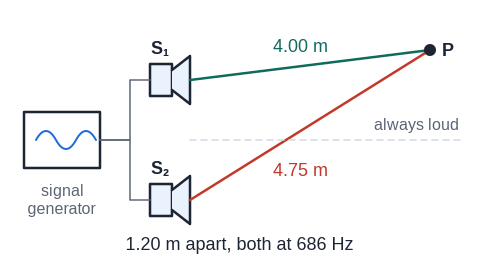
- Two speakers 1.20 m apart are driven in phase by one signal generator at 686 Hz, and sound travels at 343 m s⁻¹.
- Walking past the speakers you hear loud and quiet regions in turn, because the path difference changes smoothly from point to point.
- The central line, equally far from both speakers, is always loud: path difference zero.
Try it: loud or quiet?
Example: loud or quiet?
- With the speakers above, a listener P is 4.00 m from S₁ and 4.75 m from S₂.
- Decide whether P is loud or quiet, and find the lowest frequency that would make P loud.
- λ = v ÷ f = 343 ÷ 686 = 0.500 m
- path difference = 4.75 − 4.00 = 0.75 m
- 0.75 ÷ 0.500 = 1.5 wavelengthsa half number: the waves arrive 180° out of phase
- P is quiet (destructive interference)
- loud needs 0.75 m = nλ; largest λ is 0.75 m (n = 1), so f = 343 ÷ 0.75 = 457 Hz
The double slit: nλ = dx/L
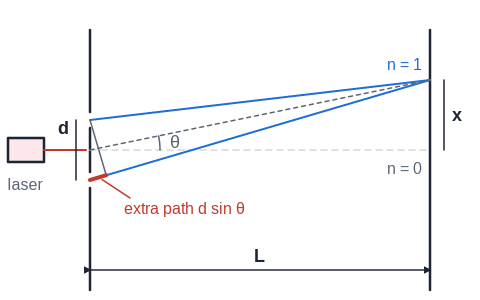
- Light from a laser passes through two narrow slits a distance d apart; each slit acts as a new source, in phase with the other.
- For a point on the screen at angle θ, the path difference is d sin θ; when that equals nλ there is a bright fringe.
- The screen is far away compared with x, so sin θ ≈ tan θ = x/L, giving nλ = dx/L, where x is the distance from the central maximum to the nth bright fringe.
- Neighbouring bright fringes are evenly spaced, Δx = λL/d, so longer wavelengths, a further screen or closer slits all spread the fringes out.
- The approximation only holds for small angles, which is true for a double slit (fringes a few mm apart on a screen metres away).
Example: measuring a laser's wavelength
- A laser shines on two slits 0.250 mm apart. On a screen 2.00 m away, the bright fringes are 5.20 mm apart.
- Find the wavelength, and how far the 4th-order maximum is from the centre.
- d = 0.250 × 10⁻³ m, x = 5.20 × 10⁻³ m for n = 1, L = 2.00 mconvert every length to metres first
- λ = dx ÷ (nL) = (0.250 × 10⁻³ × 5.20 × 10⁻³) ÷ (1 × 2.00)
- λ = 6.50 × 10⁻⁷ m = 650 nmred light
- 4th order: x = nλL ÷ d = 4 × 5.20 mm = 20.8 mm
- θ = tan⁻¹(0.0208 ÷ 2.00) = 0.60°, small enough for sin θ ≈ tan θ
Try it: change λ, d and L
Diffraction gratings: nλ = d sin θ
- A diffraction grating has hundreds of slits per millimetre; d is the gap between neighbouring slits, so 600 lines per mm gives d = 1 ÷ 600 000 = 1.67 × 10⁻⁶ m.
- Bright maxima appear where light from every pair of neighbouring slits has a path difference of nλ, so nλ = d sin θ; the angles are large, so do not use x/L.
- With many slits, a direction only slightly off the exact angle gives small phase shifts that add up along the grating, so each slit's wave is cancelled by one further along: the maxima are very narrow with wide dark gaps between them.
- More slits also let more light through, so the maxima are much brighter than a double slit's fringes, and the smaller d spreads them much further apart.
- Sin θ cannot be more than 1, so the highest order is the whole number part of d ÷ λ, and the number of maxima is 2n + 1 including the central one.
Example: a green laser and a 600 lines per mm grating
- A 532 nm green laser shines through a grating with 600 lines per mm.
- Find the angles of the maxima and how many there are.
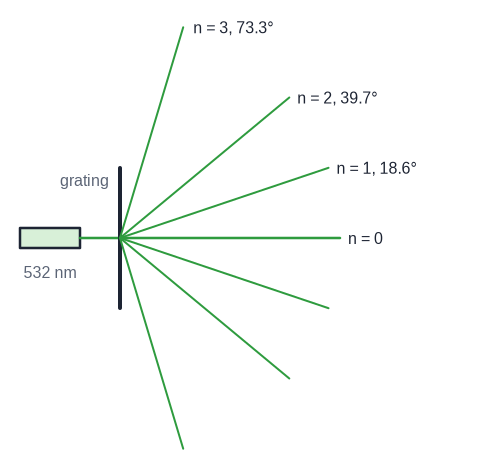
- d = 1 ÷ (600 × 10³) = 1.667 × 10⁻⁶ m
- n = 1: sin θ = 532 × 10⁻⁹ ÷ 1.667 × 10⁻⁶ = 0.3192, θ = 18.6°
- n = 2: sin θ = 0.6384, θ = 39.7°
- n = 3: sin θ = 0.9576, θ = 73.3°
- n = 4: sin θ = 1.277, more than 1no such angle
- d ÷ λ = 3.13, so orders up to 3: 2 × 3 + 1 = 7 maxima
Try it: fringes and beams
White light and real gratings
- Each colour has its own angle, so white light makes a white central maximum (every colour has zero path difference there) with a spectrum on each side, violet nearest the centre and red furthest out.
- Higher orders spread the colours more, and the second and third order spectra overlap, because 3 × 400 nm = 1200 nm is less than 2 × 700 nm = 1400 nm.
- Astronomers and chemists use gratings to measure wavelengths very precisely, which is how the lines in a star's spectrum are identified.
- A CD or DVD acts as a reflection grating: its tracks are 1.6 µm apart (CD) or 0.74 µm apart (DVD), so a DVD spreads the colours further.
| Double slit | Diffraction grating | |
|---|---|---|
| Number of slits | 2 | hundreds per mm |
| Equation | nλ = dx/L (small angles) | nλ = d sin θ |
| Maxima | broad, evenly spaced, dimmer | sharp, bright, far apart |
| Use | showing light is a wave | measuring wavelengths |
What Achieved, Merit and Excellence look like
- Achieved states a correct fact or does one calculation step; Merit explains with path difference or phase; Excellence links path difference, phase and superposition to the exact pattern seen.
- Use the words the marker looks for: path difference, in phase, out of phase, superpose, constructive, destructive.
| Grade | A model answer |
|---|---|
| Achieved | Bright fringes are where the light from the two slits interferes constructively and dark fringes are where it interferes destructively. |
| Merit | At a bright fringe the two paths differ by a whole number of wavelengths, so the waves arrive in phase; at a dark fringe they differ by a half number, so the waves arrive out of phase. |
| Excellence | The slits act as coherent sources in phase. Where the path difference is nλ the waves arrive in phase (phase difference 0° or 360°) and superpose to give a larger amplitude: bright. Where it is (n + ½)λ they arrive 180° out of phase, crest meets trough and they cancel: dark. The path difference changes steadily across the screen, so the fringes alternate. |
Common mistakes
- For a grating, sin θ = x/L, so I used nλ = dx/L at 40°.x/L is only a small-angle approximation; for a grating find θ from nλ = d sin θ, then x = L tan θ if needed.
- The grating has 600 lines per mm, so d = 600 mm.d is the gap between lines: 1 ÷ 600 mm = 1.67 × 10⁻³ mm = 1.67 × 10⁻⁶ m.
- d ÷ λ = 3.13, so there are 3 maxima.There are 3 orders on each side plus the central maximum: 7 in all.
- Dark fringes are where no light reaches the screen from the slits.Light from both slits arrives there, but 180° out of phase, so the waves cancel.
Split light with a CD or DVD
You need: an old CD or DVD, a phone torch or a white LED torch, a sheet of white paper, a darkened room
- In a dark room, shine the torch onto the shiny side of the disc so the reflection lands on the white paper or a pale wall.
- Tilt the disc slowly until coloured bands appear beside the bright white reflection.
- Note the order of colours from the white spot outwards, and look for a second, wider set of colours further out.
- If you have both, repeat with a CD and a DVD from the same distance and compare how far the colours spread.
- Look for: violet nearest the white reflection and red furthest out, and the DVD's colours spread much further, because its tracks are closer together (smaller d gives bigger θ).
Safety: Never point the torch or the disc's reflection into anyone's eyes, and do not use a laser pointer, because a reflected laser beam can damage the retina.
Your turn
Two speakers in phase emit sound of wavelength 0.40 m. At point P the path difference is 1.00 m. Is P loud or quiet?
Light of wavelength 600 nm passes through slits 0.300 mm apart onto a screen 1.50 m away. Find the fringe spacing.
Find the slit spacing d of a grating with 300 lines per mm.
Yellow light of 589 nm shines on that grating. Find the angle of the second-order maximum.
What is the highest order maximum that grating gives for 589 nm light?
Show answer
1. 1.00 ÷ 0.40 = 2.5 wavelengths, a half number, so P is quiet (destructive interference). 2. Δx = λL ÷ d = (600 × 10⁻⁹ × 1.50) ÷ (0.300 × 10⁻³) = 3.00 × 10⁻³ m = 3.00 mm. 3. d = 1 ÷ (300 × 10³) = 3.33 × 10⁻⁶ m. 4. sin θ = 2 × 589 × 10⁻⁹ ÷ 3.333 × 10⁻⁶ = 0.3534, θ = 20.7°. 5. d ÷ λ = 3.333 × 10⁻⁶ ÷ 589 × 10⁻⁹ = 5.66, so the 5th order (n = 6 would need sin θ greater than 1).
Exam-style question: a grating on the lab wall
- Aroha shines a red laser of wavelength 635 nm through a diffraction grating with 500 lines per mm, onto a wall 1.50 m from the grating. The wall is wide enough to catch every beam.
Calculate the angle of the first-order maximum.
Calculate the distance on the wall from the central maximum to the first-order maximum.
Explain why the first-order maximum is bright.
Aroha changes to a violet laser of wavelength 405 nm. Describe and explain how the pattern changes, including how many maxima there are.
Show answer
1. d = 1 ÷ (500 × 10³) = 2.00 × 10⁻⁶ m; sin θ = 635 × 10⁻⁹ ÷ 2.00 × 10⁻⁶ = 0.3175, θ = 18.5° (Achieved). 2. The angle is too large for x = nλL ÷ d, so x = L tan θ = 1.50 × tan 18.5° = 1.50 × 0.3348 = 0.502 m (Merit; Achieved if the small-angle formula gives 0.476 m). 3. At that angle light from each slit travels exactly one wavelength further than light from the slit next to it, so all the waves arrive in phase and superpose constructively, and because so many slits add together the maximum is bright (Merit for path difference and phase, Excellence for linking to superposition from many slits). 4. With a shorter wavelength, sin θ = nλ ÷ d is smaller, so every maximum moves closer to the centre. The highest order rises: for red d ÷ λ = 3.15, so 3 orders and 7 maxima; for violet d ÷ λ = 4.94, so 4 orders and 9 maxima (Excellence for the explanation and both counts).
Wave Interference
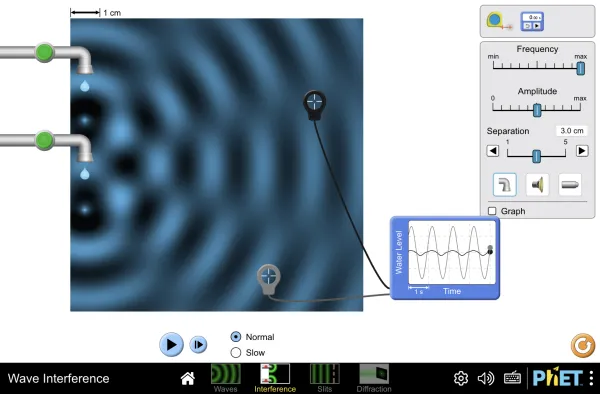
Full screen · PhET Interactive Simulations, University of Colorado Boulder, CC BY 4.0
Recap
- Coherent sources: path difference nλ gives constructive interference, (n + ½)λ gives destructive.
- Double slit: nλ = dx/L for small angles; fringe spacing λL/d.
- Grating: nλ = d sin θ with d = 1 ÷ lines per metre; highest order is the whole part of d/λ; maxima = 2n + 1.
- Grating maxima are sharper, brighter and further apart than double slit fringes.
- Convert nm and mm to metres before you substitute.
| Formula | Use it for |
|---|---|
| path difference = nλ | constructive (in phase) |
| path difference = (n + ½)λ | destructive (180° out of phase) |
| nλ = dx/L | double slit, small angles |
| nλ = d sin θ | diffraction grating, any angle |
Challenge
A violet laser of wavelength 420 nm and a red laser of unknown wavelength shine through the same diffraction grating at the same time, onto a curved screen wide enough to catch every beam. The second-order red beam lands exactly on top of the third-order violet beam, at 39.1° from the centre. (a) Find the red wavelength. (b) Find the number of lines per mm on the grating. (c) How many separate bright spots appear on the screen altogether?
Hint
Two beams in the same direction have the same sin θ, so nλ is the same for both. For (c), count each laser's maxima using d ÷ λ, then work out which spots are shared by both lasers so you do not count them twice.
Answer
(a) 630 nm. (b) d = 2.00 × 10⁻⁶ m, so 500 lines per mm. (c) Red gives 7 maxima and violet 9; the centre and the two red 2nd-order and violet 3rd-order spots are shared, so 7 + 9 − 3 = 13 separate spots.
Step by step
- Same angle means the same d sin θ, so 2 × λ(red) = 3 × 420 nm.
- Use the violet 3rd order and the angle to find d, then turn d into lines per mm.
- Red: d ÷ λ = 3.17, so orders up to 3, giving 7 maxima. Violet: d ÷ λ = 4.76, so orders up to 4, giving 9 maxima.
- Spots coincide only when n × 630 = m × 420, that is 3n = 2m: the centre (n = m = 0) and n = 2, m = 3 on each side.
- So 3 spots are shared and must be counted once.
Full working
- 2 λ(red) = 3 × 420 nm, λ(red) = 630 nmsame angle, so same nλ
- d = 3 × 420 × 10⁻⁹ ÷ sin 39.1° = 1.26 × 10⁻⁶ ÷ 0.6307 = 2.00 × 10⁻⁶ mnλ = d sin θ for violet
- lines per mm = 1 ÷ (2.00 × 10⁻³ mm) = 500d in mm
- red: 2.00 × 10⁻⁶ ÷ 630 × 10⁻⁹ = 3.17, so n up to 3, 2 × 3 + 1 = 7 maximahighest order
- violet: 2.00 × 10⁻⁶ ÷ 420 × 10⁻⁹ = 4.76, so m up to 4, 2 × 4 + 1 = 9 maximahighest order
- 630n = 420m gives 3n = 2m: (0, 0) and (2, 3) on each sideshared spots: 3
- 630 nm; 500 lines per mm; 7 + 9 − 3 = 13 spots
Rawiri sets up a double slit with slits 0.400 mm apart, lit by a laser, but he forgets to measure how far the screen is from the slits. He counts 10 bright fringes, and the distance from the centre of the first one to the centre of the tenth is 21.6 mm. He then moves the screen 0.600 m further from the slits and finds that the fringe spacing has grown by 0.960 mm. (a) Find the wavelength of the laser. (b) Find the original distance from the slits to the screen. (c) Find the fringe spacing after the move.
Hint
The fringe spacing is λL ÷ d. If L changes by ΔL, the spacing changes by λ ΔL ÷ d, and the unknown L drops out. Careful with the count: how many gaps are there between 10 fringes?
Answer
(a) λ = 640 nm. (b) The spacing was 2.40 mm (9 gaps, not 10), so L = 1.50 m. (c) 3.36 mm.
Step by step
- The spacing λL ÷ d is proportional to L, so a change ΔL in L changes the spacing by λ ΔL ÷ d.
- That gives λ = d × (change in spacing) ÷ ΔL, without needing L.
- Ten bright fringes have nine gaps between them, so the original spacing is 21.6 ÷ 9 = 2.40 mm.
- Then L = d × spacing ÷ λ.
- After the move the spacing is 2.40 + 0.960 = 3.36 mm, which matches λ × 2.10 ÷ d.
Full working
- Δ(spacing) = λ ΔL ÷ dspacing = λL ÷ d, d and λ fixed
- λ = d × Δ(spacing) ÷ ΔL = (0.400 × 10⁻³ × 0.960 × 10⁻³) ÷ 0.600 = 6.40 × 10⁻⁷ mL not needed
- spacing = 21.6 ÷ 9 = 2.40 mm10 fringes, 9 gaps
- L = d × spacing ÷ λ = (0.400 × 10⁻³ × 2.40 × 10⁻³) ÷ 6.40 × 10⁻⁷ = 1.50 mrearranged spacing formula
- new spacing = 6.40 × 10⁻⁷ × 2.10 ÷ 0.400 × 10⁻³ = 3.36 × 10⁻³ mL is now 2.10 m; check 2.40 + 0.960 = 3.36
- λ = 640 nm; L = 1.50 m; new spacing 3.36 mm
Two small speakers S₁ and S₂ are 0.900 m apart, driven by one signal generator but wired so that they are always exactly 180° out of phase. Sound travels at 343 m s⁻¹. (a) Explain why every point on the line exactly halfway between the speakers (equally far from both) is quiet. (b) At 686 Hz, how many quiet points are there on the straight line between S₁ and S₂, and how far from S₁ is each? (c) Mere stands 3.00 m from S₁ along the line through S₁ at 90° to S₁S₂. Find the lowest frequency at which she hears a loud sound.
Hint
Because the sources start half a cycle apart, the usual rules swap: a path difference of nλ now gives destructive interference and (n + ½)λ gives constructive. On the line between the speakers, a point x from S₁ has path difference (0.900 − x) − x.
Answer
(a) Zero path difference, but the waves set off 180° out of phase, so they still arrive 180° out of phase: crest meets trough and they cancel. (b) 3 quiet points, at 0.200 m, 0.450 m and 0.700 m from S₁. (c) Path difference 0.1321 m must be λ ÷ 2, so f = 1.30 × 10³ Hz (1298 Hz).
Step by step
- Out-of-phase sources swap the rules: nλ path difference is quiet, (n + ½)λ is loud.
- On the halfway line the path difference is zero, so the waves keep their 180° phase difference and cancel.
- At 686 Hz, λ = 0.500 m. Between the speakers the path difference 0.900 − 2x runs from −0.900 m to 0.900 m, so it can be −0.500, 0 or 0.500 m: three quiet points.
- For Mere, S₂ is √(0.900² + 3.00²) = 3.1321 m away, so the path difference is 0.1321 m.
- Loud needs (n + ½)λ; the lowest frequency means the longest wavelength, n = 0, so λ = 2 × 0.1321 m.
Full working
- path difference 0, phase difference 180° at the sourceso they arrive 180° out of phase: quiet
- λ = 343 ÷ 686 = 0.500 mwavelength at 686 Hz
- path difference = (0.900 − x) − x = 0.900 − 2xpoint x from S₁
- 0.900 − 2x = 0.500, 0, −0.500 gives x = 0.200, 0.450, 0.700 mquiet needs nλ here; ±1.000 m is outside the gap
- S₂ to Mere = √(0.900² + 3.00²) = √9.81 = 3.1321 mright angle at S₁
- path difference = 3.1321 − 3.00 = 0.1321 mdifference in distances
- λ = 2 × 0.1321 = 0.2642 m, f = 343 ÷ 0.2642 = 1298 Hzloud needs ½λ for the lowest frequency
- (b) 3 quiet points at 0.200, 0.450, 0.700 m; (c) f = 1.30 × 10³ Hz
The maths behind it
Report a mistake
How is NCEA Level 3 maths going?
See the NCEA Level 3 maths guide