Oxidation-reduction: electrode potentials and cells

What this lesson covers
- Oxidation numbers, and balancing half-equations and overall equations in acid.
- Standard reduction potentials, E°: what they measure and how they rank oxidants and reductants.
- Calculating E°cell and using its sign to predict whether a reaction is spontaneous.
- Electrochemical (galvanic) cells: electrodes, electron flow, the salt bridge and cell diagrams.
- Electrolytic cells, where a power supply drives a non-spontaneous reaction, and how they differ from galvanic cells.
Oxidation numbers, oxidants and reductants
- Oxidation is loss of electrons, seen as a rise in oxidation number. Reduction is gain of electrons, seen as a fall. The oxidant is reduced; the reductant is oxidised.
- Oxidation numbers: elements are 0, simple ions equal their charge, O is −2 (−1 in peroxides), H is +1 with non-metals, and the total equals the charge on the particle.
- In S₂O₃²⁻: 2x + 3(−2) = −2, so each S is +2. In MnO₄⁻, Mn is +7; in Cr₂O₇²⁻, each Cr is +6.
- Write the sign first (+7) for an oxidation number, and last (2+) for an ion's charge.
Try it: electrons moving
Example: dichromate and iodide
- Acidified potassium dichromate is added to potassium iodide solution. The orange solution turns dark brown. Write both half-equations and the balanced overall equation.
- Balance each half-equation in acid in this order: the main atom, O with H₂O, H with H⁺, then charge with electrons.
- Cr₂O₇²⁻ → 2Cr³⁺two Cr each side
- Cr₂O₇²⁻ + 14H⁺ → 2Cr³⁺ + 7H₂O7 O need 7 H₂O, so 14 H⁺
- Cr₂O₇²⁻ + 14H⁺ + 6e⁻ → 2Cr³⁺ + 7H₂Ocharge +12 on the left and +6 on the right, so 6e⁻
- 2I⁻ → I₂ + 2e⁻, × 3match six electrons
- Cr₂O₇²⁻ + 14H⁺ + 6I⁻ → 2Cr³⁺ + 3I₂ + 7H₂O
- charge: −2 + 14 − 6 = +6 on the left, 2 × 3 = +6 on the right
- brown is I₂ forming; it hides the green of Cr³⁺link to the observation
Standard reduction potentials
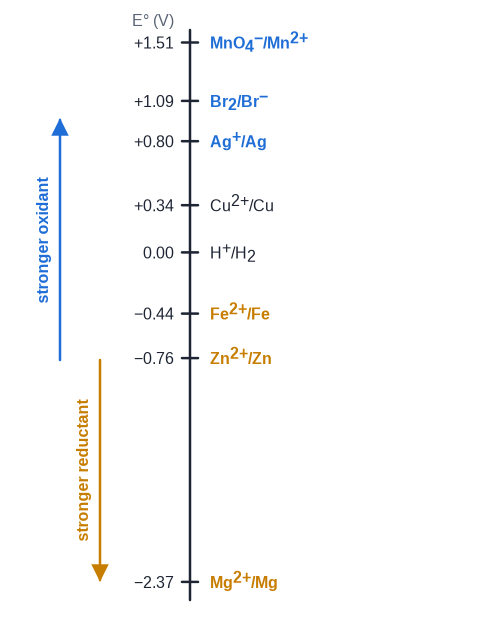
- Each half-cell is written as a reduction, such as Cu²⁺ + 2e⁻ ⇌ Cu, and its standard reduction potential, E°, is measured against the standard hydrogen electrode, set at 0.00 V.
- Standard conditions are 1 mol L⁻¹ solutions, 25 °C and 100 kPa for gases.
- The more positive E° is, the more the left-hand species wants electrons, so the stronger the oxidant. The more negative E° is, the more readily the right-hand species gives electrons away, so the stronger the reductant.
- E° does not depend on how many moles are in the equation, so it is never multiplied when a half-equation is.
| Half-equation | E° (V) |
|---|---|
| MnO₄⁻ + 8H⁺ + 5e⁻ ⇌ Mn²⁺ + 4H₂O | +1.51 |
| Cl₂ + 2e⁻ ⇌ 2Cl⁻ | +1.36 |
| Cr₂O₇²⁻ + 14H⁺ + 6e⁻ ⇌ 2Cr³⁺ + 7H₂O | +1.33 |
| O₂ + 4H⁺ + 4e⁻ ⇌ 2H₂O | +1.23 |
| Br₂ + 2e⁻ ⇌ 2Br⁻ | +1.09 |
| Ag⁺ + e⁻ ⇌ Ag | +0.80 |
| Fe³⁺ + e⁻ ⇌ Fe²⁺ | +0.77 |
| I₂ + 2e⁻ ⇌ 2I⁻ | +0.54 |
| Cu²⁺ + 2e⁻ ⇌ Cu | +0.34 |
| 2H⁺ + 2e⁻ ⇌ H₂ | 0.00 |
| Pb²⁺ + 2e⁻ ⇌ Pb | −0.13 |
| Fe²⁺ + 2e⁻ ⇌ Fe | −0.44 |
| Zn²⁺ + 2e⁻ ⇌ Zn | −0.76 |
| 2H₂O + 2e⁻ ⇌ H₂ + 2OH⁻ | −0.83 |
| Mg²⁺ + 2e⁻ ⇌ Mg | −2.37 |
How an electrochemical cell works
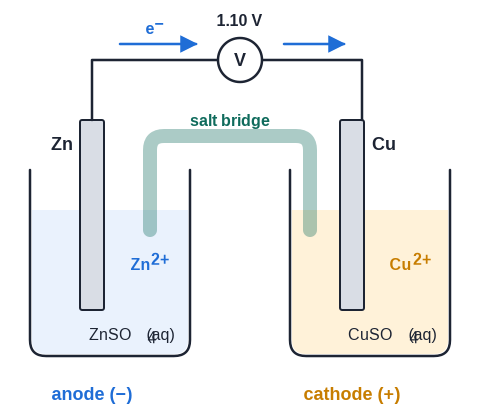
- An electrochemical (galvanic) cell keeps the oxidant and reductant apart, so the electrons have to travel through an external wire, where they can do work.
- Oxidation happens at the anode, the negative electrode: Zn → Zn²⁺ + 2e⁻. Reduction happens at the cathode, the positive electrode: Cu²⁺ + 2e⁻ → Cu. Electrons flow through the wire from anode to cathode.
- The salt bridge, such as filter paper soaked in KNO₃, lets ions move to keep each beaker electrically neutral: anions drift towards the anode beaker and cations towards the cathode beaker. Without it the current stops at once.
- A cell diagram puts the anode on the left: Zn(s) | Zn²⁺(aq) || Cu²⁺(aq) | Cu(s). A single line is a phase boundary; the double line is the salt bridge.
- If neither species in a half-cell is a metal, as in Fe³⁺/Fe²⁺, an inert platinum or graphite electrode carries the electrons: Pt(s) | Fe²⁺(aq), Fe³⁺(aq).
Example: E°cell for two cells
- Calculate E°cell for (a) Zn(s) | Zn²⁺(aq) || Cu²⁺(aq) | Cu(s) and (b) a cell made from Mg | Mg²⁺ and Ag⁺ | Ag half-cells, and write the overall equation for (b).
- E°cell = E°(cathode, where reduction happens) − E°(anode, where oxidation happens).
- (a) E°cell = E°(Cu²⁺/Cu) − E°(Zn²⁺/Zn) = +0.34 − (−0.76)
- (a) E°cell = +1.10 V
- (b) Ag⁺/Ag (+0.80) is more positive, so Ag⁺ is reduced at the cathode; Mg is oxidised at the anode
- (b) E°cell = +0.80 − (−2.37) = +3.17 V
- Ag⁺ + e⁻ → Ag (× 2) and Mg → Mg²⁺ + 2e⁻match electrons; E° is not doubled
- (b) Mg + 2Ag⁺ → Mg²⁺ + 2Ag
- both E°cell values are positive, so both cells run spontaneously as written
Predicting whether a reaction happens
- Write the proposed reaction as a reduction half and an oxidation half, look up both E° values, and calculate E°cell = E°(reduced) − E°(oxidised).
- If E°cell is positive, the reaction is spontaneous under standard conditions. If it is negative, it is not, but the reverse reaction is.
- On a table in this order, a species on the left reacts spontaneously with any species on the right that sits below it.
- A positive E°cell does not mean the reaction is fast; some spontaneous reactions are too slow to see. And under non-standard conditions, such as very dilute solutions, the cell potential differs from E°cell.
Try it: spontaneous or not?
Example: three predictions
- Predict whether (a) chlorine water oxidises bromide ions, (b) iodine oxidises bromide ions, and (c) acidified permanganate oxidises chloride ions. Then explain why permanganate titrations are acidified with sulfuric acid, not hydrochloric acid.
- (a) Cl₂ reduced, Br⁻ oxidised: E°cell = +1.36 − (+1.09) = +0.27 V
- (a) yes: Cl₂ + 2Br⁻ → 2Cl⁻ + Br₂; the colourless solution turns orange
- (b) I₂ reduced, Br⁻ oxidised: E°cell = +0.54 − (+1.09) = −0.55 V
- (b) no reaction
- (c) MnO₄⁻ reduced, Cl⁻ oxidised: E°cell = +1.51 − (+1.36) = +0.15 V
- (c) yes: some permanganate would be used up oxidising Cl⁻ to Cl₂, so the titre would be too large
- dichromate with Cl⁻: +1.33 − (+1.36) = −0.03 V, so dichromate can be acidified with HCl
Electrolytic cells
- In an electrolytic cell a power supply pushes electrons to make a non-spontaneous reaction happen, one with a negative E°cell. The supply must provide at least that voltage.
- Oxidation still happens at the anode, but here the anode is the positive electrode; reduction happens at the cathode, which is negative.
- In molten NaCl the only ions are Na⁺ and Cl⁻: sodium metal forms at the cathode and chlorine gas at the anode.
- In water, water itself competes. At the cathode, the species with the most positive E° is reduced: Cu²⁺ (+0.34) is reduced before water (−0.83), but Na⁺ (−2.71) is not, so H₂ forms instead. At the anode, water is oxidised to O₂ unless a more easily oxidised ion is present in high concentration.
- At Tiwai Point in Southland, aluminium is made by electrolysis of aluminium oxide dissolved in molten cryolite. With E° = −1.66 V for Al³⁺/Al, aluminium is too strong a reductant to be freed from its ore by heating with carbon, as iron is.
Galvanic and electrolytic cells compared
- Both kinds of cell have oxidation at the anode and reduction at the cathode. What changes is the sign of each electrode and where the energy comes from.
| Galvanic cell | Electrolytic cell | |
|---|---|---|
| Reaction | spontaneous, E°cell > 0 | non-spontaneous, E°cell < 0 |
| Energy | chemical to electrical | electrical to chemical |
| Anode (oxidation) | negative | positive |
| Cathode (reduction) | positive | negative |
| Example | zinc-copper cell, discharging battery | making aluminium, charging a battery |
Try it: run the cell
How this internal standard is assessed
- AS 91393 is assessed by your school, not in the exam. Your teacher sets a task, often a set of practical observations such as metals in solutions, cells you build and measure, or an electrolysis, followed by written questions.
- You explain what you saw using half-equations, overall equations, E° values and E°cell calculations. Calculations are limited to electrode potentials.
- Schools set their own conditions, but the written part is usually done in class under supervision, with an E° table supplied. If your teacher allows it, one resubmission can fix a small error; it is not a second attempt at the whole task.
- The grade depends on how well you link processes, observations, equations and calculations, not on how much you write.
Example: a cell task, worked
- A class built three cells, each with a Cu | Cu²⁺ half-cell joined to a different metal half-cell, and measured their voltages. Explain the results.
- Their results: Zn cell 1.04 V, Fe cell 0.74 V, Pb cell 0.44 V.
- E°cell(Zn) = +0.34 − (−0.76) = +1.10 VCu²⁺ is reduced in every cell
- E°cell(Fe) = +0.34 − (−0.44) = +0.78 V
- E°cell(Pb) = +0.34 − (−0.13) = +0.47 V
- same order as measured: the more negative the metal's E°, the stronger a reductant it is and the bigger the voltage
- each measured value is 0.03 to 0.06 V low: the solutions were not exactly 1 mol L⁻¹, the metal surfaces were oxidised, and the meter draws a little current
- in every cell the metal is the negative anode and copper the positive cathode; copper is plated onto the Cu electrode
What lifts it to Merit and Excellence
- Achieved describes processes and does the calculations. Merit explains links between what was seen, the equations and the E° values. Excellence compares and justifies, explaining why one process happens and another does not.
| Grade | A model answer |
|---|---|
| Achieved | Silver forms on the copper in AgNO₃ and the solution turns blue. Nothing happens in Pb(NO₃)₂. Cu + 2Ag⁺ → Cu²⁺ + 2Ag. |
| Merit | With Ag⁺, E°cell = +0.80 − (+0.34) = +0.46 V, so the reaction is spontaneous: Cu is oxidised to blue Cu²⁺ and Ag⁺ is reduced to grey silver crystals. With Pb²⁺, E°cell = −0.13 − (+0.34) = −0.47 V, so there is no reaction. |
| Excellence | Ag⁺ (+0.80 V) is a stronger oxidant than Cu²⁺ (+0.34 V), so it can take electrons from Cu: Cu → Cu²⁺ + 2e⁻ and Ag⁺ + e⁻ → Ag, overall Cu + 2Ag⁺ → Cu²⁺ + 2Ag, E°cell = +0.46 V. Grey-silver crystals grow on the wire and the colourless solution turns blue as Cu²⁺ forms. Pb²⁺ (−0.13 V) is a weaker oxidant than Cu²⁺, so it cannot oxidise Cu; E°cell = −0.47 V is negative and nothing is seen. The reverse, Pb reducing Cu²⁺, would be spontaneous. |
Common mistakes
- For Mg + 2Ag⁺, E°cell = 2(+0.80) − (−2.37) = +3.97 V.E° values are never multiplied by the coefficients: E°cell = +0.80 − (−2.37) = +3.17 V.
- The anode is always the positive electrode.The anode is where oxidation happens: negative in a galvanic cell, positive in an electrolytic cell.
- Electrons flow through the salt bridge.Electrons flow only in the wire; ions move through the salt bridge to keep each half-cell neutral.
- E°cell is positive, so the reaction will happen quickly.A positive E°cell shows the reaction is spontaneous, not that it is fast.
Split water with two AA batteries
You need: 2 AA batteries, sticky tape, 2 pencils sharpened at both ends, kitchen foil, baking soda, a clear glass of warm tap water, a teaspoon
- Stir a teaspoon of baking soda into the glass of water.
- Tape the two batteries end to end, positive to negative. Fold two strips of foil into thin wires and tape one to each end of the battery pair.
- Wrap the other end of each foil strip tightly around the top lead of a pencil.
- Stand both pencils in the water with their lower tips apart, and look closely at the tips for two minutes.
- Look for: bubbles stream from both tips, about twice as many from the pencil joined to the negative end. That is the cathode, where water is reduced to H₂; at the anode water is oxidised to O₂. The batteries supply the energy for a reaction that would not happen on its own.
Safety: Use baking soda, never salt, because salt water makes chlorine gas; and never let the two foil strips touch, because that shorts the batteries and makes them hot.
Your turn
Find the oxidation number of S in S₂O₃²⁻.
Calculate E°cell for Mg(s) | Mg²⁺(aq) || Cu²⁺(aq) | Cu(s).
Will Fe³⁺ oxidise I⁻? Give E°cell.
In the zinc-copper cell, which electrode is the anode, and which way do electrons flow in the wire?
CuSO₄(aq) is electrolysed with graphite electrodes. What forms at each electrode?
Show answer
1. 2x + 3(−2) = −2, so S = +2. 2. E°cell = +0.34 − (−2.37) = +2.71 V. 3. Yes: E°cell = +0.77 − (+0.54) = +0.23 V, positive, so 2Fe³⁺ + 2I⁻ → 2Fe²⁺ + I₂ is spontaneous. 4. Zinc is the anode (oxidised, negative); electrons flow from the zinc to the copper. 5. Copper at the cathode (Cu²⁺ is reduced before water) and oxygen gas at the anode (water is oxidised).
Recap
- Balance half-equations: main atom, then H₂O, then H⁺, then electrons; match electrons to combine.
- Higher E° means a stronger oxidant; lower E° means a stronger reductant.
- E°cell = E°(reduction) − E°(oxidation); positive means spontaneous. Never multiply E° values.
- Galvanic cells turn a spontaneous reaction into electricity; electrolytic cells use electricity to force a non-spontaneous one. Oxidation is always at the anode.
| Term | Meaning |
|---|---|
| Anode | where oxidation happens |
| Cathode | where reduction happens |
| Salt bridge | lets ions move to keep each half-cell neutral |
| E°cell > 0 | spontaneous under standard conditions |
Challenge
A strip of an unknown metal X, which forms X²⁺ ions, is used in the cell X(s) | X²⁺(aq) || Ag⁺(aq) | Ag(s). Under standard conditions the voltmeter reads 1.03 V, with the X electrode negative. (a) Find E° for X²⁺ + 2e⁻ ⇌ X. (b) Use your value and the E° table to predict whether X reacts with 1 mol L⁻¹ Pb²⁺(aq), with 1 mol L⁻¹ Fe²⁺(aq) and with 1 mol L⁻¹ H⁺(aq), giving E°cell each time and what would be seen. (c) X is now joined to a Zn | Zn²⁺ half-cell instead. Which electrode is the anode, what is E°cell, and write the cell diagram.
Hint
The negative electrode is the anode, so X is oxidised and Ag⁺ is reduced: 1.03 = E°(cathode) − E°(anode). Once you know E° for X, X can only give electrons to a species whose E° is more positive than its own.
Answer
(a) E° = −0.23 V (b) Pb²⁺: yes, E°cell = +0.10 V, grey lead coats X; Fe²⁺: no, E°cell = −0.21 V; H⁺: yes, E°cell = +0.23 V, bubbles of H₂ and X dissolves (c) zinc is the anode, E°cell = +0.53 V, Zn(s) | Zn²⁺(aq) || X²⁺(aq) | X(s)
Step by step
- X is the negative electrode, so it is the anode and is oxidised; Ag⁺ is reduced at the cathode.
- E°cell = E°(cathode) − E°(anode), so E°(X) = +0.80 − 1.03 = −0.23 V.
- X (−0.23 V) can reduce any oxidant with a more positive E°: Pb²⁺ (−0.13 V) and H⁺ (0.00 V), but not Fe²⁺ (−0.44 V).
- Against zinc (−0.76 V) the roles swap: zinc is the stronger reductant, so zinc is oxidised and X²⁺ is reduced.
- So X is the positive electrode in the zinc cell, though it was the negative one in the silver cell: whether a metal is anode or cathode depends on its partner.
Full working
- 1.03 = E°(Ag⁺, Ag) − E°(X²⁺, X) = +0.80 − E°(X²⁺, X)X is the anode
- E°(X²⁺, X) = +0.80 − 1.03 = −0.23 Vrearrange
- Pb²⁺ + X → Pb + X²⁺: E°cell = −0.13 − (−0.23) = +0.10 Vpositive, spontaneous
- Fe²⁺ + X → Fe + X²⁺: E°cell = −0.44 − (−0.23) = −0.21 Vnegative, no reaction
- 2H⁺ + X → H₂ + X²⁺: E°cell = 0.00 − (−0.23) = +0.23 Vpositive, H₂ bubbles
- zinc cell: E°cell = −0.23 − (−0.76) = +0.53 VX²⁺ reduced, Zn oxidised
- (a) −0.23 V (b) Pb²⁺ yes (+0.10 V), Fe²⁺ no (−0.21 V), H⁺ yes (+0.23 V) (c) Zn anode, E°cell = +0.53 V
A solution contains AgNO₃, Cu(NO₃)₂ and Mg(NO₃)₂, each at 1 mol L⁻¹. It is electrolysed with graphite electrodes while the supply voltage is raised slowly from zero. Nitrate ions are not oxidised. Use the E° table and treat all conditions as standard. (a) What forms at the anode? (b) List, in order, what forms at the cathode as the voltage rises, and the minimum supply voltage at which each starts. (c) Write the overall equation for the first stage. (d) Explain why magnesium never forms, however high the voltage, and how magnesium metal could be made instead.
Hint
At the cathode the species with the most positive E° is reduced first. The minimum voltage for each stage is the size of E°cell for (that reduction) with (the oxidation at the anode).
Answer
(a) O₂ gas (water is oxidised) (b) silver first, from 0.43 V; then copper, from 0.89 V; then hydrogen gas, from 2.06 V (c) 4Ag⁺ + 2H₂O → 4Ag + O₂ + 4H⁺ (d) water (−0.83 V) is always reduced before Mg²⁺ (−2.37 V); electrolyse molten MgCl₂, where there is no water
Step by step
- Nitrate is not oxidised, so at the anode water is oxidised to oxygen, the reverse of the +1.23 V half-equation.
- At the cathode, Ag⁺ (+0.80 V) is the strongest oxidant, then Cu²⁺ (+0.34 V), then water (−0.83 V), then Mg²⁺ (−2.37 V).
- Each reduction paired with water's oxidation has a negative E°cell, and the supply must provide at least that much voltage.
- Silver needs the least voltage, so it plates out first; copper starts once the voltage passes 0.89 V; then water is reduced to H₂.
- Water is reduced long before Mg²⁺ could be, so magnesium is never freed from a solution in water; molten MgCl₂ contains no water.
Full working
- anode: 2H₂O → O₂ + 4H⁺ + 4e⁻E° = +1.23 V, nitrate not oxidised
- Ag: E°cell = +0.80 − (+1.23) = −0.43 Vneeds at least 0.43 V
- Cu: E°cell = +0.34 − (+1.23) = −0.89 Vneeds at least 0.89 V
- H₂ from water: E°cell = −0.83 − (+1.23) = −2.06 Vneeds at least 2.06 V
- Mg: E°cell = −2.37 − (+1.23) = −3.60 Vwater is reduced first, so never reached
- 4Ag⁺ + 4e⁻ → 4Ag and 2H₂O → O₂ + 4H⁺ + 4e⁻match four electrons
- Ag (0.43 V), then Cu (0.89 V), then H₂ (2.06 V); O₂ at the anode; overall 4Ag⁺ + 2H₂O → 4Ag + O₂ + 4H⁺
Use the E° table and two extra values: Cu²⁺ + e⁻ ⇌ Cu⁺, E° = +0.15 V, and Cu⁺ + e⁻ ⇌ Cu, E° = +0.52 V. (a) Show that Cu⁺ ions in water react with themselves (disproportionate) to give copper metal and Cu²⁺, and write the equation. (b) Show that Fe²⁺ ions do not do the same thing to give Fe and Fe³⁺. (c) A bottle of pale green acidified iron(II) sulfate left open to the air slowly turns yellow-brown. Explain this with an equation and E°cell, and explain why technicians drop a clean iron nail into the bottle to keep it green.
Hint
In a disproportionation one Cu⁺ is the oxidant and another Cu⁺ is the reductant, so you need one half-equation with Cu⁺ on the left and one with Cu⁺ on the right. For (c), yellow-brown is Fe³⁺.
Answer
(a) 2Cu⁺ → Cu + Cu²⁺, E°cell = +0.37 V, spontaneous (b) 3Fe²⁺ → Fe + 2Fe³⁺ has E°cell = −1.21 V, not spontaneous (c) 4Fe²⁺ + O₂ + 4H⁺ → 4Fe³⁺ + 2H₂O, E°cell = +0.46 V; the nail reduces Fe³⁺ back, Fe + 2Fe³⁺ → 3Fe²⁺, E°cell = +1.21 V
Step by step
- For Cu⁺, the reduction Cu⁺ → Cu (+0.52 V) is paired with the oxidation Cu⁺ → Cu²⁺ (the +0.15 V half-equation reversed).
- E°cell is positive, so Cu⁺ salts in water turn into copper metal and blue Cu²⁺ on their own.
- For Fe²⁺ the reduction Fe²⁺ → Fe has E° −0.44 V and the oxidation Fe²⁺ → Fe³⁺ uses +0.77 V, so E°cell is negative: Fe²⁺ is stable.
- Oxygen (+1.23 V in acid) is a stronger oxidant than Fe³⁺ (+0.77 V), so air slowly oxidises Fe²⁺ to yellow-brown Fe³⁺.
- Iron metal (−0.44 V) is a strong enough reductant to turn any Fe³⁺ straight back into Fe²⁺, and it adds no new ion to the solution.
Full working
- Cu⁺ + e⁻ → Cu and Cu⁺ → Cu²⁺ + e⁻one Cu⁺ reduced, one oxidised
- E°cell = +0.52 − (+0.15) = +0.37 Vpositive, so 2Cu⁺ → Cu + Cu²⁺ happens
- 3Fe²⁺ → Fe + 2Fe³⁺: E°cell = −0.44 − (+0.77) = −1.21 Vnegative, does not happen
- 4Fe²⁺ + O₂ + 4H⁺ → 4Fe³⁺ + 2H₂O: E°cell = +1.23 − (+0.77) = +0.46 Vair oxidises Fe²⁺
- Fe + 2Fe³⁺ → 3Fe²⁺: E°cell = +0.77 − (−0.44) = +1.21 Vthe nail undoes it
- (a) +0.37 V, Cu⁺ disproportionates (b) −1.21 V, Fe²⁺ does not (c) O₂ makes Fe³⁺ (+0.46 V); the nail reduces it back to Fe²⁺ (+1.21 V)
Report a mistake
How is NCEA Level 3 maths going?
See the NCEA Level 3 maths guide