Melting, boiling, solubility and spontaneity
What this lesson covers
- Melting and boiling points of ionic, metallic, covalent network and molecular substances, from the forces that must be overcome.
- Comparing molecular substances by the type of attraction, the size of the electron cloud and the shape of the molecule.
- Solubility: why ionic and polar substances dissolve in water and non-polar substances dissolve in non-polar solvents.
- Entropy as the spreading out of matter and energy, and predicting the sign of the entropy change for a change of state or a reaction.
- Spontaneity: a change happens on its own when the total entropy of the system and surroundings increases, and how ΔH, ΔS and temperature decide it.
Melting and boiling: what has to be overcome
- To melt or boil a substance, energy must overcome the attractions holding its particles together, so stronger attractions mean higher melting and boiling points.
- Ionic solids (NaCl) have strong electrostatic attractions between oppositely charged ions in a 3D lattice; metals have attractions between cations and delocalised electrons; covalent networks (SiO₂, diamond) have strong covalent bonds throughout.
- Molecular substances (I₂, H₂O, CH₄) have strong covalent bonds inside each molecule, but only weak attractions between molecules, and melting or boiling overcomes only those.
- That is why molecular substances melt and boil far lower than the other three types.
| Substance | Type | Melting point (°C) | Boiling point (°C) |
|---|---|---|---|
| Sodium chloride, NaCl | Ionic | 801 | 1465 |
| Copper, Cu | Metallic | 1085 | 2562 |
| Silicon dioxide, SiO₂ | Covalent network | 1713 | Over 2200 |
| Iodine, I₂ | Molecular | 114 | 184 |
| Water, H₂O | Molecular | 0 | 100 |
| Methane, CH₄ | Molecular | −182 | −162 |
Comparing molecular substances
- Name every attraction present: temporary dipole (all molecules), permanent dipole (polar molecules) and hydrogen bonding (H on N, O or F).
- Compare like with like: if the electron clouds are similar in size, the substance with permanent dipoles or hydrogen bonds boils higher.
- If one molecule has a much larger electron cloud, its temporary dipole attractions can outweigh another's hydrogen bonds: I₂ (a solid) beats H₂O.
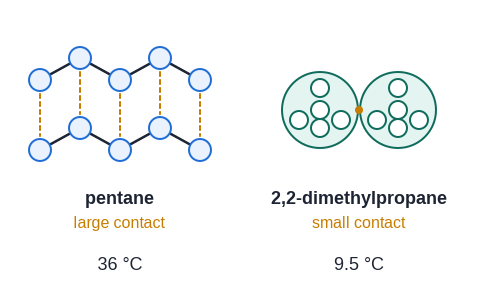
- Shape matters too: isomers have the same number of electrons, but a long chain has more surface contact with its neighbours than a compact, branched molecule, so its temporary dipole attractions are stronger.
| Isomer of C₅H₁₂ | Shape | Boiling point (°C) |
|---|---|---|
| Pentane | Straight chain | 36.1 |
| 2-methylbutane | One branch | 27.8 |
| 2,2-dimethylpropane | Compact, nearly spherical | 9.5 |
Solubility in polar and non-polar solvents
- A substance dissolves when the attractions it forms with the solvent are comparable in strength to the attractions broken in the solute and in the solvent.
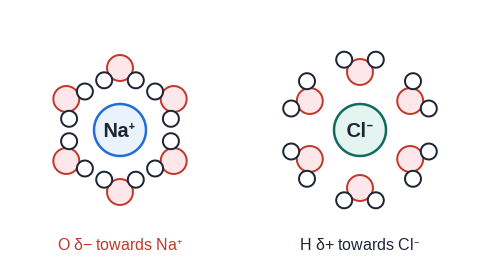
- Ionic solids dissolve in water because each ion is attracted to the polar water molecules: the δ− oxygen ends surround cations and the δ+ hydrogen ends surround anions, and these ion-dipole attractions pull ions off the lattice.
- Polar molecules that can hydrogen bond, such as ethanol and glucose, dissolve in water by forming hydrogen bonds with it.
- Non-polar substances such as iodine and fats dissolve in non-polar solvents like hexane, because both have only temporary dipole attractions; in water they would break water's hydrogen bonds without making anything as strong.
- So: like dissolves like, and the reason is always the balance of attractions broken and formed.
Try it: water or hexane?
Example: alcohols in water
- The table shows how the solubility of straight-chain alcohols in water changes with chain length. Explain the trend.
| Alcohol | Carbons | Solubility in water at about 25 °C |
|---|---|---|
| Methanol | 1 | Mixes in all proportions |
| Ethanol | 2 | Mixes in all proportions |
| Propan-1-ol | 3 | Mixes in all proportions |
| Butan-1-ol | 4 | About 7 g per 100 mL |
| Pentan-1-ol | 5 | About 2.2 g per 100 mL |
| Hexan-1-ol | 6 | About 0.6 g per 100 mL |
- every alcohol has one O–H group, which forms hydrogen bonds with water
- each extra CH₂ makes the non-polar hydrocarbon chain longerthe chain has only temporary dipole attractions
- a long chain breaks water's hydrogen bonds but cannot form hydrogen bonds itself
- solubility falls as the chain grows: the non-polar part outweighs the single O–H
- the same alcohols dissolve better and better in hexane as the chain grows
Enthalpy and entropy
- Enthalpy change, ΔH, is the heat energy taken in from or given out to the surroundings at constant pressure: negative for exothermic, positive for endothermic.
- Entropy, S, measures how spread out (dispersed) the matter and energy of a system are; the more ways the particles and their energy can be arranged, the higher the entropy.
- Entropy rises from solid to liquid to gas, when a solid dissolves, when a reaction makes more moles of gas, and when a substance is heated.
- To predict the sign of ΔS for a reaction, look at gases first: more moles of gas on the product side means ΔS is positive; fewer means negative.
| Change | Sign of ΔS (system) | Reason |
|---|---|---|
| H₂O(s) → H₂O(l) | Positive | Liquid particles move past each other |
| H₂O(l) → H₂O(g) | Positive | Gas particles spread through the whole container |
| NaCl(s) → Na⁺(aq) + Cl⁻(aq) | Positive | Ions spread through the solution |
| 2SO₂(g) + O₂(g) → 2SO₃(g) | Negative | 3 mol of gas become 2 mol |
| CaCO₃(s) → CaO(s) + CO₂(g) | Positive | A gas is made from a solid |
Predicting whether a change is spontaneous
- A spontaneous change happens on its own once started, without continuing outside help; it may still be slow (diamond turning into graphite).
- A change is spontaneous when the total entropy, of the system plus the surroundings, increases.
- An exothermic change releases heat into the surroundings, spreading energy and increasing the entropy of the surroundings; an endothermic change takes heat from the surroundings and decreases their entropy.
- The surroundings' entropy change matters most at low temperature, because a given amount of heat makes a bigger difference to cold surroundings than to hot ones.
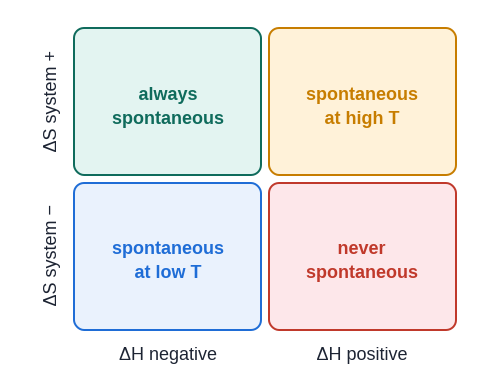
- So the sign of ΔH and the sign of ΔS (system) together decide it, and when they disagree, temperature decides.
Try it: when is it spontaneous?
Example: limestone and a cold pack
- Limestone decomposes, CaCO₃(s) → CaO(s) + CO₂(g), ΔrH = +178 kJ mol⁻¹, but only in a kiln heated above about 840 °C.
- Ammonium nitrate dissolves in water, NH₄NO₃(s) → NH₄⁺(aq) + NO₃⁻(aq), ΔH = +26 kJ mol⁻¹, by itself at room temperature: that is how an instant cold pack works.
- Explain each in terms of entropy.
- CaCO₃: a gas forms from a solid, so ΔS (system) is positive
- it is endothermic, so heat is taken from the surroundings and their entropy falls
- the surroundings' decrease is smaller at high temperature, so above about 840 °C the system's increase wins: spontaneous only when hot
- NH₄NO₃: the lattice breaks up and ions spread through the water, so ΔS (system) is large and positive
- it is endothermic, but the system's entropy increase outweighs the surroundings' decrease even at room temperature: spontaneous
Try it: weigh system against surroundings
What Achieved, Merit and Excellence look like
- Achieved recognises one idea, such as that entropy increases when particles become more spread out; Merit explains the entropy change of the system or of the surroundings; Excellence justifies spontaneity by weighing both.
- In every answer, name the system's change, the surroundings' change, which is bigger, and why.
| Grade | A model answer |
|---|---|
| Achieved | Melting increases entropy because the water molecules become more disordered. |
| Merit | When ice melts, molecules in the lattice become free to move past each other, so the entropy of the system increases. Melting is endothermic, so heat is taken from the surroundings and their entropy decreases. |
| Excellence | Melting increases the entropy of the system as molecules leave the ordered lattice. Because it is endothermic, it takes heat from the surroundings and lowers their entropy, and that decrease is larger when the surroundings are colder. At 10 °C the system's increase outweighs the surroundings' decrease, so total entropy rises and ice melts; at −10 °C the surroundings' decrease is bigger, total entropy would fall, so ice does not melt (and the reverse change, freezing, is spontaneous). |
Common mistakes
- Iodine melts at 114 °C because its covalent I–I bonds are weak.Melting overcomes the temporary dipole attractions between I₂ molecules; the I–I bond inside each molecule does not break.
- Endothermic reactions cannot be spontaneous.An endothermic change is spontaneous if the system's entropy increase outweighs the surroundings' decrease, like ice melting at 10 °C.
- Iodine does not dissolve in water because iodine is non-polar and repels water.Dissolving would break strong hydrogen bonds between water molecules and replace them with only weak attractions to I₂.
- 2SO₂(g) + O₂(g) → 2SO₃(g) has a positive ΔS because the SO₃ molecules are bigger.Three moles of gas become two, so the system's entropy decreases and ΔS is negative.
A reaction that cools itself down
You need: baking soda, white vinegar, a teaspoon, a tall glass or jar, a kitchen thermometer, if you have one, a tray or the sink
- Stand the glass on the tray, pour in half a cup of vinegar, and measure its temperature (or hold the glass in your palm to feel how cool it is).
- Add two heaped teaspoons of baking soda and stir gently.
- Measure the temperature again once the fizzing slows, or feel the glass.
- Look for: the mixture gets a few degrees colder, so the reaction is endothermic, yet it happens by itself because it makes a gas, CO₂, and the big increase in the system's entropy outweighs the decrease in the surroundings.
Safety: The mixture foams up fast and vinegar stings the eyes, so use a tall glass over a tray or sink and keep your face away from the rim.
Your turn
Butane (a straight chain) and 2-methylpropane (branched) are both C₄H₁₀. Which has the higher boiling point?
Which is more soluble in water: sodium chloride or iodine?
What is the sign of ΔS (system) for H₂O(l) → H₂O(g)?
What is the sign of ΔS (system) for N₂(g) + 3H₂(g) → 2NH₃(g)?
A reaction is endothermic and its system entropy decreases. When is it spontaneous?
Show answer
1. Butane: the same number of electrons, but the straight chain has more surface contact, so stronger temporary dipole attractions (it boils at −0.5 °C against −12 °C). 2. Sodium chloride: water's polar molecules form ion-dipole attractions with Na⁺ and Cl⁻, while non-polar iodine cannot replace water's hydrogen bonds. 3. Positive: gas particles are far more spread out than liquid. 4. Negative: 4 mol of gas become 2 mol. 5. Never: the system's entropy falls and the surroundings' entropy falls too, so the total cannot increase at any temperature.
Exam-style question: properties and spontaneity
Magnesium oxide melts at 2825 °C and iodine at 114 °C. Explain the difference in terms of the particles and the attractions between them.
Explain why iodine dissolves in hexane but hardly at all in water.
Hydrogen peroxide decomposes: 2H₂O₂(l) → 2H₂O(l) + O₂(g), ΔrH = −196 kJ mol⁻¹. State the sign of the entropy change of the system, and decide whether the reaction is spontaneous at all temperatures.
Dinitrogen tetroxide decomposes: N₂O₄(g) → 2NO₂(g), ΔrH = +57 kJ mol⁻¹. Using the entropy change of the system and of the surroundings, justify why it happens on its own only at higher temperatures.
Show answer
1. MgO is an ionic lattice of Mg²⁺ and O²⁻ ions; melting must overcome very strong electrostatic attractions between ions with 2+ and 2− charges throughout the lattice, which needs a great deal of energy. Iodine is molecular: melting overcomes only the temporary dipole attractions between I₂ molecules, which are much weaker, so far less energy is needed (Merit names both particles and both attractions; Excellence compares their strengths). 2. Iodine and hexane are both non-polar with only temporary dipole attractions, so the attractions formed between I₂ and hexane are similar to those broken, and iodine dissolves. To dissolve in water, I₂ would have to break water's hydrogen bonds but could form only weak temporary dipole attractions with water, so it hardly dissolves. 3. Positive: 2 mol of liquid produce 2 mol of liquid and 1 mol of gas. It is exothermic, so the entropy of the surroundings also increases; both increase, so the total entropy always increases and the reaction is spontaneous at all temperatures (it is slow without a catalyst). 4. One mole of gas becomes two, so the entropy of the system increases. The reaction is endothermic, so it absorbs heat from the surroundings and their entropy decreases; this decrease is larger when the surroundings are cold. At low temperature the surroundings' decrease outweighs the system's increase, so total entropy falls and the reaction is not spontaneous; at higher temperature the surroundings' decrease is smaller, the system's increase wins, and the reaction is spontaneous (Excellence weighs both changes and links them to temperature).
Recap
- Ionic, metallic and covalent network solids melt high because strong forces run through the whole structure; molecular substances melt low because only attractions between molecules are overcome.
- Among molecules: hydrogen bonds and permanent dipoles help, but electron cloud size and surface contact can outweigh them.
- Dissolving needs attractions formed that are similar to those broken: ions and hydrogen-bonding molecules in water, non-polar in non-polar.
- Spontaneous means the total entropy of system and surroundings increases; temperature decides when ΔH and ΔS disagree.
| ΔH | ΔS (system) | Spontaneous? |
|---|---|---|
| Negative (exothermic) | Positive | At all temperatures |
| Negative (exothermic) | Negative | Only at low temperatures |
| Positive (endothermic) | Positive | Only at high temperatures |
| Positive (endothermic) | Negative | Never |
Challenge
Calcium chloride is used in self-heating hot packs: CaCl₂(s) → Ca²⁺(aq) + 2Cl⁻(aq), ΔH = −82 kJ mol⁻¹. A student says: "Dissolving always spreads ions through the water, so ΔS (system) is positive, and with ΔH negative it must be spontaneous at all temperatures." In fact the small Ca²⁺ ion, with its 2+ charge, holds a shell of water molecules very tightly and in fixed positions, so ΔS (system) for dissolving CaCl₂ is negative. (a) Explain why this ion makes ΔS (system) negative. (b) Using the signs of ΔH and ΔS, state when dissolving CaCl₂ is spontaneous, and explain why it still dissolves readily in water at room temperature.
Hint
Think about what happens to the water molecules, not just the ions. Then use the table of ΔH and ΔS signs, and ask how big the surroundings' entropy gain is when 82 kJ of heat is released into room-temperature water.
Answer
(a) The ions do spread out, but many water molecules lose their freedom by being locked in ordered shells around Ca²⁺, and that loss is larger, so ΔS (system) is negative. (b) Exothermic with ΔS (system) negative: spontaneous only at low temperatures. At room temperature the large release of heat raises the surroundings' entropy by more than the system loses, so the total entropy increases and CaCl₂ dissolves.
Step by step
- Dissolving breaks the lattice and spreads Ca²⁺ and Cl⁻ ions through the solution, which on its own increases entropy.
- But the strong ion-dipole attraction of the small 2+ ion pulls water molecules into fixed, ordered positions around it.
- Those water molecules can no longer move freely, and this loss of dispersal outweighs the gain from the ions, so ΔS (system) is negative.
- The change is exothermic, so heat goes into the surroundings and their entropy increases; this gain is largest when the surroundings are cool.
- ΔH negative and ΔS negative means spontaneous only at low temperature; room temperature is low enough because 82 kJ mol⁻¹ is a lot of heat, so the surroundings' gain wins.
Full working
- ions leave the lattice and spread outΔS increases from this part
- water molecules locked in ordered shells around Ca²⁺ΔS decreases from this part, and more strongly
- ΔS (system) negativethe ordering of water outweighs the spreading of ions
- ΔH = −82 kJ mol⁻¹, heat releasedentropy of surroundings increases
- ΔH negative, ΔS negativespontaneous only at low temperatures
- at room temperature, surroundings' gain > system's losstotal entropy increases
- Spontaneous only at low temperatures, and room temperature is low enough, so CaCl₂ dissolves
Stretch a thick rubber band quickly and hold it against your lip: it feels warm. Let it contract quickly and it feels cool. Rubber is made of long, tangled polymer chains; stretching lines the chains up side by side. (a) State the sign of ΔH and of ΔS (system) for the band contracting. (b) Explain, using the entropy of the system and of the surroundings, why a stretched band contracts on its own at room temperature. (c) A weight hangs from a rubber band, which is then warmed with a hair dryer. Predict whether the weight rises or falls, and justify your prediction.
Hint
Stretching gives out heat, so contracting is the reverse. Then compare tangled chains with lined-up chains, and use the rule for a change that has ΔH and ΔS both positive.
Answer
(a) Contracting is endothermic (ΔH positive) and ΔS (system) is positive, because lined-up chains return to random tangles. (b) The system's entropy gain outweighs the surroundings' loss at room temperature, so total entropy increases. (c) The weight rises: warming makes the surroundings' loss smaller, so the drive to contract is stronger and the band shortens.
Step by step
- Stretching warms the band, so it is exothermic; contracting, the reverse, takes in heat and is endothermic.
- Lined-up chains can be arranged in far fewer ways than tangled ones, so contracting increases the entropy of the system.
- Taking in heat lowers the entropy of the surroundings, but at room temperature this loss is smaller than the system's gain, so total entropy rises and the band contracts by itself.
- ΔH positive and ΔS positive means the change is favoured more at higher temperature, because the same heat makes a smaller difference to hot surroundings.
- So warming the band strengthens its tendency to contract: it shortens and lifts the weight.
Full working
- stretching: band warmsexothermic
- contracting: ΔH positivereverse of stretching
- aligned chains → tangled chainsΔS (system) positive
- heat taken from surroundingsΔS (surroundings) negative, smaller at higher temperature
- room temperature: system's gain > surroundings' losstotal entropy increases, contraction spontaneous
- hotter: surroundings' loss smaller stillcontraction favoured even more
- (a) ΔH positive, ΔS positive; (b) total entropy rises; (c) the band contracts and the weight rises
Water and hydrogen sulfide are both bent molecules. Water boils at 100 °C with ΔvapH = +40.7 kJ mol⁻¹; hydrogen sulfide boils at −60 °C with ΔvapH = +18.7 kJ mol⁻¹. (a) Explain why ΔvapH is so much larger for water. (b) For both liquids, turning liquid into gas gives a similar large increase in the entropy of the system. Using this, and the entropy change of the surroundings, explain why water must be much hotter than hydrogen sulfide before boiling becomes spontaneous. (c) At its boiling point, liquid water and steam can sit together with neither change winning. What does this tell you about the entropy changes at that temperature?
Hint
Name the attractions between molecules in each liquid. Then remember that the heat taken in by boiling lowers the surroundings' entropy, by an amount that grows with ΔvapH and shrinks as the temperature rises.
Answer
(a) Water molecules are held by hydrogen bonds (O is small and very electronegative); H₂S has only weaker permanent and temporary dipole attractions, so far more energy is needed to separate water molecules. (b) With a similar entropy gain for the system, the larger heat taken in by water lowers the surroundings' entropy more, so the temperature must be higher before that loss becomes smaller than the system's gain. (c) At the boiling point the system's entropy gain exactly equals the surroundings' entropy loss, so the total entropy change is zero.
Step by step
- Water has H bonded to O, so hydrogen bonds form between molecules; S is less electronegative and larger, so H₂S cannot hydrogen bond.
- Boiling must overcome all the attractions between molecules, so the stronger hydrogen bonds give water the larger ΔvapH.
- Boiling is endothermic, so it lowers the entropy of the surroundings; the more heat taken, the bigger this loss, but the loss shrinks as the temperature rises.
- Both liquids gain about the same entropy on boiling, so water, which takes over twice as much heat, needs a much higher temperature before its system gain beats the surroundings' loss.
- At exactly the boiling point the two changes balance: total entropy change is zero, so neither boiling nor condensing is spontaneous.
Full working
- H₂O: TD, PD and hydrogen bonds; H₂S: TD and PD onlyH must be on N, O or F to hydrogen bond
- ΔvapH: 40.7 for H₂O > 18.7 for H₂Sstronger attractions to overcome
- ΔS (system) positive and similar for bothliquid → gas
- ΔS (surroundings) negative, larger for larger ΔvapH, smaller at higher temperatureheat taken from surroundings
- boiling spontaneous only when system's gain > surroundings' lossneeds higher temperature for water
- at the boiling point: system's gain = surroundings' losstotal entropy change is zero
- Water boils far hotter because its larger ΔvapH needs a higher temperature before total entropy can increase
Report a mistake
How is NCEA Level 3 maths going?
See the NCEA Level 3 maths guide