Momentum, energy and springs
What this lesson covers
- Momentum p = mv is a vector, in kg m s⁻¹, and impulse FΔt equals the change in momentum Δp.
- Making a collision last longer gives a smaller force for the same change in momentum.
- In a collision or explosion with no outside force, total momentum before equals total momentum after; kinetic energy is conserved only in elastic collisions.
- Work W = Fd and power P = W ÷ t; energy changes form (Ep = mgh, Ek = ½mv²) but the total is conserved.
- A spring obeys Hooke's law, F = kx, and stores elastic potential energy Ep = ½kx², the area under its force against extension graph.
Momentum and change in momentum
- Momentum is mass times velocity, p = mv, measured in kg m s⁻¹; it is a vector, so it has the direction of the velocity.
- Change in momentum is Δp = m(vf − vi), with vf and vi signed: pick a positive direction and make anything moving the other way negative.
- When an object bounces back, the change in momentum is bigger than when it stops dead, because the velocity changes sign: a ball arriving at +20 m s⁻¹ and leaving at −15 m s⁻¹ changes velocity by 35 m s⁻¹.
Impulse: force times time
- Impulse is the force multiplied by the time it acts, FΔt, in N s, and it equals the change in momentum: FΔt = Δp.
- So the average force in a collision is F = Δp ÷ Δt.
- For a person or object brought to a stop, Δp is fixed by the mass and the speed, so the only way to reduce the force is to make the stop take longer.
- That is how crumple zones, airbags, cycle helmets, padded goalposts and bending your knees on landing protect you: each stretches out the time of the collision.
Example: hitting a cricket ball
- A 0.160 kg cricket ball travels towards a bat at 30.0 m s⁻¹ and is hit straight back at 40.0 m s⁻¹. The ball is in contact with the bat for 2.00 ms.
- Find the change in momentum of the ball and the average force on it.
- take away from the bat as positive: vi = −30.0 m s⁻¹, vf = +40.0 m s⁻¹
- Δp = m(vf − vi) = 0.160 × (40.0 − (−30.0)) = 0.160 × 70.0 = 11.2 kg m s⁻¹
- Δt = 2.00 ms = 0.00200 smilli means divide by 1000
- F = Δp ÷ Δt = 11.2 ÷ 0.00200 = 5600 N
- a = Δv ÷ Δt = 70.0 ÷ 0.00200 = 35 000 m s⁻², F = ma = 0.160 × 35 000 = 5600 N
- Δp = 11.2 kg m s⁻¹ away from the bat, average force 5600 N away from the bat
Conservation of momentum
- When objects collide or push apart, the forces between them are equal and opposite (Newton's third law) and act for the same time, so one gains exactly the momentum the other loses.
- So if no outside net force acts, the total momentum before equals the total momentum after.
- Add momenta with signs: two objects moving towards each other have momenta of opposite sign, and the total can be small.
- In an explosion, such as two skaters pushing apart from rest, the total momentum is zero before and after, so they move off in opposite directions.
- Kinetic energy is conserved only in an elastic collision; in most collisions some kinetic energy becomes heat, sound and work done squashing the objects, which is why momentum is the more useful quantity for collisions.
Try it: collisions
Example: two trolleys collide and stick
- A 2.00 kg trolley moving right at 3.00 m s⁻¹ meets a 1.00 kg trolley moving left at 1.50 m s⁻¹. They stick together.
- Find their velocity after the collision, and how much kinetic energy is lost.
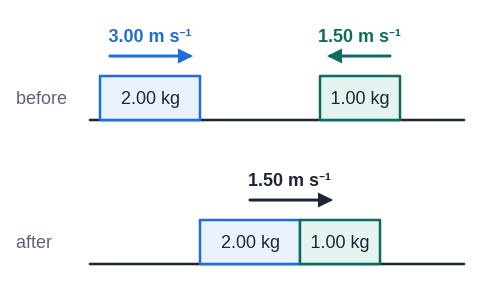
- right is positive: p before = 2.00 × 3.00 + 1.00 × (−1.50) = 6.00 − 1.50 = 4.50 kg m s⁻¹
- p after = (2.00 + 1.00) × v = 4.50, v = 1.50 m s⁻¹momentum is conserved
- Ek before = ½ × 2.00 × 3.00² + ½ × 1.00 × 1.50² = 9.00 + 1.125 = 10.125 J
- Ek after = ½ × 3.00 × 1.50² = 3.375 J
- Ek lost = 10.125 − 3.375 = 6.75 J, to heat, sound and deforming the trolleys
- p after = 3.00 × 1.50 = 4.50 kg m s⁻¹, the same as before
- 1.50 m s⁻¹ to the right; 6.75 J of kinetic energy lost, so the collision is inelastic
Work, energy and power
- Work is done when a force moves something in the direction of the force: W = Fd, in joules; the work done equals the energy transferred.
- Gravitational potential energy is Ep = mgh and kinetic energy is Ek = ½mv²; lifting a mass m by a height h takes work mgh, whatever path it takes.
- Energy is conserved: with no friction, Ep lost = Ek gained, so a falling object's speed after a drop h is v = √(2gh).
- With friction, the missing energy is the work done against friction, Ffriction × d, which becomes heat.
- Power is the rate of doing work: P = W ÷ t, in watts (1 W = 1 J s⁻¹); the same climb done faster takes the same work but more power.
Example: down a playground slide
- A 45.0 kg child starts from rest at the top of a slide 3.00 m high and reaches the bottom at 5.00 m s⁻¹. The slide is 5.00 m long.
- Find the speed she would have without friction, and the average friction force on her.
- Ep at the top = mgh = 45.0 × 9.8 × 3.00 = 1323 J
- no friction: ½mv² = mgh, v = √(2gh) = √(2 × 9.8 × 3.00) = √58.8 = 7.67 m s⁻¹the mass cancels
- Ek at the bottom = ½ × 45.0 × 5.00² = 562.5 J
- work against friction = 1323 − 562.5 = 760.5 J
- friction = W ÷ d = 760.5 ÷ 5.00 = 152.1 Nfriction acts along the whole 5.00 m of the slide
- 562.5 + 152.1 × 5.00 = 562.5 + 760.5 = 1323 Jthe energy out adds back to the energy in
- 7.67 m s⁻¹ without friction; average friction 152 N
Springs and Hooke's law
- A spring stretches (or compresses) in proportion to the force on it: F = kx, where x is the extension in metres and k is the spring constant in N m⁻¹.
- A bigger k means a stiffer spring: it needs more force for each metre of stretch.
- The spring pulls back the opposite way to the stretch, which is why the restoring force is written F = −kx.
- The energy stored is the area under the force against extension graph, a triangle: Ep = ½Fx = ½kx².
- Because x is squared, doubling the stretch stores four times the energy; past its limit of proportionality a spring no longer obeys F = kx.
Example: finding a spring constant
- A Year 12 class hung 100 g masses, one at a time, from a spring and measured its extension each time.
- Find the spring constant and the energy stored when the extension is 0.200 m.
| Mass (g) | Force (N) | Extension (cm) |
|---|---|---|
| 100 | 0.98 | 4.1 |
| 200 | 1.96 | 7.9 |
| 300 | 2.94 | 12.1 |
| 400 | 3.92 | 15.9 |
| 500 | 4.90 | 20.0 |
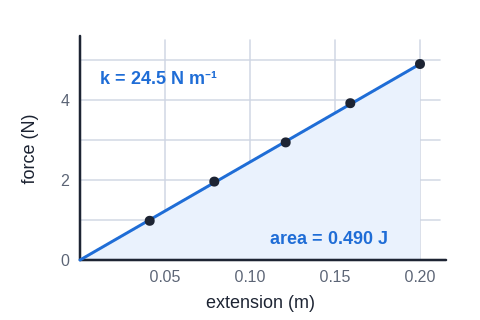
- force = weight = mg, so 100 g gives 0.100 × 9.8 = 0.98 Ngrams to kilograms first
- the points lie on a straight line through (0, 0), so F = kx holds
- k = gradient = 4.90 N ÷ 0.200 m = 24.5 N m⁻¹extension in metres, 20.0 cm = 0.200 m
- Ep = ½kx² = ½ × 24.5 × 0.200² = 0.490 J
- area of the triangle = ½ × 0.200 × 4.90 = 0.490 J
- k = 24.5 N m⁻¹, Ep = 0.490 J
Example: a spring-loaded toy dart
- A toy gun's spring, k = 800 N m⁻¹, is compressed 0.0500 m and fires a 0.0200 kg dart straight up. Ignore friction and air resistance.
- Find the dart's launch speed and how high it rises, then say what happens if the spring is compressed twice as far.
- Ep spring = ½kx² = ½ × 800 × 0.0500² = 1.00 J
- Ek = ½mv², so 1.00 = ½ × 0.0200 × v², v² = 100 m² s⁻², v = 10.0 m s⁻¹all the spring energy becomes kinetic energy
- Ep gravity = mgh, so 1.00 = 0.0200 × 9.8 × h, h = 5.10 m
- kinematics: 0 = 10.0² − 2 × 9.8 × h, h = 100 ÷ 19.6 = 5.10 m
- twice the compression: Ep = ½ × 800 × 0.100² = 4.00 J, four times as much
- 10.0 m s⁻¹, 5.10 m; doubling x gives 4 times the energy, 2 times the speed and 4 times the height
Try it: impulse and spring energy
What Achieved, Merit and Excellence look like
- Achieved names one correct idea; Merit links two (cause and effect); Excellence gives the whole chain, from what stays the same to what changes and why.
- In a safety question, say first that Δp is fixed, then that the time is longer, then use F = Δp ÷ Δt to show the force is smaller.
| Grade | A model answer |
|---|---|
| Achieved | The foam squashes, so the head stops more slowly and the force is smaller. |
| Merit | The foam crushing makes the head take longer to stop, and since F = Δp ÷ Δt, a longer time gives a smaller force on the head. |
| Excellence | The head's change in momentum is the same with or without a helmet, because it goes from the same speed to rest: Δp = mv. Crushing foam makes the stop take longer, so by F = Δp ÷ Δt the same Δp spread over a longer Δt needs a smaller average force on the head, so less injury. The work done crushing the foam also turns the head's kinetic energy into heat in the foam rather than damage to the skull. |
Common mistakes
- A ball hits the wall at 20 m s⁻¹ and bounces back at 15 m s⁻¹, so Δv = 20 − 15 = 5 m s⁻¹.Directions matter: Δv = −15 − 20 = −35 m s⁻¹, a change of 35 m s⁻¹ away from the wall.
- Momentum was conserved in the collision, so the kinetic energy must have been conserved too.Momentum is conserved in every collision with no outside force; kinetic energy is conserved only in elastic ones.
- Doubling the compression of a spring doubles the energy it stores.Ep = ½kx², so doubling x makes the energy four times as big.
- Work to climb stairs = 60 kg × 3.5 m = 210 J.The force is the weight, mg: W = 60 × 9.8 × 3.5 = 2058 J.
How much energy does a bouncing ball keep?
You need: 2 or 3 different balls (tennis ball, rubber ball, ping-pong ball), a tape measure, masking tape, a phone camera, if you have one, paper and a pen
- Tape the tape measure upright against a wall on a hard floor, with 0 at the floor.
- Hold a ball with its bottom at 1.00 m and let it go without throwing it; note the height of the bottom of the ball at the top of its first bounce (a slow-motion phone clip makes this easy).
- Repeat 3 times for each ball and average the rebound height.
- Work out the fraction of energy kept: Ep = mgh, and m and g are the same, so it is rebound height ÷ drop height; a 0.60 m bounce keeps 60%.
- Look for: no ball bounces back to 1.00 m, because some of its kinetic energy becomes heat and sound as it squashes on the floor; try a carpet and compare.
Safety: Drop the balls well away from windows, lamps and anything breakable, and keep the floor clear so nobody trips chasing a ball.
Your turn
What is the momentum of a 1200 kg car travelling at 15.0 m s⁻¹?
A 0.0600 kg tennis ball hits a wall at 20.0 m s⁻¹ and bounces straight back at 15.0 m s⁻¹. What is its change in momentum?
A 60.0 kg skater and a 40.0 kg skater stand still on ice and push each other apart. The 60.0 kg skater moves off at 2.00 m s⁻¹. What is the other skater's velocity?
A 60.0 kg student runs up stairs 3.50 m high in 4.00 s. What power does she develop lifting herself?
A spring with k = 50.0 N m⁻¹ is stretched by 0.120 m. How much elastic potential energy does it store?
Show answer
1. p = mv = 1200 × 15.0 = 18 000 kg m s⁻¹ in the car's direction. 2. Away from the wall is positive: Δp = 0.0600 × (15.0 − (−20.0)) = 0.0600 × 35.0 = 2.10 kg m s⁻¹ away from the wall. 3. Total momentum is 0 before, so 60.0 × 2.00 + 40.0 × v = 0, v = −120 ÷ 40.0 = −3.00 m s⁻¹: 3.00 m s⁻¹ in the opposite direction. 4. W = mgh = 60.0 × 9.8 × 3.50 = 2058 J; P = W ÷ t = 2058 ÷ 4.00 = 514.5 W, about 515 W. 5. Ep = ½kx² = ½ × 50.0 × 0.120² = 0.360 J.
Exam-style question: coupling rail wagons
- In a rail yard, a 1500 kg wagon rolls at 2.00 m s⁻¹ towards a stationary 1000 kg wagon on a level track. They couple together and move off as one. Ignore friction.
Calculate the momentum of the moving wagon, with its unit.
Calculate the speed of the coupled wagons.
Show that kinetic energy is not conserved in the coupling, and say where it goes.
The coupled wagons then run into a spring buffer with k = 2.40 × 10⁵ N m⁻¹. Calculate how far the buffer compresses as it stops them.
Discuss whether a stiffer buffer (bigger k) would be better for the wagons and their load.
Show answer
1. p = mv = 1500 × 2.00 = 3000 kg m s⁻¹ along the track (Achieved). 2. Momentum is conserved: 3000 = (1500 + 1000) × v, v = 3000 ÷ 2500 = 1.20 m s⁻¹ in the same direction (Merit). 3. Ek before = ½ × 1500 × 2.00² = 3000 J; Ek after = ½ × 2500 × 1.20² = 1800 J; 1200 J has become heat and sound in the coupling, so the collision is inelastic (Merit). 4. All 1800 J is stored in the spring: ½kx² = 1800, x² = 2 × 1800 ÷ 240 000 = 0.0150 m², x = 0.122 m (Excellence). 5. The wagons' change in momentum is the same, 2500 × 1.20 = 3000 kg m s⁻¹, whatever the buffer. A stiffer spring stores the same 1800 J in a smaller compression (x = √(2Ek ÷ k)), so it stops them over a shorter distance and in a shorter time, and by F = Δp ÷ Δt the force on the wagons and load is bigger. A softer buffer is gentler, as long as it is long enough to compress the extra distance (Excellence links Δp, time, force and the energy stored).
Masses and Springs
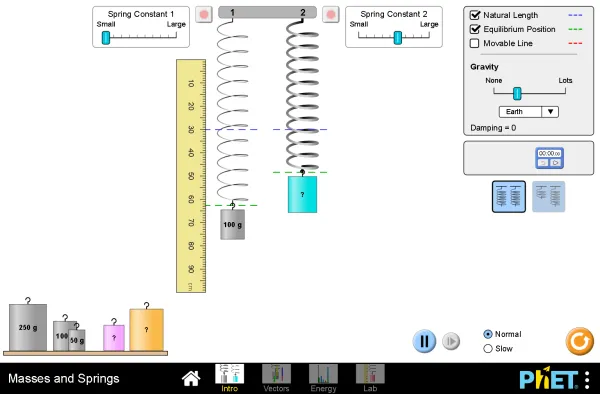
Full screen · PhET Interactive Simulations, University of Colorado Boulder, CC BY 4.0
Recap
- p = mv is a vector; give a direction, and use signs for opposite directions.
- Impulse FΔt = Δp: a longer stopping time means a smaller force.
- Total momentum is conserved in collisions and explosions; kinetic energy only in elastic collisions.
- W = Fd, P = W ÷ t, and the energy total stays the same as it changes form.
- Springs: F = kx, Ep = ½kx², the area under the force against extension graph.
| Formula | Use it for |
|---|---|
| p = mv | momentum |
| FΔt = Δp | impulse and collision forces |
| W = Fd, P = W ÷ t | work and power |
| Ep = mgh, Ek = ½mv² | gravitational and kinetic energy |
| F = kx, Ep = ½kx² | spring force and stored energy |
Challenge
A 0.020 kg pellet is fired horizontally into a 0.980 kg wooden block resting on a smooth, level surface, and stays stuck inside it. The block then slides into a spring with k = 400 N m⁻¹ and compresses it by a greatest distance of 5.0 cm before it stops. Ignore friction. (a) How fast was the pellet travelling before it hit the block? (b) What percentage of the pellet's kinetic energy was lost in the collision?
Hint
Work backwards. The spring tells you the kinetic energy of the block and pellet just after the collision. Energy is not conserved in the collision itself, but momentum is.
Answer
(a) 50 m s⁻¹ (b) 98%
Step by step
- At its greatest compression the spring has taken all the kinetic energy of the block and pellet, so find ½kx² first.
- That energy equals ½mv² for the combined 1.000 kg, which gives their speed just after the collision.
- The pellet sticks in the block, so use conservation of momentum to find the pellet's speed before the collision.
- Compare the pellet's kinetic energy before with the kinetic energy just after to find the fraction lost.
- You cannot use energy conservation across the collision, because most of the energy becomes heat and work done splitting the wood.
Full working
- x = 5.0 cm = 0.050 mmetres first
- Ep spring = ½kx² = ½ × 400 × 0.050² = 0.50 Jall the energy after the collision ends up here
- ½ × 1.000 × v² = 0.50, v² = 1.0, v = 1.0 m s⁻¹block and pellet together, 0.980 + 0.020 = 1.000 kg
- 0.020 × u = 1.000 × 1.0, u = 50 m s⁻¹momentum before = momentum after
- Ek before = ½ × 0.020 × 50² = 25 Jthe pellet alone
- lost = 25 − 0.50 = 24.5 J, 24.5 ÷ 25 × 100% = 98%to heat, sound and damage in the block
- (a) 50 m s⁻¹ (b) 98% of the kinetic energy is lost
Trolley A (2.0 kg) and trolley B (3.0 kg) sit at rest on a level track with a light spring, k = 3000 N m⁻¹, squashed 6.0 cm between them and held by a thread. The thread is cut and the trolleys fly apart. Ignore friction. (a) Find the speed of each trolley. (b) Show that A gets 60% of the spring's energy, and explain why the lighter trolley gets more. (c) The experiment is repeated with B pushed hard against a solid wall, so it cannot move. Find A's speed now, and explain why momentum is not conserved this time.
Hint
Two facts, two unknowns: the total momentum stays zero, and all the spring's energy becomes kinetic energy. Use the momentum equation to write one speed in terms of the other.
Answer
(a) A 1.8 m s⁻¹, B 1.2 m s⁻¹, in opposite directions (b) A has 3.24 J of 5.4 J (c) 2.3 m s⁻¹
Step by step
- The spring stores ½kx² = 5.4 J, and all of it becomes kinetic energy of the two trolleys.
- They start at rest, so their momenta must be equal and opposite: 2.0vA = 3.0vB, so vA = 1.5vB.
- Put vA = 1.5vB into the energy equation to find vB, then vA.
- Equal momentum p for both, and Ek = p² ÷ (2m), so the trolley with less mass gets more of the energy, in the inverse ratio of the masses: 3 to 2, so 60% to 40%.
- Against the wall, the wall pushes on the spring (an outside force), so total momentum is not conserved, but B does not move, so A gets all 5.4 J.
Full working
- Ep = ½kx² = ½ × 3000 × 0.060² = 5.4 Jspring energy
- 2.0vA = 3.0vB, so vA = 1.5vBtotal momentum zero before and after
- ½ × 2.0 × (1.5vB)² + ½ × 3.0 × vB² = 5.4all the spring energy becomes Ek
- 2.25vB² + 1.5vB² = 3.75vB² = 5.4, vB² = 1.44, vB = 1.2 m s⁻¹solve
- vA = 1.5 × 1.2 = 1.8 m s⁻¹opposite direction to B
- Ek(A) = ½ × 2.0 × 1.8² = 3.24 J, 3.24 ÷ 5.4 = 0.6060% of the energy
- Ek(B) = ½ × 3.0 × 1.2² = 2.16 J, and 3.24 + 2.16 = 5.4 Jcheck
- wall: ½ × 2.0 × v² = 5.4, v² = 5.4, v = 2.32 m s⁻¹A gets all the energy
- (a) 1.8 m s⁻¹ and 1.2 m s⁻¹ in opposite directions (b) 60% to A (c) 2.3 m s⁻¹
A 60 kg bungy jumper steps off a bridge. Her cord is 15 m long when slack and behaves like a spring once it is stretched. The lowest point she reaches is 25 m below the bridge. Treat her as a point, ignore air resistance and the mass of the cord. (a) Find the spring constant of the cord. (b) Her speed is not greatest at the moment the cord goes tight. Explain why, find where it is greatest, and find that greatest speed.
Hint
At the lowest point she is momentarily at rest, so all the gravitational energy she has lost is stored in the cord. For (b), think about the net force on her: she keeps speeding up as long as her weight is bigger than the cord's pull.
Answer
(a) 294 N m⁻¹ (b) greatest 17 m below the bridge (cord stretched 2.0 m), 17.7 m s⁻¹
Step by step
- From the bridge to the lowest point she falls 25 m and the cord stretches 25 − 15 = 10 m, with no kinetic energy at either end.
- So mgh = ½kx² with h = 25 m and x = 10 m gives k.
- Once the cord is tight it pulls up with kx. While kx is less than her weight mg, the net force is still down, so she keeps speeding up.
- Her speed is greatest where kx = mg, when the net force is zero; after that the net force is up and she slows down.
- Use energy at that point: gravitational energy lost = kinetic energy + energy stored in the cord.
Full working
- mgh = ½kx², 60 × 9.8 × 25 = ½ × k × 10²lowest point, at rest
- 14 700 = 50k, k = 294 N m⁻¹solve
- kx = mg, 294x = 60 × 9.8 = 588, x = 2.0 mnet force zero here
- drop = 15 + 2.0 = 17 m below the bridgewhere she is fastest
- Ep lost = 60 × 9.8 × 17 = 9996 J, cord energy = ½ × 294 × 2.0² = 588 Jenergy shares
- Ek = 9996 − 588 = 9408 J, ½ × 60 × v² = 9408, v² = 313.6, v = 17.7 m s⁻¹compare 17.1 m s⁻¹ when the cord first goes tight
- (a) k = 294 N m⁻¹ (b) fastest 17 m below the bridge, at 17.7 m s⁻¹
Report a mistake
How is NCEA Level 2 maths going?
See the NCEA Level 2 maths guide