Naming and drawing organic compounds
What this lesson covers
- The seven Level 2 families: alkanes, alkenes, alkynes, haloalkanes, alcohols, carboxylic acids and primary amines, and the functional group of each.
- IUPAC names: find the longest chain holding the functional group, number it so the group gets the lowest number, and list branches alphabetically.
- Constitutional isomers share a molecular formula but have their atoms joined in a different order.
- Cis and trans isomers need a C=C double bond with two different groups on each of its carbons.
- Alcohols and haloalkanes are primary, secondary or tertiary by how many carbons are bonded to the carbon carrying the OH or halogen.
- Boiling points rise with chain length; polar groups raise boiling points and water solubility until a long chain takes over.
The seven families
- Organic compounds are built on chains of carbon atoms, and each family is defined by its functional group, the part of the molecule that reacts.
- The stem gives the number of carbons in the longest chain: meth 1, eth 2, prop 3, but 4, pent 5, hex 6, hept 7, oct 8. Level 2 questions stop at eight.
- Alkanes have only C–C single bonds and are saturated; alkenes have a C=C double bond and alkynes a C≡C triple bond, so both are unsaturated.
- Haloalkanes carry F, Cl, Br or I; alcohols carry an OH; carboxylic acids end in a COOH group; primary amines carry an NH₂ group.
| Family | Functional group | Name pattern | Example |
|---|---|---|---|
| Alkane | C–C only | -ane | propane, CH₃CH₂CH₃ |
| Alkene | C=C | -ene | propene, CH₂=CHCH₃ |
| Alkyne | C≡C | -yne | propyne, CH≡CCH₃ |
| Haloalkane | –F, –Cl, –Br, –I | fluoro-, chloro-, bromo-, iodo- | 1-chloropropane, CH₂ClCH₂CH₃ |
| Alcohol | –OH | -ol | propan-1-ol, CH₃CH₂CH₂OH |
| Carboxylic acid | –COOH | -oic acid | propanoic acid, CH₃CH₂COOH |
| Primary amine | –NH₂ | -amine | propan-1-amine, CH₃CH₂CH₂NH₂ |
Naming in four steps
- 1. Find the longest continuous carbon chain that contains the functional group (or the C=C or C≡C), even if it bends on the page.
- 2. Number the chain from the end that gives the -ene, -yne, -ol or -amine the lowest number. The COOH carbon of an acid is always carbon 1, so it needs no number. In an alkane or haloalkane, start from the end nearer the first branch or halogen.
- 3. Name each branch or halogen as a prefix with its position: methyl (CH₃), ethyl (C₂H₅), chloro, bromo. Use di- and tri- for repeats, and put the prefixes in alphabetical order, ignoring di- and tri-.
- 4. If there is still a tie, number so the branches get the lowest numbers at the first point of difference.
- Numbers are separated by commas and joined to words by hyphens: 2,3-dimethylbutane, 4-methylpentan-2-ol. NZQA also accepts the older style with the number at the front, such as 1-pentyne for pent-1-yne.
Try it: build and name a molecule
Example: naming a haloalkane
- Name CH₃CHBrCH(CH₃)CH₂CH₃, drawn below as a full structural formula.
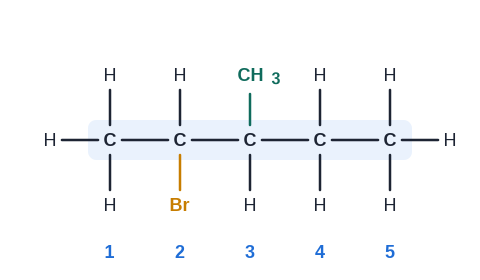
- longest chain: 5 carbons, all single bondsthe parent name is pentane
- from the left: Br on C2, CH₃ on C3, so {2, 3}
- from the right: CH₃ on C3, Br on C4, so {3, 4}2 beats 3 at the first difference
- prefixes in alphabetical order: bromo before methyl
- 2-bromo-3-methylpentane
- C₆H₁₃Br: 6 carbons in all, counting the branch
Examples: names with an ending
- Each of these follows the same four steps; the last column gives the step that decides the numbers.
| Condensed formula | Name | Why |
|---|---|---|
| CH₃CH(OH)CH₂CH(CH₃)CH₃ | 4-methylpentan-2-ol | number from the OH end: OH on C2, not C4 |
| CH₃CH=C(CH₃)CH₂CH₃ | 3-methylpent-2-ene | the double bond starts at C2 from the left, C3 from the right |
| (CH₃)₂CHCOOH | 2-methylpropanoic acid | the COOH carbon is C1, so the branch is on C2 |
| CH≡CCH₂CH₃ | but-1-yne | the triple bond starts at C1 |
| CH₃CH₂CH(NH₂)CH₃ | butan-2-amine | NH₂ on C2, counting from the right |
| CH₂ClCHClCH₃ | 1,2-dichloropropane | two chlorines, and {1, 2} is lower than {2, 3} |
Constitutional isomers
- Isomers have the same molecular formula but different structures, so they are different compounds with different properties.
- Constitutional (structural) isomers have their atoms joined in a different order: a different chain, a branch in a different place, or the functional group on a different carbon.
- C₄H₁₀ has two: butane and 2-methylpropane. C₃H₇Cl has two: 1-chloropropane and 2-chloropropane.
- C₄H₉OH has four alcohols: butan-1-ol, butan-2-ol, 2-methylpropan-1-ol and 2-methylpropan-2-ol.
- To check a pair, count every C, H and other atom: if the formulas match and the names differ, they are isomers; if the names are the same, you have drawn one molecule twice.
Cis and trans isomers
- A C=C double bond cannot rotate, so the groups on either side of it stay where they are.
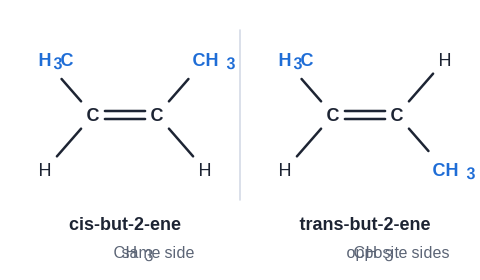
- If each carbon of the double bond holds two different atoms or groups, two arrangements exist: cis, with the matching groups on the same side, and trans, with them on opposite sides.
- But-2-ene, CH₃CH=CHCH₃, has cis and trans isomers, because each carbon of the double bond holds one H and one CH₃.
- But-1-ene, CH₂=CHCH₂CH₃, has none: its first carbon carries two H atoms, so swapping sides gives the same molecule.
- Single bonds rotate freely, so alkanes never have cis and trans isomers.
Try it: chain, numbers, cis or trans
Primary, secondary and tertiary
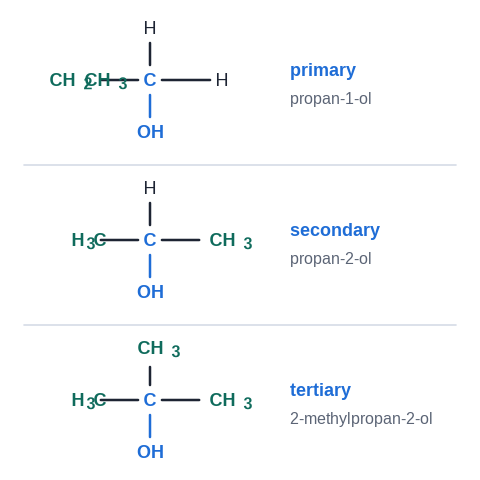
- Find the carbon that carries the OH (or the halogen) and count the other carbon atoms bonded to it.
- One carbon: primary, as in propan-1-ol. Two: secondary, as in propan-2-ol. Three: tertiary, as in 2-methylpropan-2-ol.
- The same count works for haloalkanes: 2-chlorobutane is secondary and 2-chloro-2-methylpropane is tertiary.
- The class matters in reactions: acidified dichromate oxidises a primary alcohol to a carboxylic acid, but leaves a tertiary alcohol unchanged.
Try it: primary, secondary or tertiary?
Boiling points and solubility
- Boiling separates whole molecules from each other; it never breaks the covalent bonds inside them.
- Longer chains have more electrons and more surface in contact, so the attractions between molecules are stronger and the boiling point rises: the first four alkanes are gases at room temperature, and pentane to octane are liquids.
- Alkanes, alkenes and alkynes are non-polar: they do not dissolve in water and, being less dense, float on it.
- Alcohols, carboxylic acids and amines have polar OH, COOH or NH₂ groups that hydrogen bond to each other and to water, so they boil far higher than an alkane of similar size and the short ones dissolve in water.
- As the non-polar chain grows it outweighs the polar group, so solubility falls: ethanol mixes with water in any amount, but octan-1-ol barely dissolves.
- Haloalkanes are only slightly polar and cannot hydrogen bond with water, so they are mostly insoluble.
| Alkane | Carbons | Boiling point (°C) | State at 25 °C |
|---|---|---|---|
| methane | 1 | −162 | gas |
| ethane | 2 | −89 | gas |
| propane | 3 | −42 | gas |
| butane | 4 | 0 | gas |
| pentane | 5 | 36 | liquid |
| hexane | 6 | 69 | liquid |
| heptane | 7 | 98 | liquid |
| octane | 8 | 126 | liquid |
Example: putting boiling points in order
- Put butane, pentane and butan-1-ol in order of boiling point, lowest first, and give the reason for each step up.
- butane: 4 carbons, non-polaronly weak attractions between molecules
- pentane: 5 carbons, non-polara longer chain gives more contact, so stronger attractions
- butan-1-ol: 4 carbons and a polar OHhydrogen bonds between OH groups are much stronger again
- butane (0 °C) < pentane (36 °C) < butan-1-ol
- butan-1-ol is a liquid that boils well above pentane, even though its chain is shorter
What Achieved, Merit and Excellence look like
- Achieved names the right idea; Merit links it to the structure; Excellence compares both compounds and explains the attractions on each side.
- Use the words polar, non-polar, chain length and attraction to water in every solubility answer.
| Grade | A model answer |
|---|---|
| Achieved | Propan-1-ol has a short chain, so it dissolves; hexan-1-ol has a longer chain. |
| Merit | Both have a polar OH group that is attracted to water. Propan-1-ol's chain is short, so the OH dominates and it dissolves; hexan-1-ol has a long non-polar chain that water does not attract. |
| Excellence | Both have a polar OH group that hydrogen bonds with water. In propan-1-ol the non-polar part is only three carbons, so these attractions are enough for it to mix with water. In hexan-1-ol the six-carbon non-polar chain is a much bigger part of the molecule and cannot hydrogen bond, so water molecules stay attracted to each other and most of the hexan-1-ol forms a separate layer. |
Common mistakes
- CH₃CH₂CH₂CH(CH₃)CH₃ is 4-methylpentane.Number from the end nearer the branch: it is 2-methylpentane. Always check the other direction.
- CH₃CH₂CH(CH₂CH₃)CH₃ is 2-ethylbutane.The longest chain runs through the ethyl group, giving five carbons: it is 3-methylpentane.
- But-1-ene has cis and trans isomers because it has a C=C double bond.A double bond is not enough: each of its carbons needs two different groups, and C1 of but-1-ene has two H atoms.
- Butan-1-ol boils higher than butane because its O–H bond takes more energy to break.Boiling never breaks covalent bonds; butan-1-ol boils higher because its molecules attract each other more strongly, through hydrogen bonds.
Build the isomers
You need: about 20 jelly lollies or balls of playdough in two colours (at least 5 of one colour and 12 of the other), about 20 toothpicks, paper and a pen
- Use one colour for carbon and the other for hydrogen; each carbon needs exactly four toothpicks and each hydrogen exactly one.
- Build pentane, C₅H₁₂, as one straight chain of five carbons, then pull it apart and rebuild the same atoms into every different shape you can find.
- For each model, find the longest chain and write its name; if two models get the same name, they are the same molecule turned around.
- Now build but-2-ene, C₄H₈, joining the middle two carbons with two toothpicks for the double bond, and try to twist one end while holding the other.
- Look for: exactly three isomers of C₅H₁₂ (pentane, 2-methylbutane and 2,2-dimethylpropane), and a double bond that will not twist, so the CH₃ groups stay on the same side (cis) or on opposite sides (trans).
Safety: Toothpicks have sharp points, so push them into the lollies on the table rather than towards your fingers, and do not eat lollies that have been handled and pierced.
Your turn
Name CH₃CH₂CH₂CH₂OH.
Name CH₃CH(CH₃)CH₂CH₂CH₃.
Name CH₃CH₂CH=CHCH₃.
Name CH₃CH₂CH₂COOH.
Is CH₃CBr(CH₃)CH₃ primary, secondary or tertiary, and what is its name?
Show answer
1. Butan-1-ol: the OH is on C1 of a four-carbon chain. 2. 2-Methylpentane: number from the left so the branch is on C2, not C4. 3. Pent-2-ene: number from the right so the double bond starts at C2, not C3; it has cis and trans isomers. 4. Butanoic acid: four carbons, counting the COOH carbon. 5. Tertiary, because the carbon holding the Br is bonded to three other carbons; its name is 2-bromo-2-methylpropane.
Exam-style question: three bottles of C₄H₁₀O
- A technician finds three unlabelled bottles, each holding a compound with the formula C₄H₁₀O: butan-1-ol, butan-2-ol and 2-methylpropan-2-ol.
Draw the structural formula of butan-2-ol and classify it as primary, secondary or tertiary.
Name a constitutional isomer of butan-1-ol, also an alcohol, that is not in the bottles.
The technician also has but-1-ene and but-2-ene. Explain which of the two forms geometric isomers.
Butan-1-ol dissolves only partly in water, but ethanol mixes completely. Discuss why, using the structure of each molecule.
Show answer
1. CH₃CH(OH)CH₂CH₃ drawn with every C–H bond shown; it is secondary, because the carbon holding the OH is bonded to two other carbons (Achieved). 2. 2-Methylpropan-1-ol, (CH₃)₂CHCH₂OH: the same formula with a branched chain (Achieved). 3. But-2-ene: the C=C cannot rotate, and each of its carbons holds two different groups (H and CH₃), so the CH₃ groups can sit on the same side (cis) or opposite sides (trans). But-1-ene has two H atoms on C1, so it has no geometric isomers (Merit for one requirement explained, Excellence for both requirements applied to both molecules). 4. Both have a polar OH group that hydrogen bonds with water. Ethanol's non-polar part is only two carbons, so it mixes in any amount; in butan-1-ol the four-carbon non-polar chain is a bigger part of the molecule and is not attracted to water, so only some dissolves and the rest forms a layer (Achieved names chain length, Merit links it to the polar OH, Excellence compares both molecules).
Recap
- Stem for chain length, ending for the functional group, prefixes for branches and halogens in alphabetical order.
- Number from the end that gives the functional group, then the branches, the lowest numbers.
- Constitutional isomers: same formula, atoms joined differently. Cis and trans: a C=C with two different groups on each carbon.
- Count the carbons on the carbon holding the OH or halogen: one is primary, two secondary, three tertiary.
- Longer chains boil higher; polar OH, COOH and NH₂ groups raise boiling points and help short molecules dissolve in water.
Challenge
A student draws an alcohol and names it 3-ethylbutan-2-ol. (a) Draw the molecule from the student's name as a condensed formula, explain why the name breaks a naming rule, and give the correct name. (b) Classify the alcohol as primary, secondary or tertiary. (c) The OH group is moved to the carbon that carries the branch. Name the new compound and classify it.
Hint
Build the molecule exactly as the wrong name says, then hunt for the longest chain that still includes the carbon holding the OH. Does it have to run straight along the way the student drew it?
Answer
(a) CH₃CH(OH)CH(CH₂CH₃)CH₃; the longest chain runs into the ethyl group and has 5 carbons, so the correct name is 3-methylpentan-2-ol. (b) Secondary. (c) 3-methylpentan-3-ol, a tertiary alcohol.
Step by step
- Following the student's name: a 4-carbon chain with OH on C2 and an ethyl group on C3 gives CH₃CH(OH)CH(CH₂CH₃)CH₃.
- Start at C1, go through the OH carbon and C3, then turn into the ethyl group: that path has 5 carbons, longer than the 4 the student used.
- On the 5-carbon chain the OH is on C2 from one end (C4 from the other), and the leftover CH₃ is a methyl branch on C3: 3-methylpentan-2-ol.
- The carbon holding the OH is bonded to two other carbons, so the alcohol is secondary.
- Moving the OH onto C3 gives CH₃CH₂C(OH)(CH₃)CH₂CH₃; that carbon is bonded to three other carbons, so it is tertiary, and its name is 3-methylpentan-3-ol.
Full working
- CH₃CH(OH)CH(CH₂CH₃)CH₃built from 3-ethylbutan-2-ol
- C1 to C2 to C3, then CH₂ to CH₃ of the ethyl: 5 carbonsthe longest chain containing the OH carbon
- chain CH₃CH(OH)CH(CH₃)CH₂CH₃: OH on C2, CH₃ on C3number from the end nearer the OH
- 3-methylpentan-2-ol, secondaryOH carbon bonded to 2 carbons
- CH₃CH₂C(OH)(CH₃)CH₂CH₃OH moved to the branched carbon
- OH on C3 from either end, CH₃ on C3numbering is the same both ways
- 3-methylpentan-2-ol (secondary); isomer 3-methylpentan-3-ol (tertiary)
Find every alkene with the molecular formula C₅H₁₀ (ignore ring compounds). Name each one, say which of them have cis and trans isomers, and give the total number of different alkene molecules when cis and trans forms are counted separately.
Hint
Sort by carbon skeleton first: a straight 5-carbon chain, then a 4-carbon chain with one methyl branch (2,2-dimethylpropane's skeleton cannot hold a C=C: why?). On each skeleton, slide the double bond to every possible place, then test each C=C carbon for two different groups.
Answer
Five constitutional isomers: pent-1-ene, pent-2-ene, 2-methylbut-1-ene, 3-methylbut-1-ene and 2-methylbut-2-ene. Only pent-2-ene has cis and trans forms, so there are 6 alkene molecules in all.
Step by step
- Straight chain: the C=C can start at C1 or C2 (starting at C3 or C4 is the same molecule numbered from the other end): pent-1-ene and pent-2-ene.
- Four-carbon chain with a methyl on C2: the C=C can be C1=C2, C2=C3 or C3=C4, giving 2-methylbut-1-ene, 2-methylbut-2-ene and 3-methylbut-1-ene (renumbered so the C=C gets the lowest number).
- The 2,2-dimethylpropane skeleton has a central carbon already bonded to four carbons, so it has no spare bond for a C=C.
- Cis and trans need two different groups on each C=C carbon. Pent-1-ene, 2-methylbut-1-ene and 3-methylbut-1-ene each have a CH₂= end with two H atoms. 2-Methylbut-2-ene has two CH₃ groups on C2.
- Pent-2-ene, CH₃CH=CHCH₂CH₃, has H and CH₃ on C2 and H and C₂H₅ on C3, so it alone has cis and trans forms: 5 + 1 = 6.
Full working
- CH₂=CHCH₂CH₂CH₃ pent-1-ene; CH₃CH=CHCH₂CH₃ pent-2-enestraight chain
- CH₂=C(CH₃)CH₂CH₃ 2-methylbut-1-enebranched chain, C1=C2
- (CH₃)₂C=CHCH₃ 2-methylbut-2-enebranched chain, C2=C3
- (CH₃)₂CHCH=CH₂ 3-methylbut-1-enebranched chain, C3=C4, renumbered
- C(CH₃)₄ skeleton: no C=C possiblecentral carbon already has four C neighbours
- only pent-2-ene has two different groups on both C=C carbonscis and trans test
- 5 constitutional isomers + 1 extra geometric isomer = 6 alkenes
Three bottles each hold an alcohol with the formula C₅H₁₂O. Bottle X: the alcohol is tertiary. Bottle Y: the alcohol is primary, and one carbon in it is bonded to four other carbon atoms. Bottle Z: the alcohol is secondary, its carbon chain is unbranched, and its molecule is symmetrical, so it reads the same from either end. Name X, Y and Z, and show that only one structure fits each set of clues. Then say which of the three is oxidised to a carboxylic acid by hot acidified dichromate, name that acid, and say which one leaves the dichromate orange.
Hint
For X, the carbon holding the OH needs three carbon neighbours, and those three groups must share the other four carbons. For Y, start from the carbon with four carbon neighbours: how many carbons does that use up?
Answer
X is 2-methylbutan-2-ol, Y is 2,2-dimethylpropan-1-ol and Z is pentan-3-ol. Y, the primary alcohol, is oxidised to 2,2-dimethylpropanoic acid; X, the tertiary alcohol, leaves the dichromate orange.
Step by step
- X: the OH carbon is bonded to three alkyl groups that together hold 4 carbons, so the groups must be CH₃, CH₃ and C₂H₅: (CH₃)₂C(OH)CH₂CH₃. Its longest chain has 4 carbons with OH and CH₃ on C2, so it is 2-methylbutan-2-ol.
- Y: a carbon bonded to four carbons uses all 5 carbons, giving C(CH₃)₄'s skeleton. The OH must go on an outer carbon (the central one has no spare bond), which makes it primary: (CH₃)₃CCH₂OH, 2,2-dimethylpropan-1-ol.
- Z: on an unbranched 5-carbon chain the secondary positions are C2, C3 and C4; only an OH on C3 is the same from both ends, so Z is pentan-3-ol.
- Acidified dichromate oxidises a primary alcohol to a carboxylic acid with the same carbon skeleton: Y's CH₂OH becomes COOH, giving (CH₃)₃CCOOH, 2,2-dimethylpropanoic acid, and the orange turns green.
- Tertiary X is not oxidised, so the dichromate stays orange. (Secondary Z is oxidised to a ketone, which belongs to Level 3.)
Full working
- X: C(OH) + groups holding 4 C = CH₃ + CH₃ + C₂H₅1 + 1 + 2 is the only way
- X = (CH₃)₂C(OH)CH₂CH₃ = 2-methylbutan-2-olchain of 4, OH and CH₃ on C2
- Y: central C + 4 C neighbours = 5 Cthe whole skeleton is C(CH₃)₄
- Y = (CH₃)₃CCH₂OH = 2,2-dimethylpropan-1-olOH on an outer carbon, primary
- Z: OH on C3 of CH₃CH₂CH₂CH₂CH₃the only symmetric secondary position
- Z = CH₃CH₂CH(OH)CH₂CH₃ = pentan-3-olsecondary
- (CH₃)₃CCH₂OH → (CH₃)₃CCOOHprimary alcohol to carboxylic acid; COOH carbon is C1
- X 2-methylbutan-2-ol (stays orange), Y 2,2-dimethylpropan-1-ol (gives 2,2-dimethylpropanoic acid), Z pentan-3-ol
Report a mistake
How is NCEA Level 2 maths going?
See the NCEA Level 2 maths guide