Mutations, metabolic pathways and the environment
What this lesson covers
- What a mutation is, what causes one, and the difference between gametic and somatic mutations.
- Substitutions (silent, missense, nonsense), insertions and deletions, and why a frameshift is usually the most severe.
- Metabolic pathways: one gene codes for one enzyme, and the product of one step is the substrate of the next.
- How a blocked enzyme shows in the phenotype, with PKU and albinism as examples.
- How the environment changes a phenotype without changing the genotype.
What a mutation is
- A mutation is any lasting change to the order of bases in DNA, and it is copied every time that DNA is replicated.
- Some happen by chance when DNA polymerase copies the DNA wrongly; others are caused by mutagens, which raise the rate of mutation: UV light from the sun, X-rays and gamma rays, chemicals in tobacco smoke, and some viruses.
- A gametic mutation is in a sperm or egg cell, so it can be passed to offspring and appear in every one of their cells.
- A somatic mutation is in a body cell, such as a skin cell damaged by UV; it affects only the cells copied from that one, can lead to cancer, and is not inherited.
Kinds of gene mutation
- A substitution swaps one base for another, so only one codon changes.
- Silent (same-sense): the new codon codes for the same amino acid, thanks to the degenerate code, so the protein is unchanged.
- Missense: the new codon codes for a different amino acid, so one amino acid changes; the effect depends on where it is in the protein.
- Nonsense: the new codon is a stop codon, so translation ends early and the polypeptide is cut short.
- An insertion or deletion of one base shifts the reading frame: every codon after it is read in a new set of threes, so every amino acid after it can change and a stop codon may appear early or be lost.
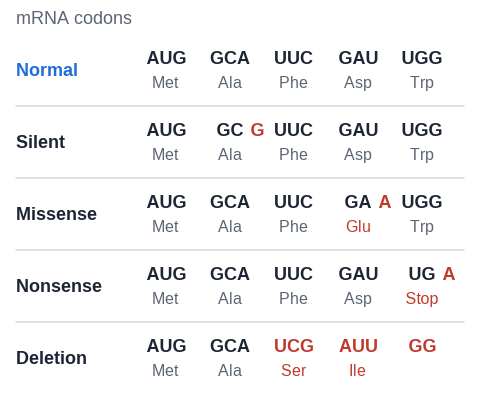
Try it: substitution or frameshift?
How severe is it?
- A frameshift near the start of a gene is usually the most severe, because almost every amino acid after it changes, so the protein folds into the wrong shape and cannot work.
- A frameshift near the end changes only the last few amino acids, so it may do less harm.
- Inserting or deleting three bases adds or removes one whole codon, so there is no frameshift, only one amino acid gained or lost.
- A missense change can still be severe if it alters a key part of the protein, such as the active site of an enzyme.
- Sickle cell disease is a single missense change: in the β-globin gene of haemoglobin, glutamic acid (codon GAG) becomes valine (GUG) at position 6, the haemoglobin molecules stick together, and red blood cells bend into a sickle shape.
| Mutation | Codons changed | Usual effect on the protein |
|---|---|---|
| Silent substitution | One, same amino acid | None |
| Missense substitution | One, new amino acid | None to severe, depends on position |
| Nonsense substitution | One, now a stop codon | Shortened, usually not working |
| Single insertion or deletion | Every codon after it | Usually not working at all |
Example: a substitution
- A template strand, 3′ to 5′, reads TAC GGT CAA CTC ATT. In a mutated copy the fourth triplet is CAC.
- Find both amino acid sequences and name the mutation.
- normal mRNA: AUG CCA GUU GAG UAAcomplement the template; A pairs with U
- normal: Met-Pro-Val-Glu, then stopcodon table
- mutated mRNA: AUG CCA GUU GUG UAAonly the fourth codon changes, GAG to GUG
- mutated: Met-Pro-Val-Val, then stopGUG codes for Val
- a missense substitution: one amino acid changes (Glu to Val) and the length stays the same
- no bases were added or lost, so there is no frameshift
Genetics lab
Example: an insertion
- Now an extra A is inserted into the same template strand after the first triplet: TAC AGG TCA ACT CAT T.
- Find the new amino acid sequence and compare it with the normal one.
- mRNA: AUG UCC AGU UGA GUA Aregroup into threes from the start codon
- Met-Ser-Ser, then stop at UGAcodon table
- normal was Met-Pro-Val-Glu: every amino acid after Met has changedthe reading frame shifted
- a frameshift that creates an early stop codon: the polypeptide is too short and will not fold or work
Try it: name the mutation
Metabolic pathways
- A metabolic pathway is a chain of reactions in a cell where the product of one reaction is the substrate of the next.
- Each step is catalysed by its own enzyme, and each enzyme is coded for by its own gene: one gene, one enzyme.
- So a phenotype, such as skin colour, depends on whether the final product is made, and how much of it.
- In people, enzyme 1 (phenylalanine hydroxylase) turns the amino acid phenylalanine into tyrosine, and enzyme 2 (tyrosinase, in a few steps shown here as one) turns tyrosine into the dark pigment melanin.
- If a mutation means an enzyme is the wrong shape, its substrate cannot fit the active site: the substrate builds up and everything after that step is missing.
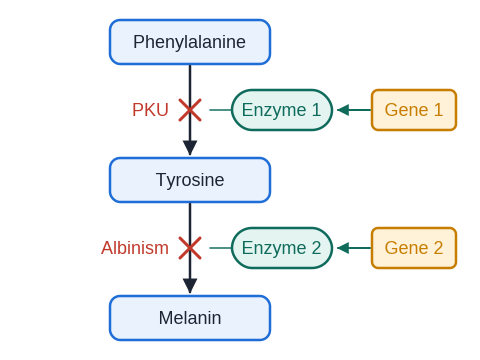
Example: which block, which phenotype?
- Use the pathway to predict what happens when each gene carries a mutation that stops its enzyme working.
- gene 2 mutated: no working tyrosinase, so tyrosine is not turned into melaninthe last step is blocked
- phenotype: no melanin, so very pale skin and hair and pale eyes (albinism)
- gene 1 mutated: phenylalanine cannot become tyrosine, so phenylalanine builds upthe first step is blocked
- phenotype: high phenylalanine harms the developing brain (PKU)
- tyrosine also comes from food, so people with PKU still make some melanin, though often less
Genotype plus environment gives phenotype
- The genotype is the set of alleles an organism has; the phenotype is how it looks and works. Environment can change the phenotype without changing a single base.
- Siamese cats carry a tyrosinase allele whose enzyme works only at cooler temperatures, so melanin forms on the ears, paws and tail, which are cooler than the body.
- Hydrangeas with the same genes flower blue in acidic soil, where aluminium is available to the plant, and pink in alkaline soil.
- Plants short of magnesium cannot make enough chlorophyll and turn yellow (chlorosis), even with perfect chlorophyll genes.
- A baby with PKU fed a low-phenylalanine diet from birth develops normally: the genotype is unchanged, but the environment (the diet) changes the phenotype.
Try it: break the melanin pathway
Gene expression in a New Zealand heel prick
- Almost every baby born in New Zealand has a few drops of blood taken from the heel 48 hours after birth, and the sample is tested for a list of rare conditions.
- Several are single-gene conditions where an enzyme or other protein does not work, so a substance builds up or a product is missing.
- Finding them early matters because, as with PKU, changing the environment (diet or medicine) can prevent the harm.
| Condition | The protein that does not work |
|---|---|
| PKU (an amino acid disorder) | The enzyme that turns phenylalanine into tyrosine |
| Cystic fibrosis | CFTR, a channel that moves salt and water out of cells |
| Galactosaemia | An enzyme needed to break down galactose from milk sugar |
Example: what each grade looks like
- Question: discuss how genes, enzymes and the environment control melanin production in a Siamese cat.
| Grade | A model answer |
|---|---|
| Achieved | A metabolic pathway is a series of reactions where each product becomes the next substrate. Genes code for enzymes, and tyrosinase turns tyrosine into melanin. |
| Merit | The cat's tyrosinase gene codes for an enzyme that only works at low temperatures. In the cool ears and paws it catalyses tyrosine to melanin, so they are dark; in the warm body it does not work, so the fur stays pale. |
| Excellence | The genotype is the same in every cell, but the phenotype differs because the environment acts on the enzyme. At body temperature the tyrosinase changes shape so tyrosine no longer fits its active site and no melanin forms; in the cooler ears, paws and tail it keeps its shape and makes melanin. A cat with a mutation that stopped tyrosinase working at any temperature would be white all over, because no amount of cold could make up for a missing enzyme. |
Common mistakes
- A substitution always changes the protein.Because the code is degenerate, a substitution can give a codon for the same amino acid: a silent mutation.
- A deletion removes one amino acid, so it is mild.Deleting one base shifts the reading frame, so every codon after it changes; only deleting three bases removes a single amino acid.
- The Siamese cat's cold ears changed its genes for dark fur.The genotype is the same everywhere; the cool temperature only lets the existing enzyme work there.
- If enzyme 2 is blocked, the substrate of enzyme 1 builds up.The substance just before the block builds up: the substrate of enzyme 2, which is the product of enzyme 1.
Stop an apple browning
You need: an apple, a lemon or lemon juice, a butter knife, 3 small plates, a fridge, a marker or labels
- Cut the apple into 6 slices with the butter knife and put 2 on each plate.
- Leave plate 1 on the bench, brush both slices on plate 2 with lemon juice and leave it on the bench, and put plate 3 in the fridge.
- Label the plates and check them every 15 minutes for an hour.
- Look for: the bench slices brown fastest. An enzyme in the apple turns substances in its cells into brown pigment when the cut surface meets air; the acid in lemon juice and the cold of the fridge slow the enzyme, so the same apple genes give a different colour.
Safety: Use a butter knife on a board and cut away from your hand, because a slipping knife on a round apple is the real risk here.
Your turn
The mRNA codon UAC changes to UAA. Name the type of mutation.
The mRNA codon GGU changes to GGC. What happens to the amino acid?
Which shifts the reading frame: deleting 1 base or deleting 3 bases?
In the pathway A → B → C, enzyme 2 (B to C) does not work. Which substance builds up, and which is missing?
Name two mutagens.
What environmental factor makes a Siamese cat's ears dark?
Show answer
1. Nonsense: UAC codes for Tyr, but UAA is a stop codon, so the polypeptide ends early. 2. Nothing: GGU and GGC both code for glycine, a silent mutation. 3. Deleting 1 base; deleting 3 removes one codon without a frameshift. 4. B builds up and C is missing. 5. Any two of: UV light, X-rays, gamma rays, chemicals in tobacco smoke, some viruses. 6. The lower temperature of the ears lets the temperature-sensitive tyrosinase work there and make melanin.
Exam-style question: melanin and mutations
- Gene 2 codes for tyrosinase, the enzyme that turns tyrosine into melanin. A short, made-up section of its template strand, 3′ to 5′, reads TAC AAG CTT GTA ACC. Mutation 1 reads TAC AAG CTC GTA ACC, and mutation 2 reads TAC AAG CTT GTA ACT.
Give the amino acid sequence for the normal gene and for each mutation.
Name the type of each mutation.
Explain which mutation is more likely to cause albinism.
Discuss how a mutation in gene 1 would show differently from one in gene 2, and how the environment can change melanin production without changing the genes.
Show answer
1. Normal mRNA AUG UUC GAA CAU UGG: Met-Phe-Glu-His-Trp. Mutation 1 mRNA AUG UUC GAG CAU UGG: Met-Phe-Glu-His-Trp. Mutation 2 mRNA AUG UUC GAA CAU UGA: Met-Phe-Glu-His, then stop (Achieved for a correct sequence). 2. Both are substitutions; mutation 1 is silent and mutation 2 is nonsense (Achieved). 3. Mutation 2, because the stop codon ends translation early, so the tyrosinase is too short to fold into its working shape and no melanin is made; mutation 1 still gives Glu (GAA and GAG both code for it) so the enzyme is unchanged (Merit). A person needs two faulty copies of the gene to have albinism. 4. Excellence: a block at gene 1 stops phenylalanine becoming tyrosine, so phenylalanine builds up (PKU), but melanin can still be made from tyrosine in food; a block at gene 2 leaves tyrosine unused, so there is no melanin and the phenotype is albinism. The environment changes the phenotype without changing the genotype: a temperature-sensitive tyrosinase makes melanin only in a Siamese cat's cool ears, paws and tail, and a low-phenylalanine diet prevents the brain damage of PKU.
Recap
- Mutations are lasting changes to the DNA base order, by chance or caused by mutagens; only gametic mutations are inherited.
- Substitutions change one codon (silent, missense or nonsense); single insertions and deletions shift the reading frame.
- In a metabolic pathway each gene codes for one enzyme; a block makes the substance before it build up and everything after it go missing.
- Phenotype comes from genotype and environment together: temperature, soil, nutrients and diet can change it without changing the genes.
| Term | Meaning |
|---|---|
| Silent | New codon, same amino acid |
| Missense | New codon, different amino acid |
| Nonsense | New codon is a stop codon |
| Frameshift | Every codon after the change is read differently |
| Metabolic pathway | Chain of enzyme steps; one product is the next substrate |
Challenge
Part of an mRNA reads UGG GGU, coding for Trp then Gly. Each codon has 9 possible single-base substitutions (3 positions, 3 other bases each). (a) For UGG, how many of the 9 are silent, missense and nonsense? (b) Do the same for GGU. (c) Explain why the two codons respond so differently, and which one is more likely to give a non-working protein after a random substitution.
Hint
List all 9 new codons for each and look each one up in the codon table. Pay attention to the third base.
Answer
(a) UGG: 0 silent, 7 missense, 2 nonsense (UAG and UGA). (b) GGU: 3 silent (GGC, GGA, GGG), 6 missense, 0 nonsense. (c) Glycine has four codons that differ only in the third base, so any third-base change is silent. Tryptophan has only one codon, so every change alters the amino acid, and two give stop codons. A random substitution in UGG is more likely to harm the protein, because it can never be silent and may cut the polypeptide short.
Step by step
- Change each base of UGG in turn to each of the other three bases.
- Look up all 9 codons: none codes Trp, and UAG and UGA are stops.
- Repeat for GGU: GGC, GGA and GGG all still code Gly.
- Degeneracy mostly sits in the third base, but only for amino acids with several codons.
- Nonsense is usually worst, then missense; silent changes nothing.
Full working
- UGG first base: AGG Arg, CGG Arg, GGG Gly3 missense
- UGG second base: UAG stop, UCG Ser, UUG Leu1 nonsense, 2 missense
- UGG third base: UGA stop, UGC Cys, UGU Cys1 nonsense, 2 missense
- GGU first base: AGU Ser, CGU Arg, UGU Cys3 missense
- GGU second base: GAU Asp, GCU Ala, GUU Val3 missense
- GGU third base: GGA, GGC, GGG all Gly3 silent
- UGG: 0 silent, 7 missense, 2 nonsense. GGU: 3 silent, 6 missense, 0 nonsense
A normal template strand, 3′ to 5′, reads TAC CGA TTT GGC AAA CTT ACC ATT. A mutant allele reads TAC CGA CTT TGG CAA CTT ACC ATT. (a) Compare the two strands and name the two changes. (b) Give the amino acid sequence for each. (c) If the mutant had only the first change, what polypeptide would form? (d) Explain why the double mutant may still make a working enzyme, but the single mutant almost certainly would not.
Hint
Line the strands up base by base. The mutant has the same number of bases, but something extra appears early and something is missing later.
Answer
(a) An insertion of C after the second triplet, and a deletion of one A from the fifth triplet. (b) Normal: Met-Ala-Lys-Pro-Phe-Glu-Trp, then stop. Mutant: Met-Ala-Glu-Thr-Val-Glu-Trp, then stop. (c) Met-Ala-Glu-Thr-Val, then stop (GUU UGA). (d) In the double mutant the deletion puts the reading frame back, so only three amino acids change and the length is unchanged; if they are away from the active site the enzyme may fold and work. With the insertion alone the frame stays shifted, an early stop appears and the polypeptide is cut short.
Step by step
- The strands match for TAC CGA; the mutant then has an extra C.
- Later the mutant has one A fewer in the AAA region, so the total length is the same.
- Transcribe both and translate with the codon table.
- For the single insertion, keep the extra base but no deletion and regroup the codons.
- Between the two changes the frame is shifted; after the deletion it is restored.
Full working
- Normal mRNA = AUG GCU AAA CCG UUU GAA UGG UAAcomplement of template
- Normal = Met-Ala-Lys-Pro-Phe-Glu-Trp, stopcodon table
- Mutant mRNA = AUG GCU GAA ACC GUU GAA UGG UAAinsertion then deletion
- Mutant = Met-Ala-Glu-Thr-Val-Glu-Trp, stopthree amino acids changed
- Insertion only: AUG GCU GAA ACC GUU UGAUGA is stop
- Insertion only = Met-Ala-Glu-Thr-Val, stopshortened polypeptide
- Double mutant: same length, 3 changes; single insertion: frameshift and early stop
A bread mould needs substance M to grow. Wild-type mould makes M from a precursor P through three steps, but the order of the substances K, L and M in the pathway is unknown. Three mutant strains are each grown on a medium with no K, L or M added, then with one of them added. Strain 1 grows only if given L or M. Strain 2 grows only if given M. Strain 3 grows if given K, L or M. (a) Work out the order of the pathway and which step each strain has blocked. (b) Which substance builds up in each strain? (c) A strain 2 variant grows with nothing added at 22 °C but needs M at 30 °C. Explain this, using genotype, enzyme shape and environment.
Hint
A strain can grow on any substance that comes after its block, but not on one that comes before it. The strain rescued by the most substances is blocked earliest.
Answer
(a) P → K → L → M. Strain 3 blocks P to K; strain 1 blocks K to L; strain 2 blocks L to M. (b) Strain 3 builds up P, strain 1 builds up K, strain 2 builds up L. (c) Its gene carries a mutation that makes the third enzyme temperature sensitive. At 22 °C it keeps its shape, L fits the active site and M is made; at 30 °C the enzyme changes shape, L no longer fits, so no M is made and the mould needs M added. The genotype is the same at both temperatures; the environment changes the phenotype, as in the Siamese cat.
Step by step
- M is needed by every strain, so it is the end product and rescues them all.
- Strain 3 is rescued by K, L and M, so its block is before K: K is the first substance after P.
- Strain 1 is rescued by L and M but not K, so its block lies between K and L.
- Strain 2 is rescued only by M, so its block lies between L and M.
- The substrate just before a block builds up because its enzyme cannot use it.
Full working
- Strain 3: rescued by K, L, Mblock P → K, earliest
- Strain 1: rescued by L, M, not Kblock K → L
- Strain 2: rescued by M onlyblock L → M, last step
- Order: P → K → L → Mfits all three strains
- Build-up: strain 3 P, strain 1 K, strain 2 Lsubstrate of the blocked enzyme
- P → K → L → M; the variant's enzyme works only at the cooler temperature
Report a mistake
How is NCEA Level 2 maths going?
See the NCEA Level 2 maths guide