Photosynthesis and respiration in the cell
What this lesson covers
- How the structure of a chloroplast and a mitochondrion suits each one to its job.
- Photosynthesis in two stages: the light-dependent stage in the thylakoids and the light-independent stage in the stroma.
- Aerobic respiration starts in the cytoplasm and finishes in the mitochondria; anaerobic respiration happens only in the cytoplasm and makes far less ATP.
- ATP is the cell's energy carrier, made in respiration and used for active transport, movement and building molecules.
- Light intensity, carbon dioxide concentration and temperature limit the rate of photosynthesis, and carbon dioxide is often the limit under water.
The chloroplast
- Chloroplasts are the organelles of photosynthesis, found in the green parts of plants, and most of all in the palisade cells near the top of a leaf.
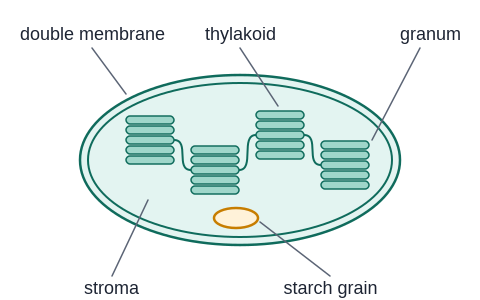
- Each is surrounded by a double membrane and filled with stacks of flattened membrane discs called thylakoids; a stack is a granum (plural grana).
- The thylakoid membranes hold chlorophyll, the green pigment that absorbs red and blue light and reflects green; stacking gives a huge membrane area to catch light.
- Around the grana is the stroma, a fluid full of the enzymes that turn carbon dioxide into glucose; glucose not used straight away is stored as starch grains.
Cell explorer
The mitochondrion
- Mitochondria are where aerobic respiration finishes, and both plant and animal cells have them.
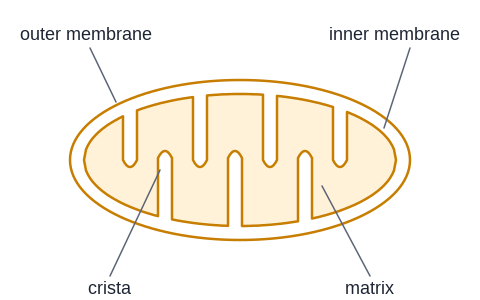
- A mitochondrion has a smooth outer membrane and an inner membrane folded into cristae, which give a large surface area for the enzymes that make most of the ATP.
- The matrix inside the inner membrane holds the enzymes that break down the products of glucose and release carbon dioxide.
- Cells with a high energy demand, such as muscle, sperm and root hair cells, have many mitochondria, often with more cristae.
Photosynthesis in two stages
- Word equation: carbon dioxide + water → glucose + oxygen, using light energy absorbed by chlorophyll.
- Balanced symbol equation: 6CO₂ + 6H₂O → C₆H₁₂O₆ + 6O₂.
- Light-dependent stage, on the thylakoid membranes: chlorophyll absorbs light energy, which splits water molecules; the oxygen diffuses out of the leaf, and the energy is used to make ATP and to load hydrogen onto a carrier molecule (NADP).
- Light-independent stage, in the stroma: a cycle of enzyme-controlled reactions uses the ATP and the hydrogen to turn carbon dioxide into glucose; it does not need light directly, but stops soon after the light-dependent stage stops.
- Because the light-independent stage is run by enzymes, it is the stage most affected by temperature.
- The plant uses the glucose for respiration, stores it as starch, and turns it into cellulose for cell walls and sucrose for transport.
| Stage | Where | Uses | Makes |
|---|---|---|---|
| Light-dependent | thylakoid membranes (grana) | light, water | oxygen, ATP, hydrogen on a carrier |
| Light-independent | stroma | carbon dioxide, ATP, hydrogen | glucose |
Aerobic respiration
- Word equation: glucose + oxygen → carbon dioxide + water, releasing energy as ATP.
- Balanced symbol equation: C₆H₁₂O₆ + 6O₂ → 6CO₂ + 6H₂O.
- Glycolysis happens in the cytoplasm and needs no oxygen: glucose is split into two smaller molecules of pyruvate, making a little ATP.
- The pyruvate moves into the mitochondria: in the matrix, the Krebs cycle breaks it down and releases carbon dioxide, and on the cristae, the electron transport chain uses oxygen and makes most of the ATP, with water as a product.
- Altogether one glucose gives up to about 38 ATP (textbooks give 36 to 38), because it is broken down completely.
Anaerobic respiration
- When there is not enough oxygen, cells rely on glycolysis alone, which happens in the cytoplasm and makes only 2 ATP per glucose.
- In animal muscle cells, the pyruvate is turned into lactic acid; in yeast and plant cells, it becomes ethanol and carbon dioxide.
- Anaerobic respiration is fast and needs no oxygen, so it powers short bursts such as a sprint, but it wastes most of the energy in the glucose.
- Lactic acid builds up and lowers the pH in the muscle, which slows the enzymes and causes fatigue and cramp, so the burst can only last seconds.
- Afterwards, heavy breathing supplies the extra oxygen needed to break down the lactic acid, mostly in the liver, which is called repaying the oxygen debt.
| Aerobic | Anaerobic | |
|---|---|---|
| Oxygen needed? | yes | no |
| Where | cytoplasm, then mitochondria | cytoplasm only |
| Products | carbon dioxide, water | lactic acid (animals), or ethanol and carbon dioxide (yeast, plants) |
| ATP per glucose | up to about 38 | 2 |
| Speed | slower, but can keep going | fast, but only for a short time |
Example: ATP from glucose
- ATP (adenosine triphosphate) carries energy around the cell: removing its end phosphate to make ADP releases energy for active transport, muscle contraction and building proteins, and respiration joins the phosphate back on.
- A muscle cell needs 380 ATP. How many glucose molecules must it break down aerobically, and how many anaerobically?
- aerobic: 380 ATP ÷ 38 ATP per glucose = 10 glucoseglucose is broken down completely to carbon dioxide and water
- anaerobic: 380 ATP ÷ 2 ATP per glucose = 190 glucoseglycolysis alone, so most of the energy stays in the lactic acid
- 190 ÷ 10 = 19how many times more glucose anaerobic respiration uses
- 10 glucose aerobically, 190 anaerobically: 19 times as much
- this is why a sprint uses up a muscle's glucose stores so quickly
Limiting factors
- A limiting factor is whichever condition is in shortest supply and holds the rate back; raising it speeds photosynthesis up until something else becomes the limit.
- Light intensity limits the light-dependent stage, carbon dioxide concentration limits the light-independent stage, and temperature affects the enzymes, mostly in the stroma.
- Through a sunny day the rate climbs from sunrise as light gets stronger and the air warms, enzymes work faster, and it peaks around midday.
- On a very hot afternoon the rate can fall: leaves close their stomata to save water, so less carbon dioxide gets in, and above the optimum the enzymes start to denature.
- Carbon dioxide is only about 0.04% of air, so on a bright day it is often the limit, which is why some glasshouse growers add carbon dioxide.
| When | Carbon dioxide (parts per million) |
|---|---|
| 1972, when measurements began | about 326 |
| Today | around 424 |
Try it: limiting factors
Example: pondweed in light and extra carbon dioxide
- A Year 12 class counted the oxygen bubbles given off by a pondweed shoot at different light intensities, in plain pond water and in water with added sodium hydrogen carbonate, which releases carbon dioxide.
- Work out the rate at 8000 lux with sodium hydrogen carbonate, then name the limiting factor in each part of the graph.
| Light (lux) | Plain water (bubbles/min) | With sodium hydrogen carbonate (bubbles/min) |
|---|---|---|
| 0 | 0 | 0 |
| 2000 | 6 | 6 |
| 4000 | 10 | 12 |
| 6000 | 12 | 18 |
| 8000 | 12 | 22 |
| 10 000 | 12 | 23 |
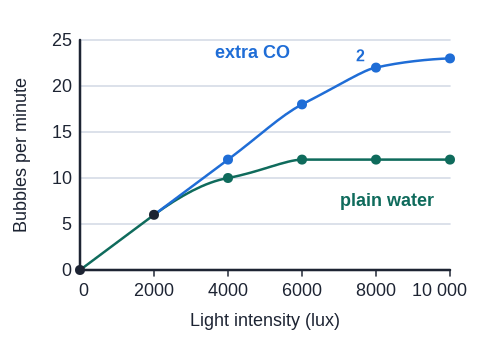
- rate = 110 bubbles ÷ 5 min = 22 bubbles/minthey counted for 5 minutes at 8000 lux with sodium hydrogen carbonate
- up to 2000 lux both rates are the sameextra carbon dioxide makes no difference, so light is limiting
- plain water levels off at 12 bubbles/min from 6000 luxmore light makes no difference, but more carbon dioxide does, so carbon dioxide is limiting
- light limits at low intensity; carbon dioxide limits the plain water above about 6000 lux
- a beaker of water between the lamp and the weed keeps the temperature the same, so temperature is not a hidden variable
Why carbon dioxide limits water plants
- A land plant takes carbon dioxide straight from the air through its stomata, and gases spread quickly through air.
- A submerged plant has to take carbon dioxide from the water, and dissolved gases diffuse about 10 000 times more slowly in water than in air.
- In still water, the plant uses carbon dioxide from the thin layer round its leaves faster than diffusion can replace it, so less carbon is available to build glucose and the rate is lower than for a land plant in the same light.
- Much of the carbon in water is in the form of hydrogen carbonate ions, which only some water plants can take in, and light also fades with depth and in muddy water.
- Water plants help themselves with very thin leaves and no thick waxy layer, so the carbon dioxide has a short distance to diffuse.
| Where the gas diffuses | How fast |
|---|---|
| Air | the baseline |
| Water | about 10 000 times more slowly |
Comparing photosynthesis and respiration
- The equations are the reverse of each other: photosynthesis stores light energy in glucose, and respiration releases that energy as ATP.
- Plants do both: they respire all the time, day and night, but photosynthesise only in the light.
- In bright light a plant photosynthesises faster than it respires, so it gives out oxygen; in the dark it only respires, so it takes in oxygen and gives out carbon dioxide.
- Both processes use membranes folded or stacked into a large area (thylakoids and cristae), and both are run by enzymes, so both are affected by temperature.
| Photosynthesis | Aerobic respiration | |
|---|---|---|
| Organelle | chloroplast | cytoplasm, then mitochondrion |
| Cells | plant cells in the light | nearly all plant and animal cells, all the time |
| Reactants | carbon dioxide, water | glucose, oxygen |
| Products | glucose, oxygen | carbon dioxide, water |
| Energy | light energy stored in glucose | chemical energy released as ATP |
Try it: photosynthesis or respiration?
Try it: where the energy goes
What Achieved, Merit and Excellence look like
- Achieved names and describes, with an equation and a location; Merit explains each type with a reason and an advantage or disadvantage; Excellence ties every advantage and disadvantage to the context and explains why both are needed.
| Grade | A model answer |
|---|---|
| Achieved | Sprinting uses anaerobic respiration in the cytoplasm, which makes lactic acid. Jogging uses aerobic respiration in the mitochondria: glucose + oxygen → carbon dioxide + water. |
| Merit | In the sprint, his blood cannot supply oxygen fast enough, so his muscle cells use glycolysis alone; it makes ATP quickly but only 2 per glucose, and lactic acid builds up. Jogging is slow enough for oxygen to keep up, so the mitochondria break glucose down completely, making up to about 38 ATP per glucose. |
| Excellence | Sione needs both. Anaerobic respiration gives him the fast burst of ATP he needs to sprint, but it uses glucose quickly and the lactic acid lowers the pH in his muscles, slowing his enzymes, so he can only sprint for seconds. Aerobic respiration is slower to supply ATP but gives about 19 times as much ATP per glucose and makes no lactic acid, so he can jog for 30 minutes; it also supplies the oxygen to clear the lactic acid from the sprint. |
Common mistakes
- Plants photosynthesise, and animals respire.Plant cells respire all the time too; they also photosynthesise when there is light.
- Respiration makes energy.Energy cannot be made; respiration releases the chemical energy stored in glucose and transfers it to ATP.
- The light-independent stage happens in the dark.It does not need light directly, but it runs in the light, because it uses the ATP and hydrogen the light-dependent stage makes.
- Anaerobic respiration happens in the mitochondria without oxygen.Anaerobic respiration happens only in the cytoplasm; the mitochondria need oxygen to do their part.
Make leaf discs float with photosynthesis
You need: a few spinach leaves, baking soda, dishwashing liquid, a plastic drinking straw, a needle-free plastic medicine syringe, 2 clear cups, water
- Stir a quarter of a teaspoon of baking soda and one small drop of dishwashing liquid into a cup of water; the baking soda supplies carbon dioxide.
- Press the straw into a spinach leaf, avoiding the veins, to punch out 20 discs.
- Put 10 discs in the syringe with some of the solution, cover the tip with your finger and pull back the plunger to suck the air out of the leaves; repeat until the discs sink, then do the same with the other 10.
- Put 10 discs into each cup of solution; stand one cup in bright sunlight by a window and put the other in a dark cupboard.
- Count how many discs are floating in each cup every 5 minutes for 30 minutes.
- Look for: the discs in sunlight rise as oxygen from photosynthesis fills the spaces in the leaf, while the discs in the dark stay down, because light is the limiting factor there.
Safety: Use only a needle-free plastic medicine syringe, never one with a needle, and do not drink the solution or point the syringe at anyone's face.
Your turn
Where in the chloroplast are water molecules split?
A cell breaks down 5 glucose molecules. How many ATP can it make at most aerobically (38 per glucose), and how many anaerobically?
Besides ATP, what does anaerobic respiration make in yeast?
Doubling the light makes no difference to a plant's rate of photosynthesis, but adding carbon dioxide raises it. What was limiting?
A pondweed shoot gives off 72 bubbles in 4 minutes. What is the rate?
Show answer
1. On the thylakoid membranes (the grana), in the light-dependent stage. 2. Aerobically 5 × 38 = 190 ATP; anaerobically 5 × 2 = 10 ATP. 3. Ethanol and carbon dioxide. 4. Carbon dioxide concentration. 5. 72 bubbles ÷ 4 min = 18 bubbles/min.
Exam-style question: tomatoes in a glasshouse
- A grower in Pukekohe raises tomatoes in a glasshouse. On sunny days she pumps in extra carbon dioxide, raising it to 1000 parts per million; outside air has about 424 parts per million.
Write the word equation for photosynthesis and name the organelle where it happens.
Calculate how many times higher the carbon dioxide concentration is inside the glasshouse than outside.
Explain why the tomato plants photosynthesise faster at midday than at sunrise.
Discuss why the extra carbon dioxide raises the rate of photosynthesis on a bright summer day but makes little difference on a dull winter morning, and why letting the glasshouse overheat would lower the rate.
Show answer
1. Carbon dioxide + water → glucose + oxygen, using light energy, in the chloroplasts (Achieved). 2. 1000 ppm ÷ 424 ppm = 2.36, about 2.4 times higher. 3. At sunrise the light is dim, so the light-dependent stage makes little ATP and hydrogen, and the cool air slows the enzymes; by midday the light is far stronger and it is warmer, so chlorophyll absorbs more energy and the enzymes work faster (Merit). 4. Excellence links the factors: on a bright, warm day light is not limiting, so carbon dioxide is in shortest supply; adding more lets the stroma's enzymes fix more carbon dioxide into glucose, so the rate rises. On a dull winter morning light is the limiting factor, so the light-dependent stage cannot supply enough ATP and hydrogen to use the extra carbon dioxide, and the cold also slows the enzymes, so adding carbon dioxide is wasted. If the glasshouse overheats, the enzymes pass their optimum and begin to denature, so the active sites no longer fit their substrates, and the plants may close their stomata to save water, so less carbon dioxide gets in and the rate falls even with plenty of light and carbon dioxide.
Recap
- Photosynthesis: 6CO₂ + 6H₂O → C₆H₁₂O₆ + 6O₂; light-dependent on the thylakoids, light-independent in the stroma.
- Aerobic respiration: C₆H₁₂O₆ + 6O₂ → 6CO₂ + 6H₂O, cytoplasm then mitochondria, up to about 38 ATP.
- Anaerobic respiration: cytoplasm only, 2 ATP, lactic acid in animals and ethanol and carbon dioxide in yeast.
- Light, carbon dioxide and temperature limit photosynthesis; name the one in shortest supply.
- Folded membranes (thylakoids, cristae) give a large area for the enzymes and pigments.
| Structure | Job |
|---|---|
| Thylakoid membranes (grana) | chlorophyll absorbs light, water is split, ATP made |
| Stroma | carbon dioxide turned into glucose by enzymes |
| Mitochondrial matrix | Krebs cycle releases carbon dioxide |
| Cristae | most of the ATP is made, using oxygen |
Challenge
During a hard climb up Rangitoto, a group of leg muscle cells needs 1000 ATP each second. The blood supplies only enough oxygen for these cells to break down 20 glucose molecules aerobically each second (38 ATP per glucose); the rest of the ATP comes from anaerobic respiration (2 ATP per glucose). (a) How many glucose molecules do the cells use each second in total? (b) What percentage of the ATP comes from anaerobic respiration, and what percentage of the glucose is used anaerobically? (c) How many oxygen molecules and how many lactic acid molecules are involved each second? (Each glucose makes two lactic acid molecules.) (d) Use your answers to explain why the climber must slow down after a short time even though most of the ATP is still being made aerobically.
Hint
Find the ATP made aerobically first, then the ATP still needed. Use the balanced equation for aerobic respiration to link glucose and oxygen.
Answer
(a) 140 glucose per second. (b) 24% of the ATP but about 86% of the glucose comes from anaerobic respiration. (c) 120 oxygen molecules used and 240 lactic acid molecules made each second. (d) The anaerobic part supplies only a quarter of the ATP but uses up six-sevenths of the glucose, so the muscle's glucose store runs down fast; meanwhile lactic acid builds up and lowers the pH, slowing the enzymes, so the climber must slow until aerobic respiration alone can meet the demand.
Step by step
- Aerobic ATP = 20 × 38.
- The rest of the 1000 ATP must come from anaerobic respiration at 2 ATP per glucose.
- Add the aerobic and anaerobic glucose for the total.
- Each glucose broken down aerobically uses 6 oxygen molecules; each one broken down anaerobically makes 2 lactic acid.
- Compare the share of ATP with the share of glucose: anaerobic respiration is very wasteful, and its lactic acid causes fatigue.
Full working
- Aerobic ATP = 20 × 38 = 760per second
- Anaerobic ATP = 1000 − 760 = 240still needed
- Anaerobic glucose = 240 ÷ 2 = 120; total = 20 + 120 = 140part (a)
- ATP share = 240 ÷ 1000 = 24%; glucose share = 120 ÷ 140 = 86%part (b)
- Oxygen = 20 × 6 = 120; lactic acid = 120 × 2 = 240C₆H₁₂O₆ + 6O₂ → 6CO₂ + 6H₂O
- 140 glucose; 24% of ATP but 86% of glucose; 120 O₂ and 240 lactic acid per second
A kawakawa plant in a sealed chamber respires all the time, giving out 2 mmol of carbon dioxide per hour, day and night. In the light it also photosynthesises, taking in carbon dioxide at a gross rate of 10 mmol per hour. (a) On a summer day with 14 hours of light and 10 hours of dark, calculate the plant's net carbon dioxide uptake over 24 hours, and the glucose this represents. (b) What is the minimum number of hours of light per day for the plant to break even? (c) In winter the light is weaker, so the gross rate drops to 5 mmol per hour, and there are 9 hours of light. Show that the plant loses carbon over a day, and explain what it uses to stay alive. (d) In the light at 5 mmol per hour, would a gas sensor show the plant taking in or giving out carbon dioxide? Explain.
Hint
Respiration happens for all 24 hours; photosynthesis only in the light. From the balanced photosynthesis equation, 6 CO₂ are fixed for every glucose made.
Answer
(a) Net uptake 92 mmol of carbon dioxide, about 15.3 mmol of glucose. (b) 4.8 hours. (c) It fixes 45 mmol but respires 48 mmol, a net loss of 3 mmol; it survives by respiring glucose from its stored starch. (d) Taking in carbon dioxide, a net 3 mmol per hour, because photosynthesis (5) is still faster than respiration (2) while the light is on; the loss happens overnight.
Step by step
- Carbon dioxide taken in by photosynthesis = gross rate × hours of light.
- Carbon dioxide given out by respiration = 2 × 24, because the plant respires day and night.
- Net uptake is the difference; divide by 6 for glucose.
- Break even when light hours × gross rate equals 48.
- In winter the total fixed is less than the total respired, so stored starch is broken down to glucose for respiration.
- During the light, compare the two rates to see which way the gas moves.
Full working
- Fixed in summer = 14 × 10 = 140 mmolphotosynthesis, light only
- Respired = 24 × 2 = 48 mmolrespiration, all day
- Net = 140 − 48 = 92 mmol CO₂; glucose = 92 ÷ 6 = 15.3 mmol6CO₂ per glucose
- Break even: 10 × hours = 48, so hours = 4.8part (b)
- Winter: 9 × 5 = 45 mmol; 45 − 48 = −3 mmolnet loss, starch used
- In light: 5 − 2 = 3 mmol per hour taken inphotosynthesis still faster
- (a) 92 mmol CO₂, 15.3 mmol glucose (b) 4.8 h (c) −3 mmol (d) taking in
In an invented experiment, a pondweed shoot is kept in a water bath at a fixed temperature, with sodium hydrogencarbonate added to give a low or a high carbon dioxide level. The net oxygen it gives out, in mm³ per minute, is measured at light intensities of 0, 1, 2, 4 and 8 units (a negative value means oxygen is taken in). Low CO₂, 20 °C: −2, 2, 6, 8, 8. High CO₂, 20 °C: −2, 2, 6, 14, 18. High CO₂, 30 °C: −4, 0, 4, 12, 28. Assume the shoot respires at the same rate in the light as in the dark. (a) Use the dark readings to find the respiration rate at each temperature, then calculate the gross rate of photosynthesis for each set at light intensities 1 and 8. (b) Identify the factor limiting photosynthesis at light intensity 8 in each set, using the data as evidence. (c) At light intensity 1 the warmer shoot gives out no oxygen at all. Explain why, using the gross rates and the enzymes involved.
Hint
Net oxygen = oxygen made by photosynthesis − oxygen used in respiration, so gross = net + the respiration rate. A factor is limiting if raising it, with everything else kept the same, raises the rate.
Answer
(a) Respiration is 2 mm³ per minute at 20 °C and 4 at 30 °C. Gross rate at intensity 1: 4 in all three sets. Gross rate at intensity 8: 10 (low CO₂, 20 °C), 20 (high CO₂, 20 °C) and 32 (high CO₂, 30 °C). (b) Low CO₂, 20 °C: carbon dioxide, because the rate has levelled off at 10 and raising the carbon dioxide doubles it to 20. High CO₂, 20 °C: temperature, because doubling the light from 4 to 8 only raises the gross rate from 16 to 20, but raising the temperature to 30 °C raises it to 32. High CO₂, 30 °C: light, because the gross rate still doubles each time the light doubles (4, 8, 16, 32). (c) At intensity 1, light limits photosynthesis, so warming does not raise the gross rate, which stays at 4. Respiration is controlled by enzymes and is not limited by light, so it doubles from 2 to 4 when the shoot is warmed. Photosynthesis now only just matches respiration, so all the oxygen made is used in respiration and the net output is zero.
Step by step
- In the dark there is no photosynthesis, so the oxygen taken in is the respiration rate: 2 at 20 °C and 4 at 30 °C.
- Add the respiration rate to each net reading to get the gross rate of photosynthesis.
- Compare sets that differ in only one factor: the two 20 °C sets differ only in carbon dioxide, and the two high CO₂ sets differ only in temperature.
- If the rate keeps rising in proportion to light, light is the limiting factor; if it has levelled off, the factor whose increase raises it is the one limiting.
- Warming speeds up enzyme-controlled reactions only when they are what limits the rate; in dim light the light-dependent stage limits photosynthesis, but respiration still speeds up.
Full working
- Respiration: 20 °C = 2, 30 °C = 4 mm³ per mindark readings, oxygen taken in
- Gross at intensity 1: 2 + 2 = 4; 2 + 2 = 4; 0 + 4 = 4gross = net + respiration
- Gross at intensity 8: 8 + 2 = 10; 18 + 2 = 20; 28 + 4 = 32gross = net + respiration
- Low CO₂ gross 4, 8, 10, 10 levels off; high CO₂ raises 10 to 20CO₂ limits
- High CO₂, 20 °C gross 16 to 20 as light doubles; 30 °C raises 20 to 32temperature limits
- High CO₂, 30 °C gross 4, 8, 16, 32, doubling with lightlight limits
- At intensity 1, gross 4 at both temperatures, respiration 2 to 4, net 4 − 4 = 0light limits photosynthesis, respiration speeds up
- (a) respiration 2 and 4; gross 4, 4, 4 at intensity 1 and 10, 20, 32 at intensity 8 (b) CO₂, temperature, light (c) gross unchanged, respiration doubled, net zero
Report a mistake
How is NCEA Level 2 maths going?
See the NCEA Level 2 maths guide