Cells, organelles and membrane transport

What this lesson covers
- The main organelles of plant and animal cells, and how the number of each organelle matches what a cell does.
- The fluid mosaic model: a phospholipid bilayer with proteins, cholesterol and glycoproteins scattered through it.
- Passive transport (diffusion, facilitated diffusion and osmosis) moves substances down a concentration gradient without ATP.
- Active transport, endocytosis and exocytosis use ATP from respiration, and active transport can move substances against a gradient.
- A small cell has a large surface area to volume ratio, which is why cells stay small or are flattened, folded or long and thin.
Organelles and what they do
- An organelle is a structure inside a cell with its own job, and most are wrapped in membrane.
- Plant and animal cells share a nucleus, cytoplasm, cell membrane, mitochondria, ribosomes, endoplasmic reticulum and Golgi body.
- Only plant cells have a cellulose cell wall, a large permanent vacuole and chloroplasts, although cells that get no light, such as root cells, have no chloroplasts.
- Excellence answers link the number of an organelle to the cell's job: a muscle cell is packed with mitochondria because it needs a lot of ATP, and a pancreas cell that makes digestive enzymes has lots of rough endoplasmic reticulum and Golgi.
- A palisade cell near the top of a leaf has many chloroplasts to absorb as much light as possible, while a root hair cell has none but has a long thin extension to take in water.
| Organelle | Found in | Job |
|---|---|---|
| Nucleus | plant and animal | holds the DNA, which controls the cell's activities |
| Mitochondrion | plant and animal | aerobic respiration, releasing energy as ATP |
| Ribosome | plant and animal | joins amino acids to make proteins |
| Rough endoplasmic reticulum | plant and animal | carries and folds proteins made by its ribosomes |
| Golgi body | plant and animal | packages proteins into vesicles to send out of the cell |
| Chloroplast | plant only | photosynthesis, making glucose |
| Cell wall | plant only | cellulose layer that supports the cell and stops it bursting |
| Large vacuole | plant only | stores cell sap and keeps the cell firm |
Cell explorer
The fluid mosaic membrane
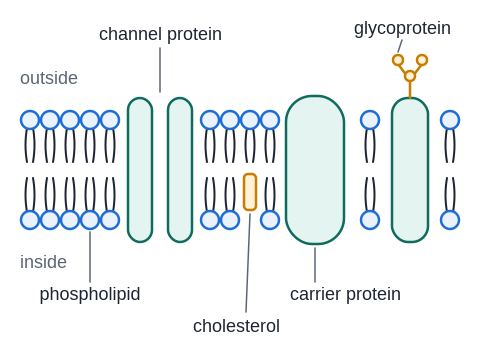
- The membrane is a phospholipid bilayer: each phospholipid has a head that is attracted to water (hydrophilic) and two fatty acid tails that repel water (hydrophobic), so the tails face each other in the middle.
- It is fluid because the phospholipids and many proteins drift sideways, and a mosaic because proteins are scattered through it like tiles.
- Channel proteins form water-filled pores for particular ions, and carrier proteins change shape to move a particular molecule across.
- In animal cells, cholesterol sits between the tails and keeps the membrane stable, and glycoproteins (proteins with sugar chains) on the outside let cells recognise each other.
- The membrane is partially permeable: small, uncharged molecules such as oxygen and carbon dioxide pass straight between the phospholipids, but ions and larger molecules such as glucose need a protein.
Diffusion and facilitated diffusion
- Diffusion is the net movement of particles from where they are more concentrated to where they are less concentrated, down a concentration gradient, because the particles move randomly.
- It is passive: the energy comes from the particles' own movement, so the cell spends no ATP.
- Oxygen diffuses into a respiring cell, and carbon dioxide diffuses out, straight through the phospholipid bilayer.
- Facilitated diffusion is still down a gradient and still uses no ATP, but the substance (glucose, or ions such as chloride) can only cross through a channel or carrier protein.
- Diffusion is faster with a steeper concentration gradient, a larger surface area, a shorter distance and a higher temperature; facilitated diffusion is also limited by how many protein channels or carriers the membrane has.
Osmosis
- Osmosis is the net movement of water molecules across a partially permeable membrane, from a dilute solution (more free water) into a more concentrated one (less free water).
- It is a special case of diffusion, so it is passive and uses no ATP; the dissolved particles, such as sugar or salt, cannot cross the membrane, so only the water moves.
- A plant cell in pure water takes in water until its vacuole pushes the membrane hard against the wall, which makes it turgid; the wall stops it bursting.
- An animal cell has no wall, so in pure water a red blood cell swells and bursts, and in a concentrated solution it loses water and shrinks.
- A plant cell in a concentrated solution loses water from its vacuole until the membrane pulls away from the wall, which is called plasmolysis, and the plant wilts.
| Solution outside the cell | Water moves | Animal cell | Plant cell |
|---|---|---|---|
| More dilute than the cytoplasm | in | swells and may burst | turgid (firm) |
| Same concentration | no net movement | unchanged | flaccid (soft) |
| More concentrated than the cytoplasm | out | shrinks | plasmolysed |
Try it: osmosis
Example: potato cylinders in sugar solutions
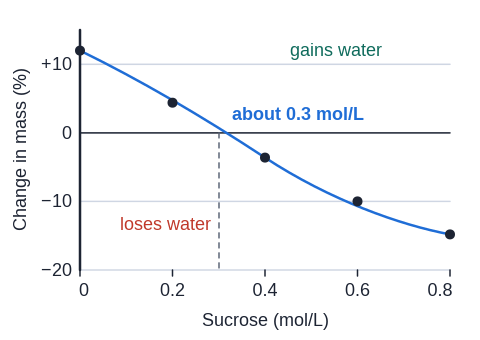
- A Year 12 class weighed potato cylinders of 2.50 g, left one in each sucrose solution for 2 hours, blotted them dry and weighed them again.
- Find the percentage change in mass for each, plot it, and use the graph to estimate the concentration of the potato cells' contents.
| Sucrose (mol/L) | Start mass (g) | End mass (g) | Change in mass (%) |
|---|---|---|---|
| 0.0 | 2.50 | 2.80 | +12.0 |
| 0.2 | 2.50 | 2.61 | +4.4 |
| 0.4 | 2.50 | 2.41 | -3.6 |
| 0.6 | 2.50 | 2.25 | -10.0 |
| 0.8 | 2.50 | 2.13 | -14.8 |
- % change = (end mass − start mass) ÷ start mass × 100percentage change lets you compare pieces of different starting mass
- 0.0 mol/L: (2.80 − 2.50) ÷ 2.50 × 100 = +12.0%the cells gained water by osmosis
- 0.6 mol/L: (2.25 − 2.50) ÷ 2.50 × 100 = −10.0%the cells lost water by osmosis
- the curve crosses 0% at about 0.3 mol/Lno net movement of water, so the solution matches the cell contents
- the potato cell contents are about 0.3 mol/L
- blotting each cylinder the same way stops surface water adding to the end mass
Active transport, endocytosis and exocytosis
- Active transport moves a substance against its concentration gradient, from low to high concentration, through a carrier protein that acts as a pump.
- The pump changes shape using energy from ATP, which the cell makes in respiration, so actively transporting cells have many mitochondria.
- Root hair cells pump mineral ions such as nitrate in from soil water, where they are less concentrated than inside the cell.
- Endocytosis takes in large particles or droplets: the membrane folds round them and pinches off a vesicle, as when a white blood cell engulfs a bacterium.
- Exocytosis is the reverse: a vesicle from the Golgi body fuses with the membrane and empties out, as when pancreas cells release digestive enzymes; both need ATP.
| Method | Direction | Protein needed? | ATP needed? | Example |
|---|---|---|---|---|
| Diffusion | down a gradient | no | no | oxygen into a cell |
| Facilitated diffusion | down a gradient | channel or carrier | no | glucose into a cell |
| Osmosis | water to the more concentrated side | no (some via channels) | no | water into a root hair cell |
| Active transport | against a gradient | carrier pump | yes | nitrate into a root hair cell |
| Endocytosis and exocytosis | into or out of the cell in vesicles | no | yes | a white blood cell engulfing a bacterium |
Try it: get it across the membrane
Surface area to volume ratio
- Everything a cell takes in or gets rid of has to cross its surface, but how much it needs depends on its volume.
- As a cell gets bigger, its volume grows faster than its surface area, so its surface area to volume ratio (SA:V) falls.
- A large cell could not exchange materials fast enough to supply its middle, and the distance to the centre would be too far for diffusion, so cells divide once they reach a certain size.
- Cells that exchange a lot have shapes that keep SA:V high: root hair cells grow a long thin extension, cells lining the small intestine have folded microvilli, and red blood cells are flattened discs.
Try it: surface area to volume
Example: comparing two cube-shaped cells
- Model two cells as cubes, one with sides of 10 µm and one with sides of 20 µm.
- Calculate the SA:V of each and say which cell exchanges materials better.
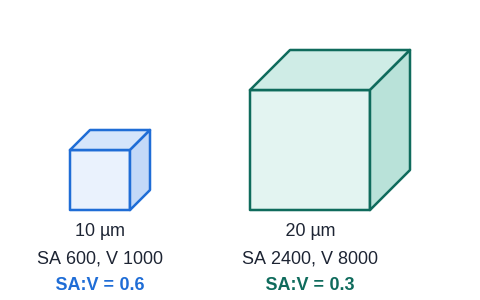
- small cube: SA = 6 × 10 × 10 = 600 µm²a cube has 6 square faces
- small cube: V = 10 × 10 × 10 = 1000 µm³
- small cube: SA:V = 600 ÷ 1000 = 0.6 µm⁻¹
- large cube: SA = 6 × 20 × 20 = 2400 µm², V = 20 × 20 × 20 = 8000 µm³doubling the side makes the area 4 times and the volume 8 times bigger
- large cube: SA:V = 2400 ÷ 8000 = 0.3 µm⁻¹
- the 10 µm cell has twice the SA:V, so each unit of its volume has twice as much membrane to supply it
What Achieved, Merit and Excellence look like
- Achieved describes or defines; Merit gives the reason how or why, using biological ideas such as concentration gradients, ATP and proteins; Excellence links several ideas together and compares, here osmosis with active transport and both with the cell's structure.
- Use the context in every sentence: name the cell, the substance and which way it moves.
| Grade | A model answer |
|---|---|
| Achieved | Water enters by osmosis and nitrate ions enter by active transport, which uses energy. |
| Merit | The cell sap is more concentrated than soil water, so water moves in by osmosis through the partially permeable membrane without ATP. Nitrate is more concentrated inside the cell than in the soil, so it must be pumped in against its gradient by carrier proteins using ATP. |
| Excellence | Both rely on the membrane, but in opposite ways. Water follows its gradient, so osmosis is passive and keeps going while the sap stays more concentrated than the soil water; the nitrate that has been pumped in helps keep it that way. Nitrate is pumped against its gradient, so the cell needs carrier proteins and a steady supply of ATP, which is why root hair cells have many mitochondria. The long hair gives a large surface area, so more water and nitrate cross the membrane each second. |
Common mistakes
- In osmosis, the salt moves out of the cell into the water.In osmosis only water moves across the membrane; the dissolved particles cannot cross it.
- Water moves from a high concentration of solute to a low concentration of solute.Water moves towards the more concentrated solution, from where there is more free water to where there is less.
- Facilitated diffusion uses energy because it uses a protein.Facilitated diffusion is passive: it goes down the gradient and needs no ATP; only active transport pumps against the gradient.
- A bigger cell has a bigger SA:V because it has more surface area.A bigger cell has more surface area, but its volume grows faster, so its SA:V is smaller.
Wilt a lettuce leaf by osmosis
You need: 2 crisp lettuce leaves of similar size, 2 bowls, cold tap water, 3 tablespoons of salt, a spoon
- Half fill both bowls with cold tap water, and stir the salt into one bowl until most of it dissolves.
- Hold each leaf by its stalk, check that both are equally stiff, and put one leaf in each bowl so it is fully covered.
- Leave them for 30 minutes.
- Lift each leaf out by its stalk and see whether it stands up or flops over.
- Look for: the leaf in plain water stays crisp because its cells take in water and stay turgid, while the leaf in salt water goes limp because its cells lose water to the more concentrated solution.
Safety: Throw both leaves away afterwards rather than eating them, because the salty one is far too salty and both have sat out of the fridge.
Your turn
A cube-shaped cell has sides of 3 µm. What is its SA:V?
A potato cylinder goes from 4.00 g to 3.70 g in a salt solution. What is its percentage change in mass?
Glucose enters a cell down its concentration gradient through a carrier protein, without ATP. Which transport method is this?
A red blood cell is put into pure water. What happens to it, and why?
Sperm cells swim using a tail that needs a lot of ATP. Which organelle would you expect to find in large numbers near the tail?
Show answer
1. SA = 6 × 3 × 3 = 54 µm², V = 3 × 3 × 3 = 27 µm³, so SA:V = 54 ÷ 27 = 2:1 (2 µm⁻¹). 2. (3.70 − 4.00) ÷ 4.00 × 100 = −7.5%, a 7.5% decrease. 3. Facilitated diffusion. 4. It swells and bursts, because water moves in by osmosis from the more dilute water and it has no cell wall to stop it. 5. Mitochondria, which make ATP in aerobic respiration.
Exam-style question: seawater on a paddock
- A storm surge floods a coastal paddock with seawater. A day later the ryegrass is wilting, even though the soil is soaking wet. Seawater is a much more concentrated salt solution than the sap inside the grass's root hair cells.
Describe osmosis.
Explain why the grass wilts after the seawater flood.
Before the flood, the root hair cells took in nitrate ions by active transport. Explain why this process needs mitochondria.
Discuss how the structure of a root hair cell suits it to taking in both water and mineral ions, and compare how the two cross the membrane.
Show answer
1. Osmosis is the net movement of water across a partially permeable membrane from a dilute solution to a more concentrated one; it is passive (Achieved). 2. The soil water is now more concentrated than the cell sap, so water leaves the root hair cells by osmosis instead of entering; the cells lose turgor, water is no longer supplied to the leaves, and the grass wilts (Merit, because it gives the reason using the gradient). 3. Nitrate is pumped in against its concentration gradient by carrier proteins, which change shape using ATP; ATP comes from aerobic respiration in mitochondria, so the cell needs many of them (Merit). 4. Excellence links the ideas: the long thin hair gives a large surface area to volume ratio, so more water and ions cross the membrane each second; water enters passively by osmosis while the sap is more concentrated than the soil water, so it needs no ATP, while nitrate is taken in against its gradient by active transport, which needs carrier proteins and ATP from the many mitochondria; the ions pumped in keep the sap concentrated, which keeps water flowing in, so the seawater flood reverses the gradient and both processes suffer.
Recap
- Match each organelle to its job, and link the number of organelles to what the cell does.
- The membrane is a fluid mosaic of phospholipids and proteins, and only lets some substances through.
- Diffusion, facilitated diffusion and osmosis go down a gradient and need no ATP.
- Active transport, endocytosis and exocytosis need ATP, and active transport works against a gradient.
- Small, flat, folded or long and thin cells have a high SA:V, so they exchange materials quickly.
| Idea | Key words for your answer |
|---|---|
| Diffusion | net movement, concentration gradient, passive |
| Osmosis | water, partially permeable membrane, dilute to concentrated |
| Active transport | against the gradient, carrier protein, ATP, mitochondria |
| SA:V | volume grows faster than surface area, cells stay small |
Challenge
Three model cells, shaped as boxes, all have the same volume of 64 µm³: cell P is a cube 4 µm × 4 µm × 4 µm, cell Q is a flat plate 8 µm × 8 µm × 1 µm, and cell R is a long rod 64 µm × 1 µm × 1 µm. (a) Calculate the SA:V of each and rank them. (b) For each cell, find the greatest distance a substance must diffuse from the surface to reach the point deepest inside it. (c) Q and R have the same greatest distance, but R has a higher SA:V. Explain why both shapes exchange materials faster than P, and suggest why a red blood cell, which must carry oxygen to every part of the body, is a flat disc rather than a cube.
Hint
A box has six faces in three matching pairs: SA = 2 × (lw + lh + wh). The deepest point is the centre, halfway across the cell's thinnest dimension.
Answer
(a) R: 4.03 µm⁻¹, Q: 2.5 µm⁻¹, P: 1.5 µm⁻¹, so R > Q > P. (b) P: 2 µm, Q: 0.5 µm, R: 0.5 µm. (c) Q and R have far more membrane for each unit of volume and every part of them is close to the surface, so substances cross more membrane each second and diffuse a shorter distance; P has the least membrane per volume and its centre is four times as far from the surface. A flat disc gives a red blood cell a high SA:V and a short diffusion distance to every haemoglobin molecule while keeping the same volume, so oxygen enters and leaves quickly.
Step by step
- Use SA = 2 × (lw + lh + wh) for each box, then divide by 64.
- Rank the three ratios.
- The deepest point is half of the smallest side away from the surface.
- Diffusion rate rises with a larger surface area and falls with a longer distance.
- Flattening raises SA:V and shortens the distance without making the cell smaller.
Full working
- P: SA = 2 × (16 + 16 + 16) = 96 µm², SA:V = 96 ÷ 64 = 1.5 µm⁻¹cube
- Q: SA = 2 × (64 + 8 + 8) = 160 µm², SA:V = 160 ÷ 64 = 2.5 µm⁻¹flat plate
- R: SA = 2 × (64 + 64 + 1) = 258 µm², SA:V = 258 ÷ 64 = 4.03 µm⁻¹long rod
- Greatest distance: P = 4 ÷ 2 = 2 µm; Q = R = 1 ÷ 2 = 0.5 µmhalf the thinnest side
- Q has 2.5 ÷ 1.5 = 1.67 times the SA:V of Psame volume, more membrane
- Rank R > Q > P; distances 2, 0.5 and 0.5 µm; flat shapes exchange fastest
Red blood cell contents have a total concentration of dissolved particles of about 0.30 mol per litre. Hospital saline is sodium chloride dissolved in water; "0.9% saline" means 0.9 g of NaCl in every 100 mL. NaCl has a molar mass of 58.5 g per mol, and in water each NaCl splits into two particles, Na⁺ and Cl⁻. (a) Show that 0.9% saline has about the same particle concentration as red blood cell contents. (b) Calculate the particle concentration of 0.45% saline and of 3% saline. (c) Predict and explain what happens to red blood cells placed in each of the three solutions, and in pure water. (d) Explain why a plant cell placed in pure water does not suffer the same fate as a red blood cell.
Hint
Find the grams in one litre first, then moles = mass ÷ molar mass, then double it for the two particles. Water moves by osmosis towards the more concentrated solution.
Answer
(a) 9 g per litre ÷ 58.5 = 0.154 mol per litre of NaCl, which gives 0.31 mol per litre of particles, about the same as the cell contents. (b) 0.45%: 0.15 mol per litre of particles; 3%: 1.03 mol per litre. (c) 0.9%: no net movement of water, cells unchanged. 0.45%: the solution is more dilute, so water enters by osmosis and the cells swell and may burst. 3%: the solution is more concentrated, so water leaves and the cells shrink. Pure water: water enters fastest and the cells burst, because they have no cell wall. (d) The plant cell's cellulose wall resists the swelling, so the cell becomes turgid but does not burst.
Step by step
- A 0.9% solution has 0.9 g in 100 mL, which is 9 g in a litre.
- Divide by the molar mass to get moles of NaCl, then double for Na⁺ and Cl⁻ ions.
- Compare each concentration with the 0.30 mol per litre inside the cells.
- Water moves by osmosis from the more dilute side to the more concentrated side; the ions cannot freely cross.
- Only the cell wall stops a plant cell bursting.
Full working
- 0.9%: 9 g per litre ÷ 58.5 = 0.154 mol per litre NaClmoles = mass ÷ molar mass
- Particles = 2 × 0.154 = 0.31 mol per litreNa⁺ and Cl⁻, matches 0.30
- 0.45%: 4.5 ÷ 58.5 × 2 = 0.15 mol per litrehalf as concentrated
- 3%: 30 ÷ 58.5 × 2 = 1.03 mol per litreover three times as concentrated
- 0.15 < 0.30, so water enters; 1.03 > 0.30, so water leavesosmosis
- 0.9% no change; 0.45% swell, may burst; 3% shrink; pure water burst
Barley roots are kept in a nitrate solution, with glucose supplied at the same rate throughout. When air is bubbled through, the roots take up 38 units of nitrate per hour; when nitrogen gas (no oxygen) is bubbled through instead, uptake falls to 2 units per hour. For the first hour, water uptake is the same in both. Nitrate is always more concentrated inside the root cells than in the solution. (a) Show that the fall in nitrate uptake matches the fall in ATP the cells can make from the same glucose. (b) Explain why nitrate uptake depends on oxygen but water uptake at first does not. (c) After a day of nitrogen bubbling, water uptake has also fallen. Explain this by linking the two processes.
Hint
Aerobic respiration gives up to about 38 ATP per glucose; with no oxygen, glycolysis alone gives 2. Ask which transport process needs ATP and which does not, then think about what keeps the cell sap more concentrated than the solution.
Answer
(a) Without oxygen the ATP per glucose falls from 38 to 2, to 238 (about 5%) of its value, and nitrate uptake falls from 38 to 2 units per hour, the same fraction, which fits nitrate uptake being limited by ATP. (b) Nitrate is taken in against its gradient by active transport, so the carrier proteins need ATP from aerobic respiration in the mitochondria; water enters by osmosis, which is passive, so it carries on as long as the sap is more concentrated than the solution. (c) Without pumped-in nitrate, the cell sap gradually becomes less concentrated as ions are used or leak out, so the concentration difference between the sap and the solution shrinks and less water enters by osmosis.
Step by step
- Compare the ATP per glucose with and without oxygen.
- Compare the nitrate uptake with and without oxygen; the fractions are the same.
- Active transport needs carrier proteins powered by ATP; without oxygen the mitochondria cannot make most of it.
- Osmosis needs no ATP, so water uptake does not change straight away.
- The ions pumped in keep the sap concentrated, so stopping the pump slowly weakens the osmosis gradient.
Full working
- ATP fraction = 2 ÷ 38 = 0.053, about 5%anaerobic ÷ aerobic, same glucose
- Nitrate fraction = 2 ÷ 38 = 0.053, about 5%uptake with nitrogen ÷ with air
- Same fraction → uptake limited by ATP supplyactive transport
- Water: osmosis, passive, no ATPunchanged at first
- Less nitrate pumped in → sap less concentrated → smaller gradientwater uptake falls later
- Both fall to about 5%; nitrate needs ATP, water follows the gradient the pumped ions create
Report a mistake
How is NCEA Level 2 maths going?
See the NCEA Level 2 maths guide