Kinetic energy, potential energy and work
What this lesson covers
- Energy is measured in joules, is never made or destroyed, and only changes form or moves between objects.
- Kinetic energy depends on mass and speed squared: Ek = ½mv².
- Gravitational potential energy depends on mass, g and height: Ep = mgh, with g = 10 N/kg in NCEA papers.
- Work is energy transferred by a force moving something: W = Fd, and power is how fast energy is transferred: P = E ÷ t.
- In a real system some energy always ends up as thermal energy and sound, so efficiency is below 100%.
A physical system and its energy
- A physical system is the object or objects you are studying, such as a falling paint tin, a lift, or a kid on a slide.
- Energy is the ability to make something happen, and it is measured in joules (J).
- Energy is conserved: it cannot be created or destroyed, only transformed from one form to another or transferred from one object to another.
- In mechanics the two forms that matter most are kinetic energy (energy of motion) and gravitational potential energy (energy stored by height).
- The exam gives you the formulae, so the marks are for choosing the right one, showing your working and finishing with a unit.
| Quantity | Formula | Units |
|---|---|---|
| Kinetic energy | Ek = ½mv² | J (m in kg, v in m/s) |
| Gravitational potential energy | Ep = mgh | J (m in kg, g = 10 N/kg, h in m) |
| Work | W = Fd | J (F in N, d in m) |
| Power | P = E ÷ t (so E = Pt) | W, which is J/s (t in s) |
Kinetic and potential energy
- Anything moving has kinetic energy, Ek = ½mv², so a heavier or faster object has more.
- Because speed is squared, doubling the speed makes the kinetic energy four times as big; this is why a car at 100 km/h is so much more dangerous than one at 50 km/h.
- Lifting an object against gravity gives it gravitational potential energy, Ep = mgh, where h is the height it was raised.
- g is the gravitational field strength, about 10 N/kg on Earth; NCEA's resource sheet uses g = 10 N/kg, so use that unless a question says otherwise.
- Mg is just the object's weight in newtons, so Ep is weight × height.
Example: lifting a bag of cement
- A builder lifts a 25 kg bag of cement from the ground onto a ute tray 1.2 m high, at a steady speed, in 2.0 s.
- Find the work done, the gain in gravitational potential energy and the builder's power output.
- F = mg = 25 × 10 = 250 Nat steady speed the lifting force equals the weight
- W = Fd = 250 × 1.2 = 300 Jwork done lifting
- Ep = mgh = 25 × 10 × 1.2 = 300 Jthe same 300 J is now stored as Ep
- P = E ÷ t = 300 ÷ 2.0 = 150 Wenergy transferred each second
- W = 300 J, Ep gained = 300 J, P = 150 W
A falling object: Ep becomes Ek
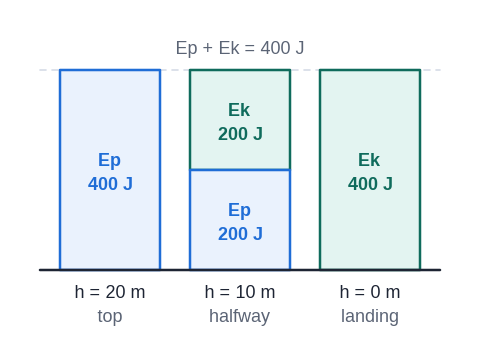
- A 2 kg ball dropped from 20 m starts with Ep = 2 × 10 × 20 = 400 J and no Ek.
- As it falls it loses height and gains speed, so Ep is transformed into Ek.
- Halfway down (10 m) it has lost 200 J of Ep, so it has 200 J of Ep left and has gained 200 J of Ek.
- Just before it lands, all 400 J is Ek, if we ignore air resistance.
- At every point Ep + Ek = 400 J: that is conservation of energy, and it lets you find the speed at any height.
Try it: energy as it falls
Example: how fast does an apple land?
- A 0.2 kg apple falls 3.2 m from a branch to the ground.
- Calculate its speed just before it lands, and state your assumption.
- Ep = mgh = 0.2 × 10 × 3.2 = 6.4 Jenergy stored at the top
- assume all Ep becomes Ek, so Ek = 6.4 Jno air resistance; this must be written down, not just used
- 6.4 = ½ × 0.2 × v²Ek = ½mv²
- v² = 6.4 × 2 ÷ 0.2 = 64rearrange for v²
- v = √64 = 8 m/sdo not forget the square root
- v = √(2gh) = √(2 × 10 × 3.2) = 8 m/sthe mass cancels, so any object dropped 3.2 m gives the same answer
Where the "lost" energy goes
- In real life the apple lands a little slower than 8 m/s, because not all of its Ep becomes Ek.
- As it falls it collides with air particles, pushing them aside and making them move faster, and rubbing them against its surface: this is air resistance.
- That energy becomes thermal energy (the air and the apple warm very slightly) and some becomes sound.
- The energy is not destroyed; it has been transferred to the surroundings in a form that is no longer useful to us.
- Efficiency = useful energy out ÷ total energy in × 100%, and in every real system it is less than 100%.
Example: a motor lifting roofing iron
- A 400 W electric hoist lifts 60 kg of roofing iron 8.0 m up the side of a house in 15 s.
- Compare the electrical energy used with the Ep gained, explain the difference and find the efficiency.
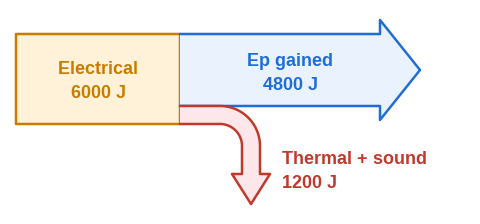
- E = Pt = 400 × 15 = 6000 Jelectrical energy supplied to the motor
- Ep = mgh = 60 × 10 × 8.0 = 4800 Juseful energy gained by the load
- 6000 − 4800 = 1200 Jenergy not stored as Ep
- efficiency = 4800 ÷ 6000 × 100% = 80%useful out ÷ total in
- 1200 J becomes thermal energy and sound: current heating the motor's wires, friction in its bearings and the pulley, and noise
Try it: balance the energy budget
What Achieved, Merit and Excellence look like
- Achieved describes: it names the energy change or gets one step of a calculation right.
- Merit explains: it gives the reason (how or why) and finishes multi-step calculations with full working.
- Excellence analyses: it links the calculation, the assumption and the particle-level reason into one connected answer, with units.
- Write the formula first, then the numbers, then the answer with a unit; NZQA's markers said many students lost marks by writing only the numbers.
| Grade | A model answer |
|---|---|
| Achieved | The real speed will be less than 8 m/s because some energy is lost to air resistance. |
| Merit | The real speed is less than 8 m/s because some of the Ep is changed into thermal energy and sound by air resistance, so less than 6.4 J becomes Ek. |
| Excellence | I assumed all 6.4 J of Ep became Ek. In reality air particles hit the apple as it falls, gaining kinetic energy and warming the air and the apple's surface. That energy is transferred to the surroundings, so Ek at the bottom is less than 6.4 J and, since Ek = ½mv², the apple lands slower than 8 m/s. |
Common mistakes
- v² = 64, so the apple lands at 64 m/s.That is v², not v; take the square root to get v = 8 m/s, a step markers often see missed.
- Energy is lost when the object hits air resistance, so the total energy goes down.Energy is never lost; it is transferred to the air as thermal energy and sound, so the total stays the same.
- A 500 g ball dropped 2 m has Ep = 500 × 10 × 2 = 10 000 J.Mass must be in kilograms: 500 g = 0.5 kg, so Ep = 0.5 × 10 × 2 = 10 J.
- Doubling the speed doubles the kinetic energy.Speed is squared in Ek = ½mv², so doubling the speed makes the kinetic energy four times as big.
How much energy does a bouncing ball keep?
You need: a tennis ball or other bouncy ball, a tape measure, masking tape, a phone camera, a hard floor beside a wall
- Stick a strip of masking tape up the wall and mark it every 10 cm from the floor to 1 m.
- Start the phone recording, then hold the bottom of the ball level with the 1 m mark and let it go without throwing it.
- Play the recording back frame by frame and read the highest point of the first bounce; repeat three times and take the average.
- Work out the percentage of Ep the ball kept: bounce height ÷ 1 m × 100%, since Ep = mgh is proportional to height.
- Look for: the ball never comes back to 1 m; the rest of its energy became thermal energy in the ball and floor and the sound of the bounce.
Safety: Drop the ball from standing height only, never from a chair or the stairs, because a fall while leaning out to follow the ball is the real danger here.
Your turn
Calculate the kinetic energy of a 1200 kg car travelling at 15 m/s.
A 0.5 kg book is lifted from the floor onto a shelf 1.8 m high. How much Ep does it gain?
A shopper pushes a trolley 25 m along an aisle with a force of 80 N. How much work is done?
A diver steps off a 5.0 m platform. Ignoring air resistance, how fast is she going when she reaches the water?
A 55 kg student runs up stairs with a total height of 12 m in 20 s. Find the Ep gained and her power.
Show answer
1. Ek = ½mv² = ½ × 1200 × 15² = 135 000 J. 2. Ep = mgh = 0.5 × 10 × 1.8 = 9 J. 3. W = Fd = 80 × 25 = 2000 J. 4. All Ep becomes Ek, so v = √(2gh) = √(2 × 10 × 5.0) = √100 = 10 m/s. 5. Ep = 55 × 10 × 12 = 6600 J; P = E ÷ t = 6600 ÷ 20 = 330 W (assuming all her work goes into Ep).
Exam-style question: the playground slide
- Aroha has a mass of 40 kg. She climbs to the top of a playground slide 2.5 m above the ground and slides down from rest. Use g = 10 N/kg.
Describe the energy changes as Aroha goes down the slide.
Calculate the greatest speed Aroha could have at the bottom, and state the assumption you made.
Her real speed at the bottom is 6.0 m/s. Discuss what happened to the rest of her energy, using calculations, and explain why the slide feels slightly warm afterwards.
Show answer
1. Gravitational potential energy is transformed into kinetic energy as she loses height and gains speed, and some becomes thermal energy and sound because of friction (Achieved). 2. Ep = mgh = 40 × 10 × 2.5 = 1000 J. Assume all the Ep becomes Ek (no friction or air resistance): 1000 = ½ × 40 × v², so v² = 50 and v = 7.1 m/s. Full working earns Merit; the correct unit and the stated assumption are needed for Excellence. 3. Real Ek = ½ × 40 × 6.0² = 720 J, so 1000 − 720 = 280 J did not become Ek (Merit for the calculation and naming friction). Excellence links it all: friction between her clothes and the slide makes the particles at both surfaces vibrate faster, raising their temperature, and she also pushes air particles aside; that 280 J is transferred to the slide, her clothes and the air as thermal energy and sound. Energy is conserved (720 + 280 = 1000 J), but only 72% of the Ep became Ek, so she reaches 6.0 m/s instead of 7.1 m/s.
Energy Skate Park: Basics
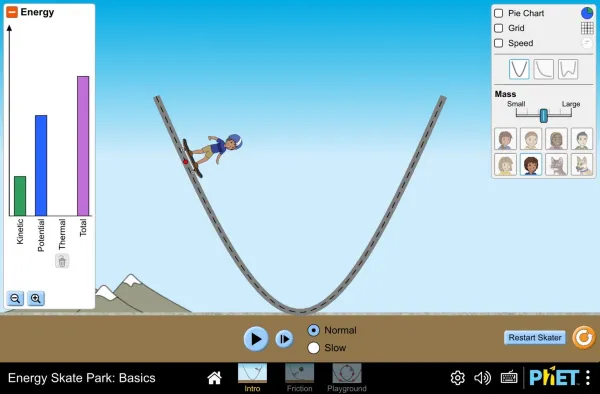
Full screen · PhET Interactive Simulations, University of Colorado Boulder, CC BY 4.0
Recap
- Energy is conserved: it changes form or moves, but the total stays the same.
- Ek = ½mv², Ep = mgh with g = 10 N/kg, W = Fd and E = Pt.
- A falling object turns Ep into Ek; assume no air resistance to find the greatest possible speed, and say so.
- Real objects land slower because some energy becomes thermal energy and sound through friction and air resistance.
- Efficiency = useful energy out ÷ total energy in × 100%.
| Situation | Energy change |
|---|---|
| Lifting a load | work done → Ep |
| Falling object | Ep → Ek (+ thermal energy and sound) |
| Electric motor lifting | electrical → Ep (+ thermal energy and sound) |
| Sliding to a stop | Ek → thermal energy by friction |
Challenge
Tama has a mass of 60 kg, including his skateboard. He starts from rest at the top of a ramp 5.0 m high and reaches the bottom at 9.0 m s⁻¹. He then rolls along flat ground until he stops, with an average friction force of 135 N acting on him. (a) What percentage of his gravitational potential energy became kinetic energy on the ramp? (b) How far does he roll on the flat ground before he stops? Use g = 10 N kg⁻¹.
Hint
Find Ep at the top and Ek at the bottom first. On the flat ground his height does not change, so friction must do work equal to all of his Ek: Ek = Fd.
Answer
(a) 81% (b) 18 m
Step by step
- At the top all his energy is Ep: 60 × 10 × 5.0 = 3000 J.
- At the bottom his Ek is ½ × 60 × 9.0² = 2430 J, so 81% of the Ep became Ek.
- The other 570 J was transferred as thermal energy and sound by friction and air resistance on the ramp.
- On the flat, friction does work on him until all 2430 J of Ek is gone, so 2430 = 135 × d.
- That gives d = 18 m.
Full working
- Ep = mgh = 60 × 10 × 5.0 = 3000 Jenergy at the top
- Ek = ½mv² = ½ × 60 × 9.0² = 2430 Jenergy at the bottom of the ramp
- 2430 ÷ 3000 × 100% = 81%useful out ÷ total in
- 3000 − 2430 = 570 Jbecame thermal energy and sound
- W = Fd, so 2430 = 135 × dfriction removes all his Ek
- d = 2430 ÷ 135 = 18 mrearrange
- (a) 81% (b) 18 m
A Taranaki farm runs a small hydro scheme. Every second, 15 kg of water falls through a height of 20 m down a pipe and turns a generator, which gives out 2.4 kW of electrical power. (a) Find the efficiency of the scheme. (b) The farmer wants 4.0 kW from the same 20 m drop at the same efficiency. What mass of water must flow through the pipe each second? (c) Explain where the rest of the energy goes. Use g = 10 N kg⁻¹.
Hint
Work out the Ep the water loses in one second: that number of joules each second is the input power in watts. For (b), work backwards from the 4000 W the farmer wants.
Answer
(a) 80% (b) 25 kg each second (c) 600 W of the 3000 W input becomes thermal energy and sound in the pipe, turbine and generator
Step by step
- In one second the water loses Ep = 15 × 10 × 20 = 3000 J, so the input power is 3000 W.
- Efficiency = 2400 ÷ 3000 × 100% = 80%.
- To give out 4000 W at 80% efficiency, the falling water must supply 4000 ÷ 0.80 = 5000 W.
- Each kilogram falling 20 m gives up 200 J, so 5000 ÷ 200 = 25 kg must fall each second.
- The 600 W that is not turned into electricity is transferred as thermal energy and sound: friction between the water and the pipe, friction in the bearings, and the current heating the generator's coils.
Full working
- Ep each second = 15 × 10 × 20 = 3000 Jso input power = 3000 W
- efficiency = 2400 ÷ 3000 × 100% = 80%useful out ÷ total in
- input needed = 4000 ÷ 0.80 = 5000 Wsame efficiency
- Ep for 1 kg = 1 × 10 × 20 = 200 Jsame 20 m drop
- mass each second = 5000 ÷ 200 = 25 kg5000 J needed each second
- 3000 − 2400 = 600 Wthermal energy and sound
- (a) 80% (b) 25 kg each second
A 0.50 kg ball is dropped from 2.5 m onto a hard floor. At each bounce it keeps 80% of the energy it had just before it hit the floor; the rest becomes thermal energy and sound. Ignore air resistance. (a) How high does it rise after the third bounce? (b) How much energy has become thermal energy and sound by then? (c) Mia says: "It keeps 80% of its energy, so it leaves the floor at 80% of the speed it hit the floor with." Use calculations to show she is wrong, and find the real percentage.
Hint
Ep = mgh, so the energy at the top of a bounce is proportional to the height: 80% of the energy means 80% of the height. For (c), find the speed just before and just after the first bounce from Ek = ½mv², and remember v is squared.
Answer
(a) 1.28 m (b) 6.1 J (c) it leaves at about 6.3 m s⁻¹ after hitting at about 7.1 m s⁻¹, which is about 89% of the speed, not 80%
Step by step
- The ball starts with Ep = 0.50 × 10 × 2.5 = 12.5 J.
- Ep is proportional to height, so each bounce reaches 0.80 of the height before: 2.5 × 0.80³ = 1.28 m.
- At 1.28 m it has 6.4 J, so 12.5 − 6.4 = 6.1 J has been transferred as thermal energy and sound.
- It hits the floor the first time with all 12.5 J as Ek, so v = √50 ≈ 7.07 m s⁻¹; it leaves with 80% of that, 10 J, so v = √40 ≈ 6.32 m s⁻¹.
- 6.32 ÷ 7.07 ≈ 0.89: because Ek depends on v², keeping 80% of the energy keeps √0.80 ≈ 89% of the speed.
- Leaving at 80% of the speed would keep only 0.80² = 64% of the energy.
Full working
- Ep = mgh = 0.50 × 10 × 2.5 = 12.5 Jenergy at the start
- h = 2.5 × 0.80 × 0.80 × 0.80 = 1.28 mheight × 0.80 at each bounce
- Ep = 0.50 × 10 × 1.28 = 6.4 Jtop of the third bounce
- 12.5 − 6.4 = 6.1 Jthermal energy and sound
- 12.5 = ½ × 0.50 × v², v² = 50, v ≈ 7.07 m s⁻¹speed hitting the floor
- 0.80 × 12.5 = 10 J = ½ × 0.50 × v², v² = 40, v ≈ 6.32 m s⁻¹speed leaving the floor
- 6.32 ÷ 7.07 ≈ 0.89√0.80 ≈ 0.89
- (a) 1.28 m (b) 6.1 J (c) about 89% of the speed, not 80%
The maths behind it
Practise this
Report a mistake
How is NCEA Level 1 maths going?
See the NCEA Level 1 maths guide