Electrical energy, power and circuits
What this lesson covers
- Current is the flow of charge (A), voltage is the energy given to each unit of charge (V), and resistance opposes the current (Ω).
- V = IR links the three, and the gradient of a voltage against current graph gives the resistance.
- Power is the rate of energy transfer: P = VI, and the energy used is E = Pt.
- Power companies charge per kilowatt-hour, so cost = power in kW × hours × price per kWh.
- Efficiency compares the useful energy out with the energy in, and the rest usually becomes thermal energy.
Current, voltage and resistance
- Current (I) is the rate at which charge flows round a circuit, carried by electrons in the wires, measured in amps (A) with an ammeter connected in series.
- Voltage (V) is the energy given to, or used by, each coulomb of charge, measured in volts (V) with a voltmeter connected in parallel across the part you are testing.
- Resistance (R) is how strongly a component opposes the current, measured in ohms (Ω); as electrons collide with the particles of the wire they give up energy and the wire heats up.
- The three are linked by V = IR: for a fixed voltage, a bigger resistance gives a smaller current.
- New Zealand's mains supply is 230 V; exam papers sometimes use 240 V, so always use the value the question gives.
| Quantity | Symbol | Unit | Measured with |
|---|---|---|---|
| Current | I | amp (A) | ammeter, in series |
| Voltage | V | volt (V) | voltmeter, in parallel |
| Resistance | R | ohm (Ω) | R = V ÷ I |
| Power | P | watt (W) = J/s | P = VI |
Example: finding resistance from a graph
- A class measured the voltage across a resistance wire kept in a beaker of water, for five different currents.
- Plot the results and use the line of best fit to find the wire's resistance.
| Current (A) | Voltage (V) |
|---|---|
| 0.10 | 1.1 |
| 0.20 | 2.5 |
| 0.30 | 3.6 |
| 0.40 | 4.7 |
| 0.50 | 6.0 |
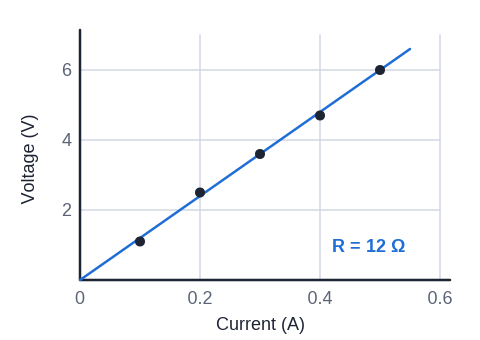
- the points lie close to a straight line through (0, 0)V is proportional to I, so R is constant
- gradient = 6.0 V ÷ 0.50 Aread a point on the line, far from the origin
- R = V ÷ I = 12 Ω
- the water keeps the wire at a steady temperature, because a hotter wire has a higher resistance
Power and energy: P = VI and E = Pt
- Power is how fast energy is transferred: P = VI, in watts, where 1 W = 1 J/s.
- Energy transferred is E = Pt, in joules when t is in seconds.
- In a heater element, a bigger current at the same voltage means a bigger power (P = VI), so more electrical energy becomes thermal energy every second.
- Over the same time, a bigger power transfers more energy (E = Pt), so the room gets more heat.
- Merit and Excellence answers say which quantity changes and which stays constant, for every formula they use.
Example: a 2400 W heater
- A 2400 W fan heater runs on New Zealand's 230 V supply for 2 hours.
- Find the current, the resistance of its element, and the energy used in kWh.
- I = P ÷ V = 2400 ÷ 230 = 10.4 Afrom P = VI
- R = V ÷ I = 230 ÷ 10.4 = 22 Ωfrom V = IR
- E = Pt = 2.4 kW × 2 h = 4.8 kWhkW × hours gives kilowatt-hours
- 4.8 × 3.6 MJ = 17.3 MJ1 kWh = 1000 W × 3600 s = 3 600 000 J
- I = 10.4 A, R = 22 Ω, E = 4.8 kWh
What a kilowatt-hour costs
- A kilowatt-hour (kWh) is the energy used by a 1 kW appliance running for 1 hour, which is 3.6 million joules; power bills count energy in kWh.
- Cost = power (kW) × time (h) × price per kWh.
- MBIE's survey of advertised prices put the national average at 42.1 cents per kWh on 15 August 2026, including GST.
- So the 2400 W heater running for 2 hours (4.8 kWh) costs about 4.8 × 42.1 = 202 cents, or $2.02.
- MBIE's model household uses 8000 kWh a year, which at 42.1 c/kWh is about $3368 a year.
| Part of the price | Cents per kWh |
|---|---|
| Lines (poles, wires and transmission) | 16.8 |
| Energy and other costs | 25.3 |
| Total retail price, GST included | 42.1 |
Try it: what it costs to run
Efficiency, and why LEDs save money
- Efficiency = useful energy out ÷ total energy in × 100%, and the energy that is not useful usually ends up as thermal energy.
- An old incandescent bulb makes light by heating a thin wire until it glows, so most of its electrical energy becomes thermal energy rather than light.
- EECA says LED bulbs use around 85% less energy than incandescent bulbs for the same light, so a 9 W LED replaces a 60 W bulb.
- Run for 4 hours a day for a year, the 60 W bulb uses 87.6 kWh ($36.88 at 42.1 c/kWh) and the 9 W LED uses 13.14 kWh ($5.53), saving about $31 a year for each bulb.
| LED | Incandescent | |
|---|---|---|
| Energy for the same light | around 85% less | the baseline |
| Lifetime | 30 000 hours | 2000 hours |
Example: how efficient is an electric jug?
- A 1500 W jug heats 1.0 kg of water from 20 °C to 100 °C in 250 s. Use c = 4200 J kg⁻¹ °C⁻¹.
- Find its efficiency and say where the rest of the energy goes.
- E in = Pt = 1500 × 250 = 375 000 Jelectrical energy supplied
- E useful = mcΔT = 1.0 × 4200 × 80 = 336 000 Jenergy gained by the water
- efficiency = 336 000 ÷ 375 000 × 100% = 89.6%useful out ÷ total in
- about 90%; the other 39 000 J heats the jug itself and escapes to the air
What changes when the resistance changes
- A variable resistor lets you change the total resistance of a series circuit by sliding or turning a contact.
- The supply voltage stays the same, so when the total resistance goes up, the current goes down (I = V ÷ R).
- With a smaller current, the voltage across the fixed component falls (V = IR), and so does its power (P = VI), so a lamp dims and a heating coil gives out less heat.
- The voltage the coil loses is now across the variable resistor: the voltages round a series circuit always add up to the supply voltage.
- A longer or thinner wire, or a hotter one, also has more resistance.
Example: turning up a variable resistor
- A 12 V battery is connected in series with a variable resistor, an ammeter and a 12 Ω heating coil, with a voltmeter across the coil.
- Compare the current, the coil's voltage and the coil's power when the variable resistor is set to 0 Ω and then to 12 Ω.
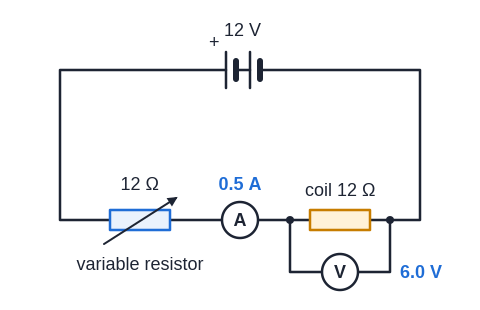
- at 0 Ω: I = 12 ÷ 12 = 1.0 Aonly the coil's resistance
- coil: V = 12 V, P = VI = 12 × 1.0 = 12 Wall of the supply voltage is across the coil
- at 12 Ω: I = 12 ÷ (12 + 12) = 0.5 Aresistances in series add
- coil: V = IR = 0.5 × 12 = 6.0 V, P = 6.0 × 0.5 = 3 Wthe other 6.0 V is across the variable resistor
- doubling the total resistance halves the current, halves the coil's voltage and cuts its power to a quarter
Try it: turn the dial
What Achieved, Merit and Excellence look like
- Achieved states the effect; Merit backs it with one formula; Excellence works through each formula in turn, saying what changes and what stays constant.
- Calculations are not needed for answers like this, but formulae are.
| Grade | A model answer |
|---|---|
| Achieved | More voltage gives more current, so the wire gets hotter. |
| Merit | The resistance stays the same, so by V = IR the current doubles; with P = VI the power increases, so more thermal energy is produced. |
| Excellence | R is constant, so doubling V doubles I (V = IR). Since P = VI and both V and I have doubled, the power is four times as big. With E = Pt and the same time, four times as much electrical energy becomes thermal energy as electrons collide with the particles of the wire. |
Common mistakes
- A 2 kW heater for 3 hours: E = 2 × 3 = 6 J.kW × hours gives kWh, so it is 6 kWh; for joules use watts and seconds: 2000 × 10 800 = 21 600 000 J.
- Current gets used up by the heater, so less comes out than goes in.Current is the same all round a series circuit; it is energy that the heater transfers to the room.
- A bigger resistance means a bigger current, because the resistor works harder.At the same voltage, I = V ÷ R, so a bigger resistance gives a smaller current.
- Power and energy are the same thing, both in watts.Power is the rate of energy transfer in watts (J/s); energy is the total amount, in joules or kWh, and E = Pt links them.
What does each appliance cost to run?
You need: the rating labels on 4 or 5 appliances (kettle, toaster, hair dryer, microwave, TV), paper and a pen, a calculator, a recent power bill, if you have one
- Find the rating label on each appliance (usually on the base or the back) and write down its power in watts.
- Estimate how many minutes a day your household uses each one.
- Work out the kWh each day: power in kW × hours used, so a 2400 W kettle used for 10 minutes is 2.4 × 10 ÷ 60 = 0.4 kWh.
- Multiply by 365 and by the price per kWh (42.1 c, or the price on your bill) to find what each costs in a year.
- Look for: the appliances that heat have the highest power, but cost depends on power × time, so a 400 W TV on for an hour uses the same 0.4 kWh as that kettle.
Safety: Only read labels on appliances that are switched off and unplugged, with dry hands, and never open an appliance or touch a plug's pins, because mains electricity can kill.
Your turn
What current flows through a 12 Ω resistor with 6.0 V across it?
A toaster draws 4.0 A from the 230 V supply. What is its power?
How much energy, in joules, does that toaster use in 3.0 minutes?
What does it cost to run a 2.0 kW heater for 3 hours at 42.1 c/kWh?
A 9 W LED gives the same light as a 60 W incandescent bulb. By what percentage is its power lower?
Show answer
1. I = V ÷ R = 6.0 ÷ 12 = 0.5 A. 2. P = VI = 230 × 4.0 = 920 W. 3. E = Pt = 920 × 180 = 165 600 J (3.0 minutes = 180 s). 4. E = 2.0 kW × 3 h = 6 kWh; cost = 6 × 42.1 = 252.6 c, about $2.53. 5. (60 − 9) ÷ 60 × 100% = 85% lower.
Exam-style question: the hair dryer
- Ari's hair dryer is rated at 1800 W on the 230 V mains supply. She uses it on high for 10 minutes every day. Electricity costs 42.1 cents per kWh.
Describe the energy changes in the hair dryer.
Calculate the current in the hair dryer on high, with a unit.
Calculate how much it costs Ari to use the hair dryer for a year.
On the low setting, the heating element has a higher resistance. Discuss how this changes the current, the power and how long Ari takes to dry her hair.
Show answer
1. Electrical energy becomes thermal energy in the heating element, kinetic energy of the fan and the moving air, and some sound (Achieved). 2. I = P ÷ V = 1800 ÷ 230 = 7.8 A (Merit needs the working and the unit). 3. E = 1.8 kW × (10 ÷ 60) h = 0.3 kWh a day; 0.3 × 365 = 109.5 kWh a year; cost = 109.5 × 42.1 = 4610 c, about $46.10 (Excellence for the full chain with units). 4. Achieved: the current is lower, so it is less hot. Merit: the voltage stays at 230 V, so a higher resistance gives a smaller current (I = V ÷ R), and P = VI is smaller. Excellence: with V constant and I smaller, P = VI is lower, so fewer joules of electrical energy become thermal energy each second; by E = Pt she needs roughly the same total energy to evaporate the water, so she must use it for longer to dry her hair.
Circuit Construction Kit: DC
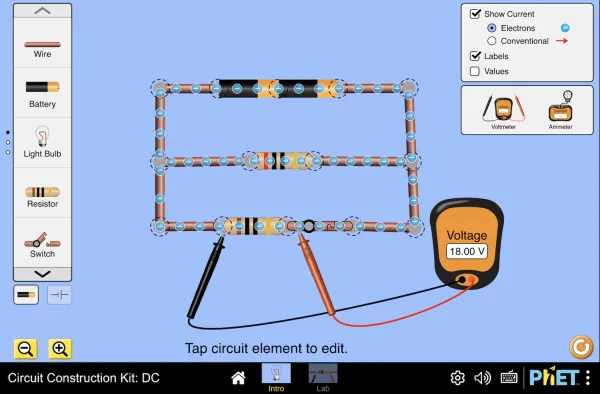
Full screen · PhET Interactive Simulations, University of Colorado Boulder, CC BY 4.0
Recap
- V = IR: at a fixed voltage, more resistance means less current.
- P = VI is the rate of energy transfer, and E = Pt is the total energy.
- Bills charge per kWh: cost = kW × hours × price, about 42.1 c/kWh in NZ in August 2026.
- Efficiency = useful out ÷ total in × 100%; LEDs waste far less as heat than incandescent bulbs.
- In every explanation, say which quantity changes, which stays constant, and which formula links them.
| Formula | Use it to find |
|---|---|
| V = IR | voltage, current or resistance |
| P = VI | power from voltage and current |
| E = Pt | energy (J with W and s, kWh with kW and h) |
| cost = kWh × price | what an appliance costs to run |
| efficiency = useful ÷ total × 100% | how much energy is wasted |
Challenge
A heater runs on the 230 V mains and has two identical heating elements, A and B. On HIGH only element A is connected. On LOW, element B is switched in series with element A. Running it on HIGH for 3 hours costs 252.6 cents at 42.1 cents per kWh. (a) Find the power on HIGH, the current, and the resistance of one element. (b) Find the current and total power on LOW, and the power given out by each element. (c) What does 3 hours on LOW cost? (d) A student says LOW gives half the heat because two elements share it. Explain what is really going on, using the formulas.
Hint
Work backwards from the cost to the kWh, then to the power. On LOW the voltage is still 230 V but the resistances in series add.
Answer
(a) 2.0 kW, 8.7 A, about 26.5 Ω. (b) 4.35 A, 1000 W in total, 500 W from each element. (c) About $1.26. (d) The total resistance doubles, so the current halves (I = V ÷ R); P = VI then halves for the whole heater, and each element, with half the current and half the voltage, gives out only a quarter of its HIGH power.
Step by step
- 252.6 ÷ 42.1 = 6.0 kWh in 3 hours, so the power on HIGH is 2.0 kW.
- I = P ÷ V = 2000 ÷ 230 ≈ 8.7 A and R = V ÷ I ≈ 26.5 Ω.
- On LOW the two elements in series give 52.9 Ω, so I = 230 ÷ 52.9 ≈ 4.35 A, exactly half.
- The total power is 230 × 4.35 = 1000 W; each element has 115 V across it and gives out 500 W, a quarter of 2000 W.
- So 3 hours on LOW uses 3.0 kWh and costs about $1.26, half the HIGH cost.
Full working
- E = 252.6 ÷ 42.1 = 6.0 kWhcost ÷ price
- P = 6.0 kWh ÷ 3 h = 2.0 kW = 2000 WE = Pt
- I = 2000 ÷ 230 = 8.70 AP = VI
- R = 230 ÷ 8.70 = 26.45 Ω ≈ 26.5 ΩV = IR
- LOW: R = 26.45 + 26.45 = 52.9 Ω, I = 230 ÷ 52.9 = 4.35 Aseries resistances add
- P total = 230 × 4.35 = 1000 W; each element: V = 4.35 × 26.45 = 115 V, P = 115 × 4.35 = 500 Whalf the current and half the voltage
- cost = 1.0 kW × 3 h × 42.1 = 126.3 cents ≈ $1.26kWh × price
- HIGH 2.0 kW, 8.7 A, 26.5 Ω; LOW 4.35 A, 1000 W (500 W each); $1.26
A jug is rated 2200 W on the 230 V supply and is 85% efficient. (a) How long does it take to heat 1.5 kg of water from 15 °C to 100 °C? Use c = 4200 J kg⁻¹ °C⁻¹. (b) At a camping ground at the end of a long cable, the voltage at the socket is only 207 V. Assuming the element's resistance and the efficiency stay the same, find the current and power of the jug there. (c) How long does the same job take at the camping ground, and by what percentage is this longer? Explain why a 10% drop in voltage causes a much bigger percentage change in the time.
Hint
Find the element's resistance from the rating first: I = P ÷ V, then R = V ÷ I. At the lower voltage the resistance is unchanged, so the current drops, and then so does the power.
Answer
(a) About 286 s (4 min 46 s). (b) R ≈ 24.0 Ω, I ≈ 8.6 A, P ≈ 1782 W. (c) About 354 s (5 min 54 s), about 23% longer, because the lower voltage lowers the current too, so P = VI falls to 0.9 × 0.9 = 0.81 of its value.
Step by step
- The water needs mcΔT = 1.5 × 4200 × 85 = 535 500 J of useful energy.
- Only 85% of the electrical energy is useful, so the jug must take in 535 500 ÷ 0.85 = 630 000 J, which at 2200 W takes about 286 s.
- The element's resistance is 230 ÷ 9.57 ≈ 24.0 Ω; at 207 V the current is 207 ÷ 24.0 ≈ 8.6 A, so the power is 207 × 8.6 ≈ 1782 W.
- The same 630 000 J at 1782 W takes about 354 s.
- Voltage and current both fall by 10%, so power falls to 0.81 of its value and the time grows by 1 ÷ 0.81 ≈ 1.23 times: about 23% longer.
Full working
- E useful = 1.5 × 4200 × (100 − 15) = 535 500 JmcΔT
- E in = 535 500 ÷ 0.85 = 630 000 Jefficiency = useful ÷ total
- t = 630 000 ÷ 2200 = 286 s ≈ 4 min 46 sE = Pt
- I = 2200 ÷ 230 = 9.57 A, R = 230 ÷ 9.57 = 24.0 Ωrated values
- at 207 V: I = 207 ÷ 24.0 = 8.61 A, P = 207 × 8.61 = 1782 Wsame resistance
- t = 630 000 ÷ 1782 = 354 s ≈ 5 min 54 ssame energy needed
- 354 ÷ 286 = 1.23, and 1782 ÷ 2200 = 0.81 = 0.9 × 0.9V and I both down 10%
- 286 s at 230 V; 8.6 A and 1782 W at 207 V; 354 s, about 23% longer
A tramping hut has a 12 V battery that stores 100 Wh (360 000 J) when full. The warden has some lamps rated 6.0 V, 3.0 W; treat each lamp's resistance as constant. (a) Explain what would happen if one lamp were connected straight to the 12 V battery, using numbers. (b) Plan A: one lamp in series with a fixed resistor so the lamp works at its rating. Find the resistor needed, the percentage of the battery's energy that goes to the lamp, and how many hours a full battery lasts. (c) Plan B: two lamps in series, no resistor. Show that each lamp works at its rating, and compare Plan B with Plan A. (d) Which plan should the warden choose, and what is one drawback of Plan B?
Hint
Find the lamp's current and resistance from its rating first. In a series circuit the current is the same everywhere and the voltages add up to 12 V.
Answer
(a) I = 1.0 A, P = 12 W, four times its rating: it would burn out. (b) A 12 Ω resistor; only 50% of the energy reaches the lamp; about 16.7 hours. (c) Each lamp gets 6.0 V and 0.5 A, so 3.0 W; same 6 W from the battery and same 16.7 hours, but twice the light and no energy wasted in a resistor. (d) Plan B; but if one lamp fails the circuit is broken and both go out.
Step by step
- At its rating the lamp takes I = 3.0 ÷ 6.0 = 0.5 A, so its resistance is 6.0 ÷ 0.5 = 12 Ω.
- On 12 V alone the current would be 12 ÷ 12 = 1.0 A and the power 12 W, four times its rating, so it would overheat and blow.
- In Plan A the resistor must take the other 6.0 V at 0.5 A, so R = 12 Ω; the battery gives 12 × 0.5 = 6 W but the lamp uses only 3 W: 50%. A full battery lasts 360 000 ÷ 6 = 60 000 s ≈ 16.7 h.
- In Plan B the two 12 Ω lamps make 24 Ω, so I = 0.5 A and each lamp has 6.0 V: both at their rating.
- The battery still gives 6 W for 16.7 h, but now all of it goes into the lamps, so the hut gets twice the light for the same energy. The drawback is that a series circuit is broken if one lamp fails.
Full working
- I = 3.0 ÷ 6.0 = 0.5 A; R = 6.0 ÷ 0.5 = 12 Ωlamp at its rating
- straight on 12 V: I = 12 ÷ 12 = 1.0 A, P = 12 × 1.0 = 12 W4 × 3.0 W: it blows
- Plan A: resistor voltage = 12 − 6.0 = 6.0 V, R = 6.0 ÷ 0.5 = 12 Ωvoltages add to 12 V
- battery power = 12 × 0.5 = 6 W; useful = 3 ÷ 6 × 100% = 50%P = VI
- time = 360 000 ÷ 6 = 60 000 s = 16.7 hE = Pt
- Plan B: R = 12 + 12 = 24 Ω, I = 12 ÷ 24 = 0.5 A, each lamp V = 0.5 × 12 = 6.0 Vseries resistances add
- Plan B: 6 W for 16.7 h, two lamps lit, no resistor wasting 3 Wcompare
- (a) 12 W, blows; (b) 12 Ω, 50%, 16.7 h; (c) both lamps at 3.0 W for 16.7 h; (d) Plan B, but one failure turns off both
The maths behind it
Practise this
Report a mistake
How is NCEA Level 1 maths going?
See the NCEA Level 1 maths guide